Vector Databases - Indexing Topology, Engine Selection Frameworks, and Real-Time State Synchronization
Introduction
In a production-grade Generative AI system, the vector database functions as the memory system of the enterprise knowledge architecture. For technology executives (CTOs, VPs, and Directors of AI Engineering), selecting and managing a vector storage infrastructure is a high-stakes decision. The choice directly influences production scale, hardware resource allocation, sub-second query latency, and long-term infrastructure spend.
As data flows out of the document processing and embedding layers, it must be indexed to support fast K-Nearest Neighbor ((k)-NN) similarity queries. In data-volatile domains such as Healthcare Revenue Cycle Management (RCM), this must happen while handling continuous document mutations, schema evolution, and complex metadata access-control filters.
Treating a vector store as a static, append-only repository is a primary reason why AI systems fail when moving from PoC to production.
This section details the cloud-agnostic index mathematics, infrastructure selection matrices, and raw data synchronization patterns necessary to operate a highly resilient enterprise vector database.
1. Vector Indexing Topologies: HNSW vs. IVF-PQ
At the core of every vector database is its Approximate Nearest Neighbor (ANN) indexing algorithm. Because calculating exact Euclidean or cosine distance across millions of high-dimensional vectors at query time is computationally impractical ((O(N)) time complexity), the database must pre-structure the vector space.
Technology leaders must choose between two dominant architectural indexing approaches: Hierarchical Navigable Small World (HNSW) graphs and Inverted File with Product Quantization (IVF-PQ).
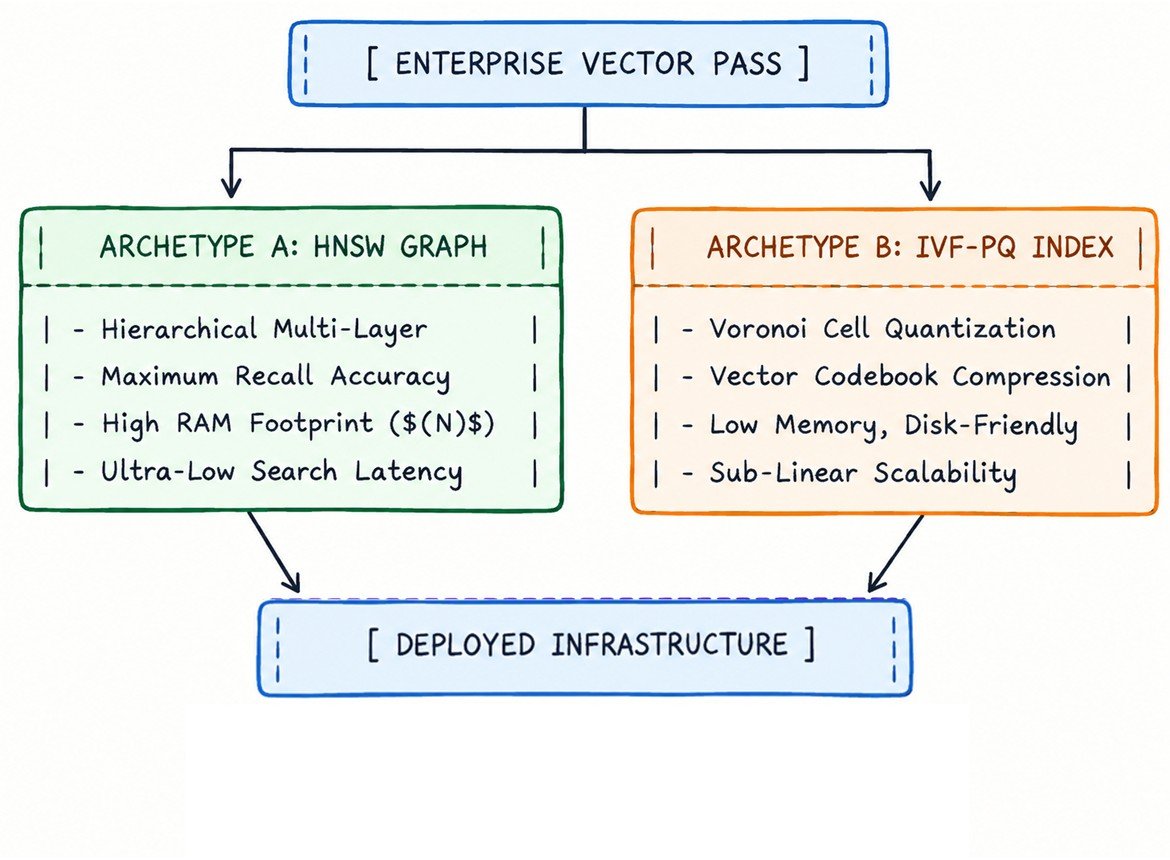
Archetype A: Hierarchical Navigable Small World (HNSW) Graphs
HNSW structures the vector space into a multi-layer graph, drawing inspiration from skip-list data structures. The top layers feature sparse connections for fast, long-distance traversal across the vector space. The bottom layer contains dense graph networks linking close semantic neighbors.
Mathematical and Algorithmic Logic
During query execution, the search engine enters the graph at the top layer (l = L). It traverses greedily across nodes by calculating the distance to neighboring elements until it reaches a local minimum. The engine then drops down to the next layer (l = L-1) and resumes the search from that coordinate, repeating this routine until it locates the closest semantic matches in the bottom-most layer (l = 0).
The search performance and recall accuracy of an HNSW graph are governed by three primary hyperparameters:
- M: The maximum number of bidirectional link connections established for each individual node at creation.
- efConstruction: The depth of the dynamic candidate list evaluated during index construction, balancing build time against graph recall quality.
- efSearch: The size of the dynamic candidate list evaluated during live query execution.
Memory Footprint Considerations
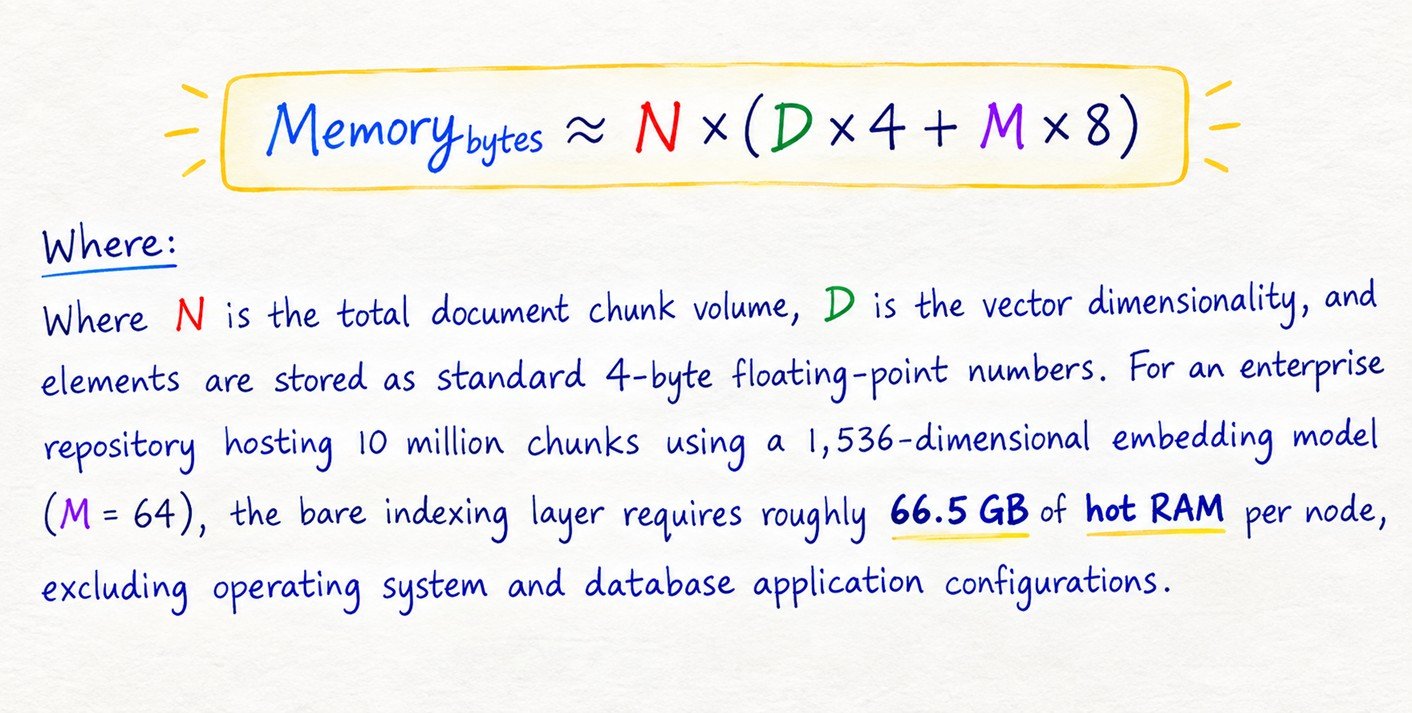
HNSW requires holding the entire graph structure directly in volatile system RAM to ensure fast node traversal. The memory overhead scales strictly as:
Archetype B: Inverted File with Product Quantization (IVF-PQ)
IVF-PQ reduces the memory bottleneck by partitioning the vector space into distinct clusters (Voronoi cells) and drastically compressing the size of the vectors using asymmetric quantization techniques.
Mathematical Quantification
-
Inverted File Partitioning (IVF): The vector space is divided into K structural clusters using standard k-means clustering algorithms. At query time, the engine calculates the distance between the query vector and the centroids of these cells, restricting the downstream search strictly to the closest clusters.
-
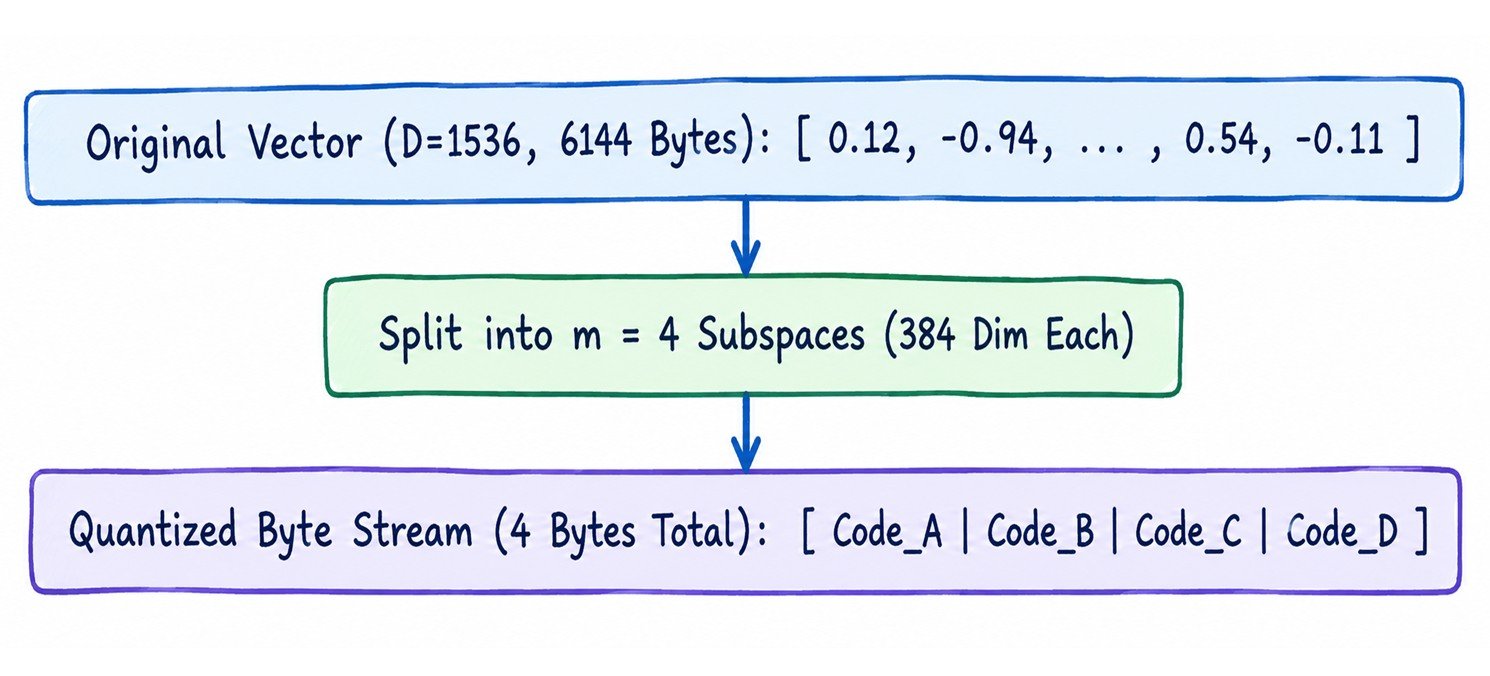
Product Quantization (PQ): A high-dimensional vector space R^D is broken down into m orthogonal, lower-dimensional subspaces R^D/m. For each subspace, a localized codebook of centroids is generated via clustering. The original floating-point values within that sub-segment are then replaced with a single 1-byte index pointer pointing to the nearest centroid.
Production Trade-offs
IVF-PQ lowers RAM consumption by 85% to 95% compared to HNSW, allowing multi-billion-scale indexes to run on cost-efficient NVMe disk tiers. However, this compression optimization introduces quantization errors, which can result in a 5% to 15% drop in maximum recall accuracy.
2. Infrastructure Architecture Strategy: Specialized Vector DBs vs. Extensible Enterprise DBs
Technology leaders must determine whether to deploy a specialized, purpose-built native vector database or leverage the vector extension modules built into existing enterprise relational, document, or wide-column database systems.
Option 1: Specialized / Native Vector Databases
Native systems are designed from the ground up to optimize high-dimensional vector search.
- Architecture Matrix: They decouple compute operations (vector distance calculations) from storage profiles (NVMe disk arrays), utilizing cloud-native distributed clustering paradigms.
- Operational Strengths: Unmatched throughput capabilities for pure vector workloads, native support for advanced hybrid retrieval operations, and fast re-indexing speeds when processing large data streams.
- Operational Weaknesses: Introduces another siloed technology into the enterprise data architecture, requiring independent operational monitoring, security evaluations, and custom infrastructure connections.
Option 2: Extensible Enterprise Databases
This path adds vector capabilities to established transactional or analytical database engines via specialized index extensions.
- Architecture Matrix: High-dimensional vectors are stored as a native column data type directly alongside standard transactional rows or JSON metadata documents.
- Operational Strengths: Maximizes leverage of existing infrastructure investments. It maintains unified ACID transactional guarantees across text attributes and vector attributes while eliminating data duplication overhead.
- Operational Weaknesses: Resource contention. Running heavy CPU-bound graph traversals or product quantization calculations on the same database engine that handles live transactional writes can lead to severe operational slowdowns.
Architectural Selection Rubric
| Decision Driver | Choose Specialized / Native Vector DB | Choose Extensible Enterprise DB |
|---|---|---|
| Scale Constraints | Multi-billion-vector datasets with constant global updates. | Under 50 million vectors integrated with relational tables. |
| Transactional Bounds | Eventual consistency across decoupled microservices. | Strict ACID transactional rules across standard fields and vectors. |
| Team Capabilities | Teams can support and monitor separate data stores. | Focus on leveraging existing DBA skills and tools. |
| Query Profiles | Complex semantic searches mixed with advanced filters. | Simple search additions onto existing structured workflows. |
3. Real-Time State Synchronization: Metadata Pre-Filtering, CRUD Pipelines, and Tombstoning
To operate successfully within volatile corporate environments like Healthcare Revenue Cycle Management, the vector database must match the state of the primary transactional systems in real time. If an RCM auditor updates a patient's access-control privileges or removes a claim record, that state mutation must instantly propagate to the vector index.
Pattern A: Two-Stage Metadata Pre-Filtering Optimization
A major flaw in early RAG systems was post-filtering: fetching the top 100 vectors via similarity search and then filtering out rows the user was unauthorized to see, which often left fewer results than requested. Production enterprise architectures mandate Deterministic Pre-Filtering.
Mechanical Execution
The database engine must utilize a unified index architecture, such as an inverted metadata index bound directly onto the HNSW graph layers. When an executive user queries the AI engine, the database applies a hard boolean filter to drop unauthorized nodes before executing the similarity path.
-- Conceptual Execution Path Engine Representation
SELECT chunk_id, cosine_similarity(embedding, :query_vector) AS score
FROM enterprise_knowledge_index
WHERE tenant_id = :authenticated_user_tenant
  AND allowed_roles ANY IN (:authenticated_user_roles)
ORDER BY score DESC
LIMIT 10;
Pattern B: The Real-Time Distributed CRUD Ingestion Pipeline
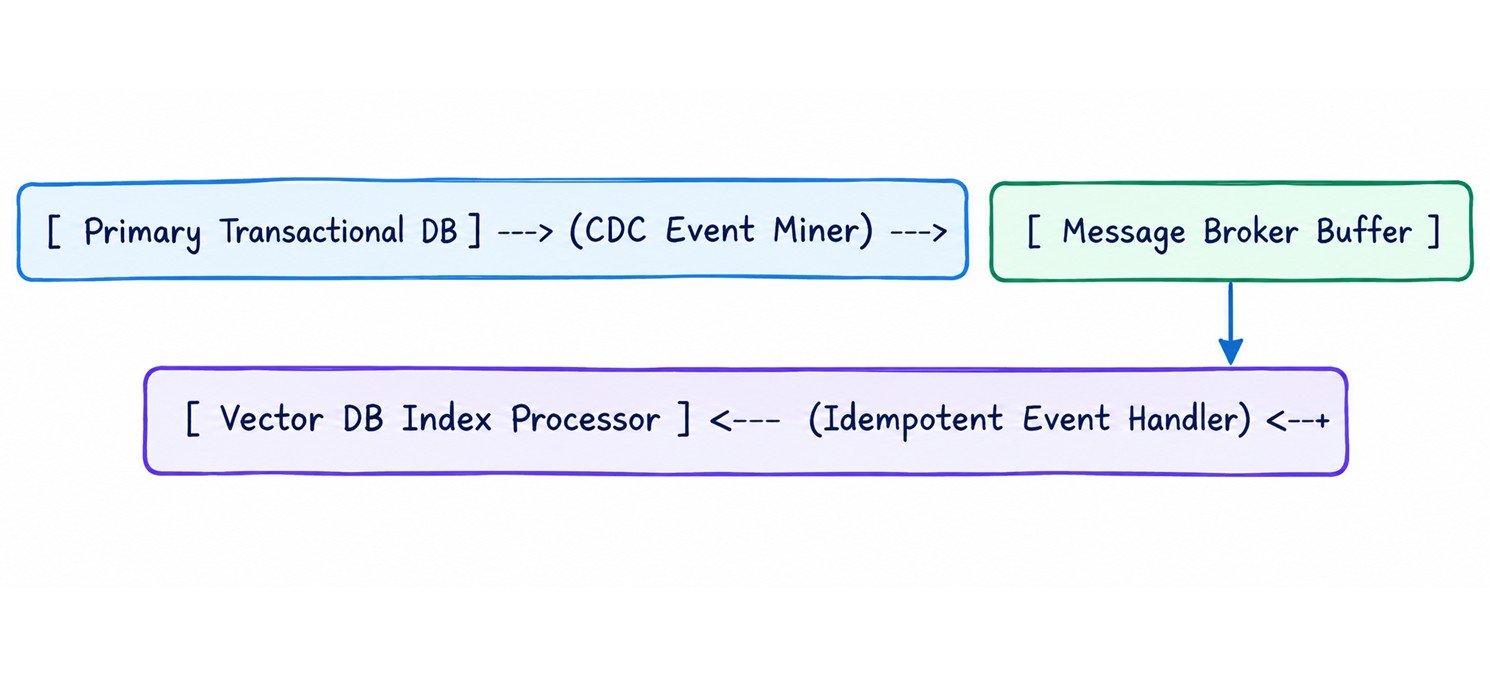
To prevent the vector space from drifting away from primary transactional databases, architectures must implement an event-driven synchronization pattern utilizing Change Data Capture (CDC).
Ingestion Synchronization Routine
- State Mutation: An upstream RCM application modifies a patient claim summary record.
- CDC Broadcast: The transaction log miner captures the change event and publishes an immutable payload to an enterprise message broker queue:
{
  "event_id": "evt_998241_alpha",
  "operation": "UPDATE",
  "target_entity": "claim_summary_88291",
  "timestamp": "2026-09-13T09:05:00Z",
  "payload": { "access_tier": "Restricted_Compliance" }
}
- Idempotent Execution: The vector database consumer process reads the event. It locates all chunk vectors linked to
claim_summary_88291using internal identity maps and performs an in-place atomic update of the metadata attributes across all indexed nodes without requiring a full structural graph rebuild.
Pattern C: Vector Tombstoning and Hard Delete Management
Deleting nodes within an approximate nearest neighbor index like an HNSW graph is a complex operation. Simply pulling a node out of a live graph breaks the routing links between neighboring elements, fragmenting the network and creating unreachable index zones.
The Production Deletion Pattern
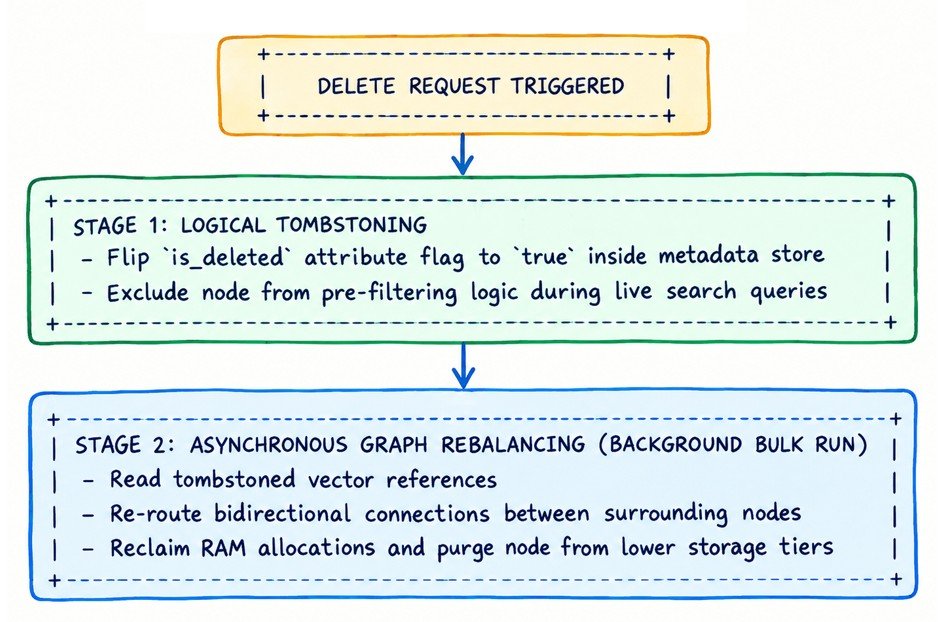
To maintain graph integrity under high delete volume, the database must execute a two-stage deletion protocol:
-
Logical Tombstoning: When a document chunk is deleted, the engine performs a fast metadata update, setting an internal
is_deletedflag totrue. The pre-filtering layer immediately excludes this chunk from all incoming user searches, rendering it invisible to downstream applications. -
Asynchronous Graph Rebalancing: During off-peak operational windows, an automated database engine routine scans for tombstoned nodes. It removes the target nodes from memory and recalculates the bidirectional connections between their former neighbor elements. This background cleanup rebalances the graph and reclaims memory allocations without degrading live query performance.
This multi-tiered approach ensures that the enterprise vector index remains accurate, highly performant, and secure under volatile corporate workloads.