Multi-Agent Architectures - Orchestration Topologies, Shared Blackboard Fabrics, and Inter-Agent Verification Barriers
Introduction
When scaling autonomous intelligence to handle complex, cross-functional enterprise objectives, engineers encounter a strict limitation: the single-agent monolithic bottleneck. Attempting to build a single LLM agent that handles data ingestion, clinical rule auditing, statistical financial analysis, and regulatory text composition simultaneously results in severe context pollution, reasoning breakdown, and high systemic fragility.
Production-grade enterprise architectures address this by distributing tasks across an ecosystem of specialized, single-purpose agents. In a high-stakes ecosystem like Healthcare Revenue Cycle Management (RCM), a multi-agent system divides a massive workflow, such as cross-payer denial reconciliation, into discrete tasks managed by dedicated agents. However, orchestrating multiple probabilistic nodes introduces substantial coordination risks: infinite loop states, race conditions, and cascading errors where an analytical miscalculation by Agent A amplifies into a compliance failure in Agent B.
This section provides the cloud-agnostic raw design patterns, orchestration topologies, distributed state models, and deterministic verification interfaces required to build a highly stable multi-agent architecture.
1. Multi-Agent Coordination Topologies: Supervisor-Worker vs. Hierarchical Swarms
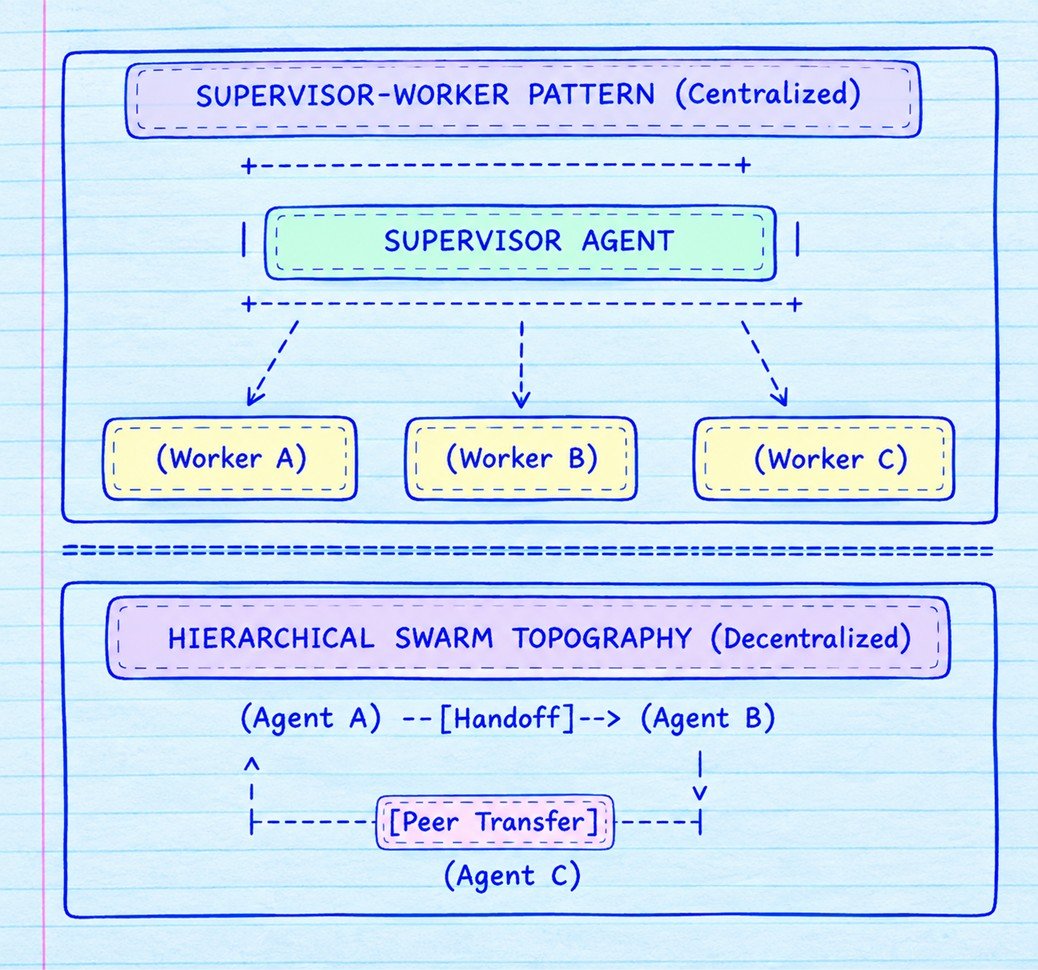
The first macro architectural choice when engineering a multi-agent network is selecting the coordination topology. Architects must choose between a centralized Supervisor-Worker Pattern and a decentralized, peer-to-peer Hierarchical Swarm Topography.
Topology A: The Supervisor-Worker Pattern
The Supervisor-Worker architecture enforces a centralized hub-and-spoke configuration. A master supervisor agent acts as the system coordinator, managing user queries and tracking the global execution state.
- Mechanics: The supervisor breaks a high-level task down into independent sub-tasks, assigns those sub-tasks to specialized worker nodes, such as an Ingestion Worker, an Auditor Worker, and a Writer Worker, and halts its execution until the worker nodes complete their tasks. Workers communicate exclusively with the supervisor, never with each other.
- Systemic Strengths: Highly predictable and easy to debug. The supervisor serves as a single source of truth, managing the execution sequence and preventing rogue agent loops.
- Systemic Weaknesses: The supervisor's context window can become a severe processing bottleneck. As long multi-turn chats accumulate data from multiple workers, the supervisor's prompt footprint inflates rapidly, leading to increased costs, slower response times, and attention degradation.
Topology B: Hierarchical Swarm Topologies
Hierarchical Swarms decouple coordination entirely, employing a decentralized, peer-to-peer network structure. The architecture operates through a distributed runtime framework where agents dynamically route execution control to one another.
- Mechanics: Each agent has access to other agents represented as programmatic tools (functions). If the active agent reaches a point in its execution loop that falls outside its domain expertise, it invokes a
transfer_control_to_agentfunction. This step serializes the current execution token and passes the runtime context over to the targeted peer node. - Systemic Strengths: Highly flexible, modular, and contextually clean. Because agents only load text payloads relevant to their immediate tasks, their localized context windows remain small, maximizing reasoning accuracy.
- Systemic Weaknesses: Difficult to predict and monitor. Without a central supervisor, peer-to-peer networks can develop unexpected loop behaviors or cyclical routing conditions under complex, edge-case user queries.
Coordination Topology Comparison
| System Dimension | Supervisor-Worker Pattern | Hierarchical Swarm Topology |
|---|---|---|
| State Management | Centralized; tracked inside a single supervisor context node. | Distributed; passed dynamically across edge execution tokens. |
| Context Footprint | Large and growing; aggregates multi-worker interactions. | Small and isolated; restricted strictly to localized peer inputs. |
| Routing Control | Deterministic/Guided; supervisor directs every step. | Probabilistic/Fluid; models decide the next hand-off destination. |
| Systemic Complexity | Linear (O(N)); easy to evaluate and trace execution paths. | Mesh network (O(N^2)); requires rigid graph state constraints. |
| Primary Use Case | Structured compliance workflows with fixed operational phases. | Open-ended exploratory audits and ad-hoc business analysis. |
2. The Shared Blackboard Architecture State Fabric
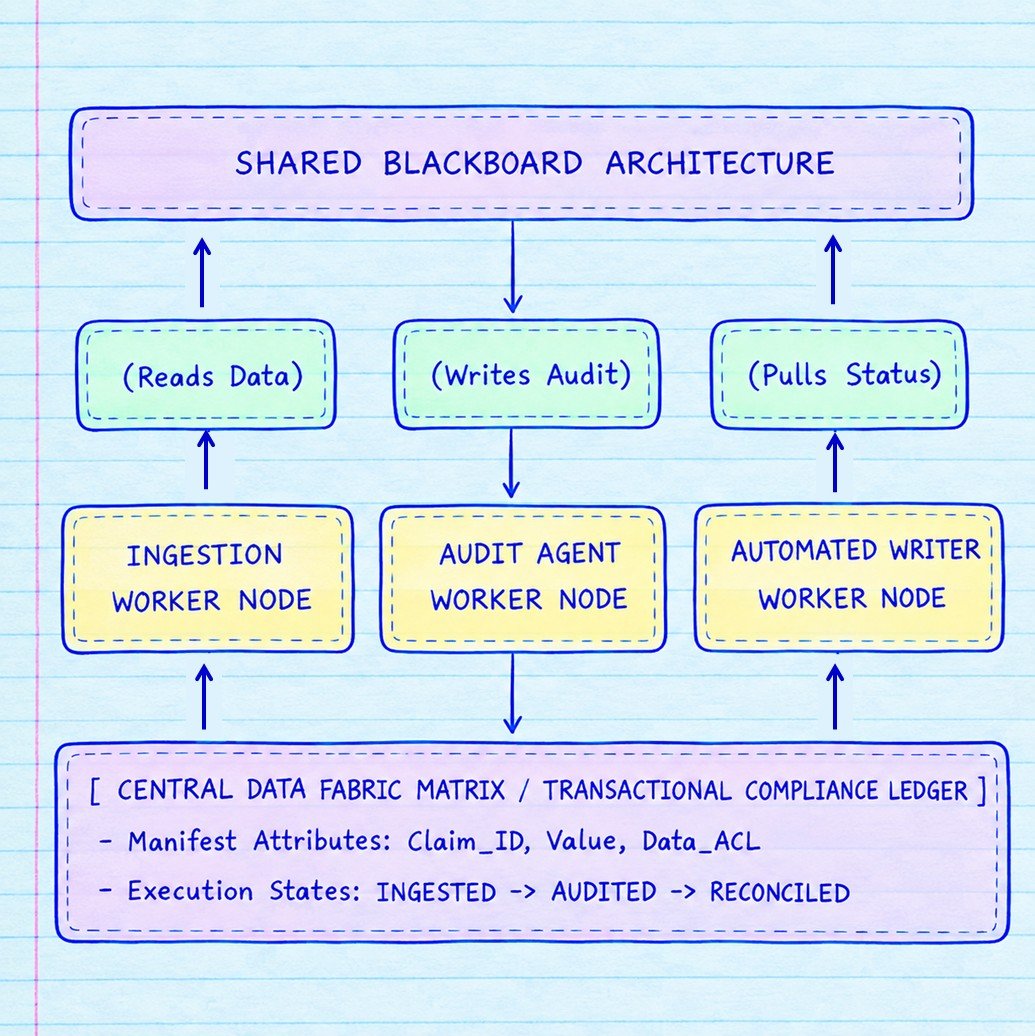
To prevent multi-agent networks from overloading their context windows through direct message-passing protocols, production platforms implement a cloud-agnostic Shared Blackboard Architecture. Rather than agents sending large text blocks directly to one another, they interact asynchronously with a centralized, structurally managed database state fabric.
Operational Mechanics
The Blackboard acts as an isolated database instance containing two key components: a global transactional ledger and a structural manifest board.
-
State Initialization: An Ingestion Worker processes a batch of raw clinical appeal documents, writes the structured data records onto the Blackboard, updates a tracking field to
INGESTED, and fires a system-wide state notification. -
Asynchronous Consumption: The Audit Agent, which has been listening for the
INGESTEDstate, wakes up, reads the structured data payload directly from the Blackboard workspace, runs its clinical rules validation, updates the dashboard ledger with its findings, and modifies the state tracking field toAUDITED. -
Decoupled Transitions: The system continues this pattern cleanly down the line. Because agents never pass data payloads directly to their peers, context windows remain clear of external system noise, memory allocations stay low, and the entire network operates with high data efficiency.
3. Inter-Agent Verification Barriers: Mitigating Cascading Errors
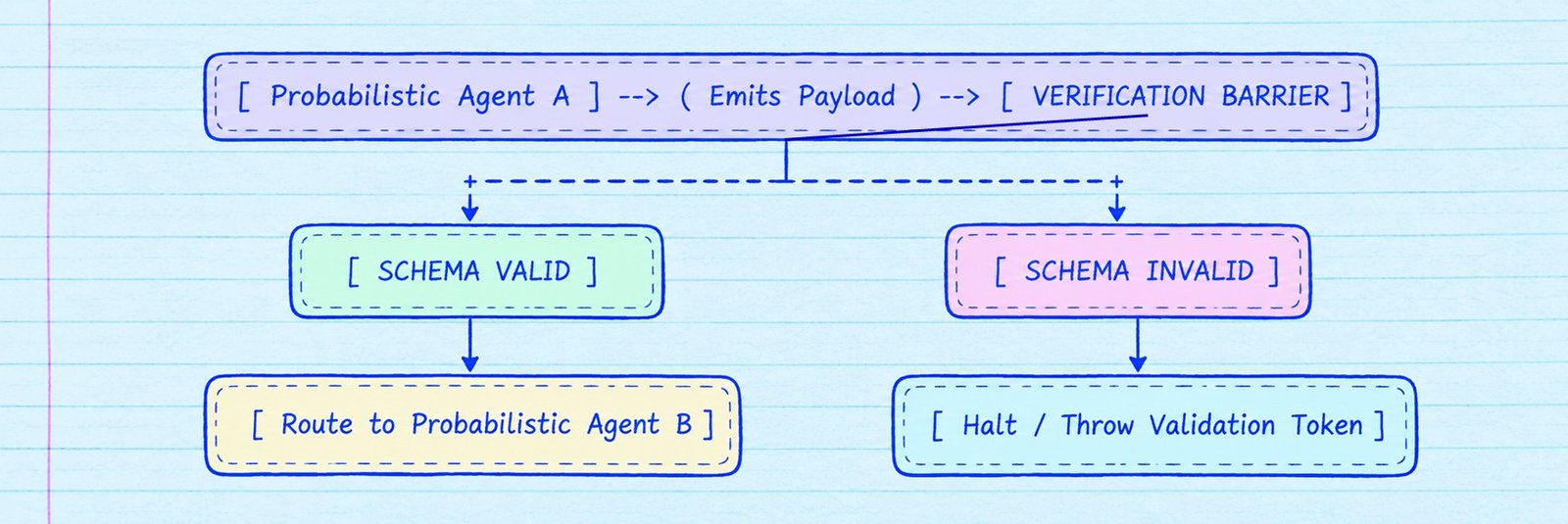
A primary vulnerability in a multi-agent system is error propagation. If an extraction agent outputs an invalid data schema, a downstream processing agent reading that malformed data will experience a processing error or generate a flawed inference. To prevent these compounding failures, the multi-agent network must implement Deterministic Inter-Agent Verification Barriers at every hand-off boundary.
The Architectural Design Pattern
A Verification Barrier is a strict, non-probabilistic software validation gate built using schema-enforcement frameworks, such as Pydantic data models or JSON Schema validators. It isolates the boundary between agents. When Agent A emits a payload to the Shared Blackboard or attempts a direct peer hand-off, the transition middleware intercepts the transaction and validates the data structure against explicit system definitions before allowing Agent B to ingest the data.
Production Schema Handoff Verification Script
The following program defines the validation barrier interface designed to protect an RCM Audit Agent from receiving malformed input data from an Ingestion Agent:
from typing import List, Optional
from pydantic import BaseModel, Field, ValidationError

# Step 1: Define the strict, non-probabilistic schema handoff constraints
class RCMHandoffPayload(BaseModel):
    claim_id: str = Field(..., min_length=5, regex="^clm_[a-zA-Z0-9_]+$")
    anonymized_patient_token: str = Field(..., regex="^t_[a-zA-Z0-9]+$")
    disputed_charge_value: float = Field(..., gt=0.0)
    primary_icd10_code: str = Field(..., regex="^[A-Z][0-9][0-9]\.[0-9]$")
    extracted_citations: List[dict] = Field(..., min_items=1)
    governance_acl: List[str] = Field(..., min_items=1)

class HandoffVerificationBarrier:
    def __init__(self, blackboard_fabric):
        self.blackboard = blackboard_fabric

    def process_agent_transition(self, source_agent_name: str, raw_payload: dict) -> bool:
        try:
            # Step 2: Force deterministic runtime validation against the schema model
            validated_matrix = RCMHandoffPayload(**raw_payload)

            # Step 3: Write the clean payload to the Shared Blackboard state fabric
            self.blackboard.commit_secure_node(validated_matrix.claim_id, validated_matrix.dict())
            return True

        except ValidationError as e:
            # Step 4: Intercept structural errors and block downstream execution
            self.log_and_route_correction(source_agent_name, e.json())
            return False

    def log_and_route_correction(self, source_agent_name: str, error_details: str):
        print(f"Alert: Inbound handoff blocked from {source_agent_name}. Schema violation detected.")
        # Trigger an immediate system loop instructing the source agent to fix its syntax errors
        self.blackboard.post_correction_token(source_agent_name, error_details)
Production Outcome
By placing validation barriers at every transition point, the architecture stops error propagation at the source. If an agent outputs an invalid diagnosis code format, such as writing M545 instead of M54.5, the verification gate catches the syntax variance, halts downstream processing, and routes a correction prompt back to the generating agent.
This design pattern isolates probabilistic errors, maintains data compliance, and ensures long-term operational stability for enterprise AI systems.