Agentic Workflows - Non-Linear Reasoning, Tool Integration, and Deterministic State Machine Controllers
Introduction
Moving an enterprise Generative AI application from a fragile Proof of Concept (PoC) to an industrialized production capability requires a fundamental shift in how we design software execution. Traditional Retrieval-Augmented Generation (RAG) is inherently linear and passive: it takes a user query, fetches corresponding text fragments, and generates a static summary. While this pattern works well for basic information lookup, it struggles when applied to complex corporate operations.
True business processes, such as auditing an automated insurance claim denial, reconciling institutional medical bills, or verifying cross-organizational patient eligibility, demand systems that go beyond finding and summarizing information. These workflows require systems that can reason iteratively, take autonomous action, execute programmatic code, interact with external software tools, and self-correct during runtime.
For technology leaders (CTOs, VPs, and Enterprise Solution Architects), transitioning to Agentic Workflows introduces a new engineering paradigm. It changes the system from a deterministic codebase to a probabilistic, model-guided agentic loop. Without explicit structural boundaries and precise state monitoring, fully open-ended agent loops will quickly derail, leading to infinite execution loops, runaway API token costs, and unguided system behaviors.
This section details the core design patterns, structural state-machine architectures, and execution loops required to deploy resilient, action-oriented agentic workflows within the enterprise.
1. The Four Core Archetypes of Agentic Workflows
Building reliable agentic systems requires moving away from massive, unguided text prompts toward highly structured design patterns. As established by industry consensus and originally conceptualized by AI pioneers like Andrew Ng, there are four core design patterns for agentic workflows that form the foundation of production-grade agent architectures:
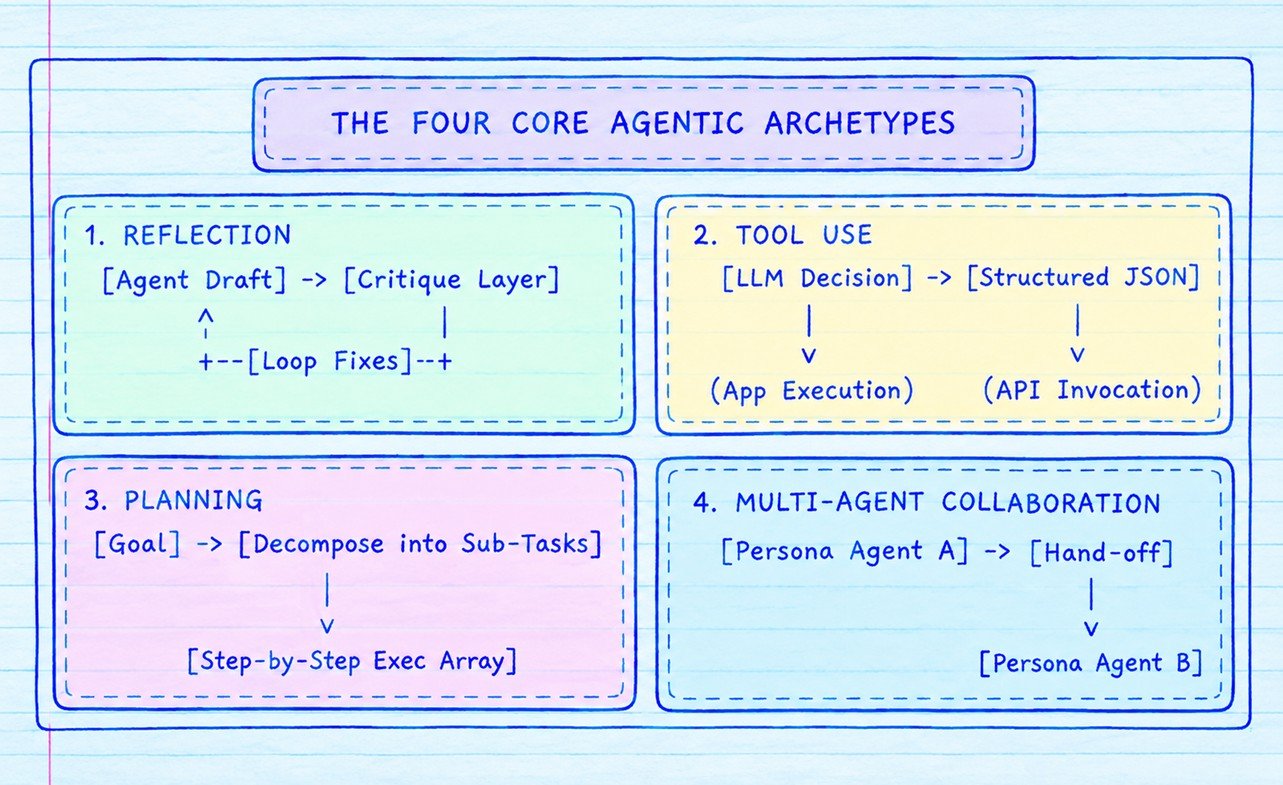
Archetype 1: Reflection (Iterative Self-Correction)
The Reflection pattern breaks the standard single-pass generation habit of LLMs. Instead of accepting the model's first-draft output as final, the architecture routes the initial response through a dedicated critique step.
- Mechanics: The model generates a candidate draft, such as an automated insurance appeal letter contesting a claim denial. This draft is programmatically fed into a secondary inference loop, running either an alternative specialized model or an explicit rule-based validator, instructed to look for errors, hallucinated codes, or incomplete arguments.
- Execution Loop: The critique step outputs a structured list of corrections, which the primary generator uses to rewrite and optimize the payload. This loop repeats until the response clears the defined system quality metrics.
Archetype 2: Tool Use (Programmatic Function Calling)
Tool Use changes an LLM from a closed text predictor into an active system driver. The model is given access to external tools via machine-readable API specifications, allowing it to interface directly with real-world applications.
- Mechanics: The agent engine provides the LLM with a list of available tools described as JSON or XML schemas, detailing function names, parameter data types, and operational descriptions.
- Execution Loop: The model does not execute the code directly. Instead, it reads the input context and outputs a structured payload, such as a function call block targeting an insurance eligibility API. The orchestration framework intercepts this payload, runs the localized application code, and returns the real-world output to the LLM to guide its next reasoning step.
Archetype 3: Planning (Goal Decomposition)
The Planning pattern allows agents to navigate complex, multi-step business objectives that cannot be resolved in a single execution turn.
- Mechanics: Given a high-level goal, such as "Audit claim 994821 and draft an appeal if the hospital billing records do not match the payer's policy," the model uses a planning framework to break the target objective down into a sequential, multi-step task list.
- Execution Loop: The agent maintains a dynamic state-tracking matrix, checking off completed tasks, adjusting downstream execution steps based on intermediary tool outputs, and determining when the overarching goal has been reached.
Archetype 4: Multi-Agent Collaboration
Multi-Agent Collaboration decomposes large, multi-faceted enterprise processes by dividing tasks among a network of specialized agent personas.
- Mechanics: Instead of forcing a single massive model to handle ingestion parsing, regulatory validation, financial calculation, and text composition simultaneously, the architecture assigns each task to a distinct, highly focused agent.
- Execution Loop: Each agent operates within a tightly defined scope, utilizing customized toolsets and system boundaries. They pass structured outputs across clear system hand-off lines, such as a Data Ingestion Agent parsing a medical chart and handing the structured JSON to an RCM Audit Agent, which validates the codes and queues the file for a Drafter Agent. This maximizes overall system precision.
2. The Agentic State-Machine Controller Architecture
To prevent autonomous agents from veering into infinite loops or exhibiting erratic behavior under production workloads, the system framework must enforce a strict Finite State Machine (FSM) tracking architecture. The LLM handles the probabilistic reasoning within each state, while the transition paths between states are managed by deterministic software boundaries.
The Core Execution States
- Reasoning State (The Thought Engine): The model analyzes the system state history, determines what actions are required to advance toward the goal, and selects the optimal tool for the next step.
- Tool Call State (The Inbound Gateway): The engine catches the structured JSON function declaration emitted by the LLM, validates the schema parameters, checks user permissions, and structures the tool execution package.
- Execution State (The Runtime Processor): The system invokes the targeted corporate API, reads the real-world response payload, sanitizes the data, and appends the result to the history log before returning to the Reasoning State.
Finite State Machine Routing Topology
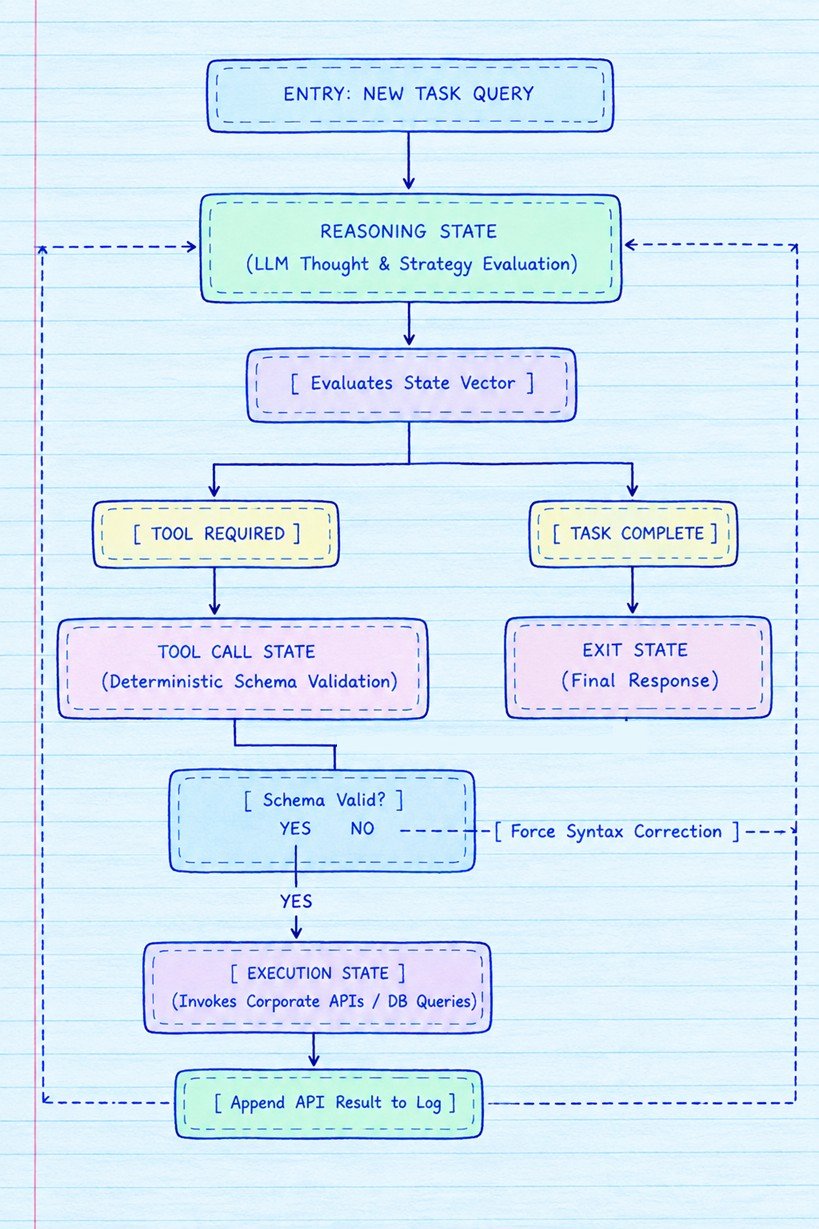
This structural loop ensures that the agent transitions safely through explicit processing gates. If a model generates an invalid function call or violates schema syntax rules, the state machine intercepts the error at the Tool Call State, blocks out-of-bounds execution, and routes a correction token back to the model without crashing the main application runtime.
3. Production Case Study Blueprint: Healthcare RCM Agentic Loop
To see these design principles in action, let us analyze a complete production-grade execution pattern for an automated Healthcare Revenue Cycle Management (RCM) Audit Agent. This blueprint demonstrates how an agent coordinates multiple tools to resolve a complex, multi-step operational objective.
Objective
Audit a specific patient claim identifier (clm_994821), determine the root cause of its insurance denial, verify current patient coverage rules, and compile a structured validation report for compliance auditing.
Complete Multi-Turn Execution Sequence
The raw data flow and message tracking log below show how the agent transitions across states and coordinates enterprise APIs to resolve the business objective:
# SYSTEM WORKFLOW LOG: CLAIM AUDIT CONTROLLER
# Target: clm_994821_west_clinic | Tenant: Provider_Network_East

---
TURN_01:
  State: REASONING_STATE
  LLM_Thought: |
    The objective requires auditing claim clm_994821_west_clinic. First, I need to inspect the
    historical transactional record of this claim to identify why it was flagged as denied.
    I will invoke the 'get_claim_history' tool using the specific claim identifier.
  Action_Emitted:
    tool_name: "get_claim_history"
    parameters: { "claim_id": "clm_994821_west_clinic" }

---
TURN_02:
  State: TOOL_CALL_STATE
  Validation: "Schema validation verified. User role 'RCM_Auditor' authorized for asset."
  State_Transition: "EXECUTION_STATE"
  API_Invocation:
    endpoint: "api.internal.rcm/v1/claims/history"
    method: "POST"
    payload: { "id": "clm_994821_west_clinic" }
  Runtime_Response: |
    {
      "status": "DENIED",
      "denial_category_code": "CO-197",
      "denial_reason": "Pre-certification / prior authorization missing or omitted.",
      "primary_procedure_cpt": "62323",
      "primary_diagnosis_icd10": "M54.5",
      "payer_id": "bchs_bluecross_east",
      "date_of_service": "2026-08-12"
    }

---
TURN_03:
  State: REASONING_STATE
  LLM_Thought: |
    The claim history reveals a denial code of CO-197 (Missing Prior Authorization) for CPT procedure code
    62323 (Epidural Injection) under payer 'bchs_bluecross_east'. I now need to check if a valid prior
    authorization token actually existed in the system repository prior to the date of service (2026-08-12).
    I will invoke the 'query_authorization_ledger' tool.
  Action_Emitted:
    tool_name: "query_authorization_ledger"
    parameters: {
      "anonymized_patient_token": "t_8f3c9a2e",
      "target_cpt_code": "62323",
      "effective_date": "2026-08-12"
    }

---
TURN_04:
  State: TOOL_CALL_STATE
  Validation: "Schema verified. Parameter matching complete."
  State_Transition: "EXECUTION_STATE"
  API_Invocation:
    endpoint: "api.internal.authorization/v2/ledger/query"
    method: "GET"
  Runtime_Response: |
    {
      "authorization_found": true,
      "auth_token": "auth_token_99321_alpha",
      "approved_cpt_code": "62323",
      "valid_from": "2026-08-01",
      "valid_to": "2026-11-01",
      "max_approved_units": 1,
      "status": "ACTIVE"
    }

---
TURN_05:
  State: REASONING_STATE
  LLM_Thought: |
    The ledger lookup reveals that a valid prior authorization token (auth_token_99321_alpha) was active
    and covered CPT code 62323 on the date of service. This indicates that the payer's denial code (CO-197)
    is factually incorrect based on system records. I have gathered the necessary evidence to conclude the
    audit. I will now compile the final verification report and exit the execution loop.
  State_Transition: "EXIT_STATE"
  Final_Output_Payload:
    audit_verdict: "ERRONEOUS_DENIAL_DETECTED"
    evidence_package:
      target_claim: "clm_994821_west_clinic"
      payer_id: "bchs_bluecross_east"
      denial_code: "CO-197"
      validated_auth_token: "auth_token_99321_alpha"
    recommended_action: |
      Generate an automated level-1 appeal packet enclosing the active prior authorization ledger
      JSON payload to force claim adjudication.
By framing enterprise AI automation as a disciplined, model-guided state machine, technology executives can confidently design systems that take real-world action safely. This agentic workflow design ensures absolute operational visibility, protects system data privacy, and prevents run-away execution behaviors, delivering a robust path forward for enterprise-scale AI automation.