RAG & Agent Architecture Decision Framework - Executive Trade-offs, TCO Models, and Sign-off Checklists
Introduction
For technology executives (CTOs, VPs, and Directors of AI Engineering), Chapter 10 has mapped out the individual infrastructure engines, structural pipeline topologies, containment systems, and decoupled governance layers that define modern cognitive architectures. However, the ultimate test of enterprise leadership is not simply understanding these isolated patterns. The ultimate test is strategic selection: looking at an incoming corporate business objective and deciding exactly which architectural blueprint to deploy.
Over-engineering a system by building an unguided, multi-agent network to solve a straightforward document-search problem wastes developer resources, introduces security risks, and blows out inference budgets. Conversely, under-engineering a system by relying on a linear RAG pipeline to solve an intricate, cross-functional data reconciliation problem results in systemic failure and high hallucination rates. Moving Generative AI from a fragile Proof of Concept (PoC) to enterprise production requires a rigorous, numbers-driven framework to balance accuracy, latency, complexity, and financial overhead.
This final section provides the multi-dimensional lookup matrices, Total Cost of Ownership (TCO) models, and boardroom sign-off checklists required to choose the right enterprise architecture pattern for your business goals.
1. The Multi-Dimensional Architecture Selector Matrix
To guide infrastructure selection, architects must evaluate incoming business problems across three specific operational dimensions: Data Volatility (State Drift), Autonomy Triggers (Reasoning Depth), and Latency Service Level Agreements (SLAs).
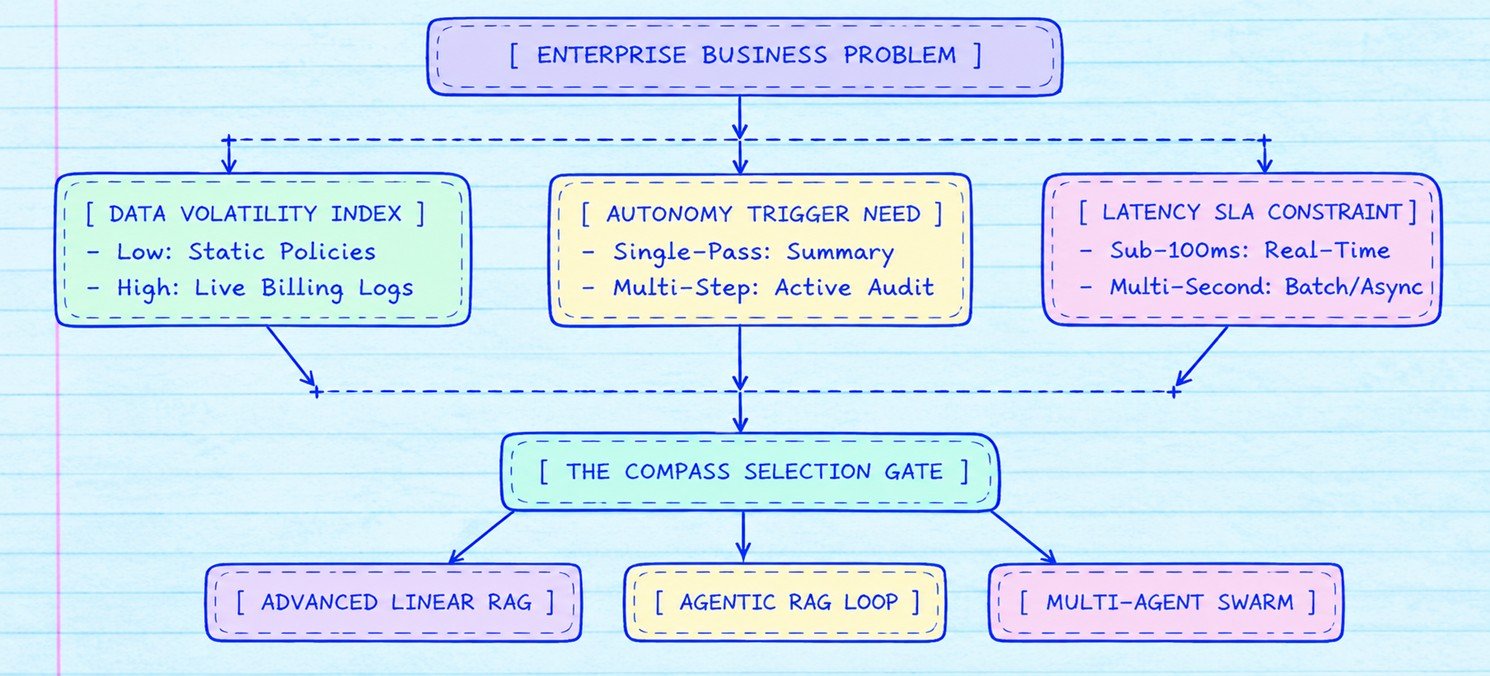
- Advanced Linear RAG Pattern: Deployed when data is mostly structured or historical, tasks require straightforward information retrieval, and systems must adhere to strict, sub-second latency targets.
- Agentic / Corrective RAG Pattern: Deployed when data updates semi-frequently, tasks require evaluating the quality of retrieved context, and the business workflow tolerates multi-second processing windows to protect accuracy.
- Autonomous Multi-Agent Architecture: Deployed when handling high-volatility live transaction streams, tasks require multi-step planning and cross-functional tool execution, and the operational environment uses asynchronous execution models.
Operational Lookup Compendium
| Target Business Problem Type | Data Volatility Metric | Required Autonomy Trigger | Latency SLA Bounds | Optimal Architectural Selection |
|---|---|---|---|---|
| Payer Policy Directory Lookup | Low (Monthly manual adjustments) | Single-Pass (Locate specific policy coverage clauses) | Sub-500ms (Live customer call center interface) | Advanced Linear RAG |
| Patient Eligibility Verification | Medium (Daily database updates) | Deterministic Tool Call (Verify identity via active REST APIs) | Sub-1 second (Front-desk patient check-in gate) | Advanced Linear RAG + Single Tool Interaction |
| Level-1 Claim Denial Appeal Drafting | Medium-High (Frequent payer code updates) | Iterative Review (Self-correct and grade appeal drafts against rule lists) | Asynchronous (< 30 seconds processing window) | Agentic / Corrective RAG Loop |
| Cross-Payer Financial Reconciliation | High (Live transactional billing feeds) | Multi-Step Coordination (Ingest, audit billing entries, run tools, update ledgers) | Batch Processing (Asynchronous overnight processing run) | Autonomous Multi-Agent Architecture |
2. Quantitative Total Cost of Ownership (TCO) and ROI Model
Technology executives cannot justify infrastructure choices based on architectural cleanliness alone; they must present a clear financial model to the CFO. Every layer of agentic autonomy added to the system increases implementation complexity, maintenance costs, and computing resource demands.
TCO Resource Allocation Metric Models
   ADVANCED LINEAR RAG COST DISTRIBUTION
   [Dev Runway: 20%] [Token Compute: 15%] [Maintenance: 15%] ---> [Accuracy Gain: Baseline]

   AGENTIC RAG LOOP COST DISTRIBUTION
   [Dev Runway: 45%] [Token Compute: 40%] [Maintenance: 35%] ---> [Accuracy Gain: +25% Shift]

   MULTI-AGENT SWARM COST DISTRIBUTION
   [Dev Runway: 80%] [Token Compute: 95%] [Maintenance: 85%] ---> [Accuracy Gain: Complex Tasks Only]
1. Development Runway
Measures the upfront software engineering overhead, deployment duration, and integration timeline needed to push the system pattern live.
2. GPU / Token Compute Overhead
Measures the ongoing variable operational expense (OpEx) driven by model inference calls, prompt expansion runs, cross-encoder evaluations, and multi-turn reasoning loops.
3. Maintenance Drag
Measures long-term infrastructure upkeep, debugging complexity, tracing requirements, configuration adjustments, and guardrail validation checks.
4. Operational Accuracy Gains
Measures the reduction in hallucination rates, improvement in compliance scores, and reduction in manual processing hours compared to standard baseline systems.
Financial Architecture Vector Comparison
| Cost-Performance Vector | Advanced Linear RAG Archetype | Agentic / Corrective RAG Archetype | Autonomous Multi-Agent Architecture |
|---|---|---|---|
| Development Runway Cost | Minimal (2 to 4 engineering weeks; simple pipeline integrations) | Moderate (6 to 12 engineering weeks; requires state grading rails) | High (24+ engineering weeks; requires sandboxing and distributed state fabrics) |
| GPU / Token Compute Overhead | Low & Predictable (Single-pass inference; fixed token sizes) | Medium & Non-Linear (Scales based on internal retry and rewrite cycles) | Compounding & Volatile (High token cost due to multi-turn loops and tool executions) |
| Maintenance Drag Profile | Low (Simple code testing; standard vector indexing monitoring) | Medium (Requires tracking state grading models and prompt performance) | Extremely High (Demands distributed log tracing, telemetry monitoring, and sandbox security audits) |
| Operational Accuracy Metrics | 90% - 94% on structured, single-document search tasks | 95% - 98% on tasks requiring self-correction and validation | 98%+ on highly complex tasks, but inefficient for straightforward inquiries |
| Financial ROI Target | High immediate yield for search and lookup tools | Strong return for automated documentation and auditing workflows | Justified only for high-value, multi-step transaction loops |
3. The Boardroom Sign-off Checklist: Executive Project Audit
Before allocating capital or dedicating engineering resources to a proposed Generative AI project blueprint, the AI Director, VP, or CTO should use this scannable audit checklist to review the system design.
[ ] SECTION 1: TASK ROUTING VALIDATION
    [ ] Has the project's Agentic Routing Index (I_Agent) been calculated?
    [ ] Is the system design free of probabilistic models for basic math or rigid ETL?

[ ] SECTION 2: INFRASTRUCTURE & RESOURCE ASSESSMENT
    [ ] Are memory-heavy storage nodes decoupled from compute-heavy GPU rerankers?
    [ ] Does the variable cost model protect the enterprise from token-burst costs?

[ ] SECTION 3: COMPLIANCE & SECURITY CONTAINMENT
    [ ] Are all sensitive identifiers (PHI/PII) masked before the embedding layer?
    [ ] Are tool execution loops contained within kernel-level isolated sandboxes?
    [ ] Are tool calls validated by an independent Policy-as-Code interceptor?

[ ] SECTION 4: DATA FRESHNESS & AUDITABILITY GATES
    [ ] Is data drift managed via event-driven CDC invalidation and chunk-level hashing?
    [ ] Do prompt structures wrap all returned chunks in clean provenance tags?
    [ ] Are escalation rules in place to pause and route high-dollar queries to human review?
Section 1: Task Routing Validation
- Calculate the Routing Index: Has the team calculated the Agentic Routing Index (I_Agent) for the target use case? Is the index calculation documented?
- Avoid Probabilistic Over-Engineering: Is the system design free of probabilistic models attempting to handle standard mathematical calculations or rigid ETL code?
Section 2: Infrastructure and Resource Assessment
- Decouple Storage and Inference: Are memory-heavy storage nodes (HNSW vector indexes) decoupled from compute-heavy GPU rerankers (Cross-Encoders) to prevent resource contention?
- Model Token Expenses: Has the team modeled worst-case variable token costs against a Token-Bucket Rate Limiter to protect the enterprise budget from runaway loop expenses?
Section 3: Compliance and Security Containment
- Enforce Pre-Embedding Masking: Are all direct patient and corporate identifiers (PII/PHI) securely masked or tokenized before text reaches the embedding or retrieval tiers?
- Harden Execution Environments: Are tool execution loops contained within kernel-level isolated sandboxes with disabled outbound network configurations?
- Decouple Policy Controls: Are agent actions intercepted and validated by an independent Policy-as-Code engine, such as OPA, rather than relying on model prompts?
Section 4: Data Freshness and Auditability Gates
- Manage Data Drift: Is knowledge freshness managed using event-driven Change Data Capture (CDC) invalidation and chunk-level hash fingerprinting to prevent index duplication?
- Enforce Data Traceability: Do prompt assembly structures wrap all returned text chunks in clean provenance tags, forcing the generative model to emit inline citations?
- Integrate Human Escalation: Are explicit escalation rules in place to pause the agent's state serialization and route queries to human review when encountering high-dollar values or low-confidence metrics?
By enforcing these technical gates, technology leaders protect their organizations from common deployment failures. This comprehensive decision framework ensures that your enterprise knowledge architecture remains cost-effective, secure, and operationally resilient as it scales in production.