Enterprise knowledge architecture
Philosophical Foundations: Cloud-Agnostic Raw Design Patterns
The engineering specifications detailed throughout this chapter are built upon a foundational architectural principle: strict cloud agnosticism. To ensure long-term platform viability and protect the organization from vendor lock-in, the core data ingestion, processing, and retrieval patterns must remain completely independent of any single public cloud vendor ecosystem or proprietary software database stack.
Enterprise technology platforms must be engineered to survive shifts in the underlying model vendor and cloud hosting landscape. Relying on cloud-specific managed wrappers or vendor-locked AI toolkits creates a fragile substrate. If a provider changes its API pricing models, deprecates an embedding engine version, or modifies data privacy rules, a dependent architecture can experience immediate operational disruptions.
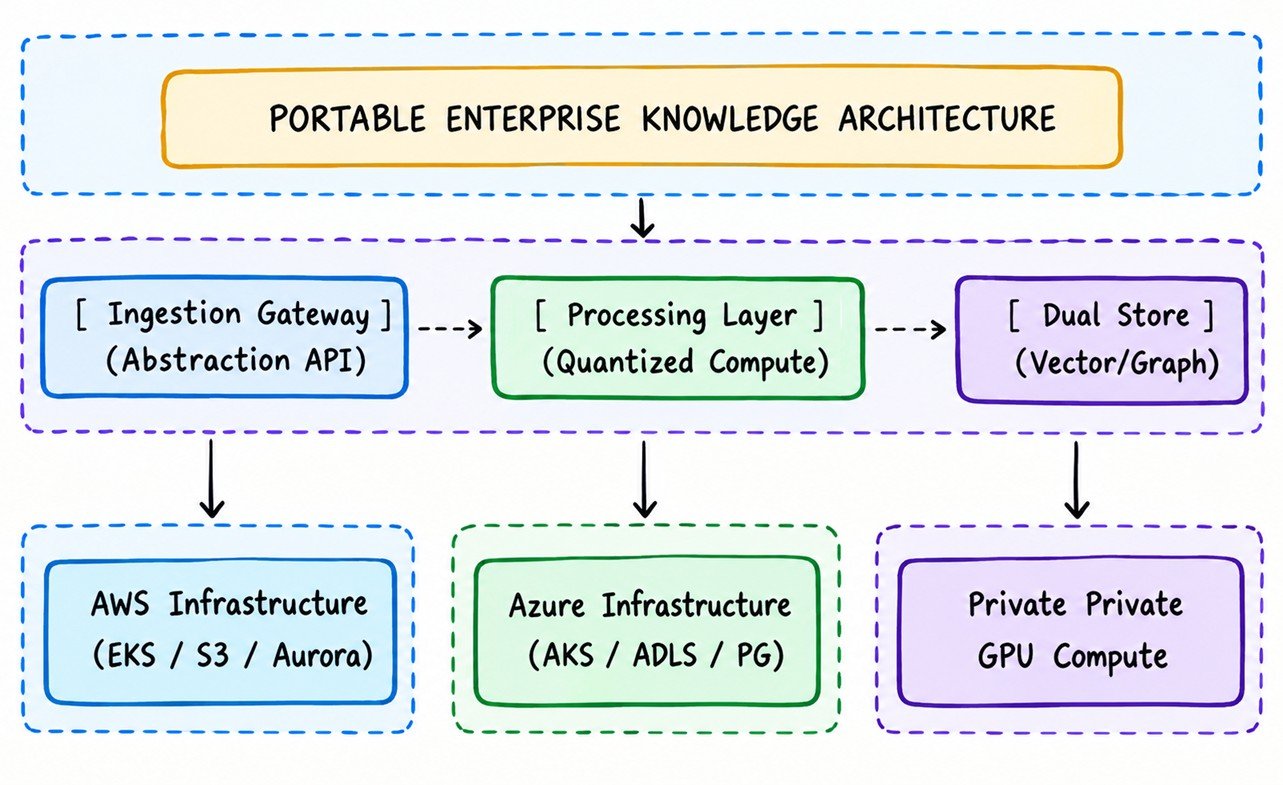
This architecture achieves portability by wrapping all processing components within standardized, containerized microservices and open communication protocols, such as gRPC and JSON Schema interfaces.
- The data pipeline views underlying object storage arrays, message brokers, and transactional databases as abstract resources managed through standardized drivers.
- Whether the platform runs on a localized enterprise GPU cluster or scales out across public cloud instances, the system execution path remains identical.
This cloud-agnostic approach ensures that enterprise technology teams maintain absolute ownership over their system configurations, storage economics, and security parameters.
The Semantic Duality: Structural Balance Between Vector Search Space and GraphRAG Topologies
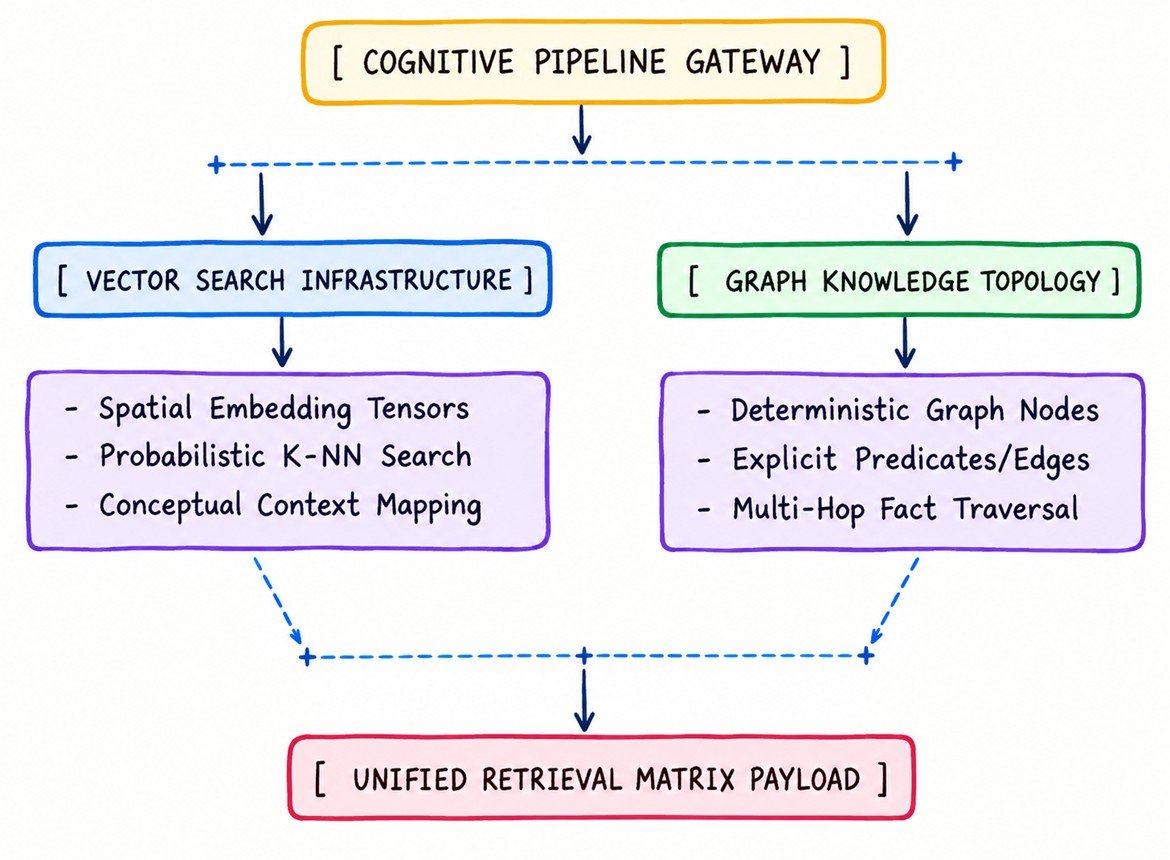
A production-grade Enterprise Knowledge Architecture must manage two distinct forms of data representation. Corporate knowledge is not a flat landscape that can be captured by a single mathematical format. Instead, it exhibits a fundamental Semantic Duality: it requires both Spatial Proximity (to handle unstructured, open-ended conceptual search) and Relational Connectivity (to enforce strict, deterministic fact traversal).
To balance these needs, production architectures deploy a dual-core index layer that combines a Dense/Sparse Vector Search Space with a GraphRAG Knowledge Graph Topology.
Core Component 1: The Vector Search Space (Spatial Proximity)
The vector store handles unstructured, open-ended semantic matching. It translates text fragments into multi-dimensional floating-point tensors, positioning documents within a coordinate system where geometric closeness indicates semantic similarity.
- Mechanics: Uses high-dimensional embedding spaces combined with sparse keyword inverted indices, such as BM25 alignment, to calculate fast Approximate Nearest Neighbor (ANN) matches.
- Best Used For: Handling ambiguous user queries, locating abstract conceptual relationships, and scanning massive document repositories in milliseconds to generate high-recall candidate pools.
- Limitation: It is inherently probabilistic. A vector search cannot safely navigate complex relational logic or track exact chains of custody across separate files. For example, asking a vector space to resolve "Find all active insurance claims for patients who were prescribed medication X by doctor Y after date Z" frequently leads to failure or context fragmentation.
Core Component 2: The GraphRAG Topology (Relational Connectivity)
The knowledge graph provides a non-probabilistic framework that structures data as explicit entities (Nodes) joined by directional relationships (Edges/Predicates).
- Mechanics: Translates document insights into strict semantic triplets:
(Subject) -> [Predicate] -> (Object). For instance,(Claim_994821) -> [HAS_STATUS] -> (Denied). - Best Used For: Multi-hop reasoning, tracking historical version ownership, and executing strict compliance validation checks across separate corporate assets.
- Limitation: High indexing complexity. Building and traversing global entity-relationship networks demands significant computing resources and requires structured data profiles to run efficiently.
The Architecture Balance Integration
Rather than forcing a choice between these two structural patterns, a production platform runs them simultaneously. Every processed chunk of corporate knowledge is written to the database layers as a dual asset: its unstructured narrative is committed to the vector space for fast semantic indexing, while its real-world entities are mapped to graph nodes to preserve factual continuity.
By combining spatial vector proximity with explicit graph connectivity, the architecture delivers a robust, high-fidelity retrieval foundation capable of supporting advanced RAG pipelines and autonomous multi-agent systems.