Agent Boundaries - Quantitative Task Classification, Sandboxed Execution, and Asynchronous Escalation Gates
Introduction
For technology executives (CTOs, VPs, and Heads of AI Practice), the most critical decision when deploying agentic automation is not choosing which Large Language Model (LLM) to use. The most critical decision is defining where the agent's autonomy must stop. In the rush to adopt generative AI, many enterprise initiatives fail because engineers attempt to use probabilistic, model-guided agent loops to solve problems that are better handled by deterministic software engineering.
Using an unpredictable agentic loop to compute standard mathematical equations, execute static Extract, Transform, Load (ETL) pipelines, or navigate rigid, compliance-heavy state flows introduces severe operational risks. It leads to erratic system behavior, runaway API token costs, and increased software vulnerability. To move generative AI from a fragile Proof of Concept (PoC) to enterprise production, architects must treat task routing as a disciplined engineering choice based on quantitative risk-reward metrics.
This section provides the cloud-agnostic raw design patterns, task-routing scoring frameworks, secure sandbox isolation models, and asynchronous escalation gates required to establish rigid operational boundaries around autonomous agents.
1. The Architectural Boundary Matrix: Deterministic Code vs. Agentic Routing
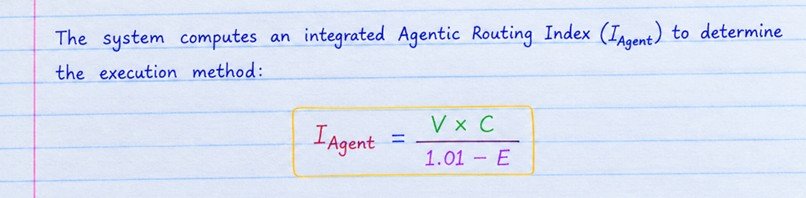
To prevent over-engineering and ensure system stability, the enterprise infrastructure must run every incoming operational task through a quantitative Task Routing Scoring Matrix. This mathematical framework evaluates three specific vector dimensions: State Space Volatility (V), Algorithmic Complexity (C), and Error Tolerance (E).
Mathematical Dimension Formulas
1. State Space Volatility (V in [0, 1])
Measures the predictability and dynamic variability of the data inputs and external environment. A highly structured database transaction has low volatility, while analyzing an open-ended, multi-page healthcare policy appeal document has high volatility.
2. Algorithmic Complexity (C in [0, 1])
Measures whether the task can be expressed as a finite sequence of known conditional statements (if/else logic). If the resolution path requires open-ended semantic reasoning or ambiguous interpretation, complexity approaches 1.0.
3. Error Tolerance (E in [0, 1])
Measures the operational blast radius and financial or legal liability of an incorrect system action. A task with an error tolerance approaching 0.0 represents zero-fault compliance limits, such as executing an accounting general ledger entry. A value approaching 1.0 means an unexpected deviation has minimal systemic impact, such as draft email phrasing suggestions.
The Routing Index Formula
-
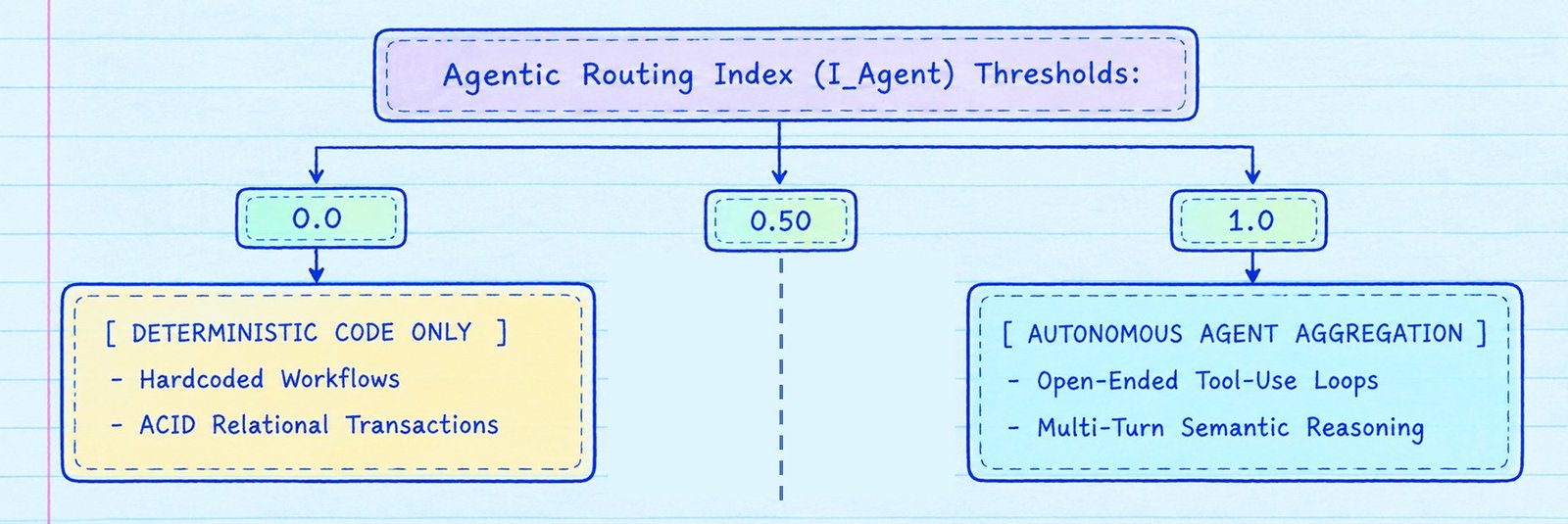
Rule Set: If I_Agent < 0.50, the system routes the task to Deterministic Code. The architecture enforces hardcoded script pipelines, microservices, or standard database procedures.
-
Rule Set: If I_Agent > = 0.50, the system routes the task to the Autonomous Agent Engine, permitting probabilistic reasoning loops and dynamic tool utilization.
Quantitative Task Routing Rubric
| Target Use Case | Volatility (V) | Complexity (C) | Error Tolerance (E) | Index (I_Agent) | Target Routing Pathway |
|---|---|---|---|---|---|
| 835 Claim Remittance Posting | 0.05 | 0.10 | 0.00 | 0.005 | Deterministic Code Only (ACID Transaction) |
| Patient Demographics Update | 0.10 | 0.05 | 0.01 | 0.005 | Deterministic Code Only (REST API Mutation) |
| Payer Policy Update Extraction | 0.85 | 0.70 | 0.40 | 0.975 | Autonomous Agent Engine (Layout-RAG Parse) |
| Clinical Appeal Drafting | 0.90 | 0.85 | 0.20 | 0.944 | Autonomous Agent Engine (Iterative Reflection) |
2. Secure Infrastructure Containment: Sandboxes and State-Machine Circuit Breakers
When the routing index allows an autonomous agent to execute, the architecture must contain its execution environment. Allowing an LLM-guided agent to invoke system-level scripts or access databases without isolation represents a severe security vulnerability.
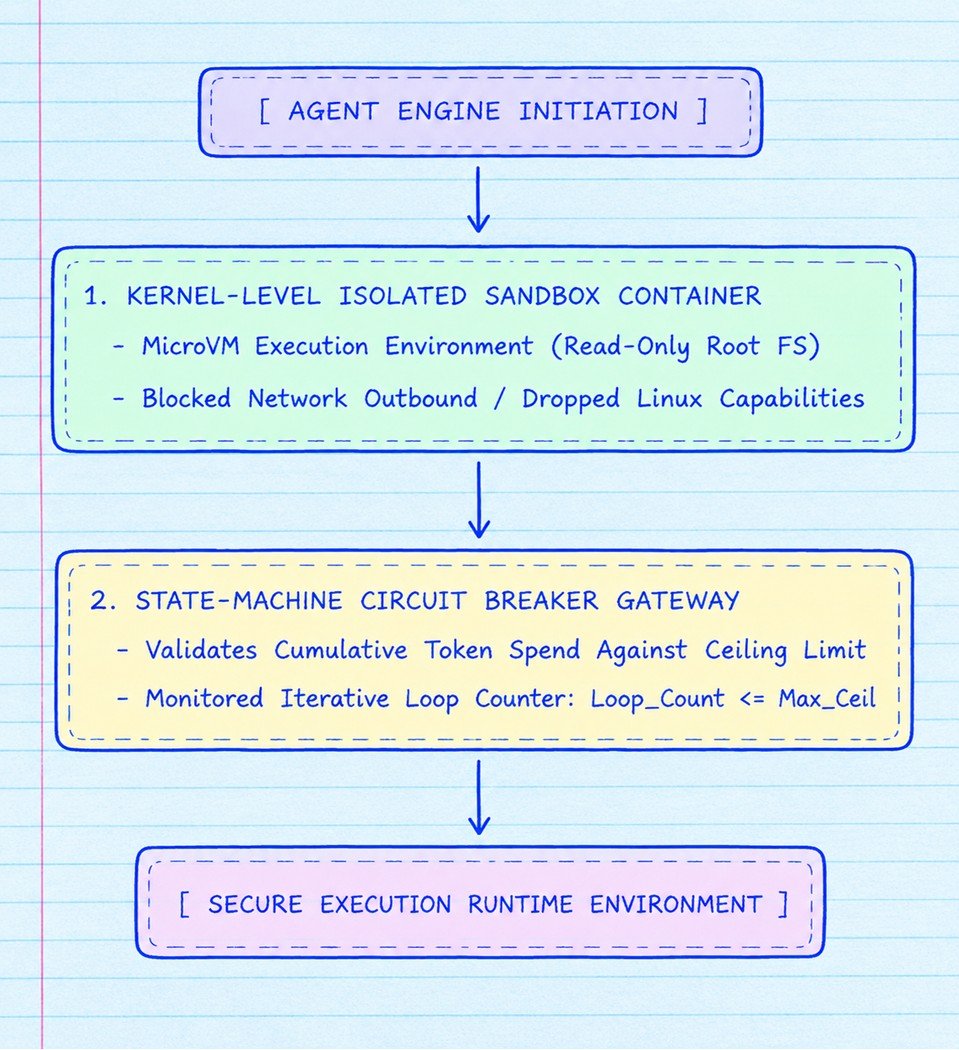
Production platforms enforce two operational containment patterns: Kernel-Level Isolated Sandboxes and State-Machine Circuit Breakers.
Pattern A: Kernel-Level Isolated Sandboxes
If an agent uses specialized tools, such as dynamic Python calculation sandboxes or code interpretation environments, it must operate inside a hardened, ephemeral guest container framework, such as microVM runtimes like Firecracker or gVisor kernel virtualization.
- Read-Only Root Filesystem: The execution environment mounts a strictly limited, read-only root directory. Temporary file writes are confined to an isolated memory buffer (
tmpfs) that destroys itself upon completion of the task sequence. - Network Namespace Isolation: Outbound TCP/IP traffic is entirely blocked by default. The sandbox can only communicate with the core orchestration manager via an isolated UNIX socket or a tightly restricted, internal-only gRPC channel.
- Capability Dropping: The microVM process drops all privileged Linux capabilities (
CAP_SYS_ADMIN,CAP_NET_ADMIN,CAP_SYS_RAWIO), ensuring that even if the agent's code execution path is compromised via prompt injection, it cannot gain host-level system execution privileges.
Pattern B: State-Machine Circuit Breakers
To prevent agents from entering runaway operational loops, such as generating infinite function-call loops that rapidly consume large API budgets, the orchestration controller wraps every step in a deterministic Circuit Breaker Middleware.
class AgentCircuitBreaker:
    def __init__(self, token_ceiling, max_loops):
        self.token_ceiling = token_ceiling
        self.max_loops = max_loops
        self.reset_tracker()

    def reset_tracker(self):
        self.cumulative_tokens = 0
        self.current_loop_count = 0

    def evaluate_step_metrics(self, latest_token_cost):
        self.current_loop_count += 1
        self.cumulative_tokens += latest_token_cost

        # Condition 1: Check loop iteration threshold
        if self.current_loop_count > self.max_loops:
            raise CircuitBreakerException(
                f"Execution Halted: Max loop ceiling allocation ({self.max_loops}) exceeded."
            )

        # Condition 2: Check financial/token budget boundaries
        if self.cumulative_tokens > self.token_ceiling:
            raise CircuitBreakerException(
                f"Execution Halted: Token economic spend limit reached ({self.cumulative_tokens})."
            )

        return True
If an agent violates either boundary, the middleware trips the circuit breaker, halts model inference, rolls back pending database staging variables, and triggers a system alert to prevent resource drain.
3. Human-in-the-Loop (HITL) Gateways: Asynchronous Escalation Queues
The ultimate containment pattern for an enterprise agent is the ability to gracefully step aside and hand task execution over to a human professional. In high-liability environments like Healthcare RCM, an agent must never be permitted to finalize an action that exceeds financial or legal thresholds without explicit verification.
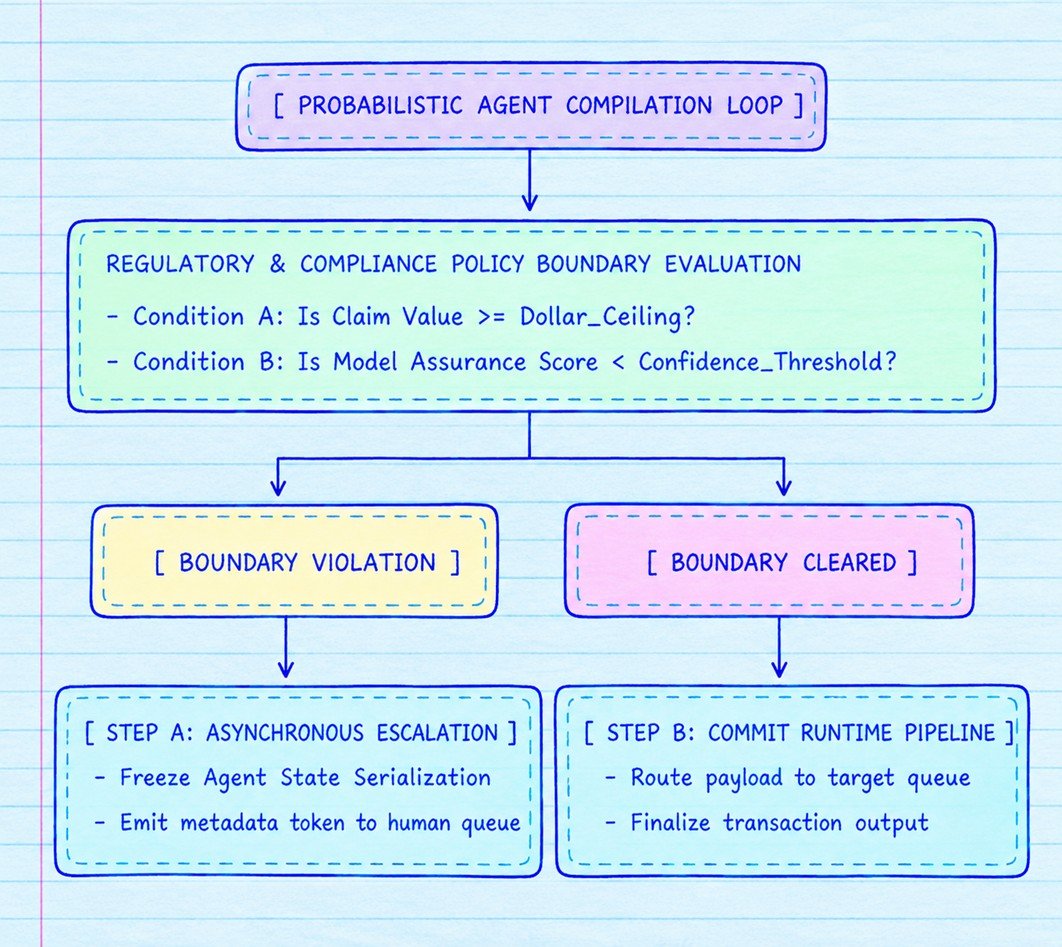
The platform implements this check using an Asynchronous Escalation Queue Pattern.
Trigger Thresholds for Escalation
An agentic workflow is intercepted and forced into an escalation track when it encounters specific operational boundaries:
- Financial Value Ceiling: In RCM operations, any disputed claim worth more than a defined threshold, such as (e.g., $10,000), requires a human audit by default.
- Model Low-Confidence Metric: If the internal model alignment score or the retrieval groundedness evaluation drops below a specific metric, such as Groundedness_score < 0.85, the system flags the context as ambiguous.
The State Serialization Hand-off Pattern
When an escalation is triggered, the system pauses execution without crashing the workflow. It serializes the agent's current state history, including its reasoning steps, tool outputs, and document reference points, into a clean JSON schema block.
High-Dollar Claim Escalation Payload Schema
The following JSON document defines the technical schema requirements for a frozen agent context payload routed to an asynchronous audit queue for human validation:
{
  "escalation_event_id": "esc_rcm_2026_8849201_a9",
  "source_workflow_context": {
    "agent_type": "Automated_RCM_Denial_Auditor",
    "active_session_uuid": "f8a293b1-cc42-491c-99e2-8231aa49fbc2",
    "escalation_timestamp": "2026-09-13T09:12:44Z",
    "trigger_reason": "FINANCIAL_VALUATION_CEILING_VIOLATION"
  },
  "domain_transactional_metrics": {
    "claim_identifier": "clm_8849201_disputed_billing",
    "payer_organization": "UnitedHealthcare_Enterprise",
    "disputed_charge_value": 42500.00,
    "target_compliance_tier": "Level_4_Review"
  },
  "frozen_agent_state_vector": {
    "completed_execution_turns": 4,
    "last_valid_state": "REASONING_STATE",
    "raw_thought_history": [
      "Turn 1: Extracted UnitedHealthcare claim denial log showing code CO-50 (Non-covered services).",
      "Turn 2: Invoked patient policy master index to check EOB clause 14.b.",
      "Turn 3: Identified structural discrepancy; procedure is covered under amendment code alpha-9.",
      "Turn 4: Compiled automated clinical appeal text draft. Value flag check initiated."
    ],
    "compiled_action_artifact": {
      "target_output_type": "Insurance_Level_1_Appeal_Packet",
      "generated_text_draft": "Dear Appeals Committee, We are formally contesting the denial of claim clm_8849201_disputed_billing... [Truncated Code Segment]...",
      "associated_citations": [
        { "doc_id": "policy_uhc_2026_master", "page": 214 },
        { "doc_id": "patient_chart_anonymized", "page": 12 }
      ]
    }
  },
  "human_review_governance": {
    "assigned_specialist_queue": "High_Value_Denial_Auditors",
    "required_review_actions": [
      "Verify_Discrepancy_Logic",
      "Approve_Appeal_Text_Draft"
    ],
    "review_status": "PENDING_HUMAN_INTERVENTION"
  }
}
This frozen block is pushed to an enterprise message queue that updates an internal specialist dashboard. A human audit professional reviews the agent's logic, execution steps, and draft document within a clean user interface.
The human auditor can choose to approve the draft, modify the text parameters, or reject the logic entirely. Once verified, the manual submission token is routed back to the orchestration engine to finalize the operation.
This hybrid design protects the enterprise system's operational integrity by combining the processing speed of autonomous agents with the secure oversight of human governance.