Context Engineering - Algorithmic Prompt Compression, Asymmetric Position Distribution, and Deterministic Provenance Boxing
Introduction
The final stage of the Enterprise Knowledge Architecture before text generation is the Context Engineering Layer. For technology executives (CTOs, VPs, and Chief Data Officers), a common error is assuming that long-context Large Language Models (LLMs) eliminate the need for careful prompt optimization. Simply dumping raw, re-ranked text fragments into an LLM context window creates severe operational issues, including high Time-to-First-Token (TTFT) latency, skyrocketing variable token costs, and increased model confusion.
In high-compliance domains like Healthcare Revenue Cycle Management (RCM), unstructured context must be treated with engineering precision. If a model is overwhelmed by wordy text blocks, it risks missing the critical clause that distinguishes a valid medical claim from a denial. Furthermore, an enterprise AI system must provide absolute data traceability. An unverified answer generated without a clear origin introduces substantial operational liability.
This section delivers the cloud-agnostic raw design patterns, token compression mathematics, and structural placement schemas required to build a highly optimized context engineering framework.
1. Algorithmic Prompt Compression: Semantic Information Pruning via Token Entropy
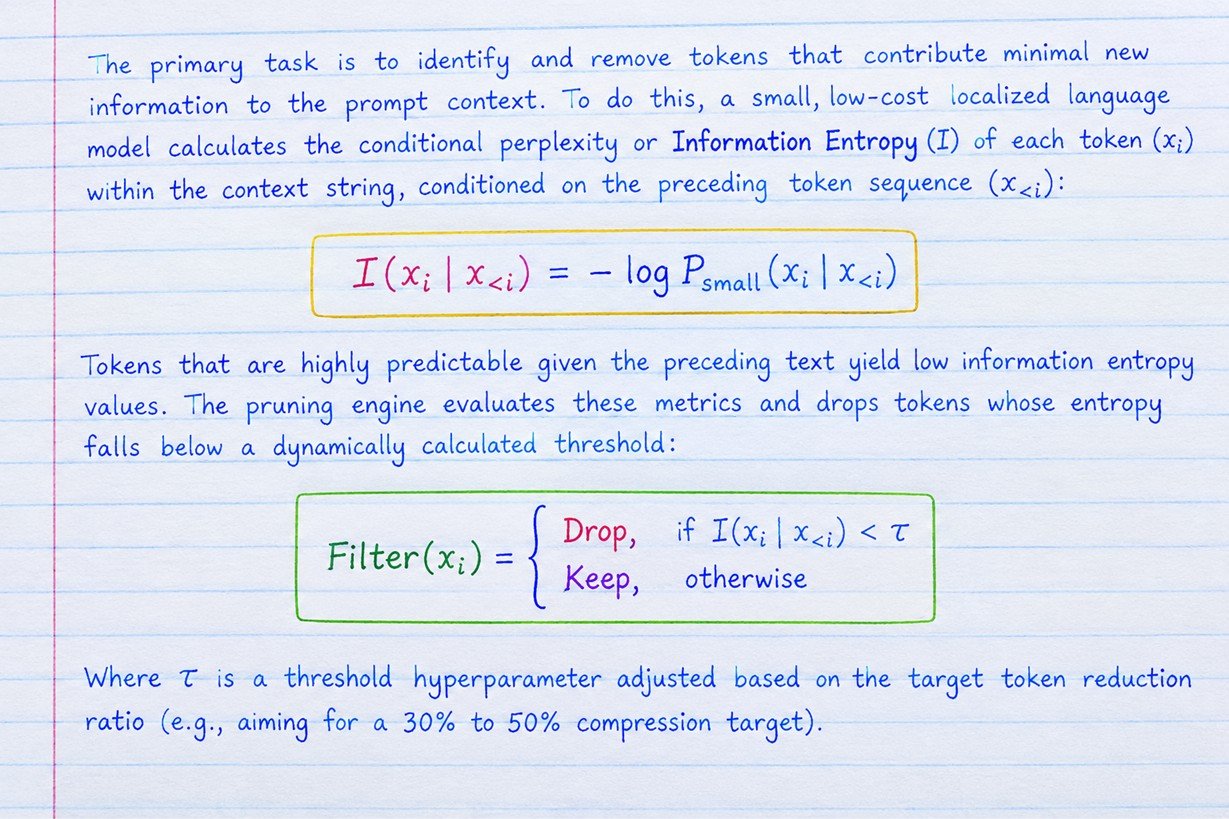
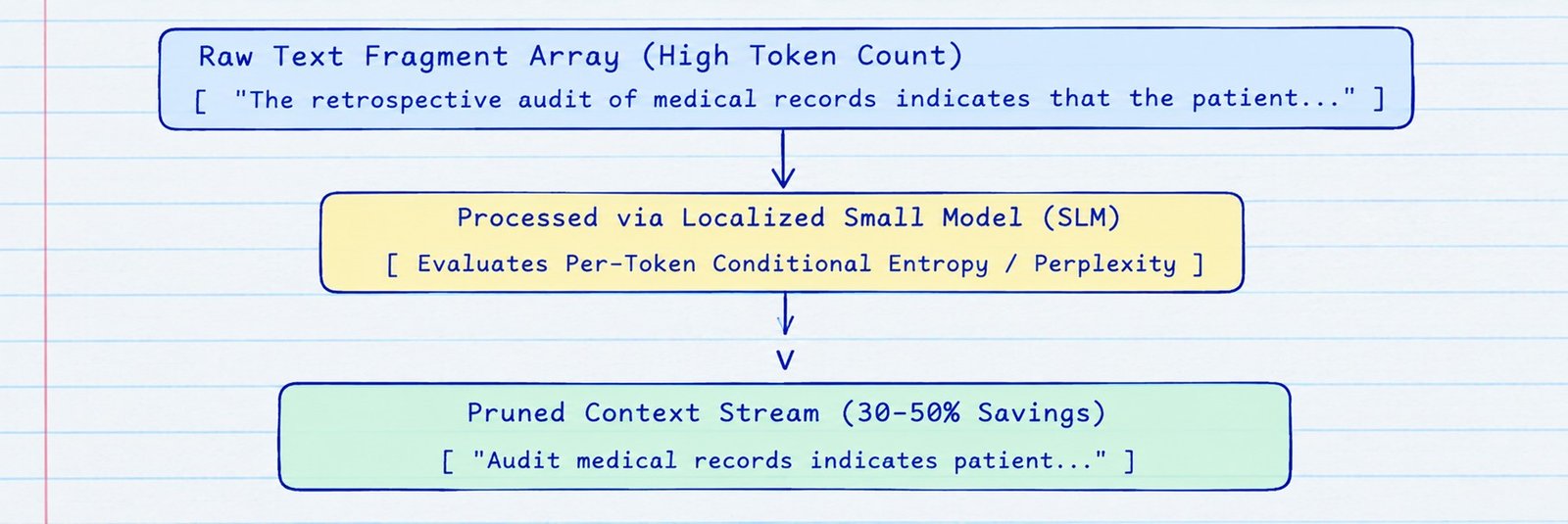
Raw document chunks contain substantial linguistic redundancy, such as filler words, repetitive legalese, and conversational syntax. Passing these unoptimized text streams directly into an LLM wastes expensive compute cycles. Production-grade enterprise architectures deploy Semantic Information Pruning at the prompt assembly boundary using localized token-entropy models, such as the LLMLingua framework, to strip out low-information tokens without losing semantic clarity.
Mathematical Foundation of Token Pruning
Operational Impact
By running this localized entropy filter on the candidate text pool before building the final prompt, the system removes 30% to 50% of the raw text footprint while retaining over 98% of the core reasoning accuracy. This directly reduces downstream inference costs, significantly shortens TTFT latency, and increases global system throughput.
2. Asymmetric Position Distribution Architecture: Navigating Context Degradation
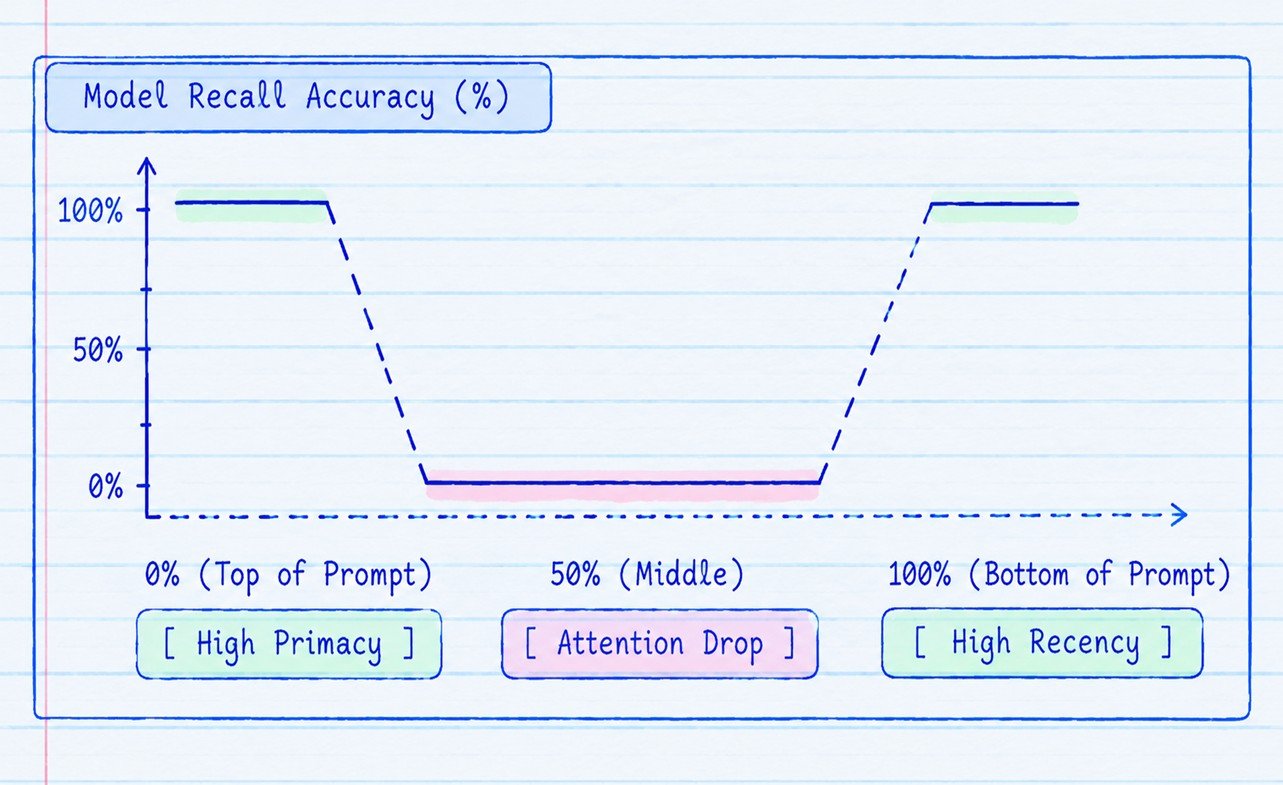
Even modern LLMs built with long-context windows exhibit a severe degradation in retrieval accuracy for data positioned in the middle of their prompt sequences, a phenomenon known as the "Lost in the Middle" curve. While a model may recall facts near the absolute beginning (primacy effect) or end (recency effect) of its context window with high precision, its attention accuracy drops significantly in the middle sections.
The Distribution Pattern
To counter this memory degradation, the framework implements an Asymmetric Position Distribution Architecture. Instead of arranging re-ranked text chunks linearly by score, the engine distributes them asymmetrically into high-attention zones.
The context builder divides the incoming chunks, sorted by relevance from the Cross-Encoder, into a strategic layout based on the model's attention profile:
- Primacy Zone (Top of Prompt): Receives the highest-scoring candidate chunks, such as Rank 1, 2, and 3. This positions the most critical data immediately after the core system guidelines, leveraging the model's strong initial focus.
- Recency Zone (Bottom of Prompt): Receives the next-highest-scoring candidates, such as Rank 4 and 5. This places highly relevant context directly adjacent to the user's final query instruction, maximizing late-stage attention recall.
- Middle Zone (Low-Attention Window): Receives the remaining lower-ranked background context chunks, such as Rank 6 through 10.
Asymmetric Array Sorting Layout
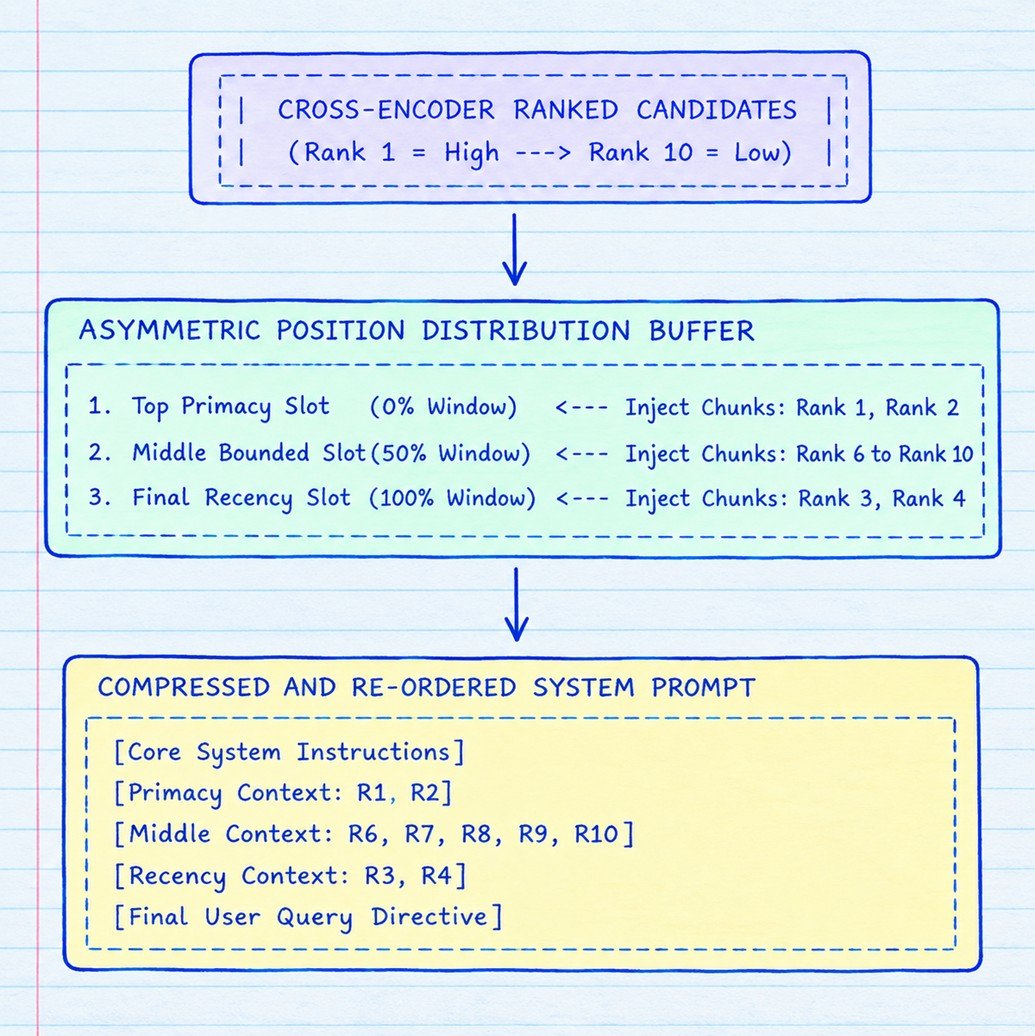
By explicitly structuring the context layout to align with the model's memory topology, technology executives protect the system from retrieval drop-offs, ensuring that critical data points are always placed within high-attention zones.
3. Deterministic Provenance Boxing: Schemas for Structured Traceability
In high-liability enterprise domains like healthcare auditing, an AI-generated answer without verifiable sources is unusable. If an enterprise agent claims that a claim was denied due to lack of prior authorization, the system must expose the exact tracking metadata behind that conclusion.
To achieve this, the context engineering layer implements Deterministic Provenance Boxing. Rather than sending chunks as loose blocks of text, every text element is wrapped in structured, machine-readable markup blocks that explicitly enforce data governance and strict traceability boundaries.
Complete Structural Production Schema
The context builder translates the final, re-ordered text chunks into a standardized structure before passing the payload to the generation fabric:
<context_repository>
  <context_node node_index="1" origin_rank="1" source_document_id="doc_8fbc93a2_2026">
    <provenance_metadata>
      <document_type>Insurance_Appeal_Denial_Letter</document_type>
      <source_page_number>4</source_page_number>
      <claim_id>clm_994821_west_clinic</claim_id>
      <anonymized_patient_token>t_8f3c9a2e</anonymized_patient_token>
      <data_classification>Highly_Confidential</data_classification>
      <access_clearance_verified>true</access_clearance_verified>
    </provenance_metadata>
    <raw_text_payload>
      Upon retrospective audit of the spinal MRI imaging records, the review panel confirmed that the clinical markers documented on page 2 do not meet the explicit criteria outlined in policy section 4.2 for immediate outpatient surgical clearance. Consequently, reimbursement for the diagnostic procedure is denied under category code C4.
    </raw_text_payload>
  </context_node>

  <context_node node_index="2" origin_rank="3" source_document_id="doc_9a4f21e0_2026">
    <provenance_metadata>
      <document_type>Enterprise_Clinical_Policy_Manual</document_type>
      <source_page_number>114</source_page_number>
      <claim_id>N/A</claim_id>
      <anonymized_patient_token>N/A</anonymized_patient_token>
      <data_classification>Internal_Proprietary</data_classification>
      <access_clearance_verified>true</access_clearance_verified>
    </provenance_metadata>
    <raw_text_payload>
      Policy Section 4.2: Outpatient spinal clearance requires documented failure of conservative physical therapy protocols for a minimum duration of six contiguous weeks, alongside radiographic confirmation of structural nerve root compression.
    </raw_text_payload>
  </context_node>
</context_repository>
Prompt Enforcement Pattern
The structured context block is appended with strict, imperative system prompt enforcement criteria:
[SYSTEM INSTRUCTION GOVERNANCE DIRECTIVE]
You are an expert automated analysis engine operating within a high-compliance enterprise ecosystem.
You are provided with a structured context repository enclosed in <context_repository> tags.
Your response must be formulated strictly using the facts contained within these nodes.

CRITICAL ENFORCEMENT RULES:
1. Every claim, assertion, or inference you generate must be immediately backed by an explicit citations tag.
2. The citation format must read exactly: [Source: {source_document_id}, Page: {source_page_number}].
3. Do not combine sources into ambiguous links. If information is drawn from multiple nodes, list each citation independently.
4. If the provided context repository contains insufficient information to answer the inbound user query, state explicitly that the data is missing, and cite the closest available document identifier evaluated.
Production Outcome
By combining machine-readable tagging schemas with explicit prompt guidelines, the architecture eliminates unstructured context drift. The downstream model naturally adopts the structured formatting rules, emitting highly precise answers with inline citations.
This enables downstream enterprise applications to parse the model's text outputs, extract the document tracking tokens, and render interactive click-to-verify citations for end users, delivering an auditable, enterprise-grade production platform.