Advanced Document Processing - Chunking Strategies, Dual Vector-Graph Storage Schemas, and Hierarchical Context Forwarding
Introduction
Once data has crossed the enterprise ingestion boundary, cleared zero-trust compliance gates, and undergone layout-aware decomposition, it enters the Document Processing Engine. For engineering executives, this phase represents the critical transition from raw, extracted data strings to structured, high-fidelity corporate knowledge.
Naïve Retrieval-Augmented Generation (RAG) applications frequently fail in production because they rely on fixed-size sliding character windows. When an Enterprise AI system attempts to parse a complex, dense document, such as a 45-page commercial insurance policy, a clinical case review, or a multi-page Healthcare Revenue Cycle Management (RCM) hospital bill, arbitrary character splits systematically rupture semantic context. They bisect essential tables, separate critical conditional clauses from their main statements, and dilute the local semantic density necessary for high-accuracy mathematical embeddings.
This section details the formal, cloud-agnostic engineering abstractions, mathematical definitions, and structural schemas required to implement an enterprise-grade document processing layer.
1. Advanced Chunking Archetypes: Semantic-Boundary vs. Hierarchical-Structural Splitters
To preserve the intellectual topology of enterprise documentation, the processing engine must employ two coexisting chunking models: Semantic-Boundary Splitters and Hierarchical-Structural Splitters.
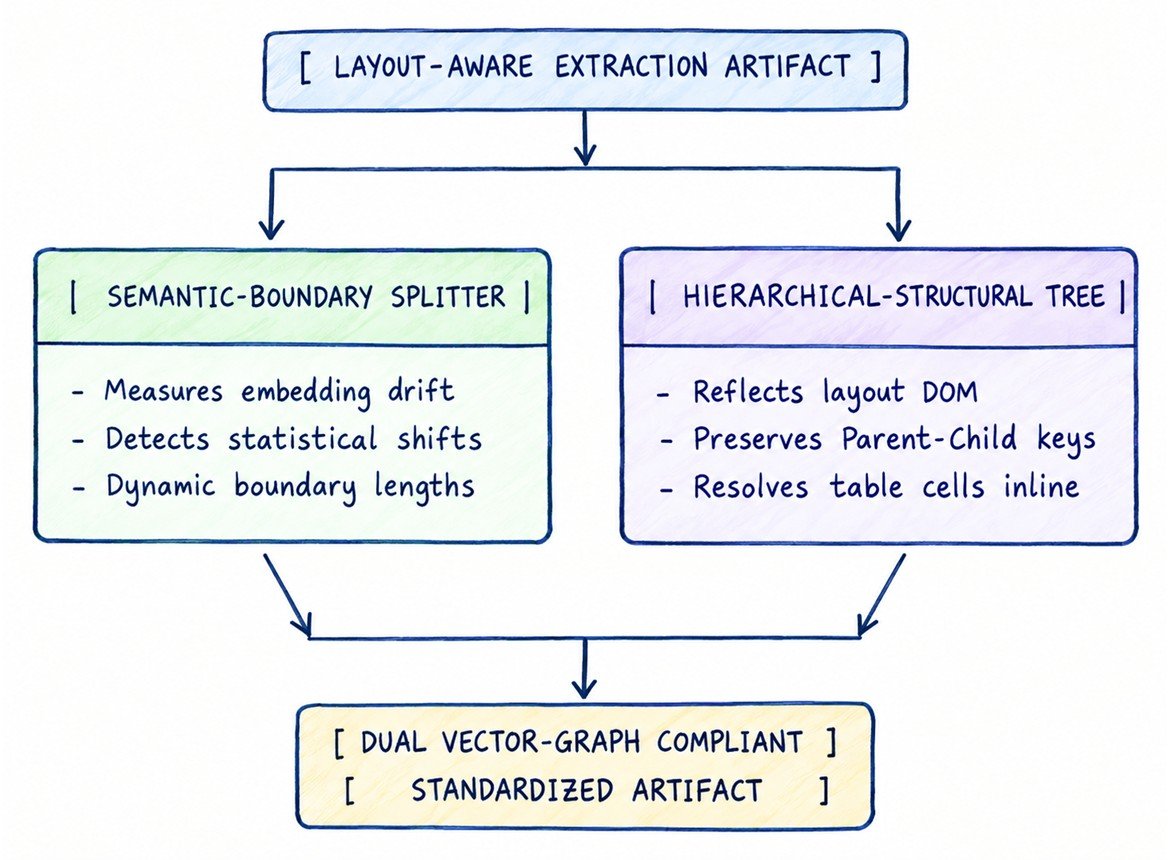
Archetype A: Semantic-Boundary Splitting via Embedding Drift
Instead of using fixed character lengths, semantic splitting treats text processing as a statistical time-series analysis problem, using mathematical distance vectors to determine breaks.
Mathematical Logic
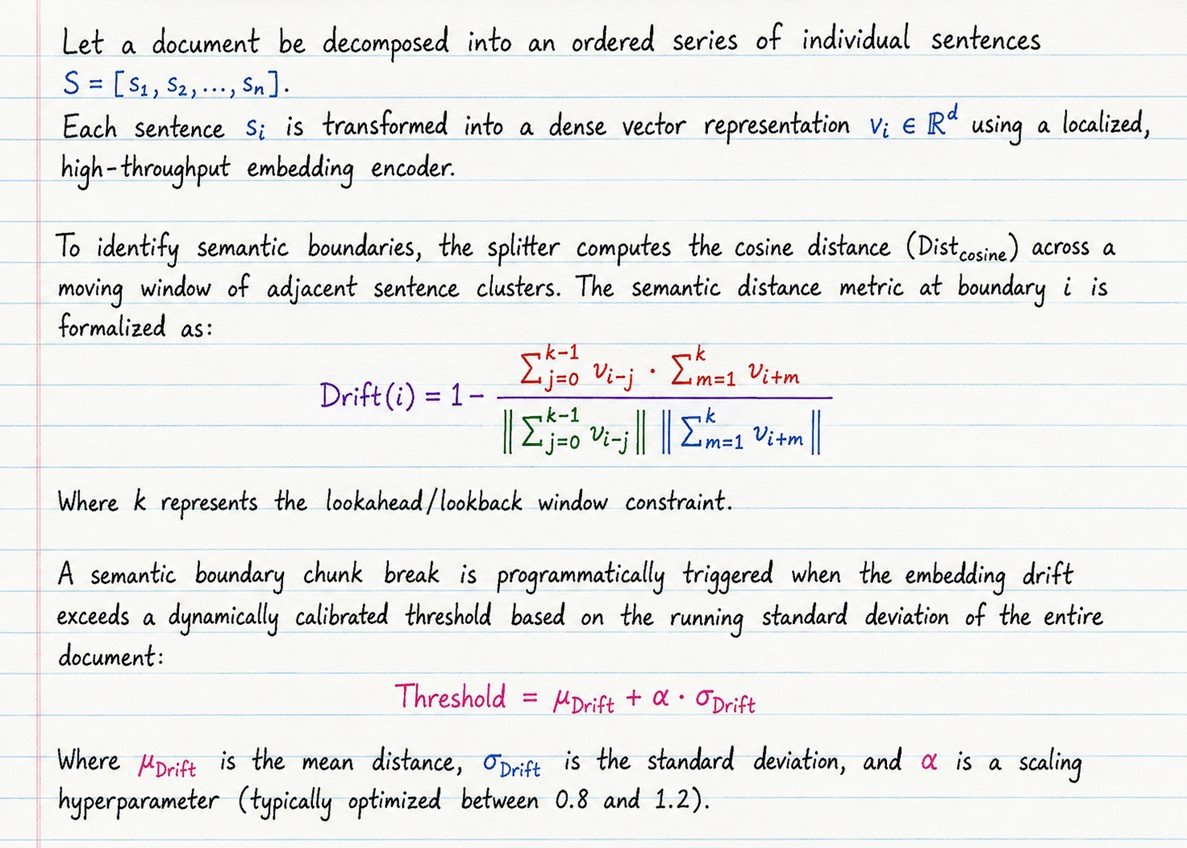
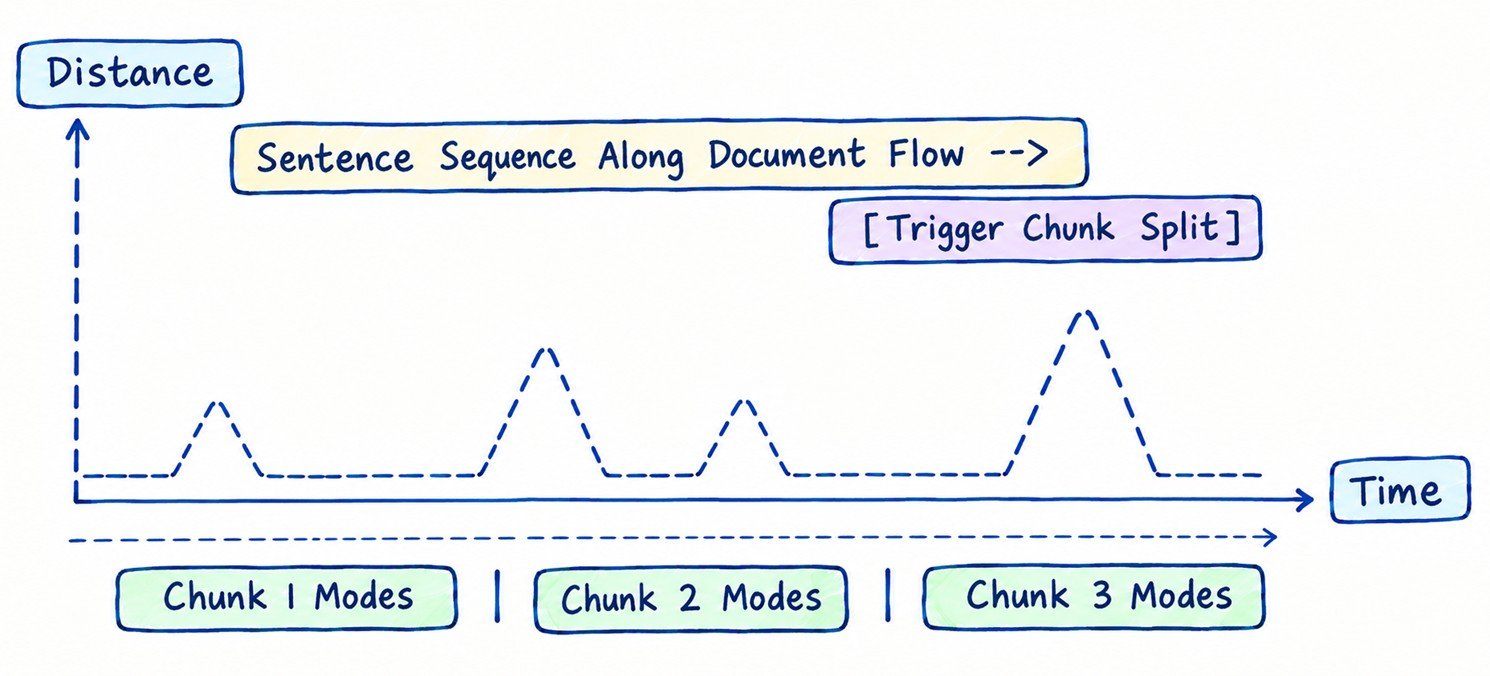
Production Trade-offs
- Strengths: Highly resilient to varying author styles; guarantees that every generated chunk contains internally cohesive concepts.
- Weaknesses: Computationally intensive, requiring an embedding pass for every sentence group before final splitting can execute.
Archetype B: Hierarchical-Structural Chunking (Node Trees)
Hierarchical splitting replicates the Document Object Model (DOM) of the ingested source file. It structures knowledge as an explicit parent-child node tree, directly reflecting the document's physical architecture:
Chapters → Sections → Subsections → Tables/Paragraphs
Parent-Child Mechanics
The document processor creates a high-level Parent Chunk containing broad contextual descriptions, such as an executive summary or section overview, spanning approximately 2,048 tokens.
Underneath this parent node, the engine segments the text into tightly bounded, low-token Child Chunks spanning 256 to 512 tokens.
Table and Element-Aware Processing
When the engine encounters structural metadata boundaries identified during ingestion, such as element_type: table, it bypasses regular text processing rules.
Tables are isolated as dedicated child nodes. The structure embeds both:
-
The raw, formatted Markdown rendering of the table.
-
An administrative summary string generated by a low-latency model, such as:
"Line item billing summaries for claim reconciliation dated Oct 2026"
This ensures that the table remains discoverable through both keyword search and vector similarity search.
2. Dual Vector-Graph Storage Schemas: Unified Spatial & Relational Topology
To power advanced enterprise RAG capabilities and autonomous agent teams, the output of the document processing pipeline must be written simultaneously to a dual storage framework:
- Vector Space: Enables open-ended semantic similarity search.
- Knowledge Graphs: Enables strict, multi-hop relationship traversal.
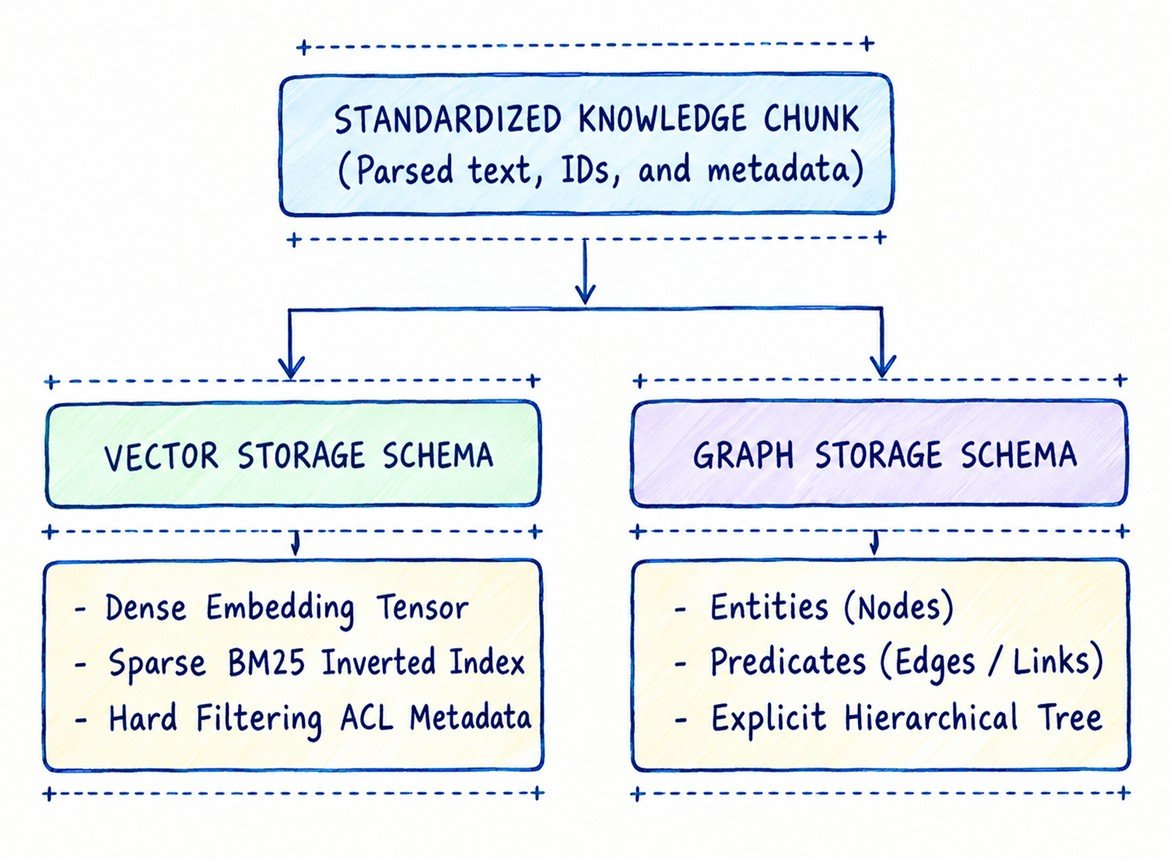
The Vector Storage Schema
The vector instance handles unstructured retrieval by calculating the spatial proximity between a user query vector and document chunks.
- Dense Payload Vectors: A mathematical array E (in R^d) generated by the enterprise embedding model, representing the semantic meaning of the processed chunk text.
- Sparse Lexical Vectors: A complementary token-frequency weight map, typically utilizing BM25 parameters, that tracks exact keyword matches. This is vital for search scenarios involving alphanumeric codes, such as ICD-10 medical billing identifiers (
E11.9) or specific insurance claim policy serial numbers. - Metadata Filtering Block: A hard database-level partitioning structure that holds the system's access-control properties (
tenant_id,allowed_roles), enabling fast operational filtering prior to calculating dot-product similarity metrics.
The Graph Storage Schema
The graph storage instance represents explicit, non-probabilistic relationships between real-world corporate entities and the underlying text files.
- Entity Extraction: During document processing, the chunk text is passed through an automated entity extraction model to resolve core concepts into distinct nodes:
Patient,Payer,Claim,ICD10_Code,Denial_Reason, andChunk_Reference. - Relationship Mapping (Predicates): Nodes are dynamically bound together using directional edges that explicitly describe their real-world connections.
Unified Vector-Graph Storage Blueprint
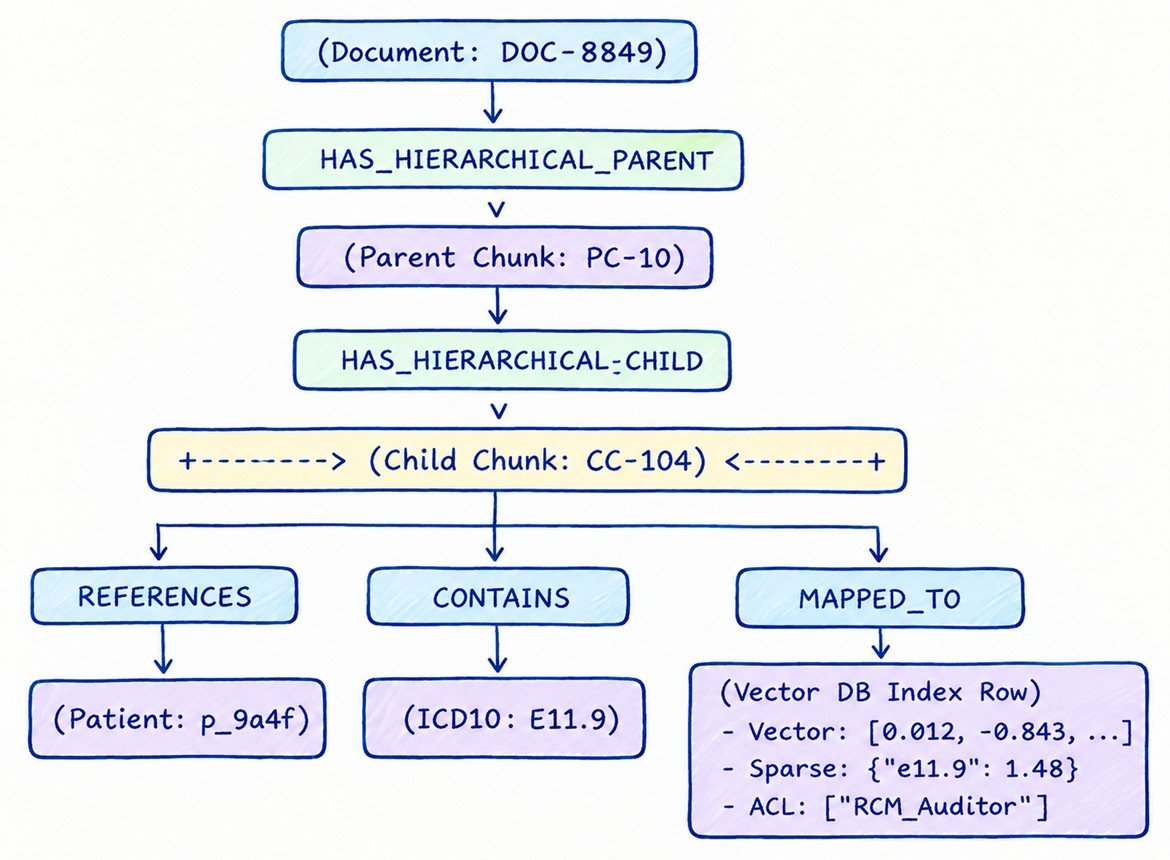
By organizing data in this dual layout, an autonomous RCM agent can execute a vector search to find relevant text blocks and then instantly traverse graph edges to discover all other related claims, billing codes, and historical appeals associated with that patient across the entire corporate entity.
3. Hierarchical Context Forwarding: Raw Design Patterns and Schemas
A recurring failure mode in production RAG systems is semantic fragmentation. When a small child chunk is retrieved by a similarity search, it often lacks the structural context needed for an LLM to accurately interpret its meaning.
For example, a text chunk stating "The service was denied due to lack of prior authorization" becomes nearly useless if the model cannot verify which specific claim, medical facility, date of service, or insurance provider the statement refers to.
Hierarchical Context Forwarding solves this issue by systematically injecting document-level metadata, transactional identifiers, and structural context directly into the text processing payload of each individual child chunk before it is indexed.
Component Taxonomy
- Document Global Block: Immutable global parameters that apply across the entire source asset.
- Parent Spatial Context: Structural context tracking where the specific text segment sits inside the larger document architecture.
- Domain Transactional Vectors: Highly specific business attributes, such as active RCM operational trackers, linked directly to the file.
Raw Ingested Schema Definition
The following JSON document defines the technical schema requirements for a fully processed, context-enriched child chunk node ready for enterprise indexing:
{
  "chunk_id": "chk_rcm_2026_994821_c042",
  "parent_chunk_id": "pchk_rcm_2026_994821_sec3",
  "document_global_context": {
    "source_document_uuid": "8fbc93a2-7d14-4b8c-b611-923f1a84f3c9",
    "document_type": "Insurance_Appeal_Denial_Letter",
    "ingestion_timestamp": "2026-09-13T08:34:12Z",
    "hash_checksum": "sha256_e3b0c44298fc1c149afbf4c8996fb92427ae41e4649b934ca495991b7852b855"
  },
  "domain_transactional_vectors": {
    "claim_identifier": "clm_994821_west_clinic",
    "anonymized_patient_token": "t_8f3c9a2e",
    "payer_organization": "BlueCross_Shield_Enterprise",
    "total_disputed_charge": 14250.00,
    "primary_icd10_code": "M54.5"
  },
  "parent_spatial_context": {
    "hierarchical_path": "Root / Section 3: Clinical Review / Subsection B: Medical Necessity Findings",
    "page_index": 4,
    "coordinate_bounding_box": {
      "x_min": 112.5,
      "y_min": 440.0,
      "x_max": 512.0,
      "y_max": 680.5
    },
    "sibling_node_linkage": {
      "previous_chunk_id": "chk_rcm_2026_994821_c041",
      "next_chunk_id": "chk_rcm_2026_994821_c043"
    }
  },
  "data_governance_acl": {
    "allowed_roles": ["RCM_Auditor", "Appeals_Specialist"],
    "tenant_id": "Provider_Network_East",
    "data_classification_tier": "Highly_Confidential"
  },
  "injected_contextual_prefix": "DOCUMENT_CONTEXT [Type: Insurance_Appeal_Denial_Letter, Payer: BlueCross_Shield_Enterprise, Claim_ID: clm_994821_west_clinic, Patient_Token: t_8f3c9a2e]. SECTION_CONTEXT [Path: Root / Section 3: Clinical Review / Subsection B: Medical Necessity Findings]. RAW_TEXT_PAYLOAD:",
  "raw_text_payload": "Upon retrospective audit of the spinal MRI imaging records, the review panel confirmed that the clinical markers documented on page 2 do not meet the explicit criteria outlined in policy section 4.2 for immediate outpatient surgical clearance. Consequently, reimbursement for the diagnostic procedure is denied under category code C4.",
  "dense_embedding_target_payload": "DOCUMENT_CONTEXT [Type: Insurance_Appeal_Denial_Letter, Payer: BlueCross_Shield_Enterprise, Claim_ID: clm_994821_west_clinic, Patient_Token: t_8f3c9a2e]. SECTION_CONTEXT [Path: Root / Section 3: Clinical Review / Subsection B: Medical Necessity Findings]. RAW_TEXT_PAYLOAD: Upon retrospective audit of the spinal MRI imaging records, the review panel confirmed that the clinical markers documented on page 2 do not meet the explicit criteria outlined in policy section 4.2 for immediate outpatient surgical clearance. Consequently, reimbursement for the diagnostic procedure is denied under category code C4."
}
The Mechanical Execution: Processing the Injection
By concatenating the injected_contextual_prefix string directly to the raw_text_payload to create the dense_embedding_target_payload, the system forces the embedding model to generate an array that accounts for critical operational variables.
When a downstream RAG system searches for "Blue Cross claims denied for outpatient spinal clearance," this child chunk will return a high similarity score, even though the raw text payload itself never mentions "Blue Cross" or "outpatient spinal clearance."
This systematic injection pattern eliminates context fragmentation and ensures that when individual text segments are retrieved from deep storage, they remain operationally robust, reliable, and secure.