Introduction
The Paradigm Shift: From Probabilistic Context to Production-Grade Knowledge Systems
The enterprise adoption of Generative AI has reached a critical structural inflection point. The initial era of large language model (LLM) deployment was characterized by unguided experimentation, where businesses rushed to plug open-ended foundation models into shallow corporate data wrappers. These early systems operated on a flawed assumption: that a model's native contextual reasoning capacity could substitute for a disciplined corporate data infrastructure. In practice, this approach exposed a fundamental mismatch between the probabilistic nature of deep learning networks and the deterministic requirements of enterprise computing.
An LLM is inherently a mathematical engine designed to predict the next word token based on statistical probabilities learned during training. It possesses no native concept of objective truth, real-time factual accuracy, or data governance boundaries. When an enterprise attempts to run high-stakes automated tasks, such as executing Healthcare Revenue Cycle Management (RCM) workflows, analyzing commercial insurance policies, or reconciling institutional financial ledgers, by sending unvalidated text directly to an LLM context window, the system inevitably experiences severe degradation.
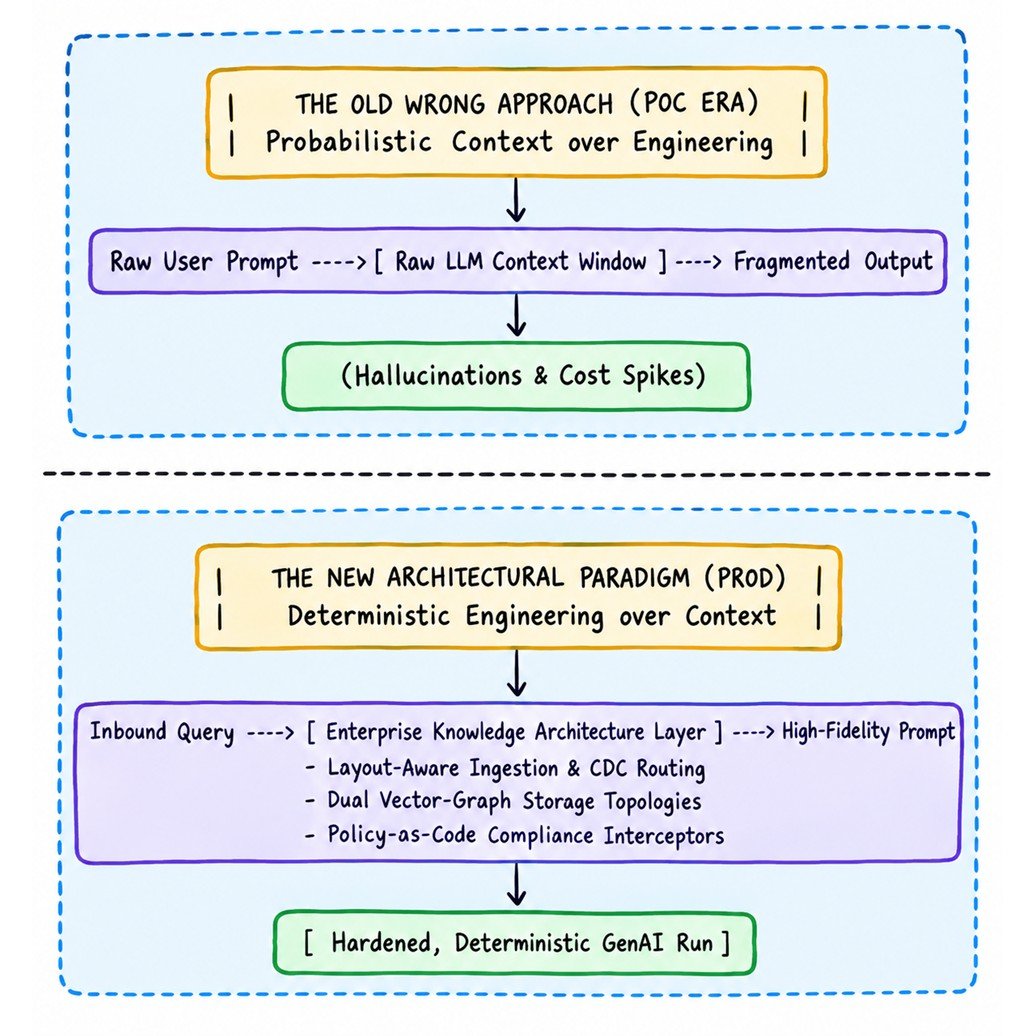
Moving Generative AI from a fragile Proof of Concept (PoC) to an enterprise production environment requires a fundamental architectural shift. Engineers must stop treating the LLM context window as an unorganized dumping ground for raw text and start treating it as a highly structured, temporary, and tightly managed computational memory space. This transition establishes a new paradigm: Production-Grade Knowledge Systems.
In this model, the probabilistic AI engine is completely decoupled from the primary enterprise knowledge asset. The data infrastructure layer is engineered to be entirely deterministic. It uses layout-aware document parsing, hybrid semantic-lexical search mechanisms, and transactional data synchronization to ensure that the context delivered to the LLM is accurate, secure, and verifiable. By placing structural constraints around the language model, architects can transform generative AI from an unpredictable conversational novelty into a reliable, enterprise-grade cognitive tier.
The Core Architectural Objective: Overcoming Fragility, Runaway Costs, and Compliance Liabilities
When technology leaders (CTOs, VPs, and Heads of AI Platforms) attempt to scale early-stage RAG prototypes up to production workloads, they face three systemic roadblocks: operational fragility, runaway computing costs, and compliance liabilities. Solving these problems is the primary objective of a production-grade Enterprise Knowledge Architecture.
1. Systemic Fragility
Naïve RAG systems collapse under the messy, volatile realities of corporate data. While a prototype may perform well when processing clean, linear text files, it encounters immediate failures when confronted with complex real-world documents, such as multi-page insurance appeal letters, scanned fax medical records, or hierarchical line-item billing sheets. Without an infrastructure layer capable of analyzing layout architecture and parsing nested tables, critical semantic relationships are broken during text chunking. This causes the downstream model to misinterpret data and generate flawed automated responses.
2. Runaway Financial Costs
Long-context foundation models give engineers the illusion of unlimited data capacity. However, from a systems-engineering perspective, context is a major driver of cost and latency. Passing thousands of uncompressed text tokens into an LLM window with every query creates a compounding financial problem.
Because attention calculation mechanisms scale quadratically with respect to token input length (O(N^2)), unoptimized prompts degrade Time-to-First-Token (TTFT) performance metrics and drive up massive operational expenses (OpEx). Production systems must implement precise data pruning, semantic information compression, and dynamic caching models to optimize token economics.
3. Compliance and Security Liabilities
In highly regulated corporate environments, deploying data pipelines without strict governance is an unacceptable compliance risk. Passing raw Protected Health Information (PHI) or Personally Identifiable Information (PII) to an embedding model or external cloud endpoint can violate global privacy frameworks, such as HIPAA and GDPR.
Furthermore, standard RAG retrieval approaches often ignore existing corporate user permission boundaries. If a vector index lacks fine-grained Role-Based Access Control (RBAC) and Attribute-Based Access Control (ABAC) filtering at the database layer, the retrieval engine can inadvertently surface confidential corporate documents to unauthorized users, causing severe data security breaches.
The Enterprise Knowledge Architecture resolves these challenges by establishing a highly disciplined, multi-layered data engineering framework. It guarantees that corporate data remains secure, auditable, performant, and cost-effective under real-world production workloads.