Data Ingestion Architecture for Enterprise AI
Introduction
Moving Generative AI from a fragile Proof of Concept (PoC) to an enterprise-grade production system requires a fundamental realization: your AI system is only as viable as its data ingestion pipeline. In an enterprise environment, such as Healthcare Revenue Cycle Management (RCM), data is not a static collection of clean text files. It is a highly volatile, multi-modal, and regulated stream of information consisting of unstructured clinical notes, scanned PDF medical appeals, legacy fax images, and structured 835/837 Electronic Data Interchange (EDI) billing transactions.
For technology leaders (CTOs, VPs, and Enterprise Architects), the challenge is no longer about writing a Python script to load documents into an LLM context window. The challenge is engineering a highly scalable, deterministic, secure, and layout-aware ingestion architecture capable of processing multi-modal corporate knowledge while strictly maintaining regulatory compliance (e.g., HIPAA, GDPR) and fine-grained access control.
This section delivers the cloud-agnostic raw design patterns, systemic trade-offs, and architectural blueprints necessary to build a production-ready enterprise data ingestion layer for probabilistic AI systems.
1. Dual-Core Ingestion Topology: Streaming (CDC) vs. Batch
An enterprise AI infrastructure cannot rely on a single ingestion modality. To serve diverse business requirements, the architecture must implement a dual-core topology that balances the immediate readiness of event-driven streaming with the cost-efficient throughput of batch processing.
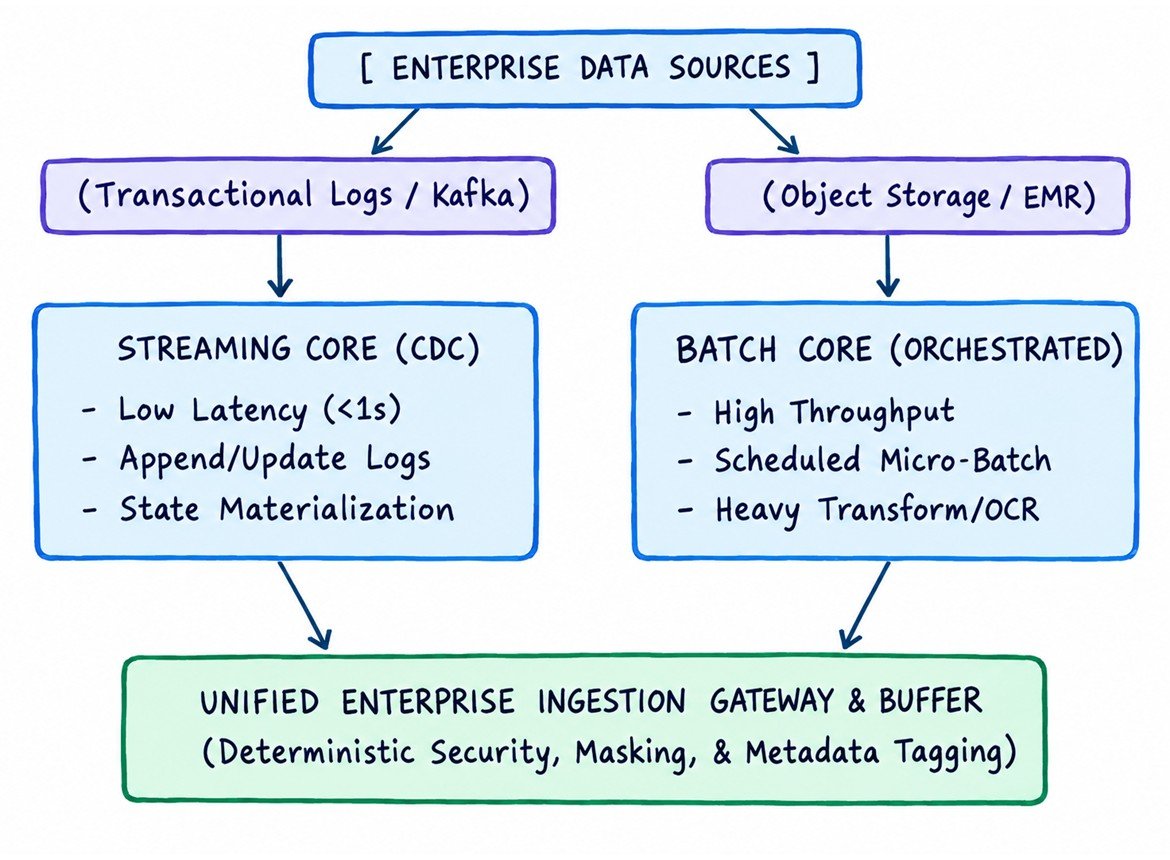
The Streaming Core: Change Data Capture (CDC)
The streaming ingestion core captures real-time data mutations directly from application databases, transactional logs, or event brokers. In RCM systems, when a claim status changes from "Pending" to "Denied," the downstream AI system must immediately know the reason for the denial to generate an automated appeal draft.
- Mechanics: Utilizes transaction log miners to capture row-level changes (
INSERT,UPDATE,DELETE) without impacting production database performance. These changes are broadcast as immutable events to an enterprise pub/sub message broker. - Latency Profile: Sub-second (< 1 second) end-to-end propagation from source mutation to ingestion buffer.
- Architectural Trade-offs: Highly complex state management. Updating an existing vector representation requires deduplication, tombstoning deleted records, and handling out-of-order events using deterministic event timestamps.
The Batch Core: Orchestrated Pipelines
The batch ingestion core handles high-volume, historically rich, or computationally heavy transformations. This includes processing millions of historical medical charts, end-of-day insurance remittance sheets, or large-scale document repositories.
- Mechanics: Scheduled or triggered micro-batches managed by an enterprise orchestration system. Data is extracted from object stores, data lakes, or file shares and processed via distributed data-parallel execution frameworks.
- Latency Profile: Ranging from 15-minute micro-batches to nightly or weekly synchronizations.
- Architectural Trade-offs: High resource utilization during processing windows, but significantly lower architectural overhead compared to real-time streams. Allows complex multi-modal optical character recognition (OCR) and deep structural parsing to run at scale without disrupting real-time application paths.
Ingestion Modality Comparison
| Architectural Dimension | Streaming Core (CDC) | Batch Core (Orchestrated) |
|---|---|---|
| Primary Use Case | Real-time claim status changes, live patient interactions, system alerts. | Historical medical records, bulk insurance policy updates, daily remittance files. |
| Ingestion Latency | Near real-time (< 1 second). | Scheduled (Minutes, Hours, Days). |
| Compute Footprint | Continuous, low-to-medium resource utilization. | Burst-oriented, highly parallelized, heavy resource utilization. |
| State & Ordering | Highly complex; requires event ordering, deduplication, and vector tombstoning. | Deterministic; snapshot-based or bounded historical delta processing. |
| Cost Profile | Higher operational overhead for continuous readiness. | Highly cost-effective; optimized via auto-scaling computing clusters. |
2. Zero-Trust Security at the Edge: Masking, Tokenization, and Metadata Tagging
In a production-grade AI system, data must be secured before it undergoes structural parsing, text extraction, or embedding. Passing raw Protected Health Information (PHI) or Personally Identifiable Information (PII) to an embedding model or an external LLM endpoint introduces unacceptable data exfiltration risks and regulatory violations.
The ingestion edge must function as a zero-trust gateway, enforcing deterministic security transformations on the raw input stream.
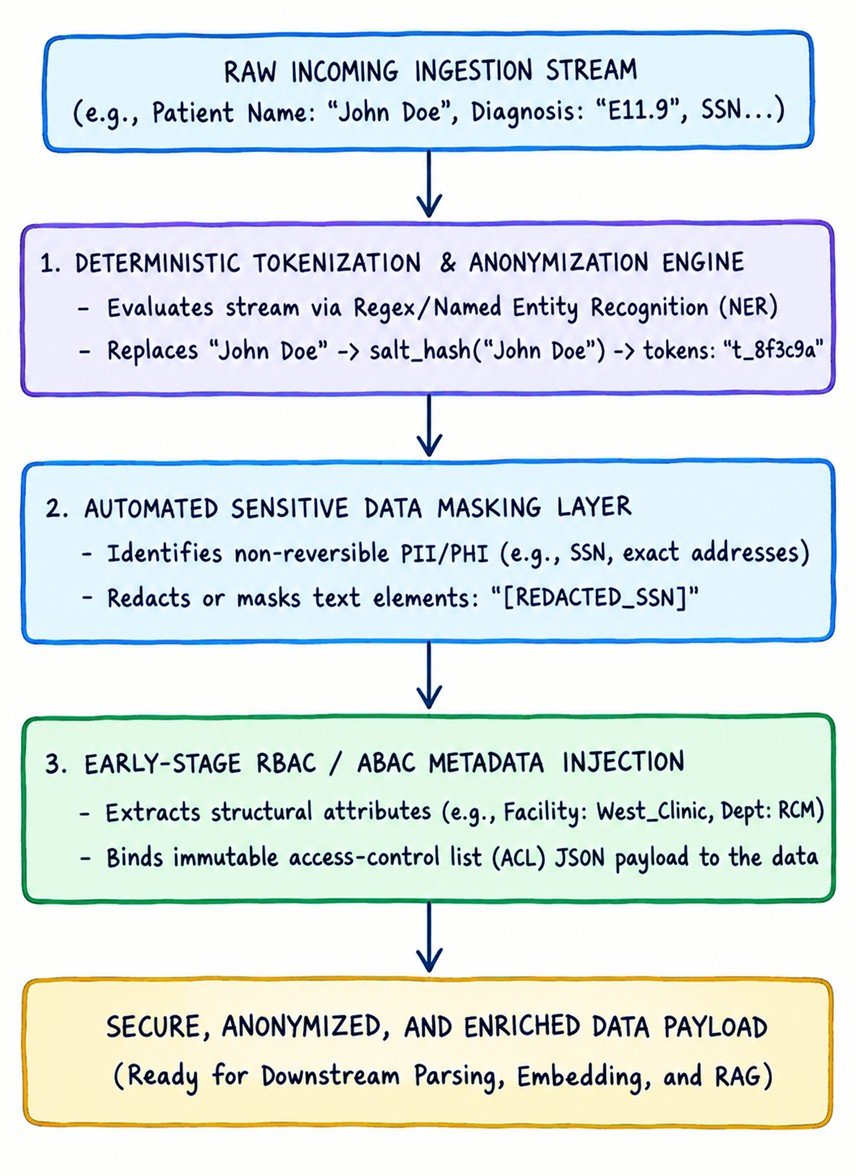
Step 1: Deterministic Tokenization and Anonymization
To maintain the operational value of the data without exposing the underlying identity, the pipeline replaces explicit identifiers with deterministic tokens.
- Pattern: The engine scans the input text using a combination of fast regex patterns and high-performance, localized Named Entity Recognition (NER) models.
- Execution: Direct identifiers (e.g., patient names, provider names) are passed through a secure, keyed cryptographic hash function (HMAC) combined with an enterprise salt value managed by a hardware security module (HSM).
- Result:
John Doebecomes a deterministic tokent_8f3c9a2e. IfJohn Doeappears across multiple documents or streams, the token remains consistent, allowing the downstream RAG or Agentic system to cross-reference data points accurately without ever knowing the patient's true identity. The mapping table is stored in an isolated, highly restricted relational database separated from the AI ecosystem.
Step 2: Automated Sensitive Data Masking
For data elements that do not require cross-referencing or structural mapping, the ingestion engine applies non-reversible masking.
- Pattern: Elements such as Social Security Numbers (SSNs), phone numbers, and financial account numbers are permanently overwritten.
- Execution: A rule-based parser captures patterns matching standard formats and replaces them with a uniform string literal, such as
[REDACTED_SSN]or[REDACTED_ACCOUNT]. This eliminates the risk of an LLM reconstructing or memorizing sensitive numerical strings during prompt composition or fine-tuning.
Step 3: Early-Stage RBAC/ABAC Metadata Injection
A critical flaw in many RAG systems is the assumption that access control can be handled entirely at the application layer. If a user queries the AI system, the system must only retrieve documents that the user is explicitly authorized to view based on Enterprise Role-Based Access Control (RBAC) and Attribute-Based Access Control (ABAC).
-
Pattern: Before data is parsed or chunked, the ingestion engine queries the corporate identity provider or reads the source data context to extract its data governance attributes.
-
Execution: The engine injects an immutable metadata header directly into the processing payload. This header includes authorization parameters such as:
{"allowed_roles": ["RCM_Auditor", "Compliance_Officer"],"tenant_id": "Enterprise_Health_System_East","data_classification": "Highly_Confidential","clearance_level": "Level_3"} -
Downstream Enforcement: When these payloads are later processed into text chunks and stored within a vector or graph store, these metadata tags are written as hard indexing properties. During future RAG queries, the retrieval engine applies a deterministic boolean filter based on the active user's authenticated security tokens, ensuring the vector space is restricted at the database level before any probabilistic similarity search takes place.
3. Deep Document Decomposition: Layout-Aware Parsing and OCR Design Patterns
Standard text splitters assume a linear, continuous flow of characters. However, real-world enterprise documents are inherently multi-dimensional. A complex medical bill or insurance appeal letter contains text arranged in multi-column layouts, embedded tables containing line-item denials, stamped signatures, and handwritten notes captured via optical imaging.
If you strip the formatting and convert these documents into raw, unformatted text strings, the context is ruined. For example, a line-item denial table read top-to-bottom across columns instead of row-by-row yields nonsensical data that completely corrupts the embedding space.
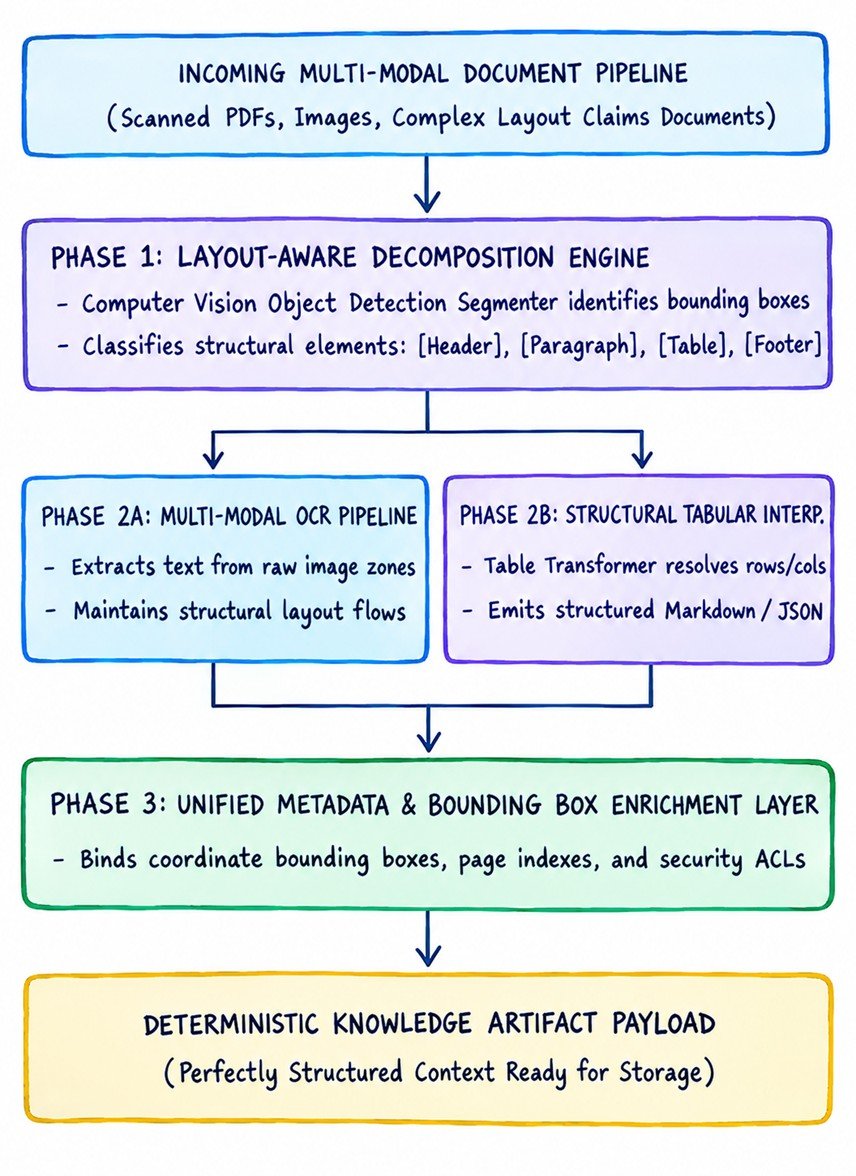
Phase 1: Layout-Aware Decomposition Engine
Before extracting any text, the ingestion pipeline passes the document through a computer vision object detection model optimized for document layout analysis.
- Mechanics: The document page is rendered as an image tensor. The model segments the page, identifying the bounding boxes (x_min, y_min, x_max, y_max) of structural elements.
- Classification: Elements are categorized into specific types:
Header,Footer,Paragraph,Table,Image, orSignature Block. - Logical Reading Order: Instead of reading text purely from left to right and top to bottom, the architecture constructs a directed acyclic graph (DAG) representing the document's natural layout flow. If a document has two vertical columns, the pipeline processes the entire first column block before moving to the second column block, preserving narrative continuity.
Phase 2A: Multi-Modal OCR Pipeline for Image and Scanned Elements
When the decomposition engine encounters text embedded within low-resolution images, legacy faxes, or scanned documents, it routes those specific bounding boxes to a specialized multi-modal OCR engine.
- Binarization and Deskewing: Bounded regions are pre-processed to correct rotation angles (deskewing), adjust contrast, and convert color channels to high-contrast binary formats to maximize character recognition accuracy.
- Spatial Mapping: Extracted characters are mapped back to their original spatial coordinates. This permits downstream systems to trace a specific piece of text directly back to the physical page and quadrant of the source document, providing robust citation capabilities for end users.
Phase 2B: Structural Tabular Extraction (Table Parsing Pattern)
Tables are highly dense knowledge frameworks. Standard linear text extraction ruins tables by flattening them into single strings. The pipeline implements a dedicated structural table parsing pattern to prevent this.
- Mechanics: When a
Tablebounding box is identified, it is routed to a specialized cell-detection transformer. The model maps the intersection of vertical and horizontal grid lines to identify explicit matrix coordinates for each cell. - Semantic Re-serialization: Instead of outputting raw comma-separated values, the ingestion engine reconstructs the table into a deterministic, machine-readable format, such as structurally validated Markdown tables or programmatic JSON objects that preserve hierarchical relationships, such as column headers mapping to explicit cell values.
Example Input Table:
| Service Date | Code | Charge | Status |
|---|---|---|---|
| 10/12/2026 | 99214 | $250.00 | Denied |
Raw Linear Ingestion Extraction (Anti-Pattern):
Service Date Code Charge Status 10/12/2026 99214 $250.00 Denied
Layout-Aware JSON Serialized Extraction (Architectural Target Pattern):
{
  "element_type": "table",
  "metadata": { "columns": ["Service Date", "Code", "Charge", "Status"] },
  "rows": [
    {
      "Service Date": "10/12/2026",
      "Code": "99214",
      "Charge": "$250.00",
      "Status": "Denied"
    }
  ]
}
Phase 3: Unified Metadata and Coordinate Enrichment
The final phase of document decomposition binds the extracted text, structured tables, and anonymized identifiers together into a single, unified ingestible schema.
Every extracted chunk is decorated with programmatic tracking attributes:
source_document_id: A unique, cryptographically generated UUID.page_number: The integer index of the source page.bounding_box_coordinates: The exact physical coordinates of the block.extraction_method:Layout_Vision_OCRorNative_Digital_Text_Extraction.
This structured package provides a reliable foundation for the next stages of the Enterprise Knowledge Architecture: Semantic Chunking, Hybrid Vector Search, and GraphRAG Knowledge Graph Synthesis.