Knowledge Freshness - Event-Driven Cache Invalidation, Hash Fingerprinting, and Temporal Decay Scoring Models
Introduction
Maintaining a production-grade Generative AI platform requires resolving a critical data reality: enterprise knowledge is non-static. In an active production environment, application databases continuously mutate, corporate policy manuals undergo regular revision, and transactional records change state. If an Enterprise Knowledge Architecture treats its retrieval indexes as immutable, append-only repositories, it introduces a severe systemic failure mode known as Knowledge Drift.
In high-velocity compliance fields such as Healthcare Revenue Cycle Management (RCM), knowledge staleness is a significant operational liability. For instance, if an insurance payer modifies its medical necessity guidelines for a specific diagnostic procedure, or if a billing code is updated, any downstream AI agent that continues to retrieve outdated documentation will generate invalid appeals. This compromises production viability and increases operational costs.
This section provides the cloud-agnostic raw design patterns, cryptographic de-duplication mechanics, and temporal scoring mathematics required to engineer a self-refreshing, time-aware enterprise knowledge retrieval layer.
1. Unified Freshness Topology: Dynamic TTL vs. Event-Driven Invalidation
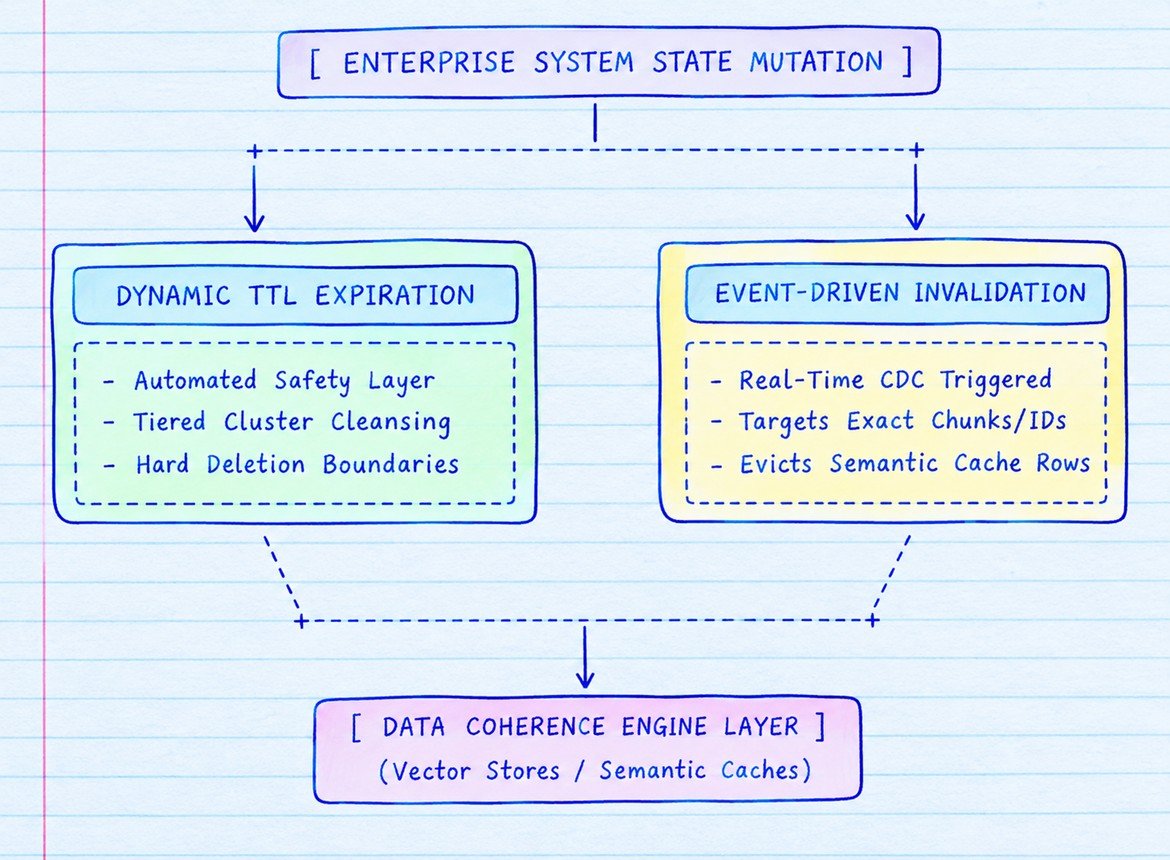
To maintain index synchronization across an enterprise data landscape, the platform must employ a two-tiered freshness topology. This balances the automated safety boundaries of Dynamic Time-To-Live (TTL) policies with the near-zero-latency updates of Event-Driven Cache Invalidation.
Tier A: Event-Driven Cache Invalidation via Real-Time CDC
For high-priority transactional states, the architecture enforces a zero-lag invalidation loop utilizing Change Data Capture (CDC) streams.
- Mechanics: When an administrative update occurs, such as an insurance claim status switching from
"Disputed"to"Settled", a log-based CDC engine publishes an invalidation event token to the enterprise message fabric. - Targeted Eviction: Specialized invalidation consumers read this token and immediately execute atomic delete or update operations across two primary downstream targets:
- The Semantic Cache: Evicts any pre-compiled query-response pairs that referenced the mutated entity, preventing the system from returning stale responses.
- The Vector/Graph Index: Triggers a logical tombstone or inline property swap on specific data nodes linked to that entity ID.
Tier B: Dynamic Time-To-Live (TTL) Expiration Policies
As an automated safety layer against missed events or broken messaging queues, the architecture applies a stratified, metadata-driven TTL policy across all stored indexes.
- Mechanics: Rather than applying a single expiration boundary across the entire system, TTLs are calculated dynamically at index time based on the underlying document classification:
Transactional_Data_Tier(e.g., live claim updates): TTL = 15 Minutes.Operational_Data_Tier(e.g., daily hospital remittance sheets): TTL = 24 Hours.Governance_Data_Tier(e.g., national CPT/ICD coding manuals): TTL = 180 Days.
- Purging Routine: Background worker threads scan these metadata tracking fields during off-peak windows. They systematically purge or flag expired vectors for re-ingestion, ensuring the data index matches the primary transactional systems.
2. Chunk-Level Hash Fingerprinting and De-Duplication Mechanics
When a large corporate document is revised, often only a small fraction of its text actually changes, such as a single line item in a table or a minor clause within a paragraph. If the ingestion engine re-processes the entire file without granular validation, it will generate redundant embeddings for the unmodified sections. This causes index pollution, inflates storage footprints, and dilutes retrieval relevance by surfacing multiple near-identical chunks.
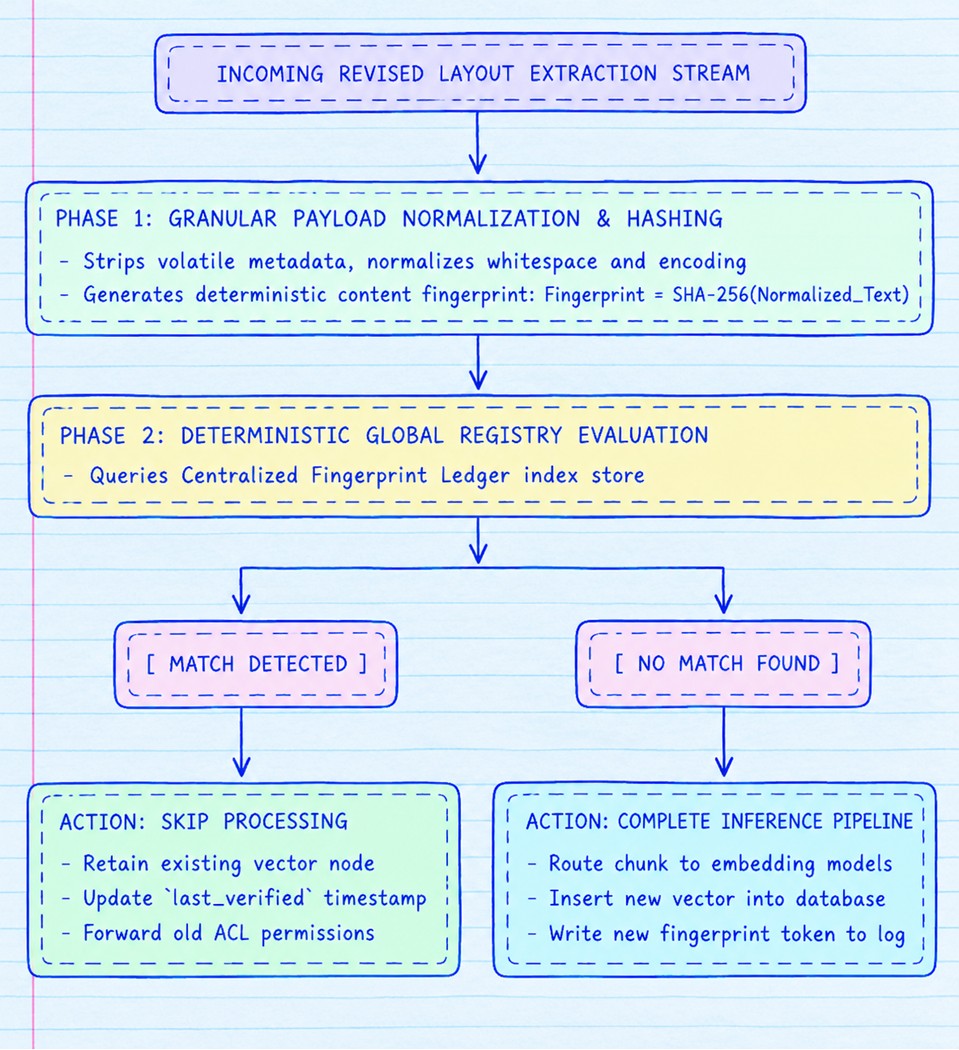
To solve this, the processing framework integrates a Chunk-Level Hash Fingerprinting Pipeline.
Step 1: Payload Normalization
Before calculating a hash, the text payload must be normalized to prevent character-level discrepancies from breaking the matching logic. The engine strips out volatile metadata fields, such as system processing timestamps or temporary session keys, normalizes whitespace configurations, and standardizes character encodings to UTF-8.
Step 2: Cryptographic Fingerprint Generation
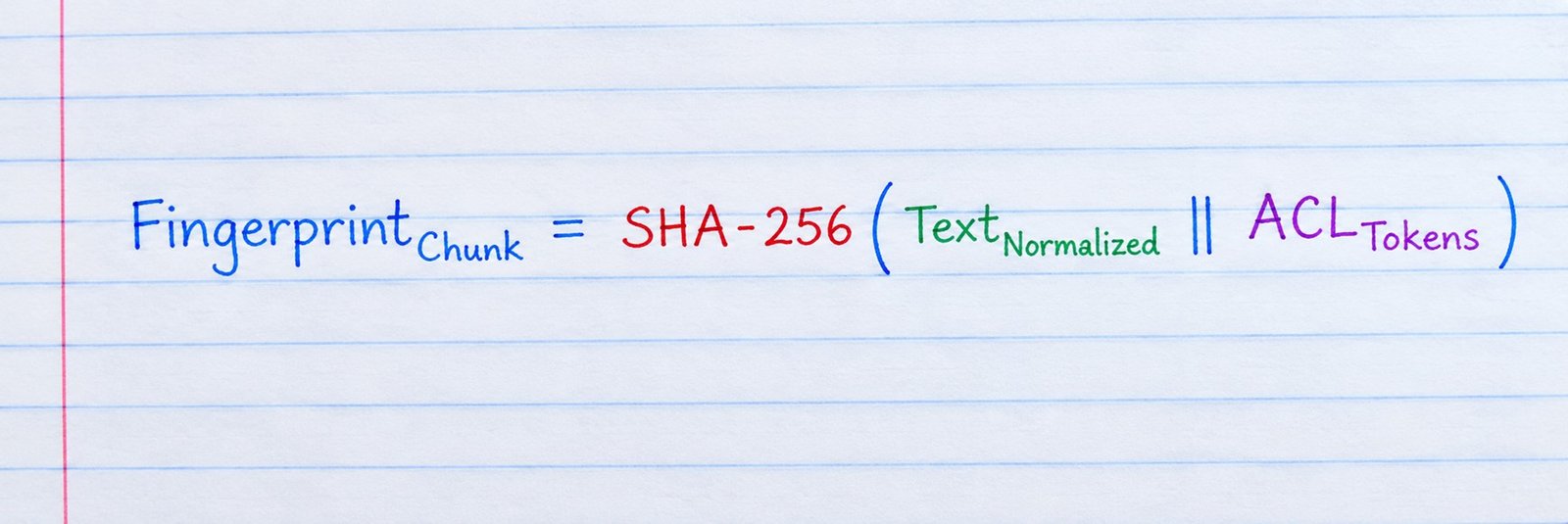
The normalized text string, combined with any core structural governance flags, such as the security ACL definition, is passed through a high-performance, deterministic hashing algorithm, such as SHA-256. This yields a unique, fixed-length fingerprint string:
Step 3: Ledger Reconciliation Loop
Before invoking downstream embedding or cross-encoder models, the system performs a lookup against a centralized corporate fingerprint registry.
- The Cache-Hit Path: If the fingerprint already exists in the ledger, the engine determines that the underlying content has not changed. It skips the expensive embedding generation phase entirely, retains the existing vector database node, and simply updates the
last_verified_timestampflag. This avoids unnecessary model inference steps. - The Cache-Miss Path: If the fingerprint is missing, the engine treats the chunk as new or updated text. The fragment is routed through the embedding pipeline, a new vector index is generated, and the fingerprint registry is updated. The previous version of the chunk is marked as stale using tombstoning routines.
3. Temporal Context Integration: Dynamic Time-Decay Scoring Filters
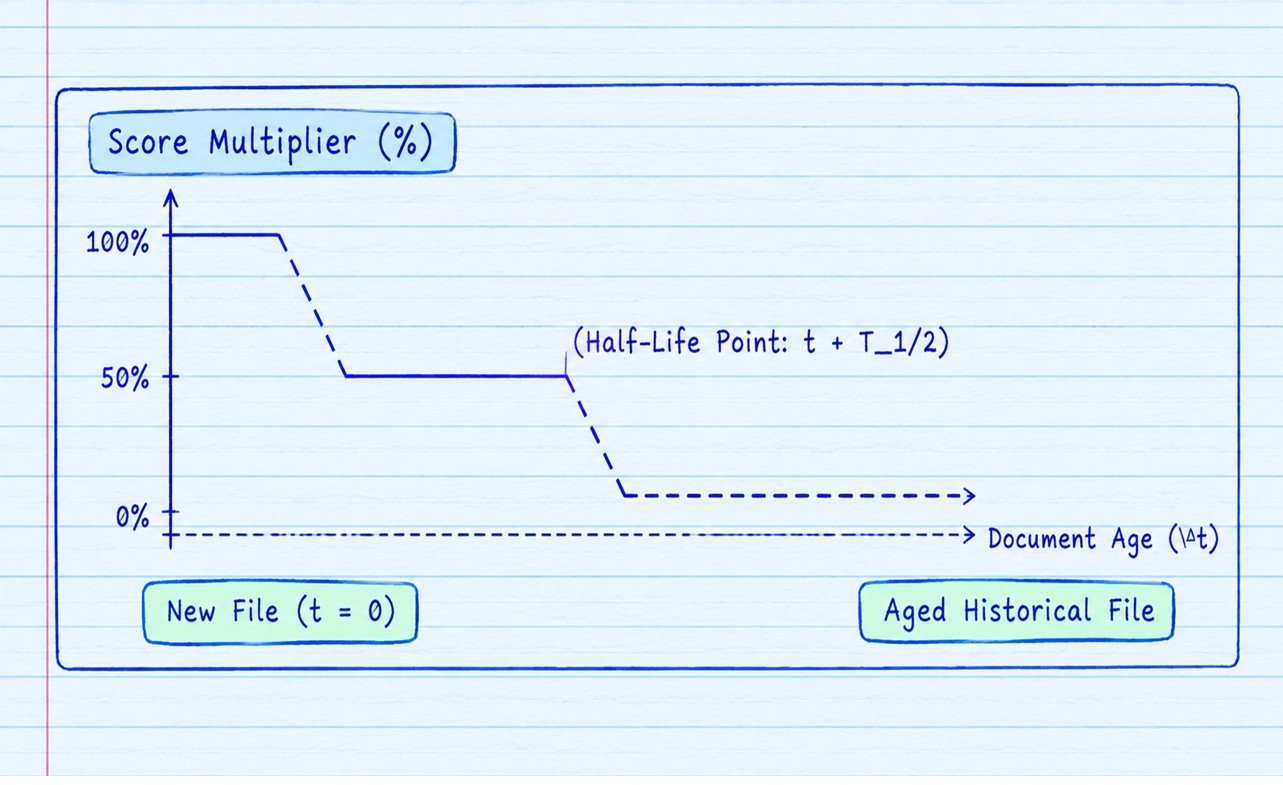
In many enterprise workflows, the value of a piece of information decreases as it ages. For example, an insurance appeal ruling from 2020 has significantly less operational relevance than a policy update issued in 2026. If a hybrid search engine relies solely on semantic or lexical score matching, older, textually dense historical documents can crowd out newer, more accurate data points.
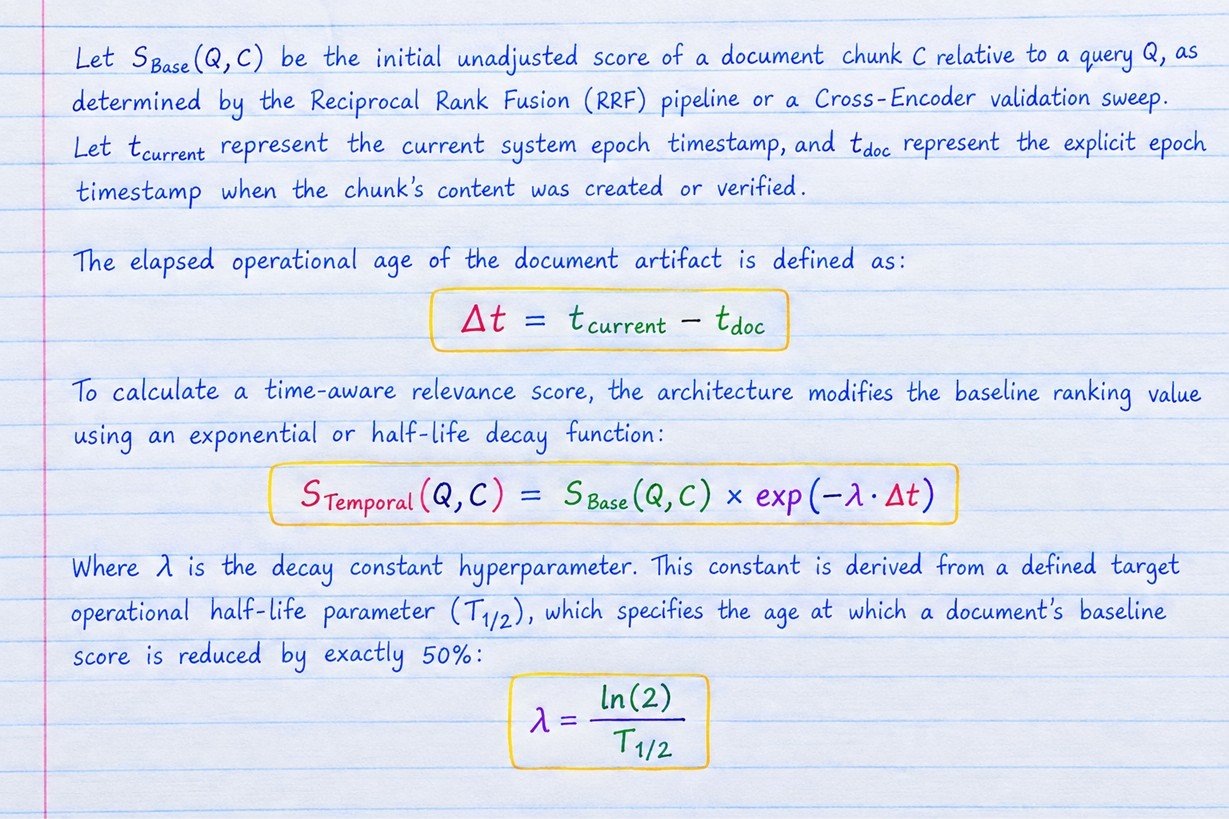
To address this, production architectures inject an explicit Temporal Time-Decay Function directly into the final hybrid retrieval ranking calculation.
Mathematical Formulation
Bounded Architecture Implementation
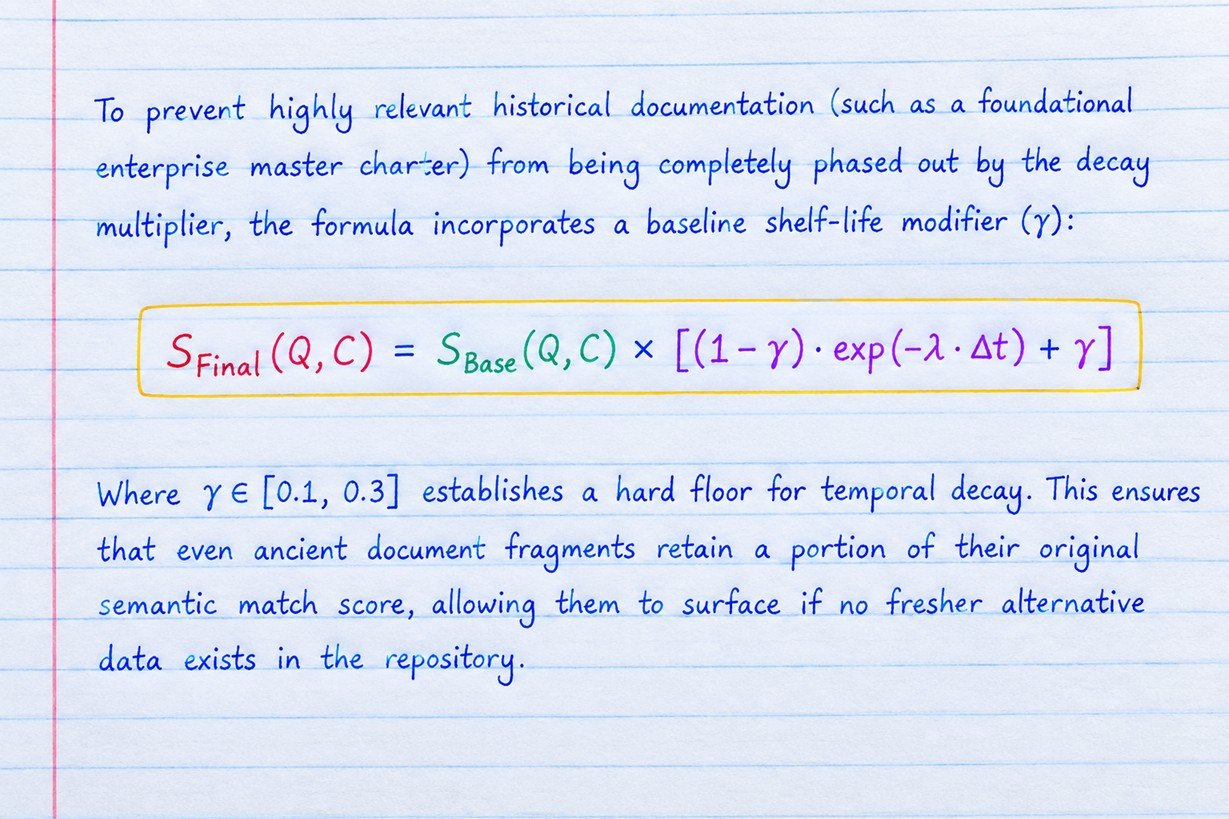
By implementing this mathematical filter within the retrieval layer, technology executives ensure that the generative AI layer naturally prioritizes current information. This design choice maintains system accuracy and guards against knowledge drift under real-world enterprise workloads.