Reranking Infrastructure - Localized Cross-Encoders, Dynamic Slashing Gates, and Asymmetric Compute Topologies
1. Localized Cross-Encoder Architectures and Quantization Optimization
To guarantee absolute data privacy, eliminate external network latency variance, and maintain strict data compliance, the enterprise architecture must deploy localized, specialized Cross-Encoder Reranker Models, such as the BGE-Reranker family or self-hosted Cohere Reranker containerized engines, directly on private enterprise inference clusters.
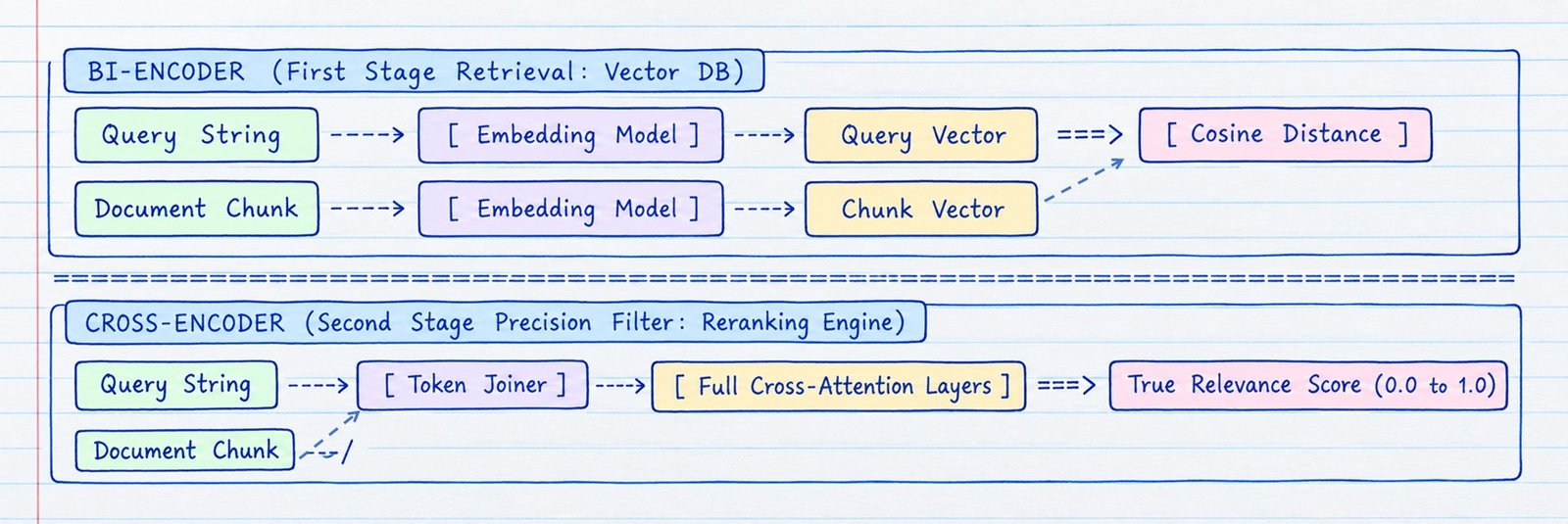
The Architectural Difference: Bi-Encoder vs. Cross-Encoder
Traditional vector databases rely on Bi-Encoder architectures, where the query string and document chunks are encoded into separate, independent vector representations. The similarity calculation is simplified to a dot-product or cosine proximity operation between two points in space.
A Cross-Encoder removes this separation. It accepts both the query string and the candidate text chunk simultaneously as a single token array input, passing them through the model's full cross-attention layers. This permits every single word token in the query to be weighed directly against every single word token in the document text, capturing complex conditional clauses, negative qualifiers, and specific industry codes with exceptional clarity.
Memory and Footprint Quantization Optimization
Cross-encoders are computationally heavy. To maximize throughput and minimize the hardware footprint on enterprise inference clusters, models must undergo structural precision quantization before being deployed to production.
- Float16 (Half-Precision) Optimization: Converts standard FP32 weight tensors down to 16-bit floating-point arrays. This reduces the active VRAM footprint by exactly 50% and unlocks the accelerated Tensor Core processing capabilities of modern enterprise GPU accelerators, cutting cross-attention calculation time in half.
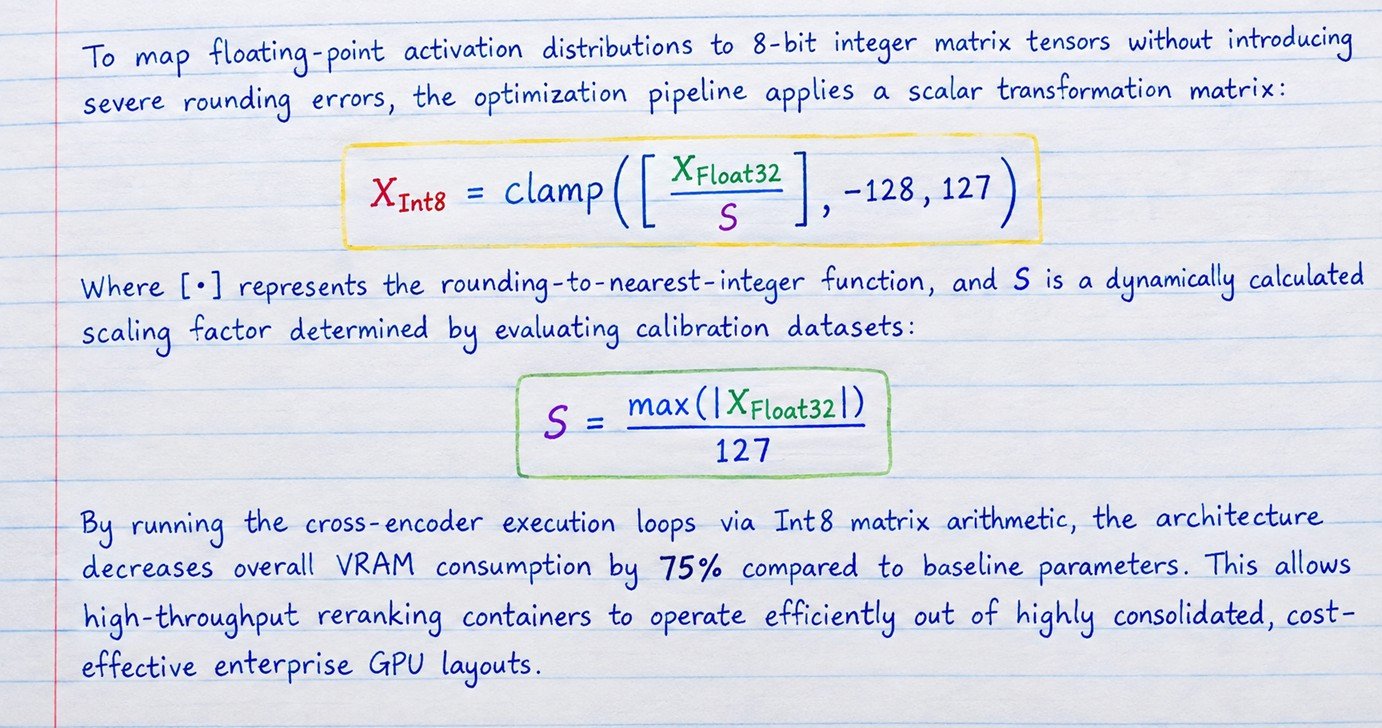
- Int8 (8-Bit Integer) Quantization: Compresses weight values further into standard 8-bit integers using symmetric linear quantization methods.
Mathematical Representation
2. The Dynamic Slashing Gate: Latency Protection Design Patterns
Because cross-encoders pass query and text combinations through full attention matrices simultaneously, their algorithmic runtime complexity scales quadratically with respect to token input length: O(M x N^2), where M is the number of candidate chunks evaluated and N is the cumulative token window. Reranking every single item in a large first-stage candidate pool, such as 200 nodes, creates a severe operational bottleneck that increases system latency.
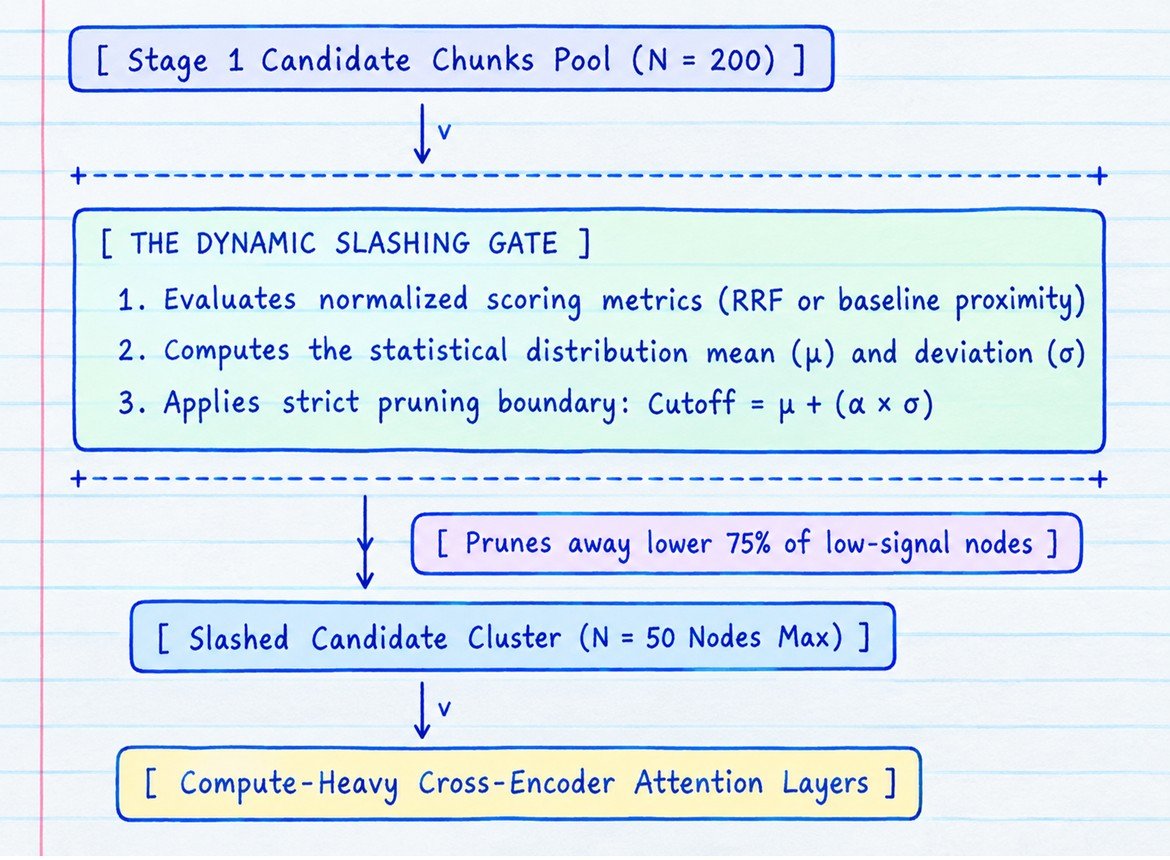
To protect the user experience and maintain strict sub-100ms service-level agreements (SLAs), the pipeline must implement a Dynamic Slashing Gate between Stage 1 retrieval and Stage 2 reranking.
The Pruning Algorithm Pattern
Instead of blindly passing all 200 retrieved items to the cross-encoder, the Dynamic Slashing Gate screens the candidate pool using rapid statistical metrics.
- Metric Calculation: The gate reads the normalized output scores, such as the Reciprocal Rank Fusion output values or the sparse-dense combined distances, of the incoming candidate matrix.
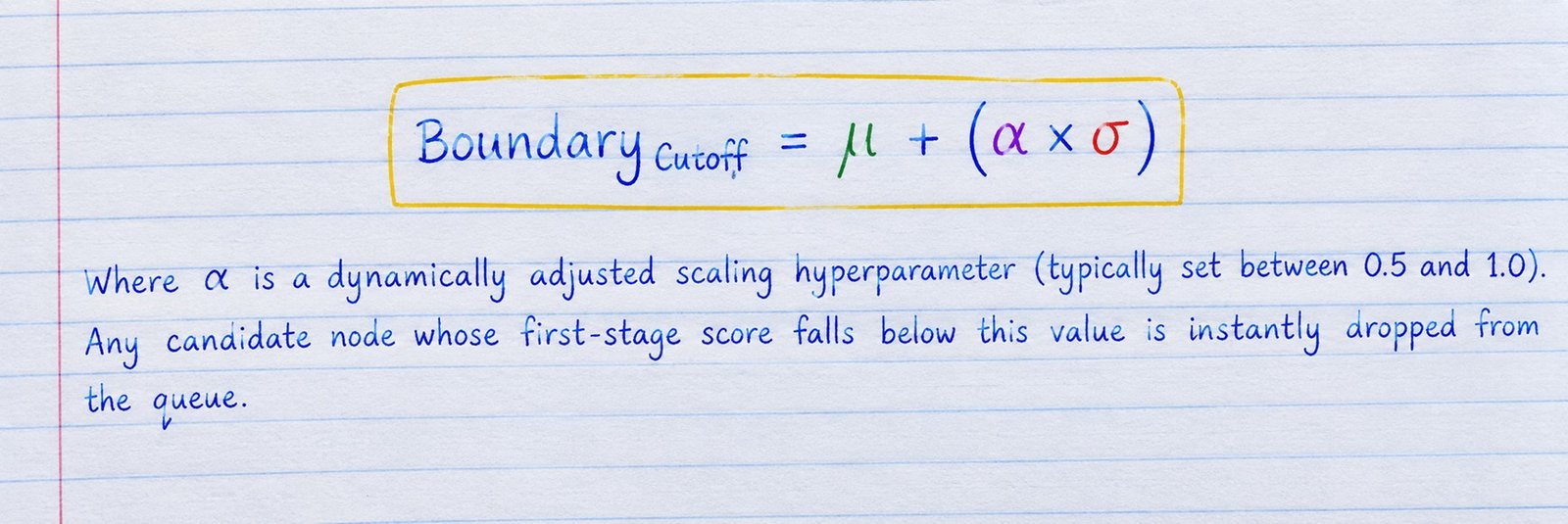
- Statistical Shift Detection: The engine calculates the mean (symbol mu) and standard deviation (symbol sigma) of the scores within the current retrieval batch.
- Boundary Truncation Execution: The gate applies a strict pruning cutoff threshold:
- Hard Capped Bounds: If the statistical cutoff does not prune enough records, the engine applies a hard operational cap, selecting only the top 50 highest-scoring fragments.
By filtering the candidate pool from 200 down to a maximum of 50 high-signal nodes before initiating the cross-encoder inference path, the architecture avoids wasting compute cycles on low-relevance documents. This reduces overall reranking latency by over 60%, protecting the performance envelope of the platform.
3. Asymmetric Compute Infrastructure Decoupling Topology
Under high corporate user concurrency, combining storage access patterns and heavy model inference tasks on a single compute node creates severe resource contention. The memory-heavy requirements of running multi-million-node HNSW vector graph lookups clash directly with the compute-heavy requirements of running full cross-attention transformer models.
To guarantee operational stability, the platform must enforce an Asymmetric Compute Infrastructure Topology, completely decoupling the data access nodes from the model inference arrays.
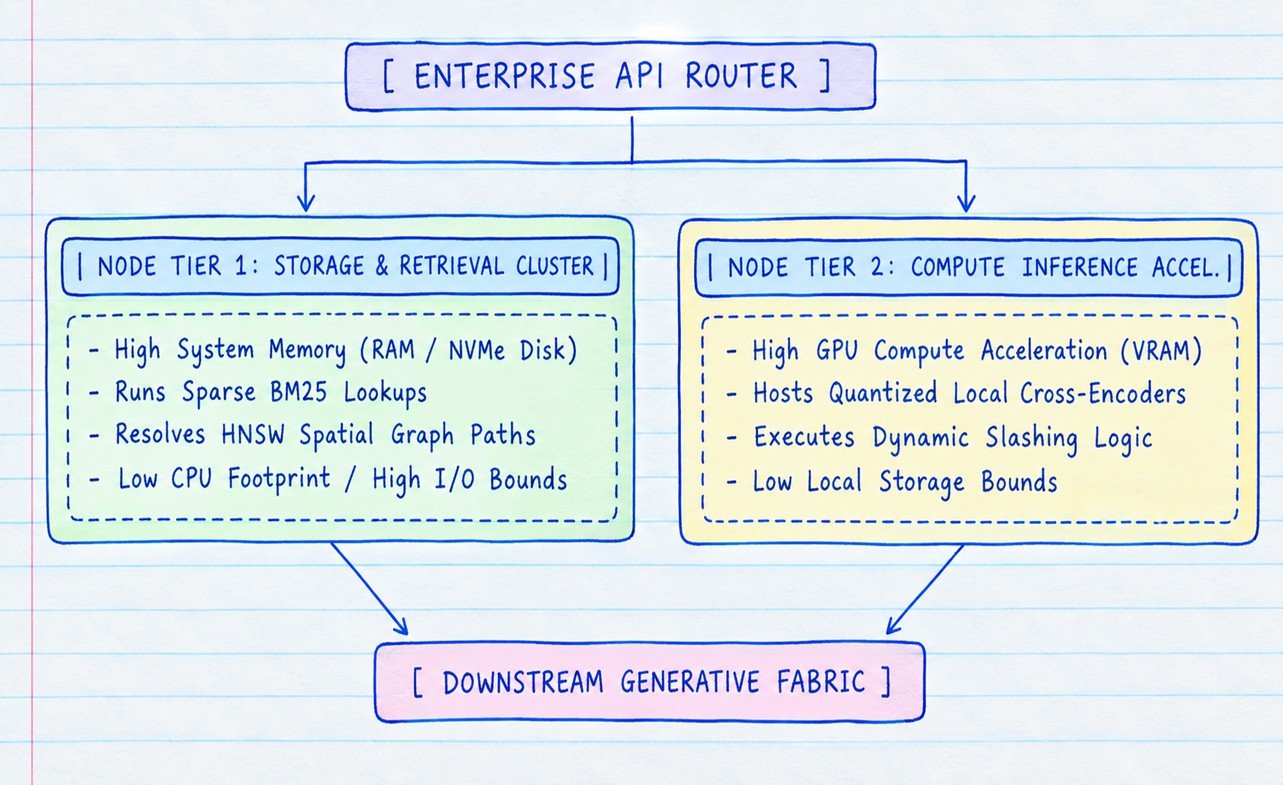
Node Tier 1: Storage and Retrieval Cluster (Memory-Optimized)
This layer is engineered exclusively to manage large-scale data input/output operations.
- Hardware Profile: High-performance, memory-optimized system architecture packed with system RAM and fast enterprise NVMe solid-state disk arrays. Low GPU requirements.
- Software Responsibilities: Hosts the core vector databases, maintains inverted metadata indexes, processes incoming Change Data Capture (CDC) events, and executes Stage 1 high-recall parallel lookups.
- Operational Boundary: This tier finishes its task by emitting the raw 200-candidate-node text array, instantly freeing up memory blocks to handle the next concurrent inbound search query.
Node Tier 2: Compute Inference Accelerator Cluster (Compute-Optimized)
This layer is built entirely to handle high-intensity matrix math operations.
- Hardware Profile: Compute-optimized architecture featuring enterprise GPU accelerator rigs configured with localized high-bandwidth VRAM pools. Minimal system disk storage requirements.
- Software Responsibilities: Hosts the containerized, Int8/Float16-quantized localized Cross-Encoder models and runs the Dynamic Slashing Gate validation layer.
- Operational Boundary: This tier receives the candidate payload stream via low-latency internal-network gRPC channels. It processes the cross-attention calculations inside its isolated GPU tensor pipelines and returns the top 10 finalized, high-fidelity context blocks to the downstream orchestration fabric.
By separating the architecture into these two distinct layers, technology executives eliminate resource contention bottlenecks. This asymmetric decoupling lets the storage tier scale independently based on document volume, while the compute tier scales dynamically based on concurrent user traffic, ensuring a stable, scalable production path for enterprise AI operations.