RAG Architecture Patterns - Macro-System Blueprints and Agentic Corrective Feedback Loops
Introduction
For technology executives (CTOs, VPs, and Directors of AI Architecture), engineering an enterprise-grade AI system requires shifting focus from isolated components to holistic system orchestration. Up to this point in the chapter, we have analyzed the individual engines that form a modern retrieval pipeline: Data Ingestion, Layout-Aware Document Processing, Embedding Optimizations, Vector Storage Infrastructure, Hybrid Retrieval, Reranking, and Context Assembly.
However, a production-grade application is not merely a collection of distinct microservices. It is a unified macro-system architecture configured to meet explicit business constraints, compliance parameters, and Latency Service Level Agreements (SLAs). In challenging business environments like Healthcare Revenue Cycle Management (RCM), choosing the wrong macro blueprint leads directly to system failure, manifesting as runaway token overhead, slow user interfaces, or unreliable, unverified answers.
This section delivers the macro-level system blueprints, end-to-end design configurations, and iterative agentic feedback patterns required to compose enterprise-grade Retrieval-Augmented Generation (RAG) platforms.
1. The Macro Pattern Landscape: Structural Blueprint Configurations
Production systems deploy RAG across three distinct macro-architectural patterns depending on the complexity of the task, the latency budget, and the necessary reasoning depth: Naïve RAG (the PoC baseline), Advanced Linear RAG (the deterministic production pipeline), and Agentic/Corrective RAG (the iterative loop blueprint).
Pattern A: Naïve RAG (The PoC Anti-Pattern)
Naïve RAG represents the foundational baseline pattern popularized by early generative AI prototyping frameworks.
[ Inbound Query ] ---> [ Single Vector Index Lookup ] ---> [ Simple Context Box ] ---> [ LLM Generation ]
- Execution Flow: An incoming user query is embedded, matched against a single vector store via Approximate Nearest Neighbor (ANN) search, and the resulting raw text slices are concatenated into a prompt window for immediate language model generation.
- Production Viability: Extremely Low. Because it lacks ingestion security masking, semantic filtering, keyword alignment, or reranking, this pattern is highly vulnerable to data exfiltration, context fragmentation, and severe hallucinations. It should be treated strictly as a prototyping tool, not a production target.
Pattern B: Advanced Linear RAG (The Industrial Production Pipeline)
Advanced Linear RAG is the standard architecture for high-throughput, enterprise-scale applications requiring predictable performance and sub-100ms processing boundaries.
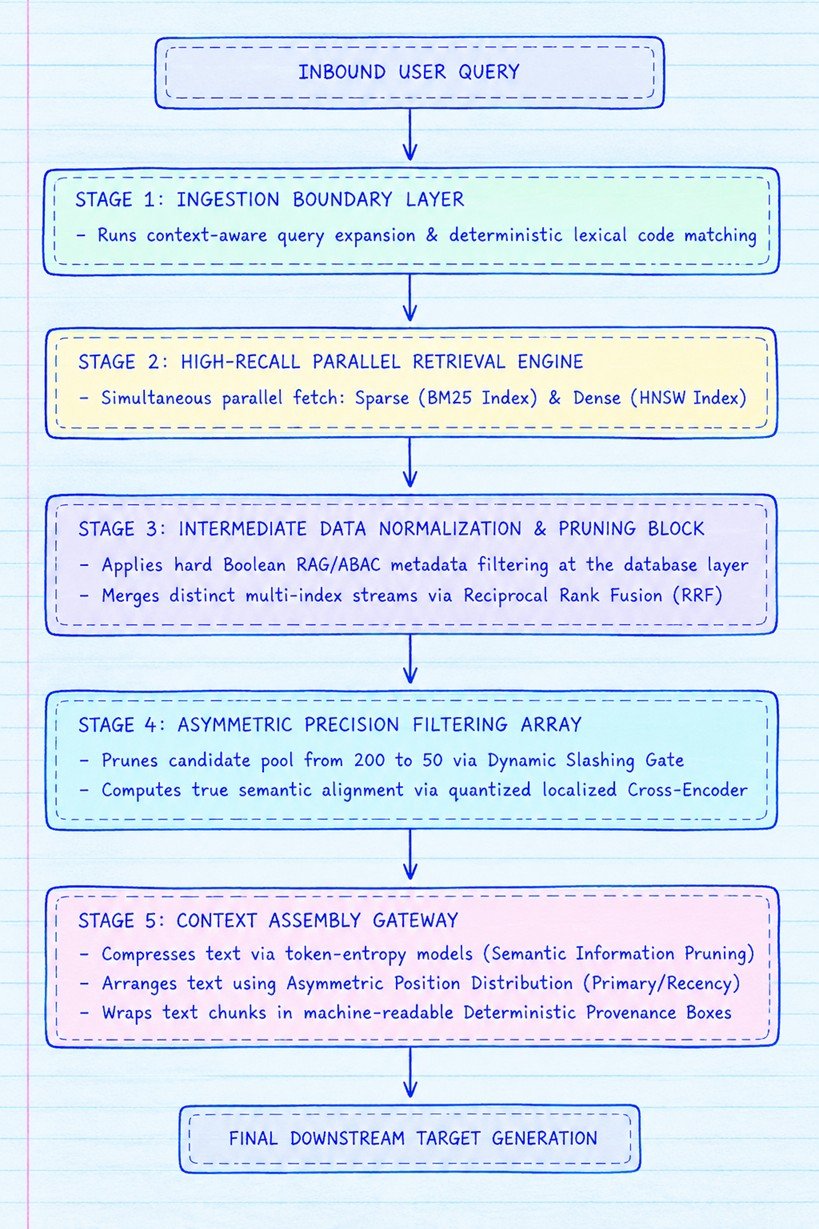
- Execution Flow: The query is expanded, evaluated in parallel across sparse and dense database instances with active RBAC/ABAC filters, combined using Reciprocal Rank Fusion (RRF), pruned via a Dynamic Slashing Gate, validated by a localized Cross-Encoder, compressed, structured with inline provenance tagging, and positioned according to the model's attention profile before generation.
- Production Viability: High. This pattern delivers high reliability, strong security controls, and predictable execution latencies for the majority of enterprise lookups.
Pattern C: Agentic / Corrective RAG (The Iterative Reasoning Blueprint)
Agentic RAG transitions from a single linear execution path to an active, multi-turn reasoning process. It introduces an internal evaluation agent that scores the quality of retrieved data and dynamically adjusts its retrieval strategies before generating an output.
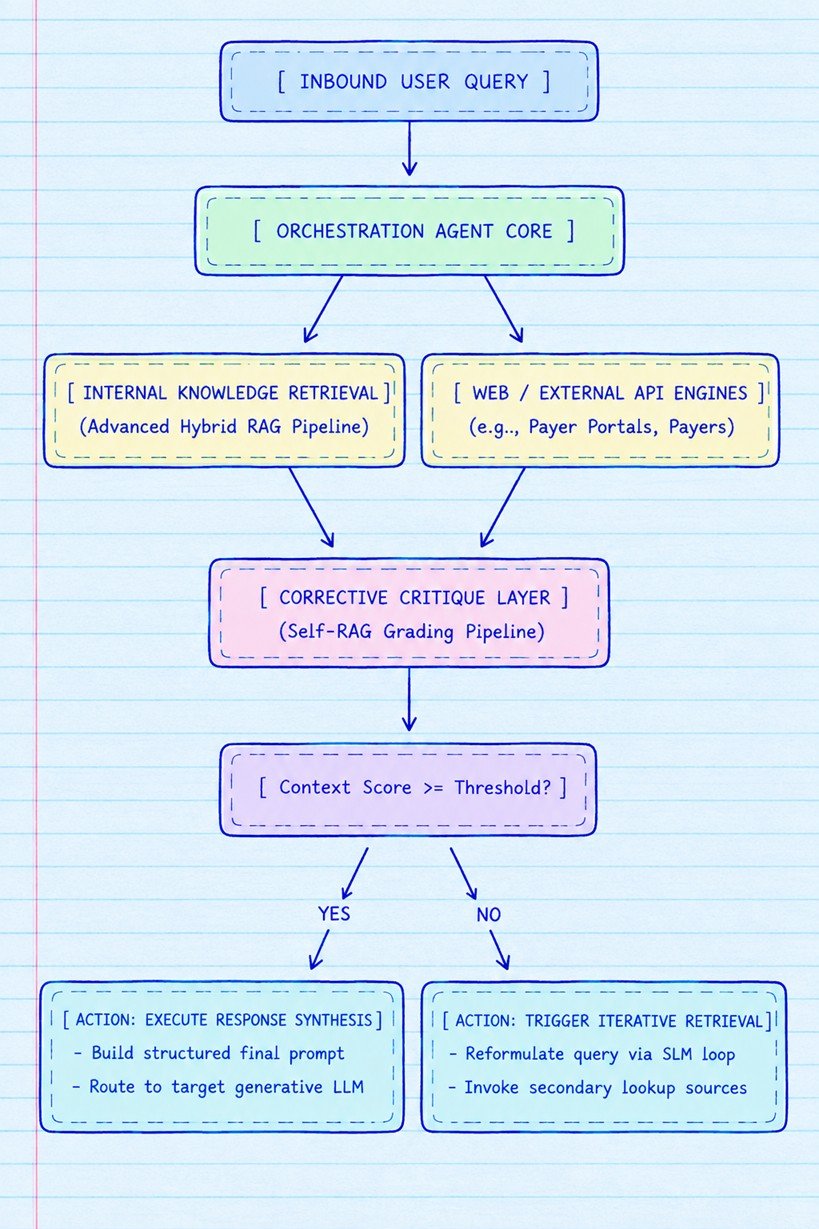
- Execution Flow: The system treats the advanced RAG pipeline as an actionable tool. The core agent initiates a search loop, passes the candidates through an internal grading routine, evaluates the context score, and either routes the results to generation or initiates a secondary search loop using alternative queries or external resources if the context is insufficient.
- Production Viability: High for Complex Scenarios. It is designed specifically for complex tasks that require analyzing multi-document relationships, verifying clinical facts, or handling cross-organizational data reconciliation.
2. Macro Archetype Decision Matrix
To assist technology leaders in optimizing their infrastructure budgets and architecture configurations, the table below provides a direct structural comparison of the three major RAG patterns.
| Architectural Metric | Naïve RAG Archetype | Advanced Linear RAG Archetype | Agentic / Corrective RAG Archetype |
|---|---|---|---|
| End-to-End Latency | Ultra-Low (< 200ms TTFT) | Low & Predictable (300ms - 800ms total execution) | High & Variable (2,000ms - 10,000ms+ due to multi-turn inference) |
| Compute Cost Profile | Minimal; basic single-pass API or token search fees. | Predictable; bounded by parallel lookups and local Cross-Encoder passes. | High & Non-Linear; scales based on evaluation loops and tool calls. |
| Token Efficiency | Poor; passes raw, wordy document slices containing noise. | High; utilizes algorithmic compression and dynamic pruning rules. | Dynamic; consumes high token volumes during loop passes, but optimizes final prompt. |
| Implementation Complexity | Low; trivial setup using out-of-the-box libraries. | Medium-High; requires distributed queues, dual indices, and quantization. | High; requires active state management, routing models, and grading rails. |
| Hallucination Mitigation | Low; prone to context pollution and source drift. | High; enforces strict metadata filtering and precise reranking gates. | Maximum; validated by automated internal grading loops before generation. |
| Primary Enterprise Use Case | Initial system prototyping and internal sandboxed engineering tests. | High-throughput search, customer support interfaces, standard data lookups. | Multi-document clinical audits, complex contract analysis, RCM claim appeals. |
3. Deep-Dive: The Agentic Corrective Feedback Loop (Self-RAG Architecture)
The defining characteristic of an Agentic/Corrective RAG Pattern is its ability to self-correct during runtime. In high-liability environments like Healthcare RCM, if a similarity search returns documents that are textually similar but operationally irrelevant, such as content discussing an entirely different insurance policy tier, a linear system will pass that bad data to the LLM, leading to a flawed output.
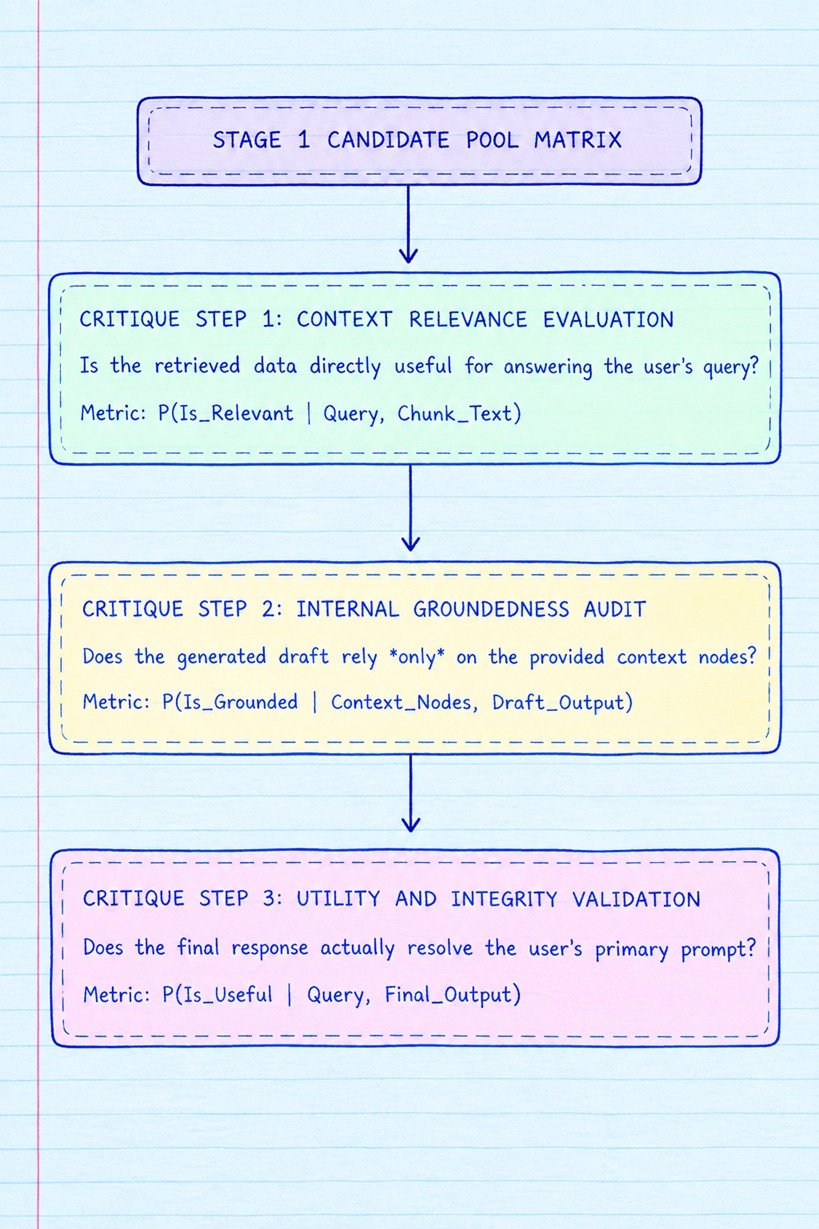
An Agentic Corrective loop introduces a dedicated Critique and Grading Layer that sits between retrieval and generation to validate context quality.
The Core Grading Abstractions
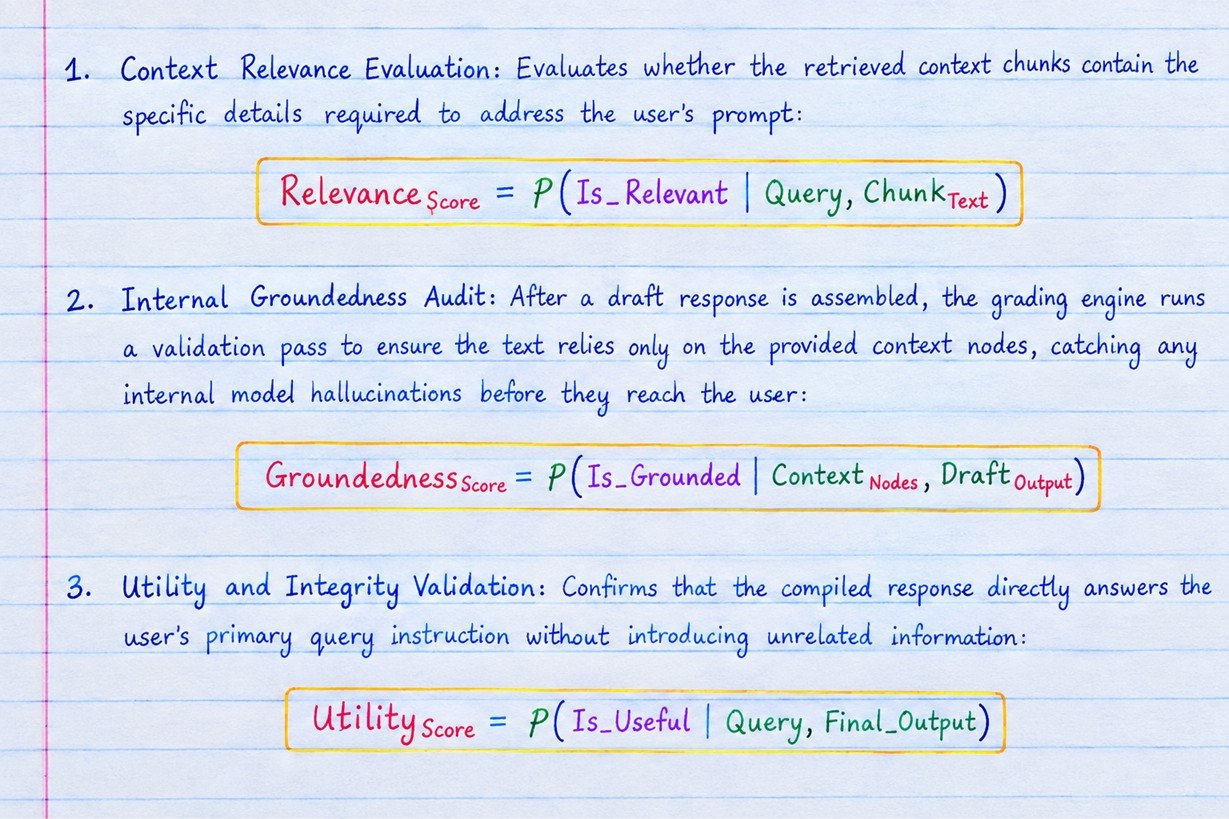
The critique engine runs a series of low-latency, specialized token-classification evaluations to score the retrieved candidate pool across three distinct parameters:
Complete Algorithmic Implementation Flow
The following programmatic structure outlines the execution path of the agentic corrective loop, providing a blueprint for building self-correcting retrieval architectures:
class CorrectiveRAGAgent:
    def __init__(self, retrieval_pipeline, critique_engine, slm_gateway, llm_engine):
        self.retrieval_pipeline = retrieval_pipeline
        self.critique_engine = critique_engine
        self.slm_gateway = slm_gateway
        self.llm_engine = llm_engine
        self.relevance_threshold = 0.75
        self.max_retries = 3

    def execute_retrieval_loop(self, user_query, security_acl):
        retry_count = 0
        active_query = user_query
        external_data_payload = None

        while retry_count < self.max_retries:
            # Step 1: Execute the baseline Advanced Linear RAG Pipeline
            candidate_chunks = self.retrieval_pipeline.fetch(active_query, security_acl)

            # Step 2: Pass candidates through the context relevance evaluator
            relevance_score = self.critique_engine.evaluate_relevance(active_query, candidate_chunks)

            if relevance_score >= self.relevance_threshold:
                # The context is valid; exit the loop and move to generation
                return self.generate_and_verify(user_query, candidate_chunks)

            # Step 3: Context fallback path if relevance threshold is missed
            retry_count += 1
            print(f"Warning: Relevance score {relevance_score} missed threshold. Initiating retry {retry_count}")

            # Action A: Use an in-house SLM to re-write and optimize the search query
            active_query = self.slm_gateway.reformulate_query(user_query, active_query, candidate_chunks)

            # Action B: If internal indices are insufficient, fetch external reference data
            if retry_count == 2:
                external_data_payload = self.retrieval_pipeline.fetch_external_payer_portal(user_query)
                active_query = f"{active_query} {external_data_payload}"

        # Hard Fallback Path: If loops fail to locate valid data, return a safe system message
        return self.llm_engine.emit_safe_failure_response(user_query)

    def generate_and_verify(self, original_query, verified_chunks):
        # Step 4: Generate a draft response using the verified context pool
        draft_response = self.llm_engine.generate_draft(original_query, verified_chunks)

        # Step 5: Verify groundedness to protect against model hallucinations
        groundedness_score = self.critique_engine.evaluate_groundedness(verified_chunks, draft_response)

        if groundedness_score < 0.90:
            # Hallucination detected; strip out the draft and trigger correction paths
            return self.reconstruct_safe_response(original_query, verified_chunks)

        return draft_response
By framing retrieval as an active, self-correcting loop rather than a single linear path, the Agentic RAG architecture provides technology leaders with a highly robust framework for complex enterprise workflows. This design ensures that the system handles messy corporate data securely, maintains high retrieval accuracy, and prevents hallucinations under real-world production workloads.