Controlling Agent Autonomy - Dynamic Permission Scaling, Token-Bucket Throttling, and Policy-as-Code Interceptors
Introduction
Deploying autonomous agent networks within a mission-critical enterprise production fabric introduces a fundamental engineering challenge: the governance of emergent behavior. In an interconnected multi-agent ecosystem, agents are given access to high-impact corporate systems through execution tools. While this capability unlocks significant automation value, it also introduces substantial systemic risks. Left unchecked, an agent network can execute unauthorized API mutations, trigger cascading loops that result in catastrophic cloud computing costs, or experience semantic drift that circumvents corporate compliance guidelines.
For technology leaders (CTOs, VPs, and Heads of AI Practice), controlling agent autonomy must not be treated as a prompt engineering exercise. Attempting to manage an agent's behavioral boundaries using system-level prompts, such as "Do not delete rows" or "Act responsibly", is a fragile anti-pattern that is vulnerable to prompt injection attacks and probabilistic models failing to follow instructions.
Instead, enterprise systems require an independent, deterministic infrastructure enforcement layer. This section delivers the cloud-agnostic raw design patterns, runtime permission scaling matrices, state-throttling algorithms, and decoupled policy-as-code interceptors required to establish absolute control over autonomous agent networks.
1. The Dynamic Autonomy Tier Matrix: Runtime Permission Scaling
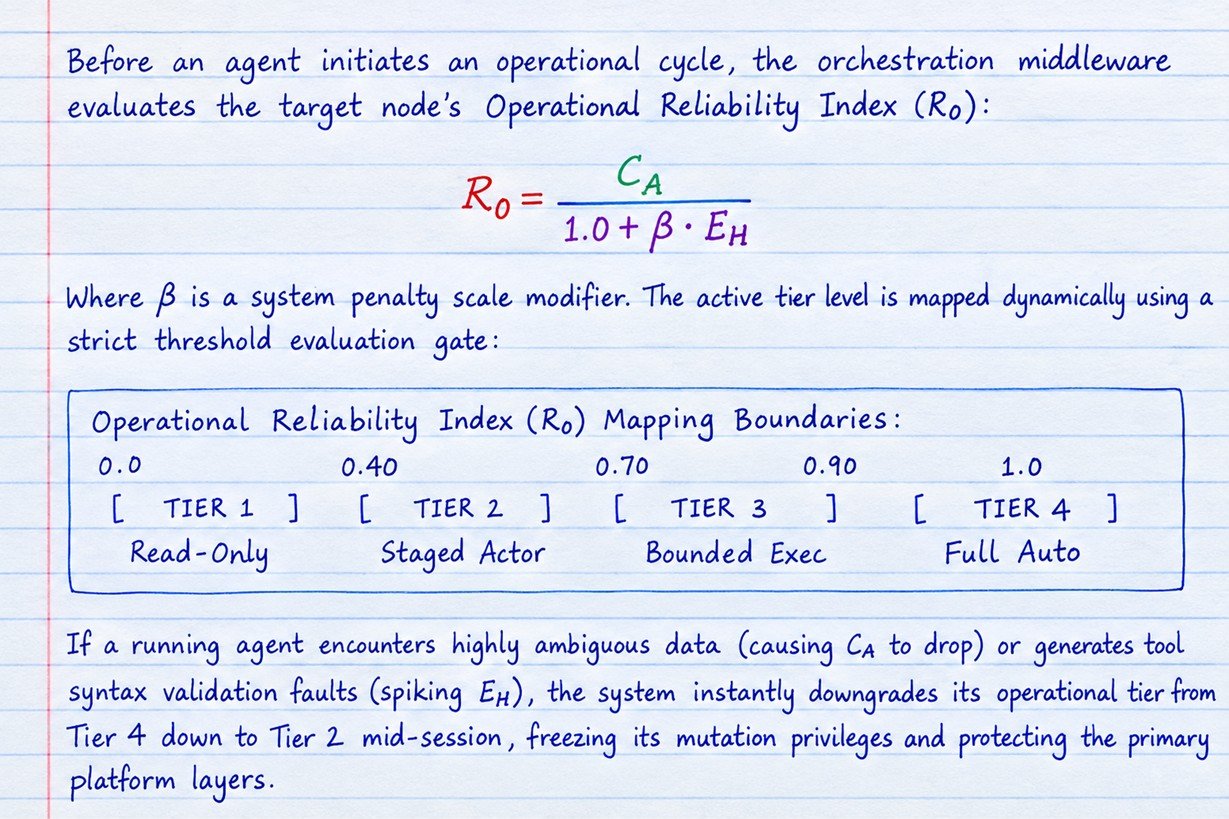
An agent's operational boundaries should not be fixed at design time. To maximize utility while protecting system integrity, the platform must implement a Dynamic Autonomy Tier Matrix. This framework evaluates an agent's active confidence metrics (C_A) and its trailing historical error rate (E_H) in real time to dynamically dial its execution privileges up or down.
The Autonomy Tier Architecture
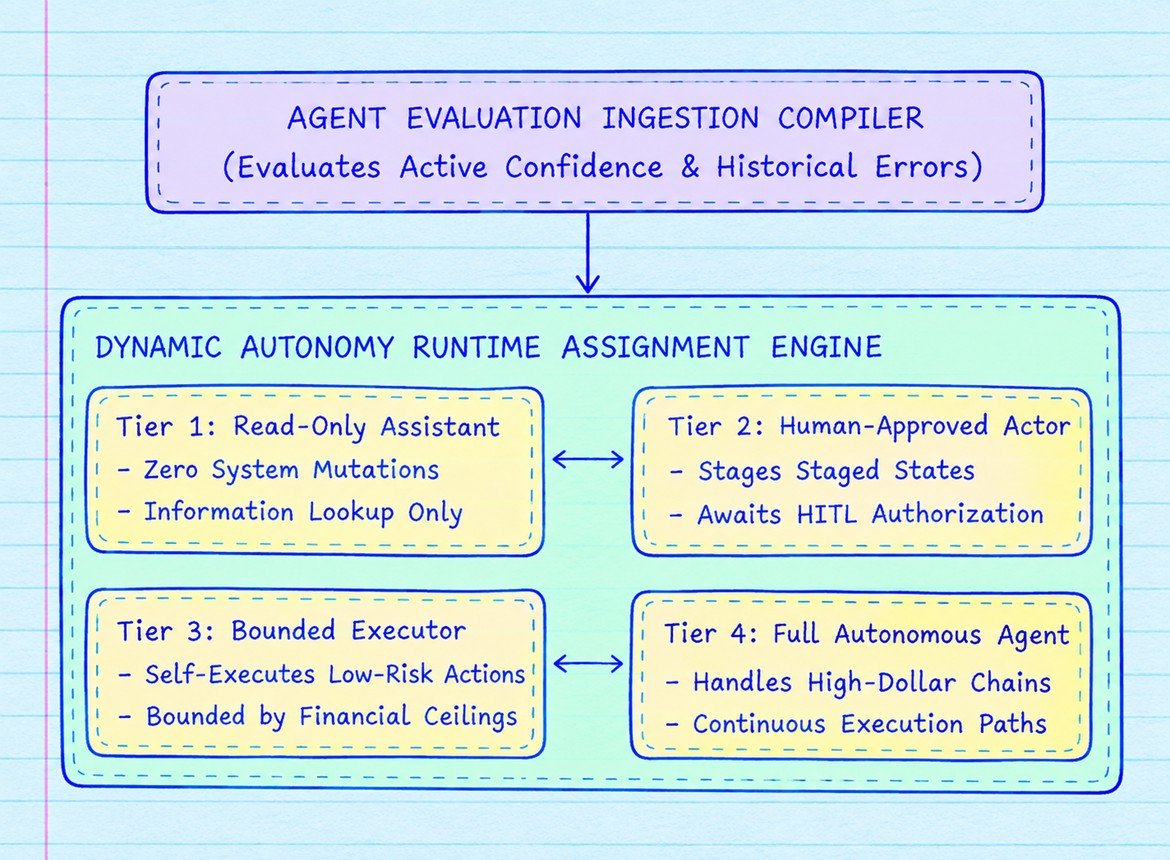
- Tier 1: Read-Only Assistant (Information Lookup Only): The agent can query database vectors and parse layouts but has zero capability to emit state mutations or tool calls to external platforms.
- Tier 2: Human-Approved Actor (Staged Execution): The agent can formulate tool execution payloads, such as compiling a claim denial appeal, but cannot submit them. Payloads are written to a staging database and await explicit Human-in-the-Loop (HITL) authorization.
- Tier 3: Bounded Executor (Autonomous Low-Risk Execution): The agent self-executes low-risk actions. In our Healthcare Revenue Cycle Management (RCM) context, this includes autonomous status inquiries or processing appeals valued below a strict threshold, such as
< $1,000. - Tier 4: Full Autonomous Agent (Unrestricted Operational Execution): The agent operates continuously across high-value operational loops, utilizing full multi-agent tool execution without intermediate manual holds.
The Runtime Tier Scaling Algorithm
2. Token-Bucket Rate Limiters: Execution Loop Budget Valves
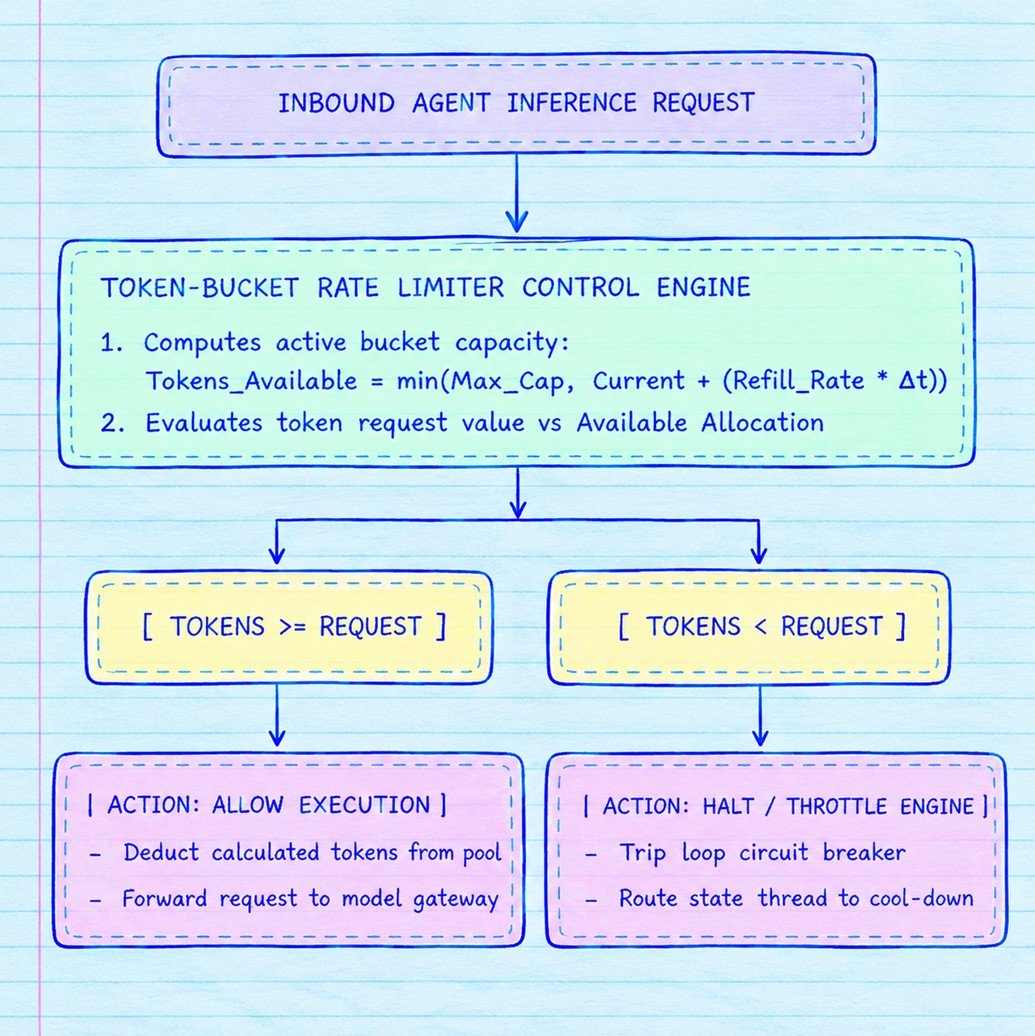
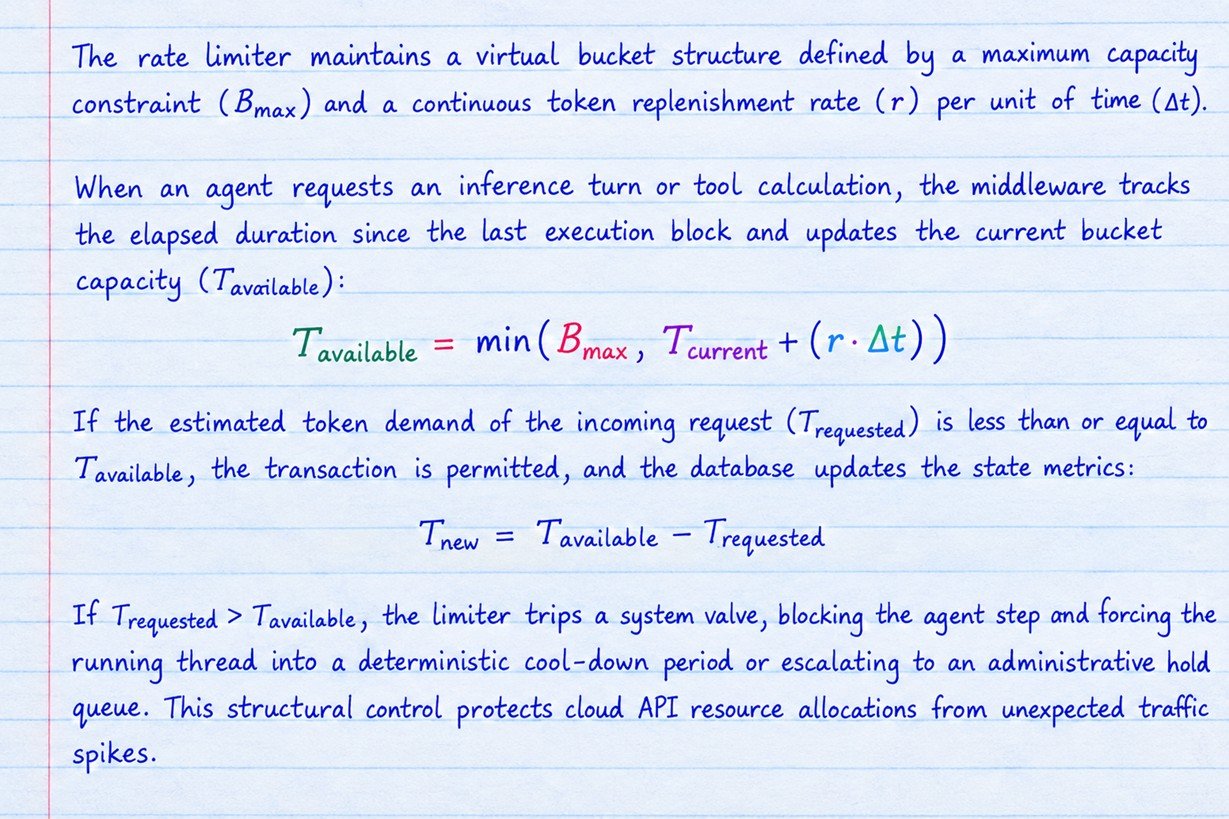
Autonomous agents interacting across multi-turn loops are susceptible to recursive loop failures, where models repeatedly call identical or structurally broken tools in rapid succession, wasting massive token resource pools. To mitigate this compute drain, the architecture enforces a specialized Model Token-Bucket Rate Limiter Engine to serve as a high-precision performance and financial valve.
Mathematical Algorithmic Foundation
3. Policy-as-Code Interceptors: Decoupled Corporate Governance Enforcers
A major security vulnerability in multi-agent application design is embedding compliance logic directly inside the agent code or model prompt blocks. This tightly coupled approach makes auditing difficult and leaves system tools vulnerable to manipulation. Production-grade architecture mandates a Decoupled Policy-as-Code Interceptor Engine.
Every action or function call formulated by an autonomous agent is intercepted by an external governance gateway before it can reach any production API system, validating it against hard-coded corporate parameters using policy engines such as Open Policy Agent (OPA).
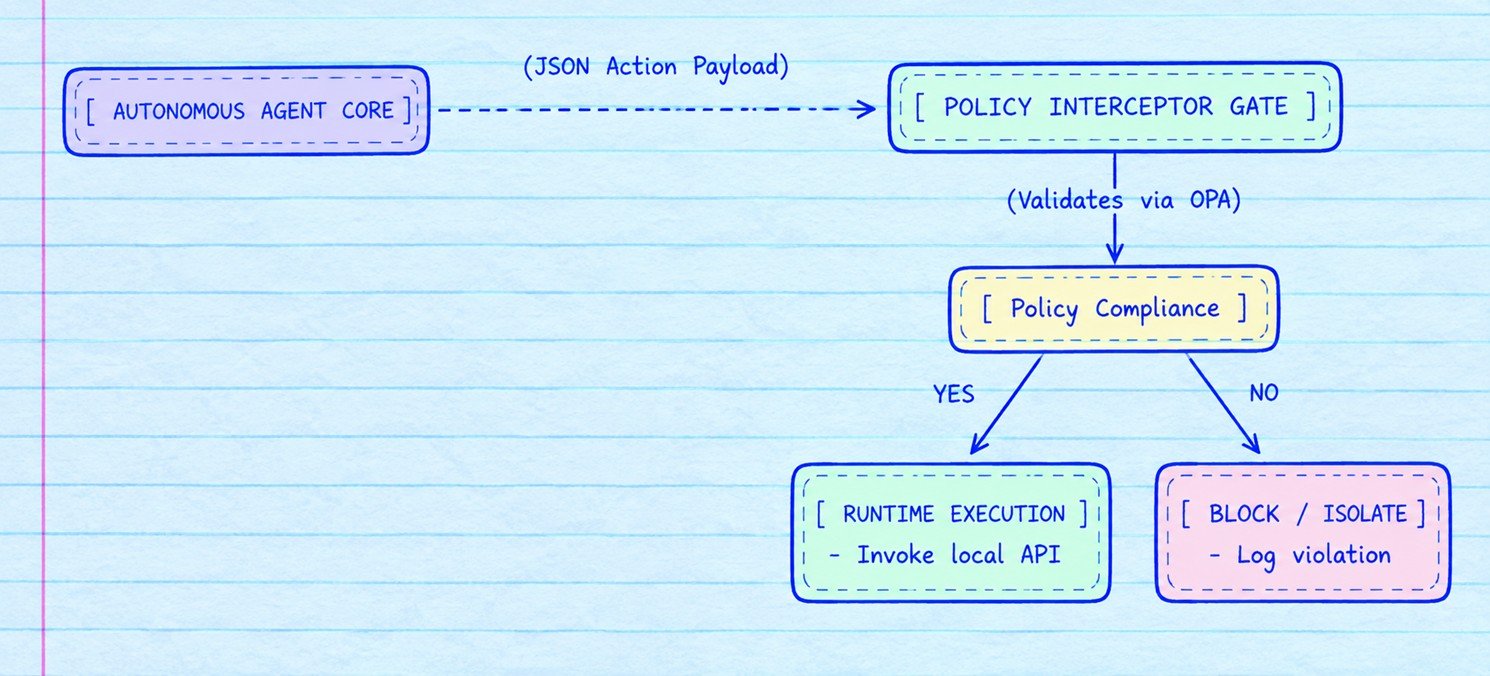
Production Policy Definition Pattern (Rego Architecture)
The Policy Engine reads a universal, declarative rule definition that dictates system permission rules. The logic operates entirely independently of the LLM state space.
The following production policy script defines a declarative rule ledger that intercepts tool payloads, verifies billing value limits and user authorization matrices, and permits execution only when all defined policy conditions are satisfied (below code snippet is in Rego):
package enterprise.rcm.governance

# Default policy configuration blocks out all agent access paths
default allow = false

# Rule definition: Validate agent tool invocation capabilities
allow {
    # Condition A: Ensure target action matches valid tool definitions
    input.action.type == "submit_claim_appeal"

    # Condition B: Verify agent operational status classification limits
    input.agent.autonomy_tier in ["Tier_3", "Tier_4"]

    # Condition C: Enforce structural financial risk ceiling thresholds
    input.action.payload.disputed_value <= 10000

    # Condition D: Enforce explicit data role boundary matrices
    input.user.roles[_] == "RCM_Auditor"
}

# Explicit exception engine: Route high-dollar actions to human hold gates
requires_human_intervention {
    input.action.type == "submit_claim_appeal"
    input.action.payload.disputed_value > 10000
}
Interceptor Ingestion Framework Execution
When an agent outputs a function block targeting a production endpoint, such as invoking submit_claim_appeal with a data payload, the integration middleware packages the request context into a unified JSON telemetry matrix and queries the Policy Engine.
If the OPA payload evaluates to allow = true, the transaction is cleared and passed to the enterprise database routing layer. If the policy returns a violation or triggers requires_human_intervention, the middleware intercepts the pipeline, locks the target database row, and routes a structured error payload back to the agent:
{
  "status": "GOVERNANCE_EXECUTION_BLOCKED",
  "error_code": "POLICY_VIOLATION_ERR_04",
  "diagnostic_message": "Action halted by external Policy Engine. Disputed charge value ($42,500.00) violates autonomous Tier-3 budget ceilings. Payload has been routed to the Asynchronous Escalation Queue."
}
By decoupling governance from the probabilistic reasoning of language models and enforcing it through deterministic policy-as-code interceptors, technology executives establish ironclad boundaries around autonomous agent networks. This architectural design ensures operational predictability, protects corporate resources, and maintains system integrity under production workloads.