Enterprise Embedding Architecture - Hosting Topologies, Matryoshka Optimization, and Domain Contrastive Fine-Tuning
Introduction
In an enterprise-grade AI architecture, embeddings are not merely an optional preprocessing step; they represent the fundamental computational substrate that translates human language into a machine-readable semantic coordinate system. For technology leaders like CTOs, VPs, and Heads of AI Practice, the choice of an embedding framework establishes the performance envelope, security baseline, and cost structure of the entire enterprise knowledge retrieval capability.
When building an enterprise system, such as a Healthcare Revenue Cycle Management (RCM) framework, the embedding layer must handle highly specialized vocabularies. General-purpose models trained on open web text consistently fail when encountering domain-specific contexts, such as distinguishing between an administrative claim rejection and a clinical medical necessity denial. Furthermore, processing millions of complex corporate transactions demands strict compliance with zero-exfiltration security guidelines and fine-grained control over storage costs and inference latencies.
This section provides the cloud-agnostic raw design patterns, mathematical foundations, and system topologies required to engineer a scalable, cost-optimized, and domain-aligned enterprise embedding layer.
1. Architectural Hosting Topologies: Self-Hosted Open-Weights vs. Managed Enterprise APIs
The first strategic decision when designing an enterprise embedding layer is choosing between a self-hosted infrastructure running open-weights models and a managed enterprise embedding API.
Technology leaders must evaluate this choice across four critical vectors:
- Security
- Latency
- Customization
- Long-Term Token Economics
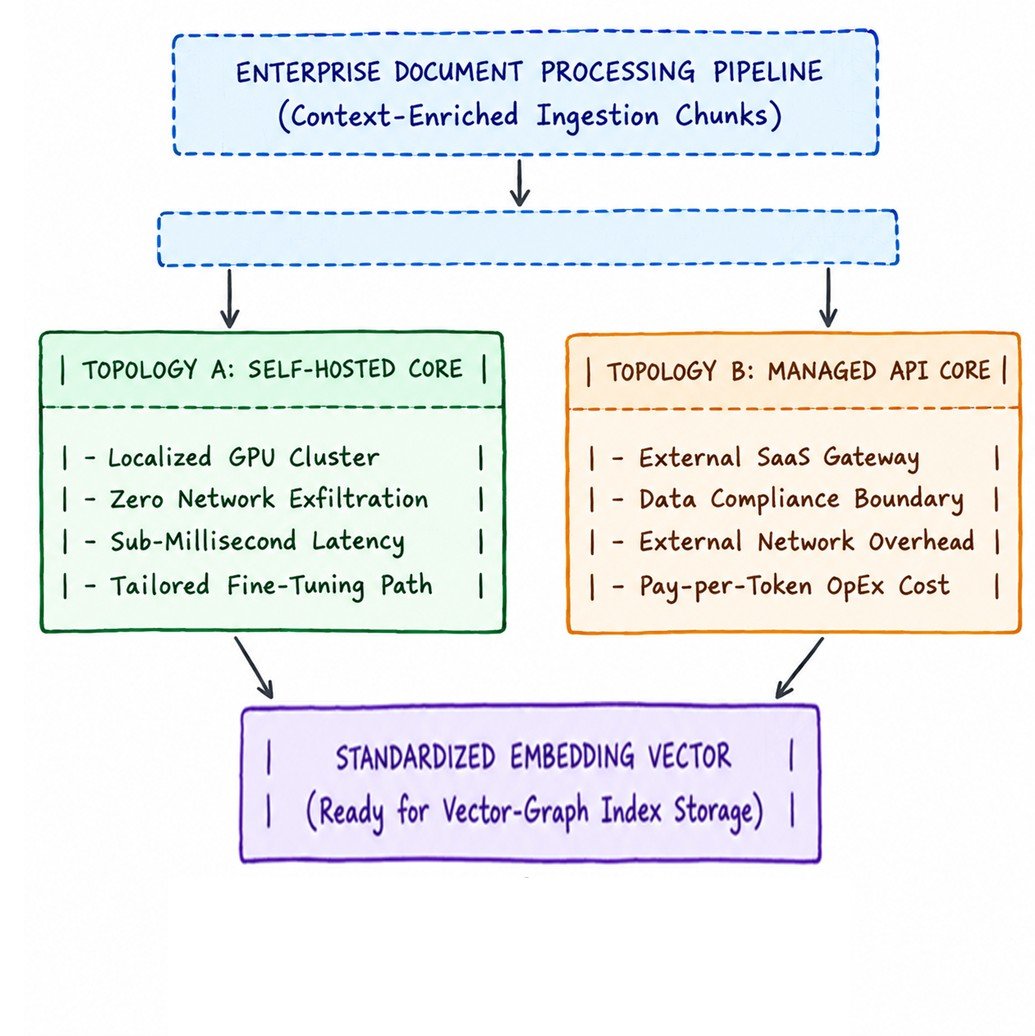
Topology A: Self-Hosted Open-Weights Models
This approach deploys state-of-the-art open-weights embedding models, such as NV-Embed, BGE, or Mistral-based embedding backbones, directly onto private, cloud-agnostic enterprise GPU clusters managed through container orchestration platforms.
- Security & Compliance: Offers complete isolation. Data never leaves the enterprise network security boundary, supporting strict HIPAA and GDPR requirements.
- Latency Profile: Extremely low and deterministic latency. By bypassing the public internet and eliminating HTTP/TLS handshake overhead, localized vector inference avoids external network jitter.
- Customization: Unlocks the ability to modify the underlying model weights using proprietary training data.
- Operational Cost: Shifts from variable operational expense (OpEx) to a predictable baseline cost, consisting of CapEx or fixed OpEx for compute infrastructure. This framework is highly cost-effective for continuous, high-throughput pipelines.
Topology B: Managed Enterprise Embedding APIs
This framework offloads vector generation to specialized external model provider gateways through public cloud endpoints.
- Security & Compliance: Requires extensive legal and technical review of third-party data processing agreements (DPAs) to ensure that customer data is never cached, logged, or used for model training.
- Latency Profile: Highly variable, ranging from 20ms to over 200ms, depending on network congestion, geographic distance to the gateway provider, and API rate-limiting queues.
- Customization: Highly restricted. Enterprise teams are limited to black-box systems with no direct way to optimize internal model weights for specialized terminology.
- Operational Cost: Uses a purely consumption-based, pay-per-token pricing model. While highly efficient for early-stage PoCs, this model presents significant financial risks in production due to runaway token costs as document volume grows.
Architectural Trade-off Matrix
| Architectural Dimension | Self-Hosted Open-Weights Core | Managed Enterprise API Core |
|---|---|---|
| Data Privacy / Exfiltration Risk | Zero Risk; data is isolated in a private environment. | Medium-High Risk; demands strict contractual DPAs. |
| Network Latency & Jitter | Sub-millisecond, highly deterministic. | 20ms–200ms+, subject to network performance. |
| Domain Fine-Tuning | Native capability via custom loss functions. | Impossible; locked behind provider APIs. |
| Infrastructure Overhead | High; requires GPU cluster orchestration. | Zero; simple REST/gRPC API integration. |
| Cost Scaling Model | Fixed compute costs; ideal for large scale. | Linear variable cost; expensive at high scale. |
2. Advanced Vector Optimization: Matryoshka Representation Learning (MRL) and Hybrid Alignment
In a high-throughput enterprise platform processing millions of document chunks, storing high-dimensional vectors, such as 4,096-dimensional float32 arrays, presents severe infrastructure bottlenecks, including runaway RAM consumption, increased storage costs, and sluggish similarity search speeds.
To resolve this, production architectures utilize Matryoshka Representation Learning (MRL) alongside sparse-dense hybrid vector alignment.
Matryoshka Representation Learning (MRL)
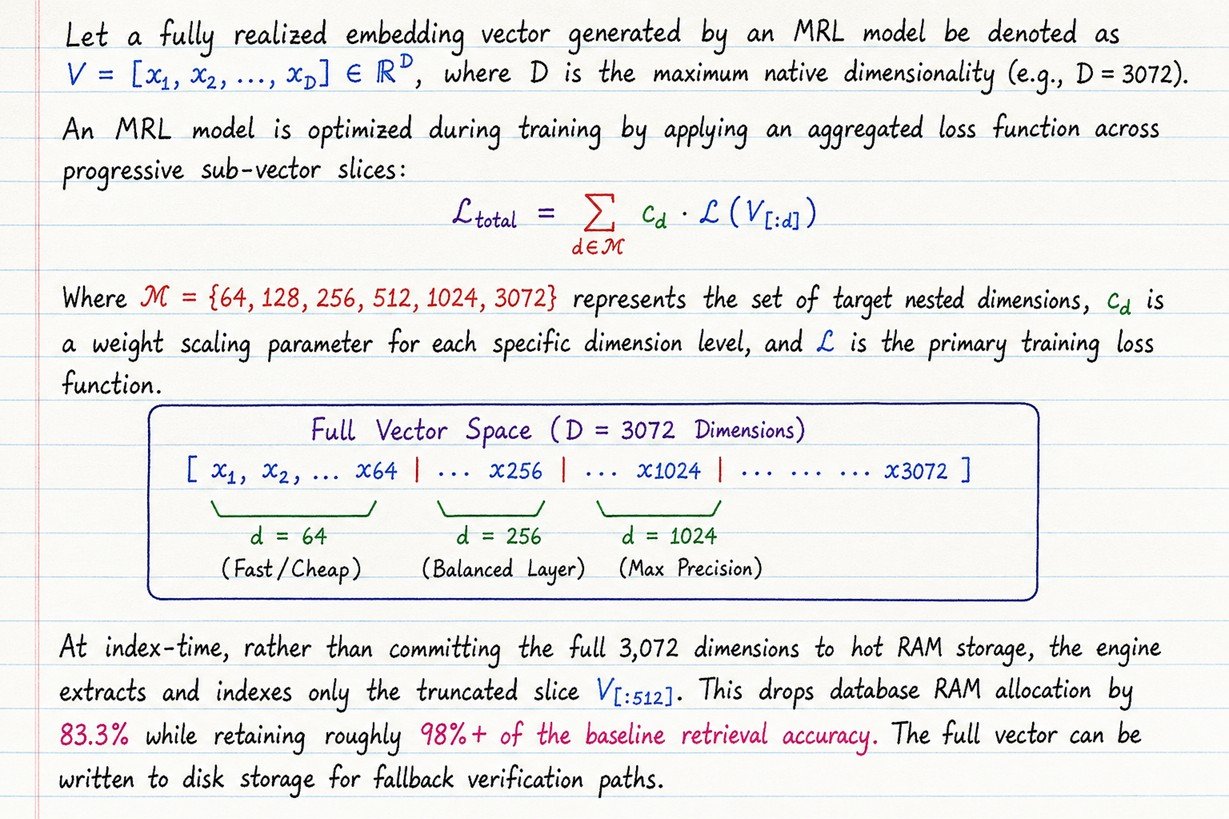
Matryoshka models are trained to pack a document's primary semantic information into the earliest dimensions of the final vector. This architectural pattern allows engineers to dynamically truncate a high-dimensional vector to a fraction of its original footprint without experiencing significant losses in retrieval accuracy.
Mathematical Representation
Sparse-Dense Hybrid Vector Alignment
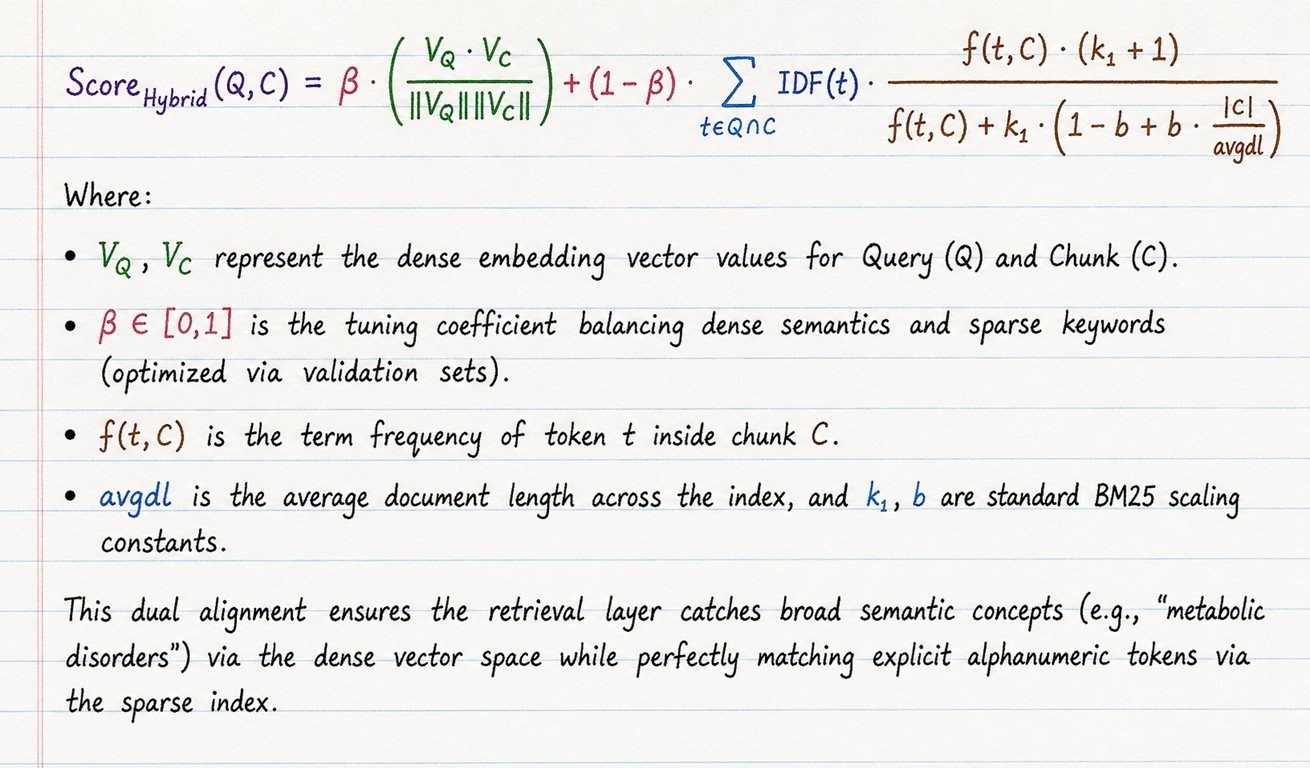
To deliver absolute precision when searching for exact domain codes, such as an ICD-10 code E11.9 or an exact invoice reference code, the architecture combines dense semantic vectors with sparse lexical distributions within a single retrieval layer.
Vector Alignment Formula
The retrieval engine evaluates matches by computing a normalized, hyperparameter-weighted combination of dense vector cosine proximity and sparse BM25 scores:
3. Domain-Specific Customization: Contrastive Fine-Tuning with Triplet Loss
Standard embedding models are typically trained on general-domain sources such as Wikipedia, Reddit, and open-source web books. When deployed within highly specific business environments, such as Healthcare Revenue Cycle Management (RCM), they can fail to resolve localized semantic logic.
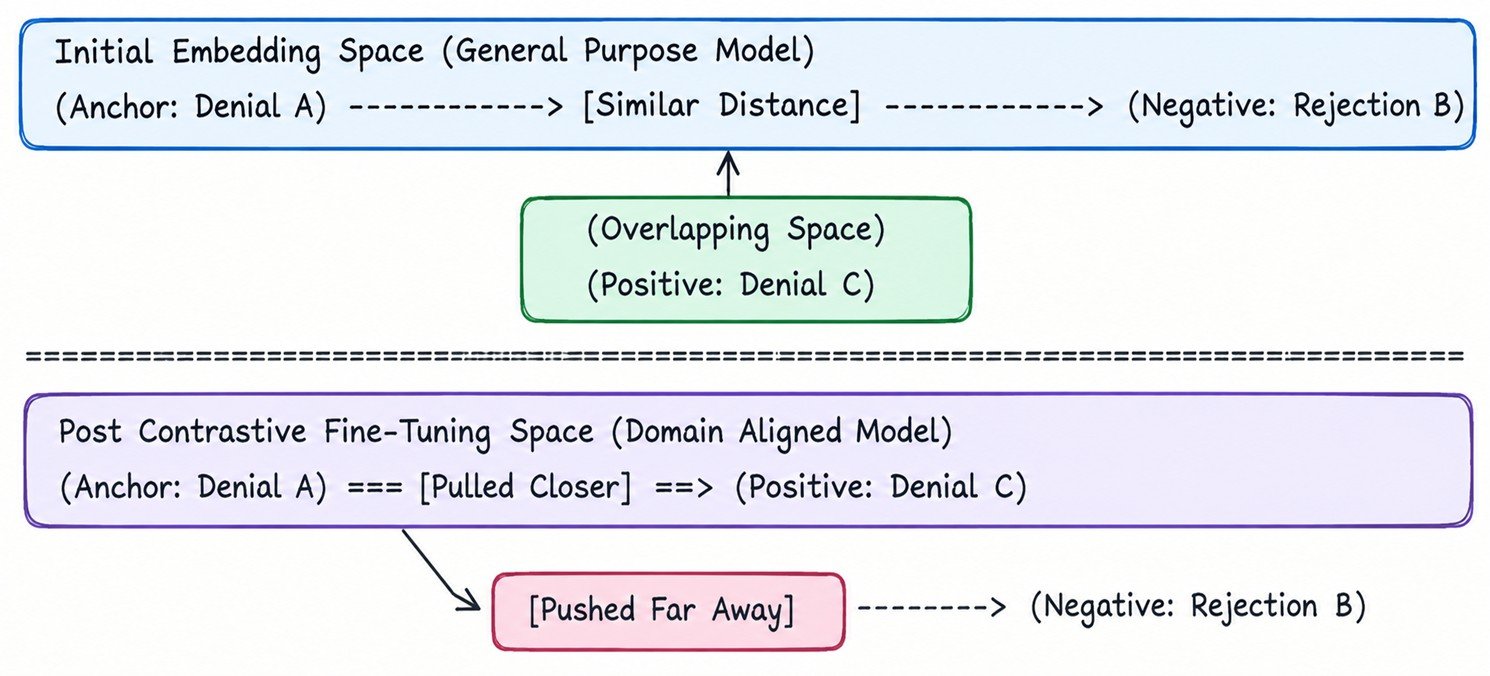
For instance, to a general-purpose model, the phrases "Claim denied due to missing authorization" and "Claim rejected due to formatting error" may appear nearly identical in semantic space. In clinical operations, however, these statements represent completely distinct financial categories requiring entirely different operational workflows.
To address this semantic alignment problem, the architecture must implement a localized Contrastive Fine-Tuning pipeline using custom Triplet Loss configurations.
The Triplet Data Architecture
The enterprise data platform constructs an automated, highly structured training dataset composed of three distinct element types:
- Anchor (A): A target corporate text chunk, such as a specific clinical medical necessity denial notice.
- Positive (P): A distinct text chunk that shares the exact operational semantic meaning, such as a successful appeal argument contesting a medical necessity denial for the same clinical scenario.
- Negative (N): A text chunk that appears visually or lexically similar but belongs to a completely different operational category, such as a technical billing rejection letter regarding formatting issues.
Triplet Loss Mathematical Optimization
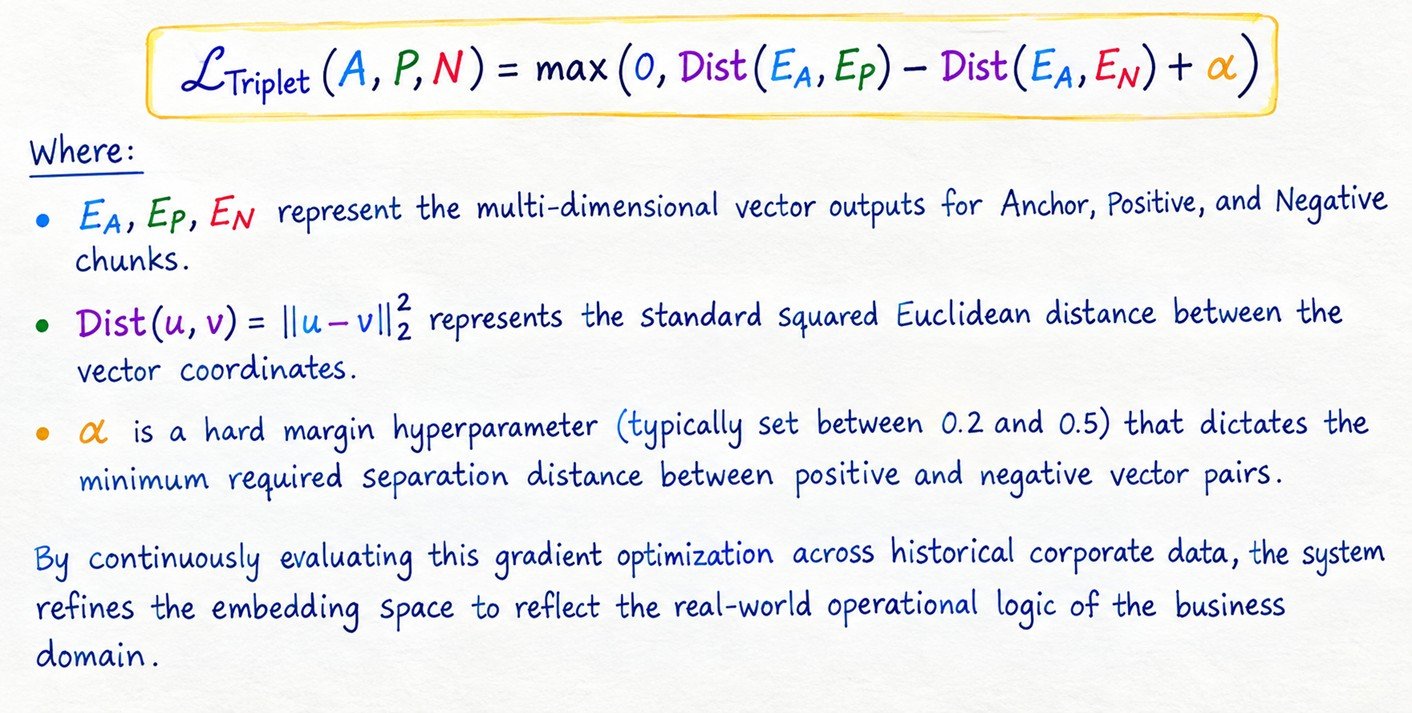
During the fine-tuning optimization run, the embedding encoder is trained to adjust its internal weights so that the anchor vector is pulled closer to the positive vector in multi-dimensional space, while the negative vector is pushed further away.
The objective function is formalized as:
Production Implementation Workflow Blueprint
- Mining Historical Patterns: The data engineering team pulls past operational transcripts and categorizes them by concrete outcomes, such as successful appeals versus systemic rejections.
- Generating Triplet Groups: An automated processing script pairs active text records with matching outcomes (Positives) and structurally similar failures (Negatives).
- Executing the Training Run: A self-hosted open-weights base embedding model is fine-tuned using the Triplet Loss objective function over a series of brief optimization cycles.
- Validating Semantic Separation: The updated model weights are evaluated against a golden validation dataset to ensure the semantic distance between operational categories meets baseline separation thresholds before the weights are pushed to the live production index.
This specialized domain alignment guarantees that downstream vector retrieval engines locate relevant knowledge artifacts with extreme accuracy, providing a robust foundation for enterprise-scale RAG systems and autonomous multi-agent environments.