Hybrid Search Architecture - Query Expansion, Multi-Stage Execution Boundaries, and Rank Fusion Pipelines
Introduction
For technology executives steering enterprise Generative AI initiatives, the retrieval mechanism within a Retrieval-Augmented Generation (RAG) platform represents a critical operational pivot point. If retrieval accuracy is low, the downstream Large Language Model (LLM), regardless of its parameter size or contextual reasoning capabilities, will generate structurally flawed, incomplete, or hallucinated responses.
In demanding operational fields like Healthcare Revenue Cycle Management (RCM), relying on a single retrieval vector is an anti-pattern. Pure semantic vector search excels at capturing broad conceptual relationships but frequently fails to locate specific alphanumeric keys, such as an ICD-10 medical billing code (M54.5) or an exact insurance claim identifier (clm_994821). Conversely, classic keyword search frameworks, such as BM25, excel at exact character matching but lack the semantic awareness to recognize that "spinal inflammation" and "myelitis" describe identical underlying medical scenarios.
Production-grade enterprise architectures resolve this dichotomy by deploying a unified Hybrid Search Engine. This section delivers the cloud-agnostic raw design patterns, multi-stage latency-cost optimization metrics, and rank fusion mathematics required to build an industrialized, sub-100ms hybrid retrieval system.
1. Inbound Query Transformation: Context-Aware Query Expansion Design Patterns
User-generated queries entering an enterprise AI interface are frequently brief, ambiguous, or lacking necessary domain context. If the system attempts to match raw user strings directly against indexed vector-graph stores, the retrieval recall rate degrades significantly. The hybrid retrieval pipeline must execute Context-Aware Query Expansion at the ingestion boundary before touching any data indexes.
The Multi-Fork Expansion Pattern
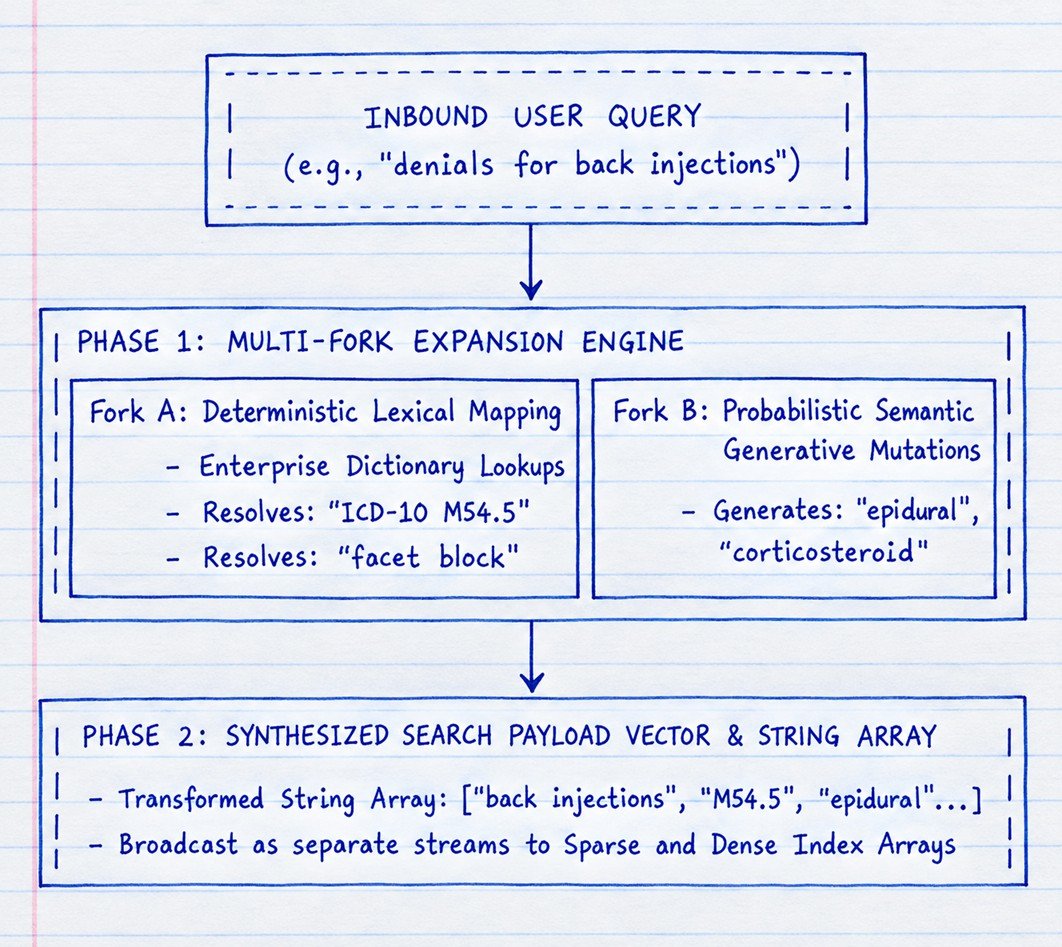
The pipeline intercepts the query and routes it through two parallel expansion forks:
Fork A: Deterministic Lexical Mapping (Enterprise Vocabulary Lookups)
The input string is checked against an in-memory enterprise dictionary or taxonomy store. If the query contains vague vocabulary like "back injections," the lookup engine flags the entry and injects explicit domain synonyms. In our RCM context, this maps the query to precise healthcare categories: ["epidural steroid injection", "ESI", "facet joint block", "CPT 62323", "ICD-10 M54.5"].
Fork B: Probabilistic Semantic Mutations
Simultaneously, a low-latency, highly optimized Small Language Model (SLM) runs a single-token generation path to emit alternative syntactic phrasings. Guided by system prompts, it converts the user prompt into a structured JSON array containing related conceptual phrasing variants.
The Synthesized Search Payload
The outputs of both forks are deduplicated and compiled into an enriched retrieval definition. This unified definition includes the raw user input, the deterministic code keys, and the semantic phrase variations.
This expanded package is broadcast as independent parallel execution streams to the underlying sparse (lexical) and dense (vector) database layers, maximizing search coverage across both index formats.
2. Multi-Stage Execution Boundaries: Optimizing the Latency-Cost-Accuracy Envelope
To implement hybrid retrieval across millions of enterprise document chunks without introducing crippling latency spikes, the system architecture must enforce clear operational boundaries. A common engineering error is executing heavy algorithmic calculations across the entire document corpus.
Production-grade architectures isolate processing tasks into a tiered Two-Stage Multi-Pass Retrieval Pipeline, striking an optimal balance between execution speed, system cost, and retrieval recall accuracy.
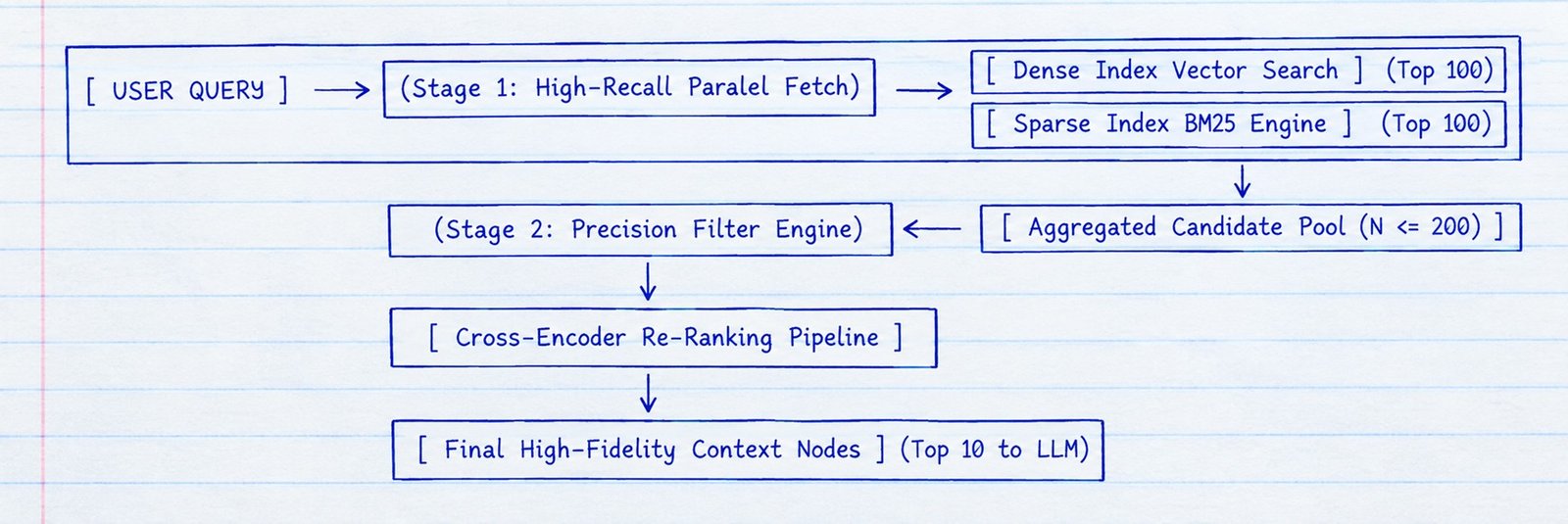
Stage 1: High-Recall Parallel Fetch (Candidate Generation)
Stage 1 is optimized exclusively for maximum data recall. It treats the entire multi-node database structure as the target input but utilizes computationally efficient indexing methods to rapidly isolate candidate chunks.
- Dense Execution: The expanded query is converted into an embedding and passed to the vector database to fetch the top 100 most similar chunks using fast Approximate Nearest Neighbor (ANN) HNSW graph traversal.
- Sparse Execution: Simultaneously, the raw text strings are evaluated by a sparse inverted index engine to retrieve the top 100 matching documents based on BM25 frequency weights.
- Performance Profile: These operations run in parallel. Total Stage 1 execution time is bounded by the slower of the two database lookups, typically finishing in sub-15 milliseconds. The output is a consolidated candidate pool containing up to 200 distinct text nodes.
Stage 2: Precision Filter Engine (Candidate Re-Ranking)
Stage 2 is optimized exclusively for maximum precision. It works only on the small pool of candidate nodes generated by Stage 1, allowing the system to use more powerful, computationally heavy model architectures.
- Cross-Encoder Integration: The system takes the 200 candidate nodes and feeds them, alongside the original user query, into a deep Cross-Encoder re-ranking transformer model.
- Attention Mechanics: Unlike dual-encoder embedding models that process query and document vectors independently, a Cross-Encoder passes the query string and candidate text chunk through full cross-attention layers simultaneously. This allows the model to score the true conditional relevance of every sentence pair with exceptional detail.
- Pruning Output: The Cross-Encoder outputs an optimized relevance score between
0.0and1.0for each chunk. The engine sorts the candidates based on these scores, prunes away low-scoring records, and routes the top 10 highest-fidelity context chunks to the downstream generation model.
Multi-Stage Performance Envelope Metrics
| Operational Dimension | Stage 1: Parallel Fetch | Stage 2: Cross-Encoder Pruning |
|---|---|---|
| Computational Focus | High Recall / Ultra-Low Latency. | High Precision / Context Validation. |
| Data Scope Evaluated | Full database corpus (Millions of rows). | Highly restricted candidate pool ((\le 200) nodes). |
| Algorithmic Complexity | Sparse Inverted Index / HNSW Search. | Deep Cross-Attention Transformer Network. |
| Execution Latency | 10ms–15ms | 30ms–50ms |
| Infrastructure Profile | Low-cost memory and NVMe disk I/O. | Short burst compute on specialized accelerator chips. |
3. Rank Fusion Pipelines: Reciprocal Rank Fusion (RRF) Implementation
A core engineering challenge in hybrid search is merging the disparate scoring spaces of Stage 1 engines. A sparse BM25 lookup outputs unbounded log-frequency ratios, such as scores from 0.0 to 35.4, while a dense vector engine returns bounded cosine similarities, such as scores from -1.0 to 1.0. Attempting to combine these metrics directly using linear weighting schemes is brittle and prone to scoring drift as dataset sizes scale.
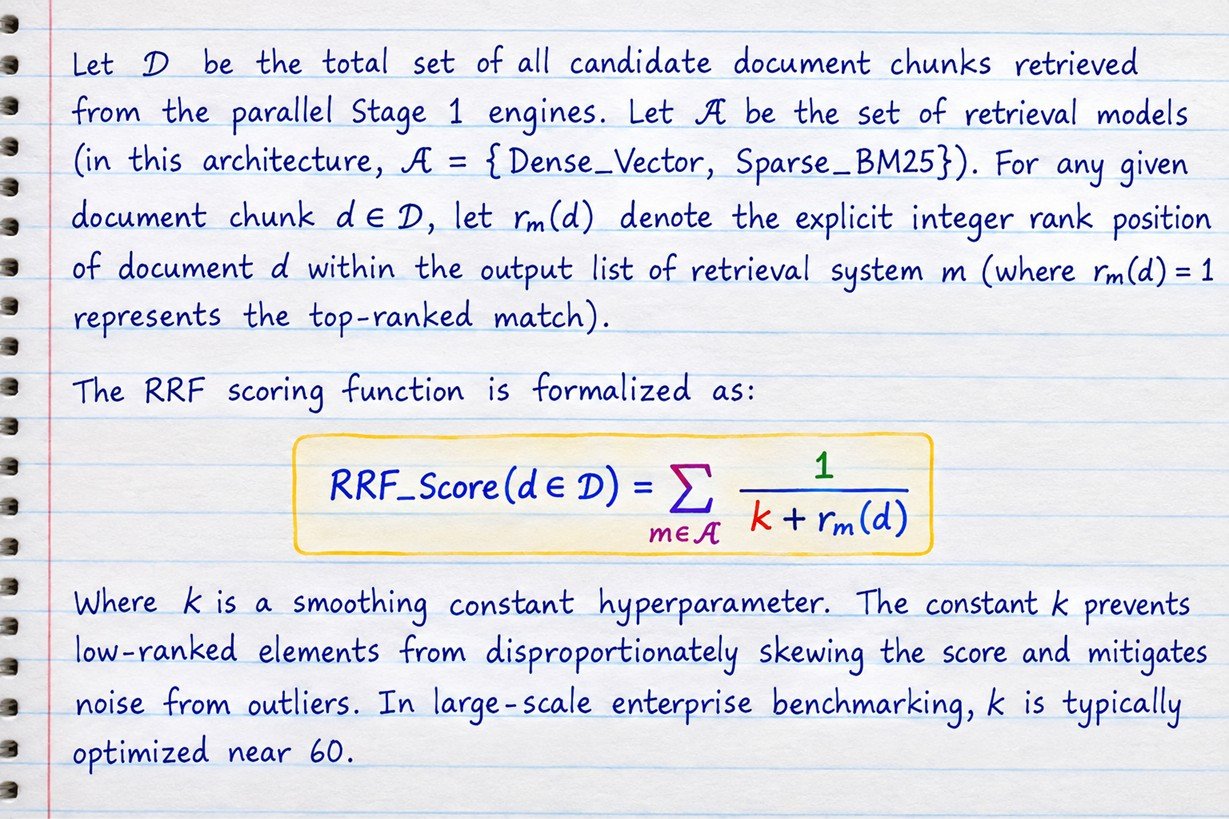
Production enterprise platforms resolve this by using Reciprocal Rank Fusion (RRF). RRF is a model-agnostic, deterministic rank-scoring algorithm that ignores the raw distance scores entirely, focusing instead solely on the relative position (rank) of a document chunk within each independent retrieval index.
Mathematical Foundation
Complete Algorithmic Pipeline Architecture
The raw, cloud-agnostic data flow pattern below shows how an incoming user query is transformed, matched across parallel systems, and consolidated using the deterministic RRF algorithm:
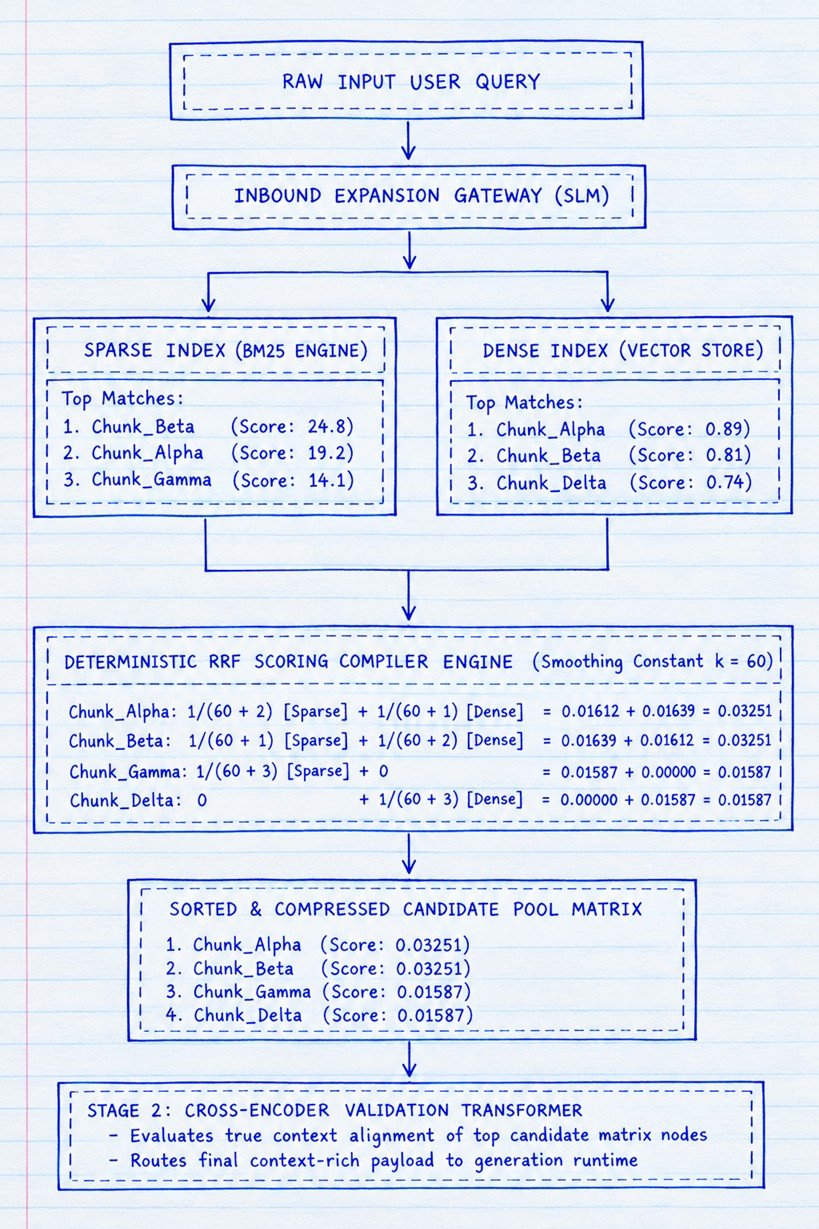
By removing reliance on raw distance scores and focusing purely on normalized rank positioning, RRF guarantees a stable, scalable hybrid retrieval path. This rank fusion blueprint ensures the downstream generation layers receive highly precise corporate context under real-world operational workloads.