Why enterprises need an AI platform
Introduction: The PoC-to-Production Wall
The initial wave of Generative AI adoption was defined by rapid, decentralized experimentation. Engineering teams across the enterprise successfully built thousands of isolated Proof of Concepts (PoCs) using basic API wrappers and open-source frameworks. However, as organizations attempt to move these applications into sustained production environments, they invariably hit a structural wall.
Moving a probabilistic, LLM-powered system into production introduces immense complexities around unpredictable costs, strict latency requirements, security vulnerabilities, and shifting data privacy regulations. When every independent product team attempts to solve these systemic engineering challenges from scratch, the enterprise slips into architectural chaos.
An Enterprise AI Platform is not merely an engineering convenience; it is a governance, security, and financial necessity. It transforms AI capabilities from isolated, fragile projects into a resilient, industrialized corporate utility.
The Architectural Mandate: Unifying Capability for Scaled Enablement
To break through this operational wall, the Enterprise AI Platform shifts the paradigm from individual application development to structural platform engineering. By abstracting foundational model access, compliance routing, and operational tracing into a shared control plane, the platform achieves three primary goals:
-
Radical Decoupling of Logic and Infrastructure: Product teams focus purely on business logic and orchestration, while the platform absorbs the complexity of token rate-limiting, failover topologies, and multi-model provisioning.
-
Systemic Security and Least-Privilege Enclaves: Security boundaries, PII redaction, and compliance guardrails are enforced uniformly at the ingress/egress layers, removing the burden of manual safety implementation from application developers.
-
Operational Predictability at Corporate Scale: The enterprise gains a single pane of glass to audit total token spend, monitor cross-application performance metrics, and dynamically swap model backends as the global AI market matures.
The Anti-Pattern: The Fragmented AI Wilderness
Before designing the architecture of an enterprise AI platform, technology leaders must understand the systemic failures of a decentralized operating model. Without a unified platform, every application team attempts to build its own production-grade stack. This creates a highly fragmented architecture across the enterprise footprint.
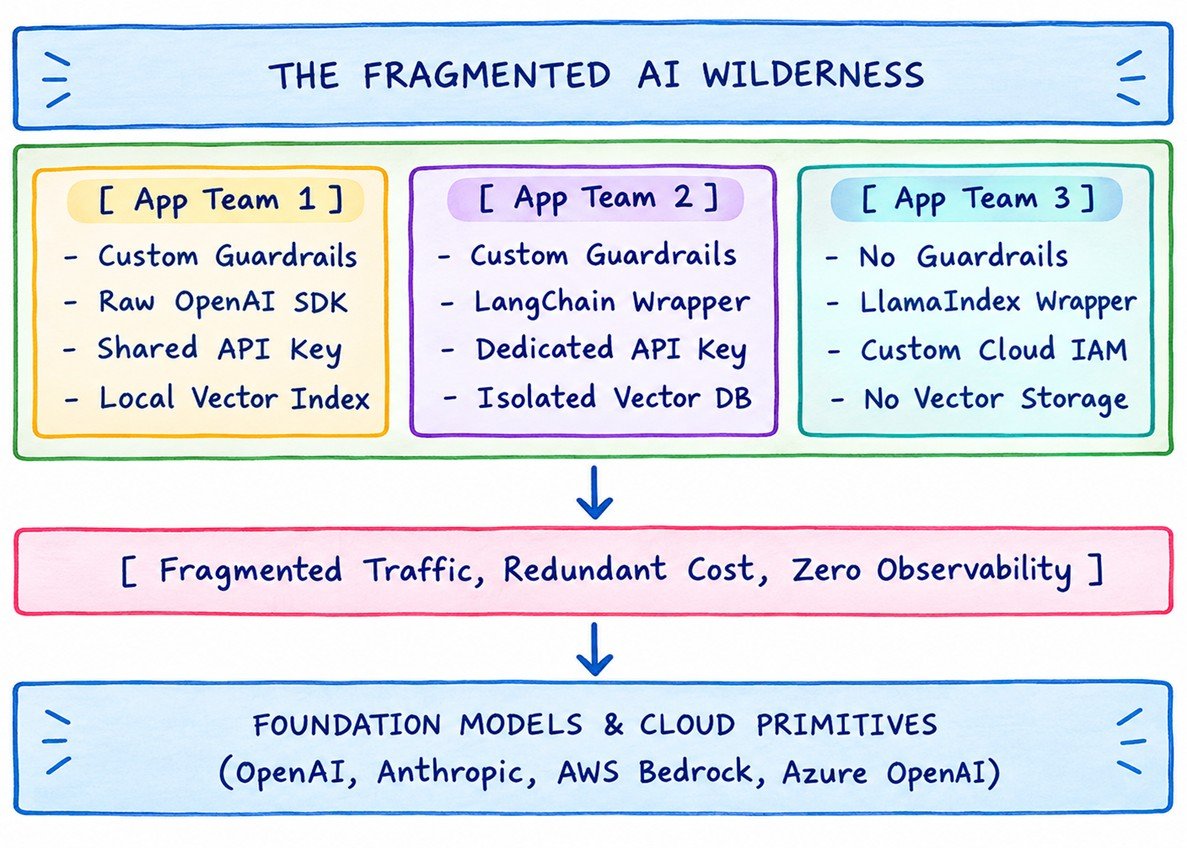
This structural fragmentation introduces three critical enterprise liabilities:
1. The Proliferation of "Shadow AI" and Wrapper Sprawl
When every engineering team operates independently, they naturally gravitate toward developer-friendly wrapper frameworks. While these frameworks are excellent for rapid prototyping, they frequently introduce opaque abstractions, non-deterministic behaviors, and hidden dependencies that complicate long-term maintenance.
Worse, without centralized access controls, teams provision their own external API keys or deploy unvetted open-source models on rogue cloud instances. This creates an unmanageable environment where security teams cannot audit what code is running, which models are being invoked, or what data is leaving the corporate network.
2. The Multi-Cloud and Vendor Lock-In Trap
The foundation model landscape is highly volatile. A model that leads the market in capability and cost efficiency today may be surpassed by a competitor next month.
When application teams tightly couple their business logic to specific, vendor-proprietary APIs or unique cloud-native primitives, they lock the enterprise into that specific ecosystem. If an organization needs to shift a workload from an external API provider to a self-hosted model on a different cloud provider due to changing compliance mandates or cost structures, rewriting dozens of fragmented applications becomes cost-prohibitive.
3. Strategic Blindness (The Observability Deficit)
In a fragmented architecture, leadership lacks a unified pane of glass to evaluate AI investments. There is no centralized mechanism to track total token consumption, analyze system-wide latency, measure model accuracy, or monitor semantic drift.
Without this data, the enterprise cannot accurately calculate the unit economics of its AI applications or determine if its generative systems are genuinely driving business value.
The Catalysts for a Unified AI Platform
The transition from a fragmented environment to a structured AI platform is driven by four structural mandates: Regulatory Compliance, Economic Sustainability, Knowledge Standardization, and Developer Velocity.
1. The Regulatory Compliance & Governance Mandate
For enterprises operating within heavily regulated sectors, such as finance, healthcare, and insurance, under frameworks like the EU AI Act, HIPAA, or strict regional data residency laws, a decentralized AI architecture is a major compliance risk.
The primary catalyst for a unified AI platform is the absolute enforcement of a Data Perimeter and PII Sanitization Layer.
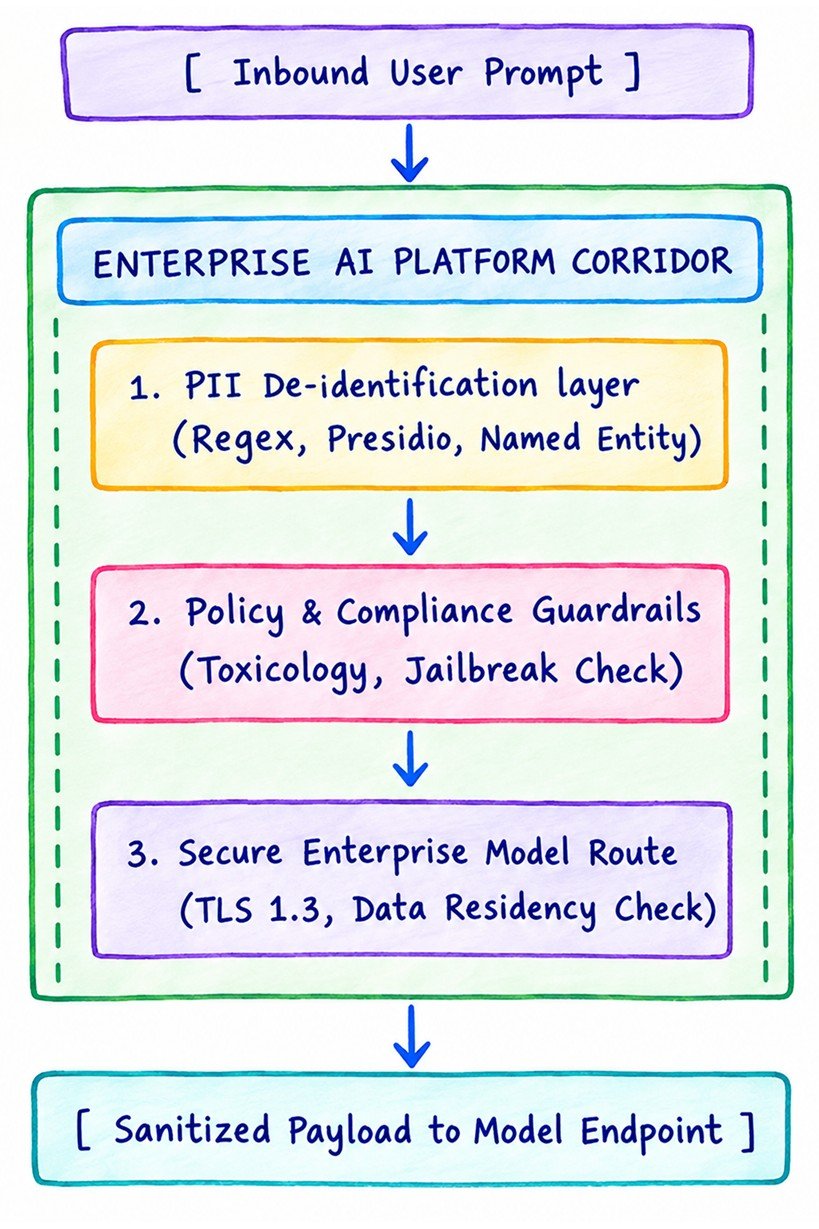
When an application team interacts with a foundation model, the platform acts as an inline proxy. Before any payload leaves the application boundary:
- Automated Inspection: The platform intercepts the prompt and scans it for Protected Health Information (PHI), personally identifiable information (PII), or proprietary source code.
- Token Sanitization: Sensitive entities are dynamically redacted, masked, or tokenized before model submission, and securely re-identified upon response generation.
- Compliance Logging: Every interaction is immutably logged with comprehensive metadata, capturing system prompts, hyperparameter settings, and model versions, to establish a clear audit trail for regulatory reviews.
2. The Economic Sustainability Mandate (FinOps Integration)
As transactional volumes scale from thousands of test queries to millions of production invocations, the unoptimized consumption of token-based APIs quickly leads to unsustainable costs. A unified AI platform operates as the central mechanism for enforcing enterprise-wide FinOps control.
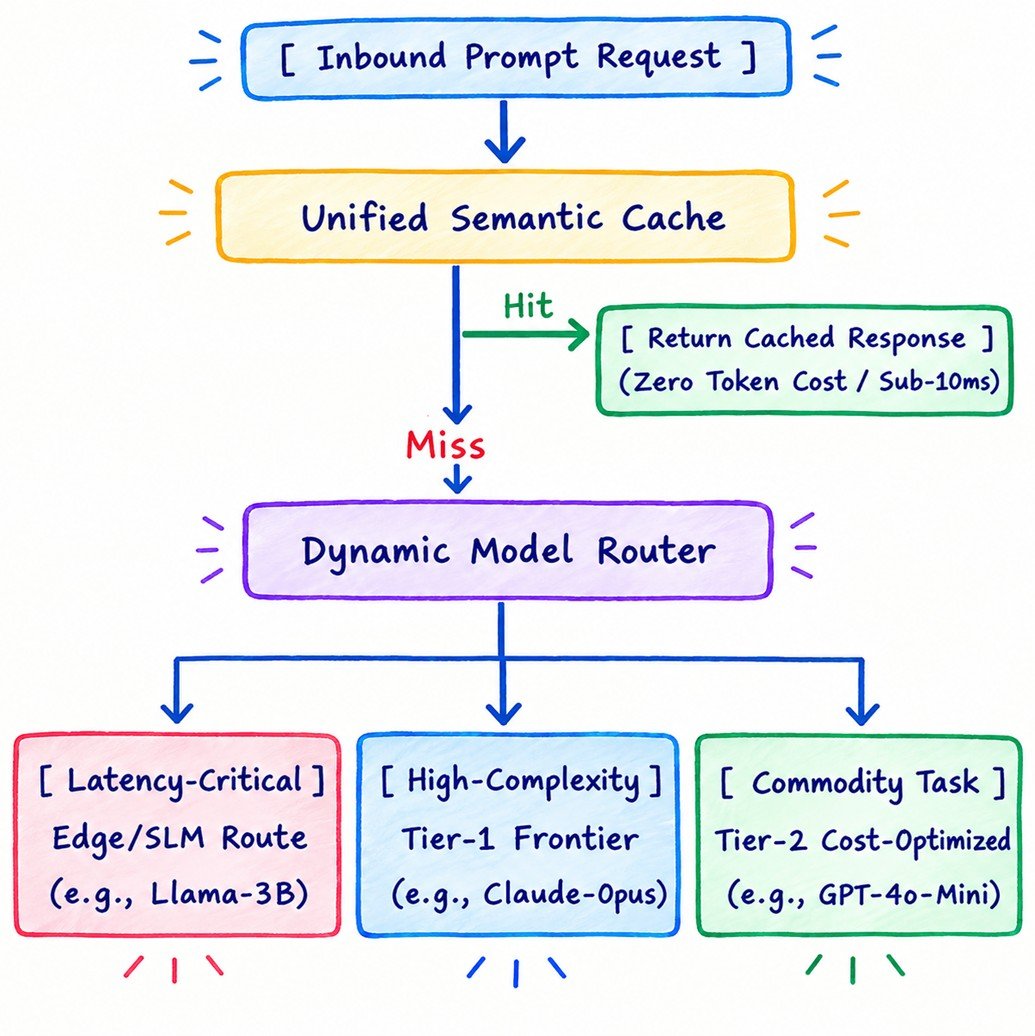
- System-Wide Semantic Caching: Rather than evaluating every prompt uniquely, the platform hosts a high-performance vector-based caching tier. If a new prompt matches the semantic intent of a recently processed query within an approved mathematical threshold, the platform serves the cached response directly. This eliminates downstream inference costs and reduces latency from seconds to milliseconds.
- Intelligent Model Routing: Not every enterprise task requires a premium, frontier-tier foundation model. The platform implements dynamic, policy-based routing engines. A simple classification or text summarization task is automatically routed to a highly economical Small Language Model (SLM) or a cost-optimized cloud primitive. Only highly complex, non-deterministic reasoning tasks are escalated to premium frontier models. This optimized distribution minimizes the organization's average cost per successful task.
3. The Enterprise Knowledge & Artifact Architecture
Modern generative architectures depend heavily on grounding models with corporate data via Retrieval-Augmented Generation (RAG) and Agentic workflows. In a fragmented organization, every team builds separate data parsing, chunking, and vector indexing scripts. This creates highly fragmented silos of enterprise knowledge.
The AI Platform standardizes this layer by providing centralized, reusable utilities that manage the complete lifecycle of corporate data:
- Standardized Data Pipelines: The platform orchestrates cloud-native data primitives into ingestion pipelines that enforce unified document chunking strategies, such as semantic chunking with optimal token overlaps, and standardized embedding generation.
- Managed Vector Infrastructure: Instead of multiple isolated vector database deployments, the platform provisions a multi-tenant, highly secure vector infrastructure. This infrastructure handles index management, shard distribution, and hybrid search optimization, combining keyword and dense vector retrieval, as a shared utility service for all applications.
- Unified Tool and Agent Registries: As applications evolve from simple chatbots into autonomous agents, they must securely interact with internal systems via APIs. The platform establishes a centralized, governed Tool Registry. Every API tool exposed to an LLM is securely registered, authenticated, version-controlled, and continuously audited for data exfiltration risks.
4. The Maximization of Developer Velocity
The primary objective of an engineering team should be designing business logic and optimizing user experiences, not reinventing foundational AI infrastructure.
By abstracting model integration APIs, authentication protocols, rate limiting, and fallback configurations into a single, highly available platform layer, application developers can move quickly. Integrating advanced generative capabilities becomes as straightforward as calling a standardized internal SDK or API endpoint.
The Blueprint: The Architectural Paradigm Shift
The implementation of an Enterprise AI Platform fundamentally changes how applications interact with intelligent systems. It moves the organization away from point-to-point integrations and establishes a secure, managed corridor for all AI workloads.
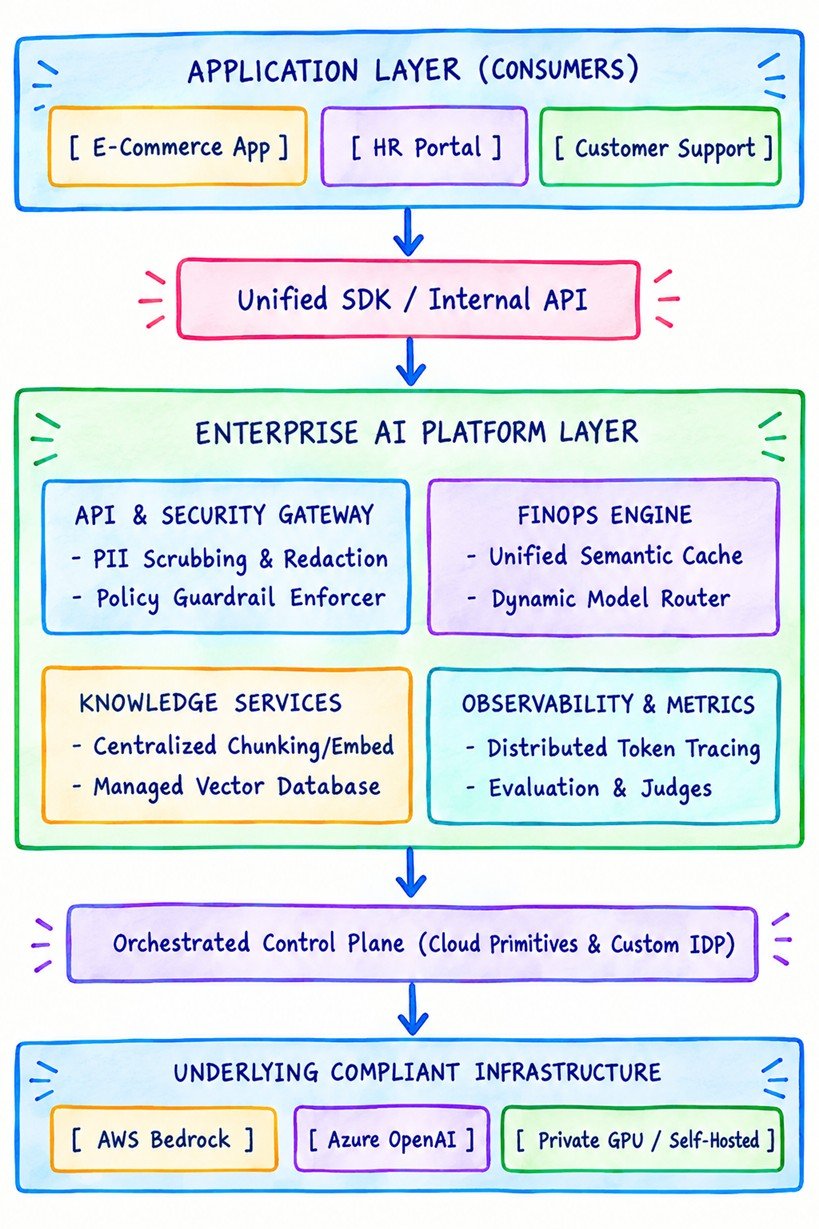
| Architectural Capability | Without an AI Platform (The Fragmented Wilderness) | With a Managed AI Platform |
|---|---|---|
| Data Perimeter Protection | Ad-hoc; dependent on individual developers correctly configuring API parameters. Highly vulnerable to PII leakage. | Automated inline scanning, PII redaction, and policy enforcement at the gateway level before data leaves the network. |
| Model Abstraction & Agility | Tight coupling to specific model APIs; changing vendors requires extensive application code refactoring. | Loose coupling; applications target a stable internal API, allowing the platform team to swap model providers transparently. |
| Cost Optimization | Zero cross-team efficiency. Duplicate queries repeatedly invoke downstream APIs, driving up token costs. | Centralized semantic caching and dynamic routing minimize premium model calls and lower inference expenses. |
| Knowledge Architecture | Siloed, inconsistent vector indexes with highly variable chunking and embedding strategies. | Centralized RAG pipelines, shared multi-tenant vector infrastructure, and governed tool registries. |
| Enterprise Observability | Blind spots; impossible to audit total usage, performance metrics, accuracy, or cost distributions. | Comprehensive distributed tracing, centralized telemetry, and automated LLM-as-a-Judge evaluations. |
Conclusion
For enterprise technology leaders, building a dedicated AI platform is no longer an optional engineering preference. It is a foundational business necessity. Relying on fragmented application wrappers and direct, unmonitored API integrations introduces major security risks, unpredictable costs, and operational bottlenecks.
By establishing a centralized, production-grade AI platform, the enterprise securely isolates its sensitive data assets, optimizes its operational costs, and provides engineering teams with the reliable infrastructure they need to build high-impact applications. The AI platform transforms Generative AI from a collection of fragile proofs of concept into a resilient, scalable, and highly industrialized enterprise asset.