Guardrail Services - The Enterprise Safety and Compliance Proxy
Introduction
Deploying generative AI across an enterprise introduces a new class of runtime security vulnerabilities. Unlike deterministic web applications, probabilistic LLM interfaces are susceptible to prompt injection attacks, accidental PII leakage, toxic output generation, and intellectual property (IP) violations. Relying on the native safety filters of public foundation models is insufficient for enterprise compliance; these filters can be bypassed by sophisticated jailbreaks and often lack alignment with specific corporate data policies.
Guardrail Services act as the security proxy layer of the Enterprise AI Platform. Placed directly within the ingress and egress paths of the Model Gateway, this service runs a dual-plane security strategy:
- Inline Synchronous Inspection: A sub-20ms firewall that sanitizes inputs and blocks unsafe outputs before they reach the backend models or end users.
- Out-of-Band Asynchronous Auditing: A parallel system that tracks long-term compliance, analyzes security trends, and flags anomalies without slowing down the live user experience.
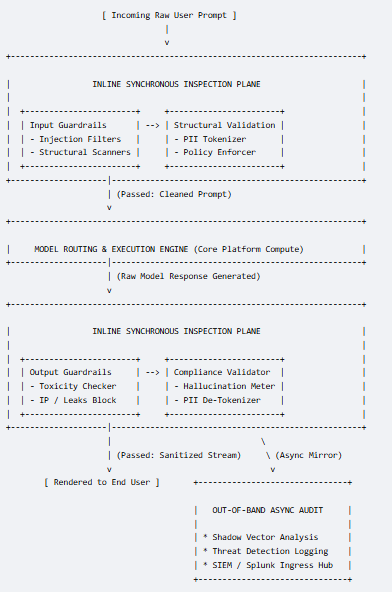
1. Inline Synchronous Inspection Plane (Input & Output)
The inline inspection plane acts as a low-latency proxy positioned directly in the request path. To prevent usability bottlenecks, this layer must execute its entire check sequence in under 20 milliseconds. It uses specialized, single-purpose scanning models rather than large foundation models to keep latency low.
Input Guardrail Architecture: Prompt Injection and Jailbreak Filters
When a user prompt enters the platform, it is evaluated for malicious structural anomalies.
- Heuristic Keyword Scanning: The engine scans for known jailbreak strings and formatting patterns, such as
"Ignore all previous instructions"and"You are now in Developer Mode". - Vector Intent Match: The prompt is converted into a vector embedding and matched against a local, fast vector database containing known jailbreak templates. If the cosine similarity crosses a strict safety threshold, the request is instantly blocked.
- Indirect Ingestion Attacks: When using RAG pipelines, external documents can introduce hidden threats. The input guardrail inspects retrieved text segments for hidden system commands designed to hijack the model's instructions mid-session.
Structural PII Masking and Tokenization Pipelines
To comply with global data regulations, such as GDPR and CCPA, raw Personally Identifiable Information (PII) must be stripped before a payload leaves the enterprise firewall.
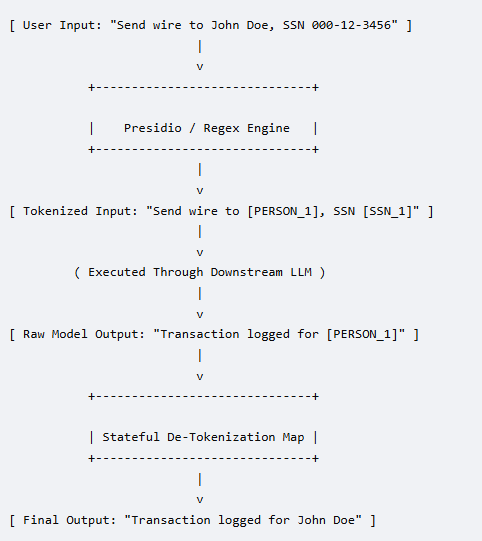
- Named Entity Recognition (NER): The pipeline uses high-speed sequence classification models, such as Microsoft Presidio or specialized spaCy pipelines, alongside standard regex filters to identify structured data such as Social Security Numbers, credit card numbers, email addresses, and names.
- Stateful Tokenization Map: Identified entities are replaced with anonymous placeholder tokens, such as
[SSN_1]. The real values are stored securely in a short-lived, in-memory lookup table. - Egress De-Tokenization: When the model responds, the output passes through an egress de-tokenizer. This engine reconstructs the text by replacing the placeholder tokens with the original values, ensuring the end user sees the correct information while keeping the backend provider completely blind to the raw private data.
Output Guardrail Architecture: Toxicity, IP Leaks, and Hallucination Control
The egress guardrail evaluates the model's generated output before it reaches the user interface.
- Toxicity and Sentiment Checks: Fast classification layers scan the output text stream for profanity, hate speech, or off-brand responses.
- Intellectual Property Protection: The system monitors for potential copyright violations by comparing long blocks of generated code or text against protected corporate repositories or open-source licenses.
- Hallucination Filters: For data-critical workflows, the engine compares the model's response against the original source documents retrieved during the RAG step. If the output introduces concepts missing from the verified source context, the engine intercepts the response.
2. Out-of-Band Asynchronous Auditing Plane
While inline inspection blocks immediate threats, long-term compliance and threat detection require an out-of-band auditing plane. This system operates asynchronously, using mirrored traffic payloads to run complex analysis without adding latency to the live user experience.
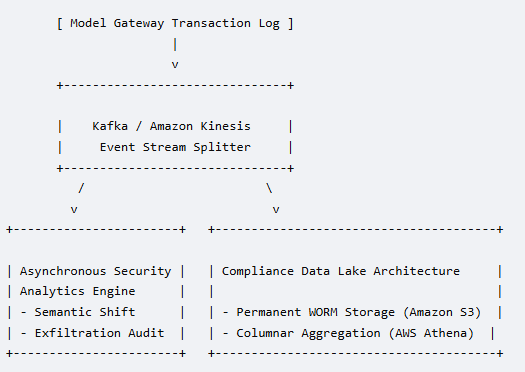
Async Auditing Mechanics
- Traffic Mirroring: As the Model Gateway completes a transaction, it publishes a cloned copy of the input prompt, retrieved context, and generated output to a distributed stream processor, such as Amazon Kinesis or Apache Kafka.
- Semantic Shift Analysis: A background analytics worker reviews the stream over time to identify slow-moving security risks, such as data exfiltration attempts where a user piecemeal extracts sensitive information across hundreds of low-volume sessions.
- SIEM Ingress Hub: Audit logs are formatted into structured JSON files and pushed directly to corporate Security Information and Event Management (SIEM) systems, such as Splunk or AWS Security Lake. This allows security operations teams to view AI usage alongside traditional enterprise network telemetry.
3. Reference Implementation: Pure Logical Proxy Interception Pattern
To maintain platform flexibility, the guardrail system should follow a vendor-agnostic logical interception pattern. This model can be implemented using open-source tools or integrated directly with cloud-native options like Amazon Bedrock Guardrails.
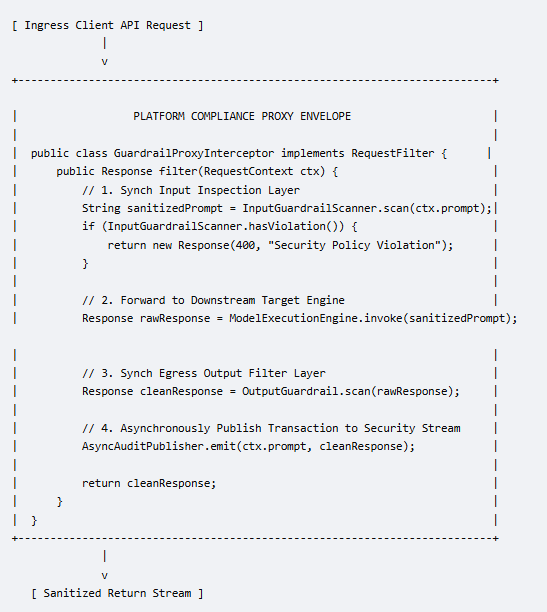
Implementation Architecture
- Decoupled Interception: The logical proxy pattern isolates the security logic from both the application front ends and the backend model engines.
- Cloud Infrastructure Mapping: Organizations can implement this pattern natively using cloud services like Amazon Bedrock Guardrails. Bedrock provides managed endpoints that automatically handle PII masking, keyword blocking, and safety scoring directly within the API gateway layer, delivering robust security controls without the burden of managing raw infrastructure.
4. Prompt Watermarking and Egress Steganography: Traceable Output Provenance
As generative AI content spreads across corporate channels, enterprises face a growing risk of insider data exfiltration. Malicious or negligent actors can copy proprietary code, strategic marketing plans, or confidential regulatory reports out of the platform interface and post them to public forums, file-sharing sites, or corporate communication channels. Because text copy-pasting strips traditional file metadata and access control lists, tracing a raw text block back to the leaking user session is incredibly difficult.
Prompt Watermarking and Egress Steganography addresses this vulnerability. This technique embeds invisible, mathematically verifiable fingerprint signatures directly into the model's text stream as it is generated. By positioning this service in the egress path of the Model Gateway, the platform can trace any leaked text snippet back to the exact user ID, session timestamp, and application origin without modifying the core model weights or changing the visible text.
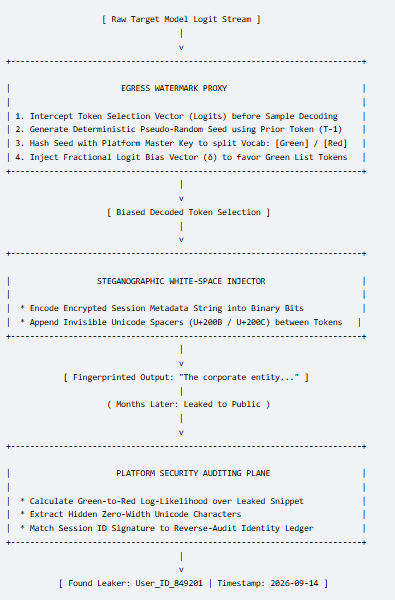
Token-Level Generative Watermarking Mechanics
To watermark text naturally without degrading writing quality, the egress proxy modifies the final token generation probabilities (logits) at runtime. This process relies on a shared platform key and token-level classification:
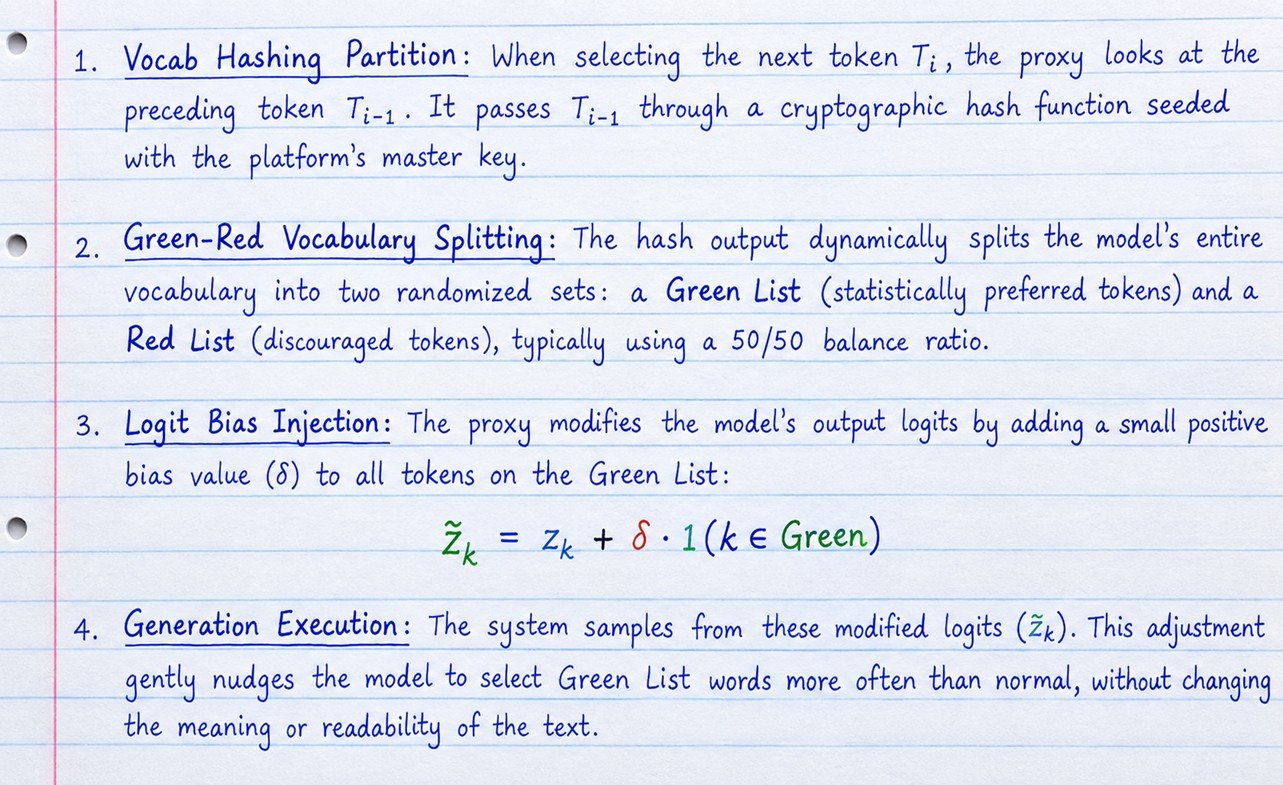
When human beings write or edit text, their word choices are generally balanced across both lists. However, a snippet generated by this watermarked engine will contain an unnaturally high concentration of Green List tokens. If a 200-word paragraph is leaked, the platform's security audit plane can analyze it using the master key. It calculates the statistical log-likelihood of the word distribution. If the Green List density crosses a specific threshold, the snippet is verified as platform-generated with near-statistical certainty.
Egress Steganography and Zero-Width Unicode Injection
While token-level watermarking confirms the origin platform, it cannot pinpoint the exact user session. To embed distinct tracking data, such as user IDs and timestamps, into short text snippets, the egress engine applies Zero-Width Unicode Steganography:
- Metadata Encoding: The proxy serializes the transaction's tracking data, such as
Tenant: Corp-A, User: 849201, TS: 1792184100, and compresses it into a standard binary bitstream, such as01011001.... - Invisible Character Mapping: These binary bits are mapped directly to invisible, non-rendering Unicode characters. For example, a
0bit maps to a Zero-Width Space (U+200B), and a1bit maps to a Zero-Width Non-Joiner (U+200C). - Token Interleaving: The proxy injects these invisible characters between standard words and punctuation marks as the text stream is sent to the client interface.
The resulting text looks completely normal to the user and passes through standard text editors undetected. However, if that text is later found in an unapproved location, a security officer can paste the raw string into the platform's forensics tool. The tool extracts the hidden Unicode sequence, decodes the binary stream, and immediately identifies the exact user session responsible for the leak.
5. Red-Teaming Automation and Drift Detection: Continuous Security Validation
Guardrails are not static defenses. As foundation models are updated, new open-source software libraries are deployed, and adversarial prompt injection techniques evolve globally, a platform's defensive baseline experiences security drift. An exploit vector that was successfully intercepted by a semantic guardrail filter yesterday might bypass it today because of minor changes in model routing logic or subtle formatting updates in an upstream RAG pipeline.
To combat this, a production-grade Enterprise AI Platform cannot rely on manual, seasonal penetration testing. It must deploy a Continuous Automated Red-Teaming (CART) Pipeline. Operating entirely out-of-band within the auditing plane, this framework uses specialized adversarial agent models to run continuous, simulated attacks against the active guardrail layers, catching defensive regressions before malicious actors can exploit them.
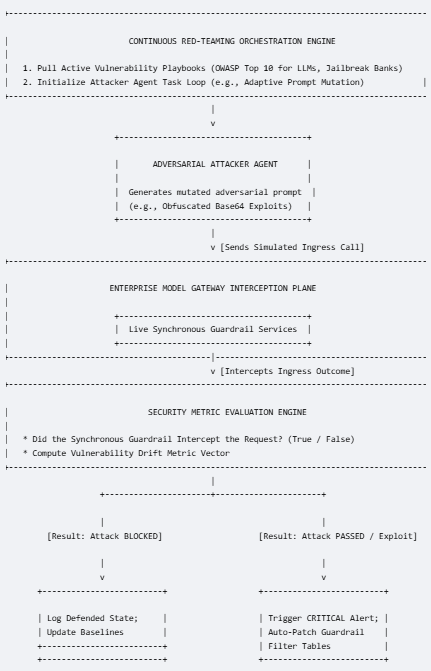
The Adversarial Attacker-Evaluator Loop
The automated red-teaming pipeline runs an iterative loop driven by two competing components: an Adversarial Attacker Agent and a Defensive Evaluator.
- Vulnerability Playbook Seeding: The pipeline pulls the latest known vulnerability vectors from an updated security repository, such as the OWASP Top 10 for LLM Applications or empirical jailbreak databases.
- Adversarial Prompt Mutation: Instead of sending static attack strings, the Attacker Agent uses an LLM fine-tuned for security exploitation. This model dynamically alters the attack payload, applying techniques such as character obfuscation, multi-language wrapping, Base64 encoding, or hypothetical role-play framing to disguise the malicious intent.
- Simulated Execution: The pipeline routes the mutated prompt through a test gateway endpoint that mirrors the exact configuration of the live production environment.
- Outcome Classification: The Defensive Evaluator reviews the system's reaction. If the synchronous guardrail layer intercepts the prompt and returns a
400 Bad Request, the attack fails, and the defense remains validated. If the prompt bypasses the guardrail and elicits an unsafe response from the target backend model, a security regression is confirmed.
Tracking and Measuring Defensive Drift
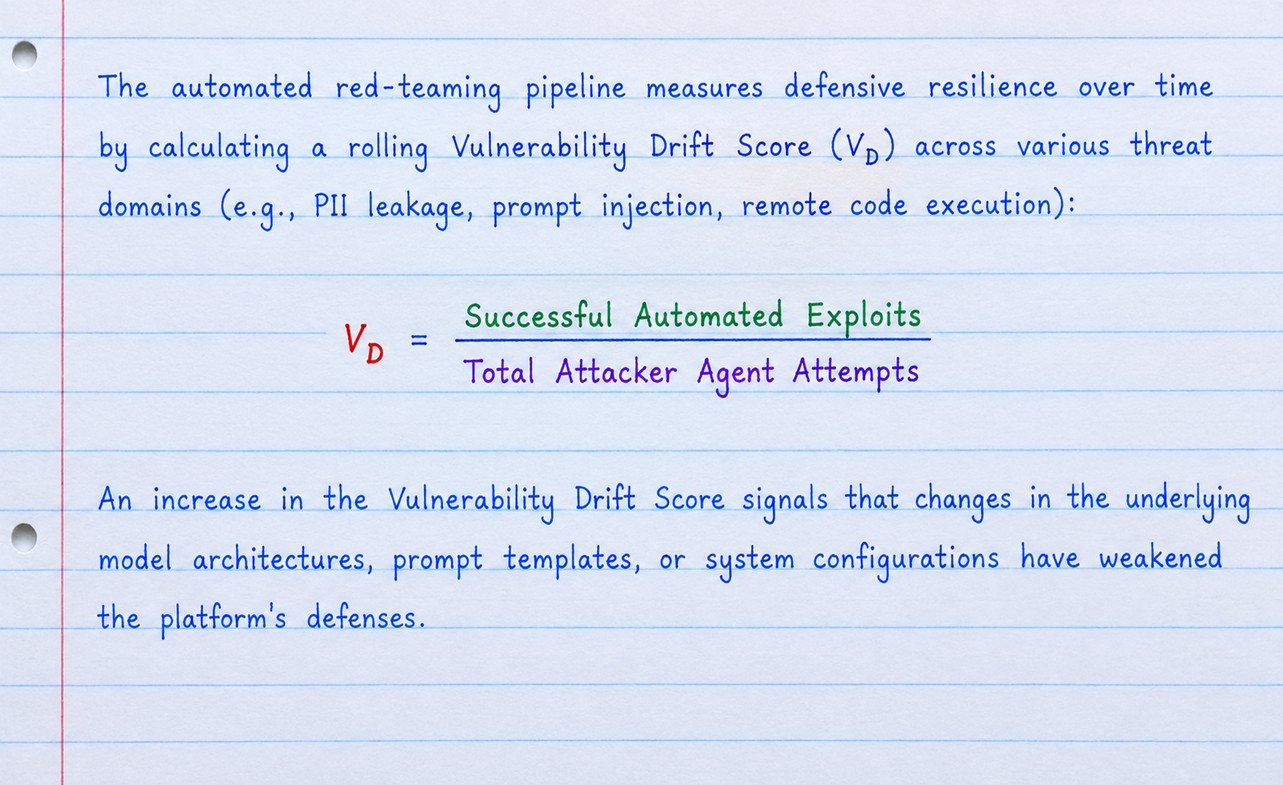
Automated Hot-Patching and SIEM Escalation
When the pipeline detects a high-severity guardrail failure, it bypasses standard slow patching cycles to secure the system immediately:
- Real-Time Vector Store Appends: The pipeline captures the successful adversarial prompt string, converts it into a vector embedding, and writes it directly into the input guardrail's low-latency blocklist database. This hot patch instantly protects the live Model Gateway against that specific attack pattern and its close structural variations.
- Targeted Rule Updates: The framework automatically generates regex matching rules or adjusts string-similarity thresholds to block the new exploit vector at the proxy layer.
- Security Incident Escalation: The platform compiles a detailed vulnerability report, including the full prompt mutation path and the model's unredacted output, and fires a critical security incident alert to the enterprise SIEM, such as Splunk or AWS Security Lake, allowing security teams to perform urgent root-cause analysis.
6. Context-Aware Dynamic Thresholding: Adaptive Safety Controls
A common point of friction in enterprise AI deployments is the rigidity of traditional security filtering. Applying a single, uniform safety policy across an entire global organization creates operational inefficiencies. A strict toxicity and content rule designed for customer-facing support bots will break workflows if applied blindly to a legal discovery team analyzing hostile litigation documents or to a cybersecurity incident response team scanning raw malware strings. Conversely, relaxing filters to accommodate research teams introduces unacceptable risk if those relaxed boundaries leak into public-facing applications.
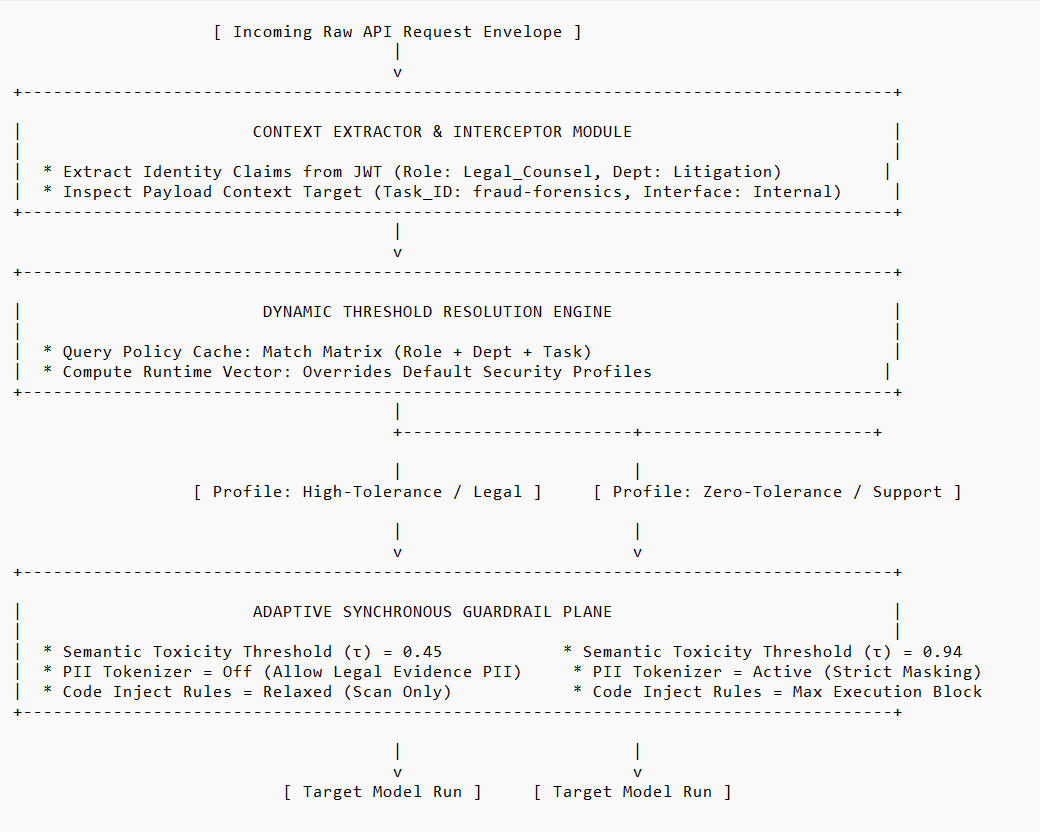
Context-Aware Dynamic Thresholding solves this conflict by transforming the guardrail plane from a static firewall into a context-sensitive proxy. Operating at the wire level within the Model Gateway interceptor, this architecture dynamically adjusts semantic tolerance scores, regex enforcement arrays, and PII redaction rules in real time. It recalculates these settings for every transaction by analyzing the user's role, department, and specific business task being executed.
The Contextual Matrix Resolver
When a request packet lands at the Model Gateway proxy, it passes through a Contextual Matrix Resolver before any safety filters are executed. This resolver compiles an operational runtime context vector by evaluating three primary layers:
-
Identity and Entitlement Claims:
The proxy parses the user's cryptographically validated JSON Web Token (JWT) to extract structural claims, such as
roles: ["SecOps-Analyst"]anddepartment: ["Cybersecurity"]. -
Application Target Profile: The gateway identifies the consuming application's profile class. Internal, employee-facing knowledge systems are granted different baseline risk profiles compared to external customer-facing web chat interfaces.
-
Declared Task Intention: Applications pass a signed metadata header specifying the active business task, such as
task_intent: "malware-log-decompilation"ortask_intent: "public-press-release-generation".
Mathematical Threshold Adjustments
Once the context vector is compiled, the engine queries an in-memory policy cache to apply exact mathematical overrides to the guardrail parameters.
For example, when evaluating semantic toxicity or prompt injection vectors using cosine similarity distance matches, the system replaces the static baseline threshold with a contextual variable, tau_runtime:
// Example Evaluated Runtime Policy Configuration
{
  "context_match": {
    "role": "SecOps-Analyst",
    "department": "Cybersecurity",
    "task_intent": "malware-log-decompilation"
  },
  "runtime_overrides": {
    "semantic_filters": {
      "injection_attack_threshold": 0.98,
      "toxicity_censorship_threshold": 0.35
    },
    "pii_masking": {
      "enforced": false,
      "exception_types": ["IP_ADDRESS", "EMAIL_ADDRESS"]
    },
    "structural_code_blocks": {
      "allow_executable_scripts": true
    }
  }
}
- Toxicity Relaxation: Under this specific policy, the toxicity threshold drops to
0.35. This change allows the cybersecurity analyst to feed raw, aggressive phishing email text containing profane or hostile language into the model for analysis without the guardrail intercepting the request. - Injection Tightening: Conversely, because malware analysis introduces a high risk of indirect prompt injection hidden inside log strings, the injection attack threshold tightens to a highly sensitive
0.98. This setting ensures the guardrail blocks any hidden commands inside the logs that try to hijack the model's primary instructions.
Cryptographic Intent Validation and Anti-Tampering
Allowing client applications to pass metadata flags that lower security thresholds introduces a clear exploit vector: a compromised front end could theoretically fake a high-privilege task_intent string to bypass platform guardrails.
To prevent this tampering, the Enterprise AI Platform enforces Cryptographic Intent Validation:
- Signed Metadata Payloads: Any application requesting a high-tolerance guardrail profile must submit a token signed by a trusted identity provider or the corporate security orchestrator.
- Gateway-Level Privilege Check: The Guardrail Service recalculates the permissions independently at the gateway layer. If the signature is invalid or the user's backend Active Directory profile does not explicitly support the requested high-privilege role, the proxy ignores the request headers, applies the maximum zero-tolerance safety profile, and logs a security compliance violation to the enterprise SIEM.
7. Leadership Takeaways: Strategic Imperatives for the C-Suite
For technology executives, an enterprise guardrail strategy cannot be reduced to a binary toggle between "open access" and "complete block." Treating AI safety as a static, uniform filter hamstrings engineering velocity, irritates line-of-business developers, and leaves the enterprise blind to sophisticated, multi-turn data exfiltration vectors.
To establish an enduring security perimeter, technology leaders must drive three key strategic imperatives:
- Move Safety Control to the Network Wire: Never leave security implementation up to individual application front ends or native, black-box vendor safety APIs. The enterprise must deploy its own decoupled, inline security proxy layer directly within the ingress control plane to ensure consistent policy enforcement across every model and application.
- Enforce Context-Aware Security Profiles: Static, one-size-fits-all guardrails introduce operational friction and stall adoption. Insist on a dynamic, context-aware threshold architecture that automatically tailors safety boundaries, balancing strict protection for public-facing assets with operational flexibility for highly sensitive, internal expert teams.
- Implement Continuous Defensive Testing: Guardrails age and experience security drift the moment they are deployed. Treat AI safety like traditional software quality by investing in continuous, automated red-teaming pipelines that constantly test your defenses against modern jailbreak techniques, catching vulnerabilities before they can hit production infrastructure.