RAG Services - The Enterprise Contextual Augmentation Engine
Introduction
A foundation model lacks access to private, real-time enterprise data. While fine-tuning adjusts a model's style, behavior, or domain-specific terminology, it is an expensive and slow mechanism for injecting fluid corporate knowledge. Retrieval-Augmented Generation (RAG) Services provide the authoritative bridge between unstructured enterprise data stores and probabilistic inference models.
At production scale, naive RAG architectures, which simply convert a prompt to an embedding, run a single-vector search, and pass the raw text fragments to an LLM, fail to meet enterprise standards. They suffer from semantic noise, retrieval misses that lead to hallucinations, lack of access control, and high latency.
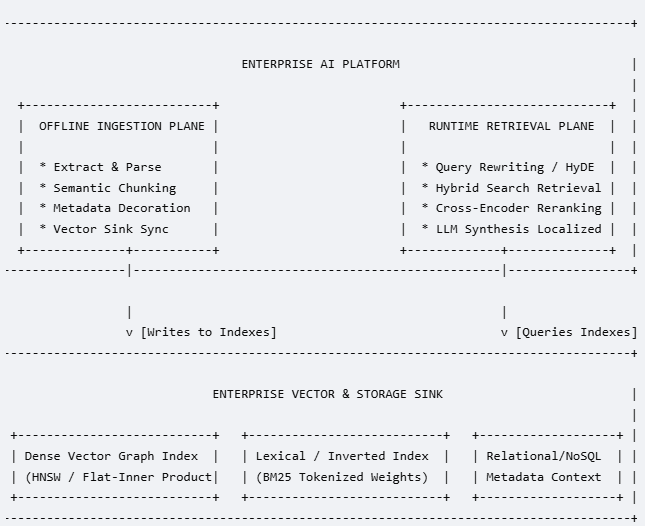
A production-grade Enterprise RAG architecture must treat data ingestion and runtime retrieval as two distinct, decoupled planes. This section outlines how to design an enterprise-grade RAG infrastructure that ensures data security, sub-second latency, and contextually precise synthesis.
1. The Offline Data Ingestion & Enrichment Plane
The reliability of a runtime retrieval step is entirely dependent on the structural hygiene of the offline data ingestion pipeline. This pipeline must process multi-format document lakes asynchronously, normalizing disparate corporate data into semantically dense, structured segments.
Document Extraction and Multimodal Partitioning
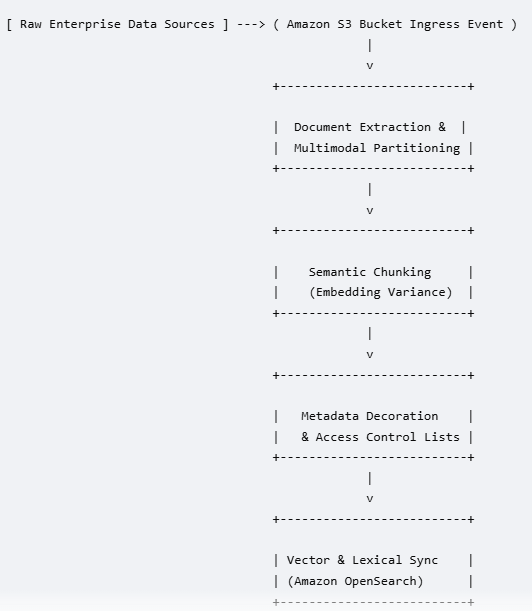
Data ingestion begins by monitoring data stores, such as an Amazon S3 landing zone, using event-driven microservices. Raw files, including PDFs, PPTXs, HTML pages, and scanned images, are passed through structural document parsers.
- Text lines are extracted while preserving semantic layout boundaries.
- Complex components, such as tables, charts, and embedded images, are partitioned using visual document layout analysis models.
- Tables are converted into Markdown or structured JSON formats, rather than raw text streams, to preserve their relational coordinate meaning.
Semantic Chunking and Token Optimization
Traditional chunking methods rely on fixed character counts with arbitrary offsets, such as 500 characters with a 50-character overlap. This approach routinely splits sentences mid-thought, destroying semantic context. Enterprise RAG pipelines utilize Semantic Chunking:
- Sentence Disaggregation: The document parser splits the extracted text block into distinct, complete sentences based on structural punctuation boundaries.
- Vector Distance Sliding Scale: The pipeline runs each sentence through a fast, localized embedding model. It then calculates the distance between the vectors of consecutive sentences.
- Split Point Identification: When the semantic distance between sentence (N) and sentence (N+1) crosses a pre-configured variance threshold, the system flags a topic shift and inserts a chunk boundary. This keeps conceptually unified paragraphs intact within a single chunk, maximizing retrieval accuracy.
Metadata Decoration and Access Control List (ACL) Injection
Before a chunk is written to a database index, the pipeline decorates it with structural and security metadata. This step is critical for enforcing enterprise data isolation:
// Example Structured Chunk Payload for Vector Sink Ingress
{
  "chunk_id": "doc-49201-chunk-12",
  "document_id": "sec-filing-2026-q3",
  "payload_text": "Company X realized a 14% increase in sub-surface infrastructure revenue...",
  "embeddings": [0.0124, -0.0941, 0.3129, "...", 0.0041],
  "metadata": {
    "data_source": "s3://corp-finance-legal/sec/2026_q3.pdf",
    "created_timestamp": 1792184100,
    "document_type": "financial-report",
    "temporal_scope": "2026-Q3"
  },
  "security": {
    "allowed_groups": ["finance-analysts", "executive-leadership"],
    "classification_level": "restricted",
    "data_residency": "eu-west-1"
  }
}
By embedding enterprise Group IDs directly into the security.allowed_groups property of each record, the platform can filter out unauthorized data blocks during retrieval, protecting sensitive corporate information.
Vector DB Synchronization and Indexing Topologies
The final phase of the ingestion plane writes the enriched payload into a hybrid indexing platform, such as Amazon OpenSearch Service. The payload is distributed across two distinct, synchronized index structures:
- Vector Graph Index (Dense Representation): Chunks are mapped into dense vector spaces using high-performance embedding topologies like Hierarchical Navigable Small World (HNSW) graphs. HNSW graphs optimize for fast Approximate Nearest Neighbor (ANN) searches, ensuring low-latency retrieval.
- Inverted Lexical Index (Sparse Representation): The same text chunk is indexed simultaneously using standard keyword tokenizers like BM25. This step ensures exact keyword matches, such as specific serial numbers, SKU codes, or product terminology, are preserved during search operations.
2. The Real-Time Runtime Retrieval Service Plane
The runtime service plane executes synchronously within the Model Gateway path, intercepting incoming user prompts and enriching them with contextually precise data chunks before invoking an LLM.
Step 1: Query Rewriting and Hypothetical Document Embeddings (HyDE)
Raw human prompts are often poorly structured for direct database lookups. A user might type, "Where is that document outlining our server fire suppression protocols?"
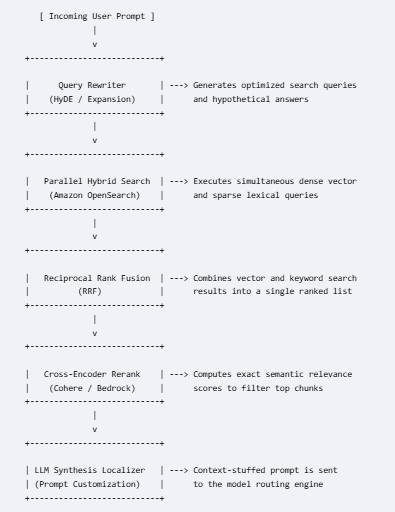
The retrieval service uses a lightweight, fast model to transform this user prompt via two key methodologies:
- Query Expansion: The rewriter generates alternative phrasing, stripping out conversational fillers and adding common industry synonyms, such as transforming the prompt into:
"server fire suppression protocols datacenter safety manual standard operating procedure". - Hypothetical Document Embeddings (HyDE): The rewriter generates a brief, hypothetical ideal answer to the user's question. This hypothetical response contains the structural syntax and language patterns expected in the real documentation. The system embeds this hypothetical response and uses it as the search vector, which significantly improves matching accuracy in dense vector spaces.
Step 2: Multi-Modal Parallel Hybrid Search
The system passes the rewritten query to the storage engine, such as Amazon OpenSearch, where it executes Parallel Hybrid Search. This step runs two distinct queries simultaneously:
- Dense Vector Search: The system converts the query into a vector and searches the HNSW index to capture the abstract conceptual meaning of the prompt.
- Sparse Lexical Search: The system runs a standard BM25 keyword query over the inverted index to find exact matches for specific terminology or identification codes.
To ensure data security, the platform automatically appends a hard metadata filter to both search queries at runtime, using the user's validated JWT security tokens:
// Runtime Security Filter Injection
{
  "query": {
    "bool": {
      "must": [
        { "knn": { "embedding_vector": { "vector": [0.012, -0.094, "..."], "k": 25 } } }
      ],
      "filter": [
        { "terms": { "security.allowed_groups": ["finance-analysts"] } }
      ]
    }
  }
}
Step 3: Reciprocal Rank Fusion (RRF)
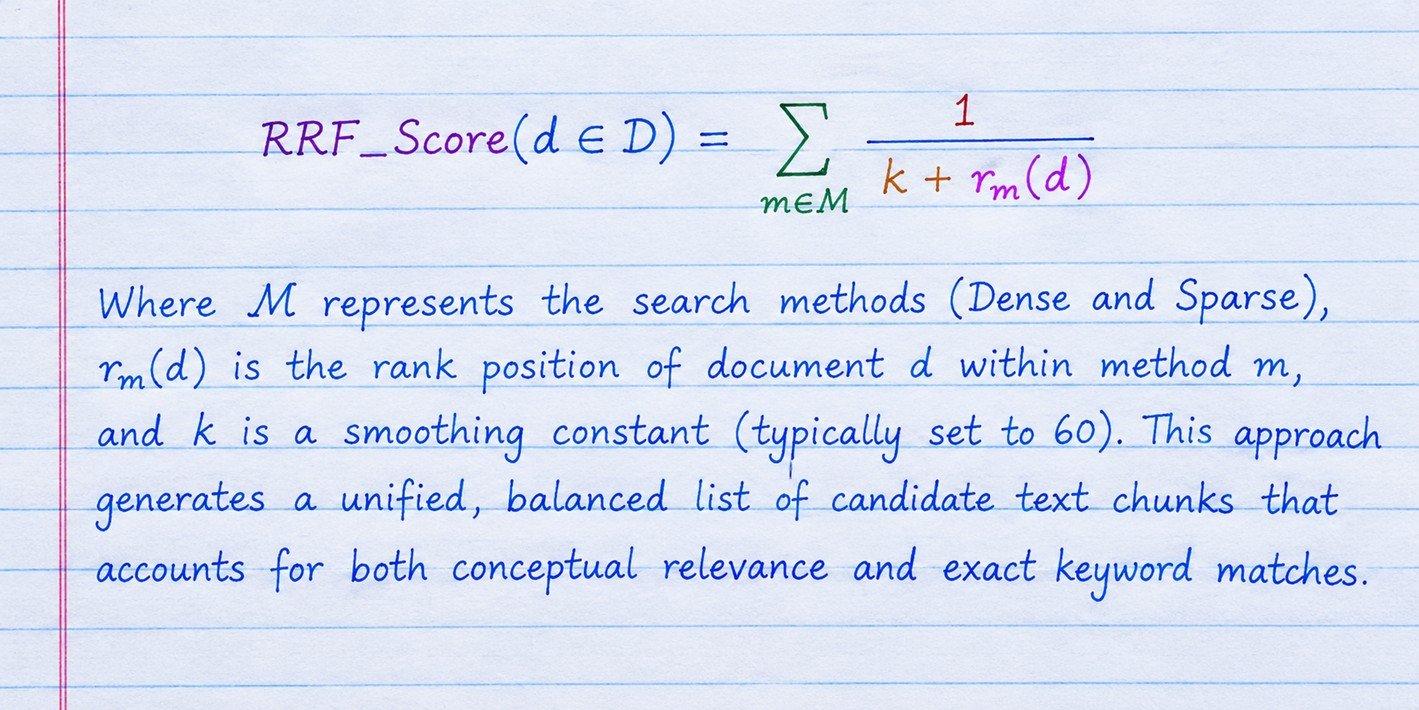
Vector distances and BM25 scores use completely different numeric scales, making them impossible to compare directly. To merge these result lists cleanly, the service uses Reciprocal Rank Fusion (RRF).
RRF scores each document chunk based solely on its relative rank position within each independent search result list, rather than its raw score:
Step 4: Cross-Encoder Reranking
While hybrid vector searches are fast and scalable, they evaluate text chunks independently, which can miss nuanced context. To address this, the top candidate chunks, such as the top 25 results from the RRF step, are passed through a highly precise Cross-Encoder Reranking Model, such as Cohere Rerank or an equivalent Amazon Bedrock service.
Unlike bi-encoder models that evaluate queries and documents separately, a Cross-Encoder processes the user query and the retrieved text chunk together through attention layers. This step calculates an exact relevance score between 0 and 1, allowing the system to re-sort the chunks and discard irrelevant data. The engine retains only the highest-scoring segments, such as the top 5 chunks, keeping the final context window lean and highly relevant.
Step 5: Context Assembly and LLM Synthesis Orchestration
The final step assembles the refined data chunks and the original user query into a secure, structured system prompt template:
[SYSTEM PROMPT]
You are an authoritative enterprise assistant. Answer the user query using ONLY the provided verified context. If the answer cannot be derived from the context, state clearly that you do not have sufficient information.

VERIFIED PRIVATE CONTEXT:
---
Source: [sec-filing-2026-q3]
Context Fragment: Company X realized a 14% increase in sub-surface infrastructure...
---

USER QUERY:
{USER_PROMPT}
This context-stuffed payload is forwarded directly to the platform's Model Routing Engine, which dispatches it to the most cost-effective and available frontier model for final text generation.
3. Advanced Enterprise RAG Orchestration Patterns
As business operations grow more complex, simple linear retrieval pipelines can struggle with multi-hop questions, contradictory source files, or queries that lack relevant information. To handle these challenges, enterprise platforms implement advanced, non-linear orchestration patterns.
Corrective RAG (CRAG)
Corrective RAG (CRAG) adds an automated validation step after retrieval to assess the quality of the gathered context before it reaches the LLM.
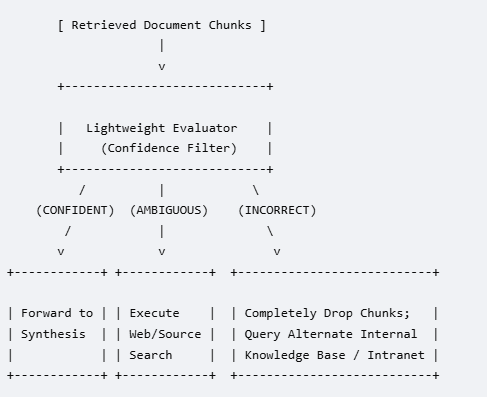
- The Confidence Filter: A lightweight evaluation service reviews the retrieved chunks and scores their relevance to the query.
- Corrective Actions:
- Correct: If confidence is high, the pipeline proceeds directly to generation.
- Incorrect: If the chunks are flagged as irrelevant, the system strips them out completely and triggers an alternate search against a backup internal knowledge base or company directory.
- Ambiguous: If the data is partially relevant but incomplete, the system combines the retrieved chunks with a safe web search or intranet query to fill in the missing details before synthesis.
Self-RAG (Adaptive Retrieval)
Self-RAG uses a single, fine-tuned model that outputs specialized reflection tokens to evaluate its own work and dynamically adjust its retrieval behavior.
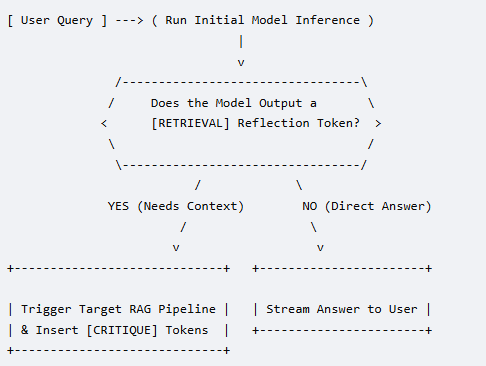
During generation, the model determines whether it needs more information to answer the query. If it requires external data, it outputs a specialized [RETRIEVAL] token, which pauses generation and tells the platform to run a targeted RAG query.
Once the context is retrieved, the model uses internal [CRITIQUE] tokens to verify whether the retrieved chunks are relevant and free of contradictions, ensuring the final output is highly accurate.
Agentic RAG Pipelines
For complex tasks that require analyzing multiple documents or comparing data across systems, the platform deploys an Agentic RAG Pipeline. This pattern replaces rigid, linear pipelines with an autonomous execution loop driven by an LLM agent.
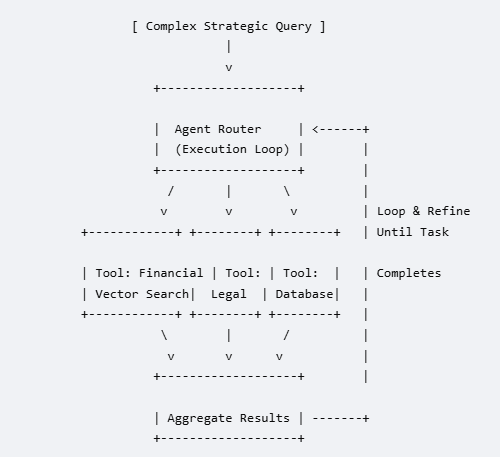
The router treats individual vector indices, relational databases, and enterprise applications as independent tools. When given a complex request, the agent creates an execution plan, calls the necessary tools in parallel, reviews the intermediate findings, and refines its search strategy until it compiles a comprehensive, validated answer.
4. Architectural Implementation Blueprint: AWS Native Reference Stack
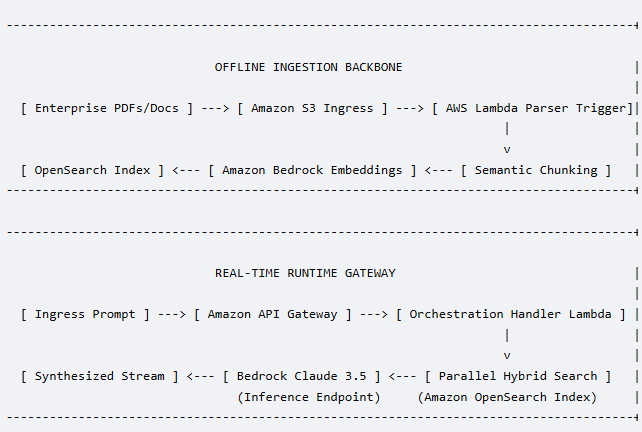
Enterprise platforms can implement this decoupled RAG architecture using AWS Serverless and Managed Infrastructure Primitives. This configuration ensures secure, automated data scaling and maintains sub-second response times across all production workloads.
Architecture Mechanics
- The Ingestion Path: Document uploads to Amazon S3 trigger an AWS Lambda function that parses files and applies semantic chunking. The text chunks are processed through Amazon Bedrock embedding models and written directly to an Amazon OpenSearch Service index.
- The Runtime Path: Incoming requests pass through Amazon API Gateway to an orchestration Lambda function. This function executes query expansion, runs a hybrid search with metadata security filters against Amazon OpenSearch, and sends the top reranked chunks to Amazon Bedrock, such as Claude 3.5 Sonnet, to stream the final, verified response back to the user.
5. Leadership Takeaways: Strategic Imperatives for the C-Suite
For technology executives, an enterprise RAG service is more than an information retrieval tool. It is the foundational mechanism for safely deploying corporate knowledge to generative AI applications. Managing this layer effectively requires addressing three key strategic mandates:
- Enforce Security Access Controls at the Retrieval Layer: A foundation model cannot understand your company's internal data permissions. If a user doesn't have access to a sensitive document in your corporate storage systems, the RAG engine must ensure those text chunks are filtered out before they can reach the LLM prompt.
- Decouple Ingestion from Synthesis Platforms: Avoid building rigid, end-to-end setups tied to a single vendor. By keeping your data ingestion pipelines, vector storage layers, and model execution planes independent, you ensure the flexibility to swap out underlying models or storage engines as technology and pricing evolve.
- Prioritize Context Hygiene Over Model Size: Sending large volumes of unrefined data into an LLM context window increases token costs and degrades response accuracy. Investing in robust query optimization, semantic chunking, and cross-encoder reranking keeps context windows lean, lowers operating costs, and delivers cleaner, more reliable answers.
6. Multi-Modal Data Indexing Details: Processing Images, Blueprints, and Charts
Enterprises rarely store knowledge exclusively as clean, structured text. Core business intelligence is frequently locked inside multi-modal visual formats, such as engineering blueprints, corporate slide decks, financial charts, medical scans, or product schematics. Forcing these complex visual assets through standard Optical Character Recognition (OCR) systems destroys their spatial meaning. Converting a multi-column chart or an architectural blueprint into a single string of OCR text strips away the physical relationships, arrows, and data matrices that give the asset its business value.
To unlock this data safely, a production-grade Enterprise AI Platform must implement a Multi-Modal Data Indexing and Retrieval Pipeline. This pipeline uses cross-modal embedding models, such as Amazon Bedrock Titan Multimodal Embeddings, to map both text and images into a single, shared vector space. This unified structure allows users to search visual assets using natural language prompts or query textual documentation using an image payload.
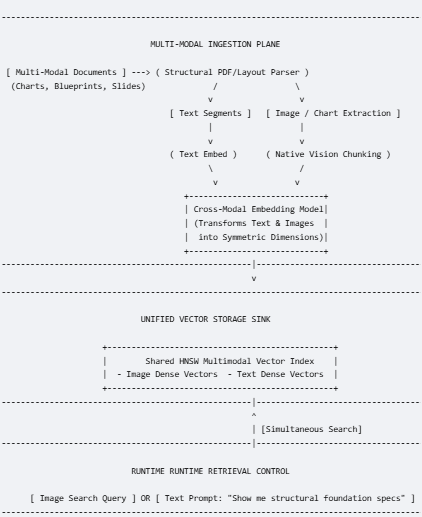
Dual Ingestion Processing: Structural Parsing and Vision Chunking
When a document with complex visual elements enters the ingestion plane, it follows a dual processing track that splits text from layout components:
- Layout-Aware Visual Extraction: The system uses structural layout parsing algorithms to separate the document. Standard text paragraphs flow down the textual semantic chunking path. Meanwhile, tables, graphs, drawings, and images are isolated and extracted as independent high-resolution image files, such as
.pngor.webpsnippets. - Context Alignment & Vision Chunking: The pipeline keeps these extracted images bound to their surrounding document context. If a chart is surrounded by explanatory paragraphs, that text is captured as descriptive metadata. The image snippet itself is prepared for direct vector transformation, ensuring its visual structure is preserved exactly as printed.
Cross-Modal Vector Space Mechanics
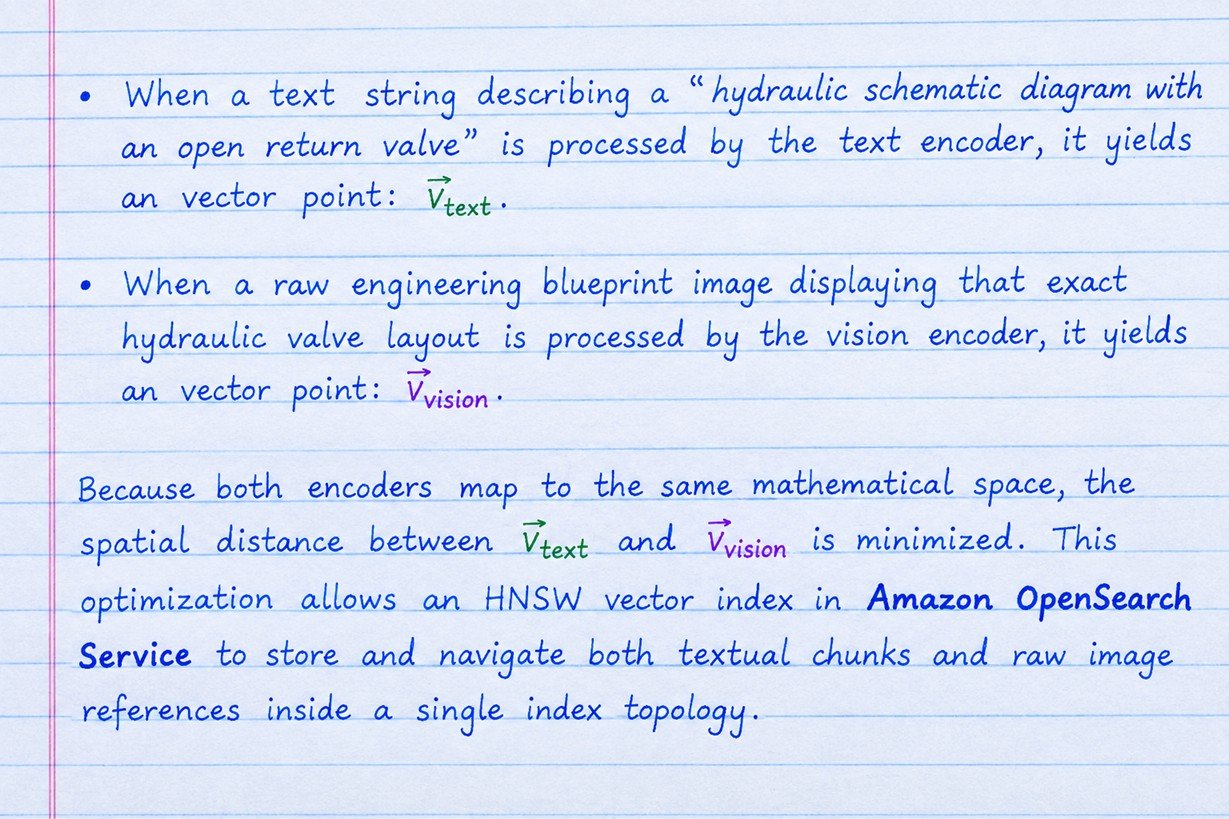
The core of this multi-modal pipeline is a specialized cross-modal transformer model. Unlike standard text-only transformers, a cross-modal model features twin encoding layers: a textual encoder and a vision encoder, typically built on a Vision Transformer (ViT) architecture.
During training, these encoders are aligned using contrastive learning techniques, forcing them to output vectors of identical dimensionality, such as 1024 dimensions, into a shared coordinate space.
Multi-Modal Synthesis Orchestration
When a query executes at runtime, the platform accommodates multiple query styles and formats seamlessly:
- Cross-Modal Search Execution: If a user submits a text string asking for "foundation structural blueprints for site B," the routing layer transforms this text into a cross-modal vector. The engine searches the shared HNSW index, finds the closest matching dense image vectors, and returns the original high-resolution blueprint snippet.
- Context Window Assembly & Vision LLM Dispatch: Once the relevant visual assets are retrieved, the orchestration engine bypasses traditional text-only prompts. It builds a multi-modal payload that combines the user's question, retrieved text segments, and the raw retrieved image files directly into the request envelope:
// Example Ingress Payload for a Vision-Capable Frontier Model (e.g., Claude 3.5 Sonnet)
{
  "model": "anthropic.claude-3-5-sonnet",
  "messages": [
    {
      "role": "user",
      "content": [
        { "type": "text", "text": "Analyze this retrieved engineering blueprint alongside the safety manuals below. Does the configuration comply with our fire safety code?" },
        { "type": "image", "source": { "type": "base64", "media_type": "image/png", "data": "iVBORw0KGgoAAAANS..." } },
        { "type": "text", "text": "[Verified Text Context Fragment from Safety Manual Section 4.2] All open valves must clear..." }
      ]
    }
  ]
}
This multi-modal payload is routed directly to a vision-capable frontier model. The model analyzes both the text and visual structures simultaneously, delivering a precise, verified answer that protects data accuracy across the enterprise.
7. Vector Index Maintenance Pipelines: Rebalancing, Schema Evolution, and Real-Time CRUD
A quiet failure point in enterprise RAG systems is the long-term degradation of the vector database. While a static index performs well during initial proof-of-concept testing, an enterprise production database is a living infrastructure component. It must continuously handle real-time modifications (CRUD operations), update its underlying data schemas, and absorb millions of new embedding records without degrading search accuracy or violating sub-second latency SLAs.
Without active operational maintenance, a vector index faces severe structural drift. High-volume updates cause index fragmentation, unvalidated document deletions lead to "ghost" retrievals, and changes to the underlying embedding models can require massive re-indexing efforts. A production-grade RAG platform must run automated Index Maintenance Pipelines to keep its storage sinks optimized and reliable.
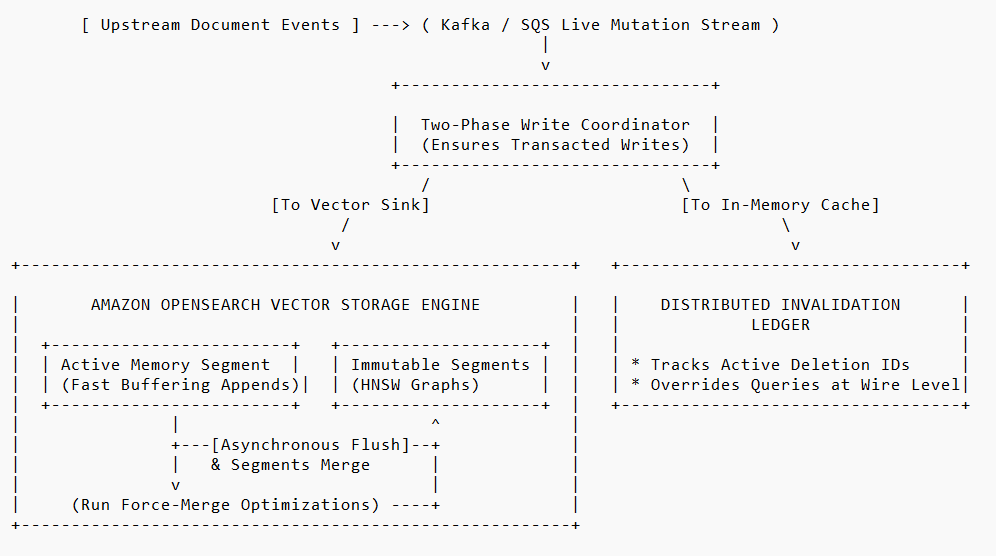
Real-Time CRUD Operations and the Ghost Retrieval Problem
In vector architectures based on Hierarchical Navigable Small World (HNSW) graphs, mutating records in real time introduces significant background overhead. When a document is updated or deleted in an upstream enterprise store, such as SharePoint or an S3 bucket, that event must propagate to the vector database instantly.
- The Deletion Challenge: HNSW graphs are built on interconnected node pathways. Completely removing an element in real time breaks these paths, which can corrupt the graph structure and degrade search accuracy. To prevent this, enterprise databases use Soft Deletions. The system marks the target document identifier as tombstoned inside a fast, in-memory validation ledger, skipping its vector data during search operations.
- Asynchronous Compaction Flushes: To clear out tombstoned nodes permanently, the platform runs scheduled asynchronous compaction jobs. It writes new vector appends into a temporary, fast memory buffer first. The engine then systematically flushes these memory buffers into immutable background segments, merging them with the main graph and re-linking the node connections without disrupting live runtime traffic.
Index Rebalancing and Controlling Graph Fragmentation
As millions of new vectors flow into a database index over time, the structural geometry of the HNSW graph begins to fragment. This drift causes nearest-neighbor lookups to miss optimal entry nodes, which lowers retrieval accuracy.
To maintain performance, the platform tracks graph health metrics, such as the Recall-vs-Latency Drift Ratio. When fragmentation triggers an alert, the engine initiates an automated rebalancing routine:
- Read/Write Replica Splitting: The routing layer isolates the fragmented index segment and diverts active write operations to a secondary hot replica instance.
- Force-Merge Optimizations: The engine runs a background force-merge process, re-indexing the vectors into a clean, unfragmented HNSW graph with optimized connectivity settings, such as tuning parameters like
mfor maximum connections per node andef_constructionfor search depth. - Hot Swap Execution: Once the clean graph is compiled and validated, the engine swaps the internal routing pointers to make the optimized segment active, restoring baseline search speeds.
Schema Evolution and Embedding Model Migrations
Enterprise schemas evolve to meet shifting business demands. A company might need to append new metadata attributes, such as adding a geo_region tag for sovereign compliance or inserting custom text vectors into pre-existing index records.
- Dynamic Mapping Updates: Modern vector databases support zero-downtime schema extensions, allowing teams to append non-indexed metadata fields dynamically without rebuilding the core HNSW graph.
- The Hard Model Migration Challenge: If the business decides to replace its underlying embedding model with a newer, higher-performance architecture, such as upgrading from a model with 768 dimensions to a denser 1024-dimension model, the old vector indices become mathematically incompatible. The platform cannot run vector calculations across two different coordinate spaces.
To handle these major model updates without causing production downtime, the platform executes a Blue-Green Index Migration Pipeline:
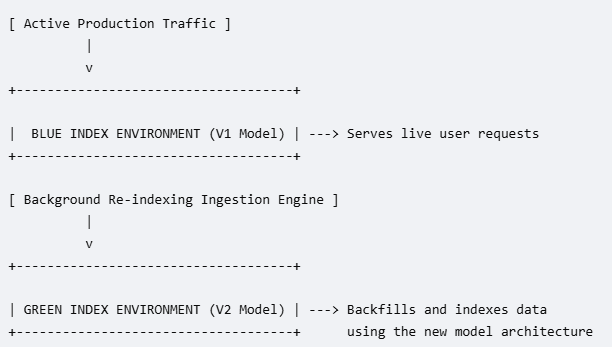
- Green Index Allocation: The system spins up an isolated, empty index space, the Green Index, configured for the new model's dimensions.
- Background Data Re-indexing: An asynchronous ingestion engine pulls historical records from cold storage, re-embeds the text using the new model architecture, and populates the Green Index in the background.
- Live Traffic Shadowing: During the final stages of the backfill, the platform gateway duplicates a small stream of live incoming data, sending it to both indices to verify the Green Index's retrieval accuracy under real-world conditions.
- Atomic Pointer Cutover: Once the Green Index matches performance and accuracy targets, the platform's Model Router updates its internal pointers, instantly switching active production traffic to the new index with zero service interruption.
8. Leadership Takeaways: Strategic Imperatives for the C-Suite
For technology executives steering an organization from experimental Generative AI projects to scaled production, RAG services represent the primary mechanism for anchoring probabilistic intelligence to corporate reality. A poorly designed RAG strategy leads directly to data security leaks, unpredictable cloud costs, and inaccurate model outputs.
To maintain an unshakeable architectural foundation, technology leaders must execute three strategic mandates:
- Treat Context Hygiene as a Financial Guardrail: Sending massive, unrefined data text dumps into a frontier model's context window is an anti-pattern that drains budgets and degrades accuracy. Force engineering teams to invest in advanced, multi-stage retrieval pipelines, incorporating semantic chunking, hybrid queries, and cross-encoder rerankers, to keep context windows lean and cost-efficient.
- Enforce Zero-Trust Security at the Retrieval Plane: Foundation models possess zero innate understanding of your enterprise data permissions or access control lists (ACLs). The RAG orchestration plane must systematically inject cryptographic metadata filters at the wire level, ensuring a user's prompt can never retrieve or synthesize context blocks from records they are unauthorized to view.
- Insulate the Platform from Index and Vector Drift: A vector database is not a static data warehouse; it is a fluid, high-maintenance micro-system. Budgets and roadmaps must explicitly account for automated data operations infrastructure to handle real-time soft deletions, regular graph compactions, and the mathematical inevitability of blue-green index migrations when switching embedding vendors.