Multi-Model Architecture - The Heterogeneous Aggregation and Semantic Routing Engine
Introduction
Relying on a single foundation model provider to power an entire enterprise software ecosystem introduces severe structural risks: architectural dependency, vendor lock-in, rigid cost structures, and vulnerabilities to localized vendor outages or API deprecations. Furthermore, sending basic text classification or data extraction requests to an expensive, high-latency frontier model is an operational inefficiency that drains corporate budgets.
A mature Enterprise AI Platform must implement a decoupled, resilient Multi-Model Architecture. This architecture functions as an abstraction and aggregation plane positioned directly between consuming business applications and the changing marketplace of proprietary public cloud APIs and self-hosted, private open-source model clusters.
By standardizing interaction contracts, executing real-time payload mutations, and applying token-aware semantic load balancing, the platform ensures complete operational sovereignty, optimized cost-to-performance ratios, and continuous runtime availability.
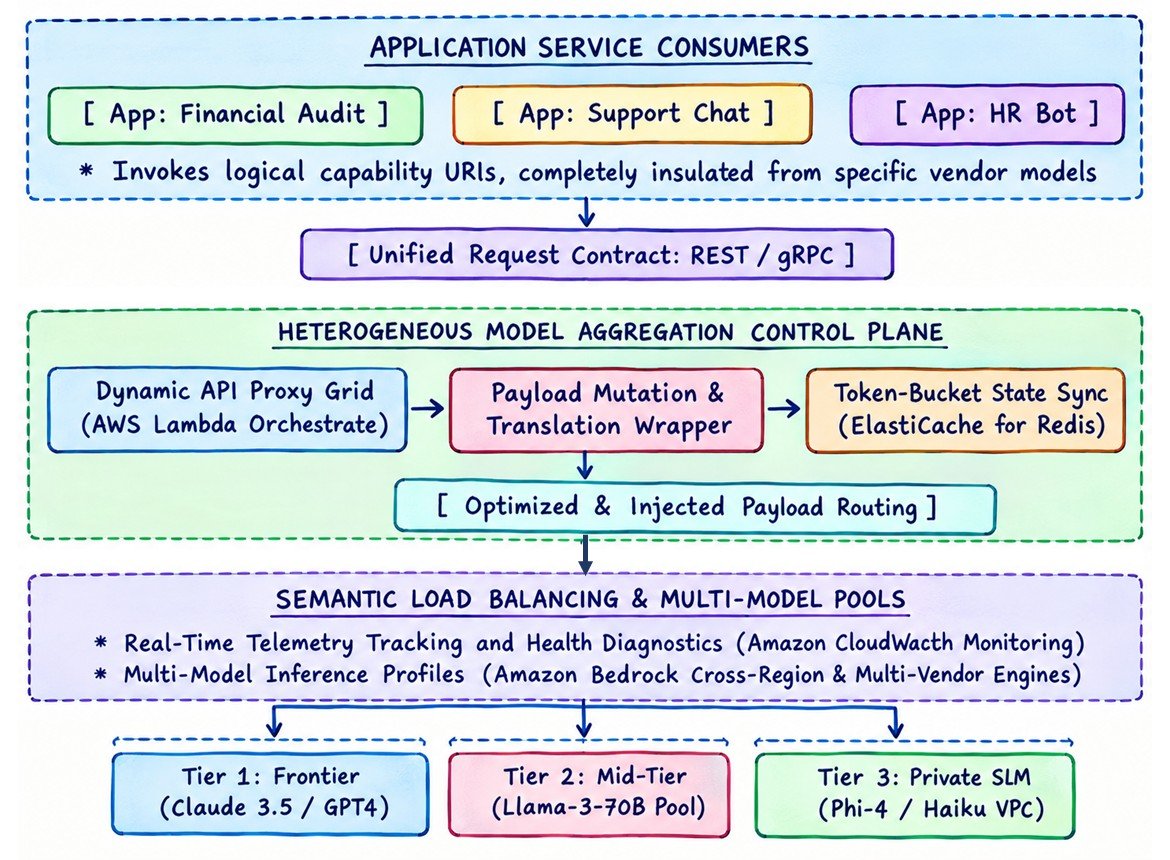
1. The Heterogeneous Model Aggregation Plane
The primary responsibility of the aggregation plane is the complete erasure of provider-specific API variance. Consuming corporate systems must interface with a singular, uniform contract that abstracts away structural schema differences between vendors.
The Unified Interface Contract
Applications trigger inference calls by communicating with an abstracted gateway endpoint, passing a standardized JSON or gRPC payload. The platform exposes a vendor-neutral dialect that supports advanced inference traits like streaming tokens, structured output formatting, system role controls, and multi-modal attachments:
// Unified Platform Request Contract Schema
{
  "routing_alias": "contract-risk-assessment-high-priority",
  "temperature": 0.1,
  "max_tokens": 2048,
  "response_format": { "type": "json_object" },
  "messages": [
    { "role": "system", "content": "You are a corporate compliance judge..." },
    { "role": "user", "content": "Evaluate target file clauses: ..." }
  ]
}
Decoupled Runtime Providers
Behind this unified interface, the platform manages connection engines for diverse infrastructure footprints:
- Proprietary Public Cloud APIs: Managed integration adapters for cloud-hosted environments (e.g., Anthropic Claude via Amazon Bedrock, OpenAI native, Azure OpenAI).
- Self-Hosted Private Clusters: Enterprise-controlled, isolated inference clusters running open-source models (e.g., Llama, Mistral, Qwen) inside private virtual private clouds (VPCs), powered by optimized inference serving engines like vLLM or Triton Inference Server.
2. Dynamic Semantic Load Balancing and Runtime Mutation Engine
A request cannot simply be forwarded raw to a model endpoint. The platform's runtime proxy layer applies real-time data translation, input verification, and distributed state alignment to control traffic behavior before it reaches the compute sinks.
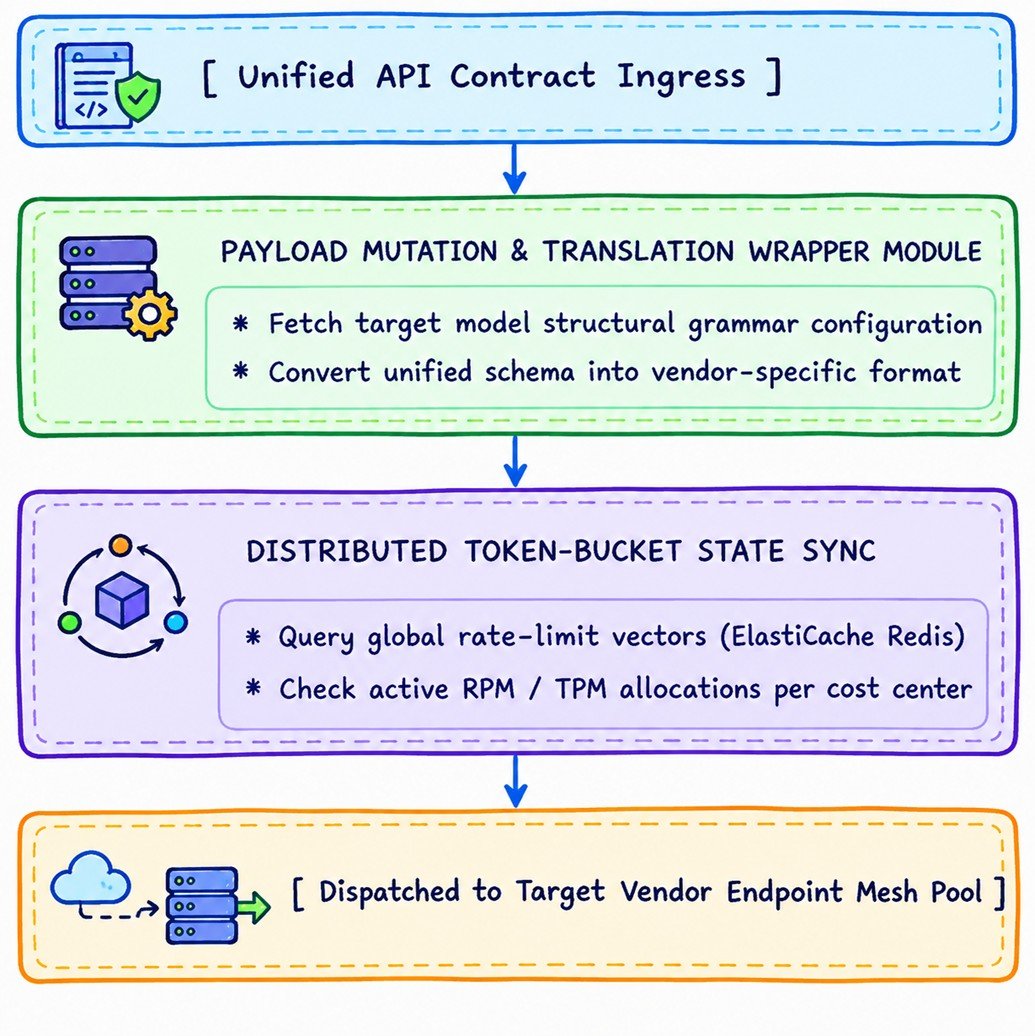
The Payload Mutation and Translation Wrapper
Every model architecture expects distinct layout parameters, token flags, and chat history schemas. For example, Anthropic models utilize a specific text-to-image blocks array layout, while OpenAI formats multi-modal attachments using distinct detail and URL indicators, and raw open-source completions often require explicit special token identifiers (e.g., <|im_start|>).
The Payload Mutation Engine acts as an inline transformer:
- Target Resolution: The router maps the request to a specific destination model (e.g., swapping the platform alias for
anthropic.claude-3-5-sonnet). - Grammar Transformation: The wrapper pulls the structural grammar blueprint for the target model and transforms the incoming unified payload into the provider's exact proprietary format on the fly.
- Prompt Modification: If switching from a reasoning-heavy frontier model to a smaller, token-efficient small language model (SLM), the engine automatically injects stabilizing system prompt modifiers to enforce formatting compliance and prevent output drift.
Distributed Token-Bucket and Concurrency State Synchronization
To prevent erratic traffic spikes from triggering crippling HTTP 429 (Too Many Requests) blockages across shared corporate API keys, the routing layer integrates with Amazon ElastiCache for Redis.
Before a transaction is cleared for dispatch, the proxy updates an in-memory distributed token-bucket tracker. Redis tracks Requests-Per-Minute (RPM), Tokens-Per-Minute (TPM), and active streaming concurrency counts globally across all application regions. If a specific provider endpoint approaches its quota ceiling, the load balancer intercepts the call, delaying or re-routing the payload to an available variant pool before an upstream throttle event can occur.
3. Advanced Multi-Model Orchestration Patterns
Publication-grade resilience requires moving beyond static routing grids. The platform implements dynamic, non-linear orchestration patterns that evaluate model behavior, performance cost, and systemic health in real time.
Cascade Fallback Routing
To maintain absolute cost optimization without sacrificing intelligence quality, the system executes a Cascade Fallback Routing Pattern:
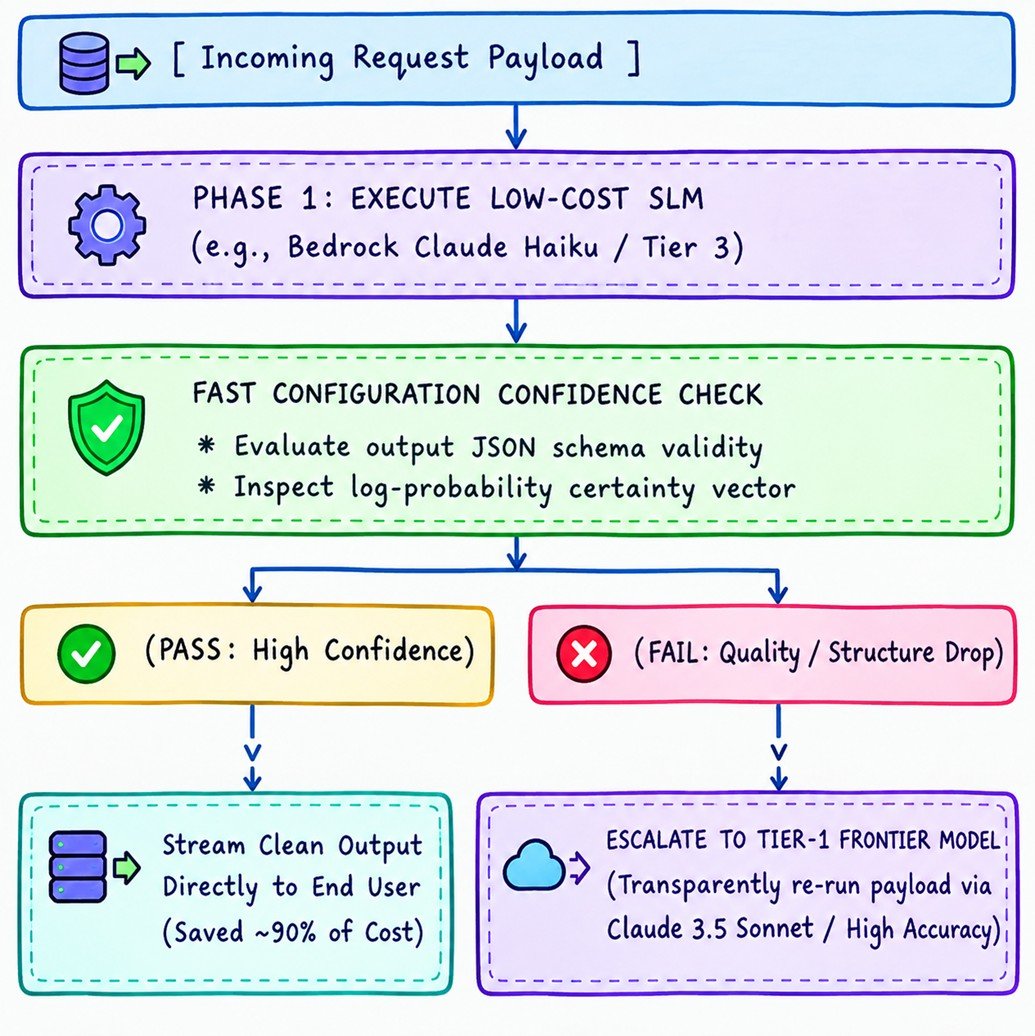
The router dispatches the payload first to a low-cost, high-velocity model (Tier 3 SLM). As token generation concludes, an automated evaluation gate verifies the response quality, such as checking JSON schema formatting or inspecting average log-probability scores.
If the output passes the confidence gate, the response is delivered, securing significant structural cost savings. If the validation gate flags a failure or ambiguity, the engine intercepts the response, masks the failure from the user, and transparently escalates the payload to a Tier 1 frontier reasoning model to complete the request accurately.
Symmetric Multi-Provider Failover Topologies
When a cloud provider suffers a major regional outage or experiences localized capacity degradation, the platform ensures complete survivability through Symmetric Failover Topologies managed via Amazon Bedrock Multi-Model Routing Profiles:
- Active-Active Cross-Region Mirroring: The load balancer distributes traffic evenly across identical model variants deployed in separate geographical cloud regions (e.g., load balancing between
us-east-1andus-west-2). - Cross-Vendor Cross-Architecture Failover: If an entire model vendor family encounters an active service disruption, the platform gateway detects consecutive
5xxerror telemetry via Amazon CloudWatch. The system instantly trips its internal circuit breakers, changing the active routing table mappings to shunt 100% of production traffic to a completely separate cloud vendor running an equivalent model class (e.g., seamlessly switching from Anthropic Claude on Bedrock to OpenAI models on Azure), preserving enterprise business continuity.
4. Reference Implementation: The Multi-Model Routing Proxy
The serverless reference deployment blueprint for this multi-model abstraction plane utilizes highly available AWS compute and caching components to execute low-latency dynamic routing.
+-----------------------------------------------------------------------------------------+
|                                                                                         |
|                         AWS LAMBDA ROUTING AND MUTATION PROXY                           |
|                                                                                         |
|   public class MultiModelRouter implements RequestHandler<GatewayRequest, Response> {   |
|       public Response handleRequest(GatewayRequest req, Context context) {              |
|           // 1. Check current global provider rate limits in Redis Cache                |
|           ProviderConfig provider = RedisClient.getOptimalEndpoint(req.alias);          |
|                                                                                         |
|           // 2. Transpile unified request format into target model grammar schema       |
|           String targetPayload = PayloadMutationEngine.transpile(req, provider.type);   |
|                                                                                         |
|           try {                                                                         |
|               // 3. Dispatch execution to target infrastructure model endpoint          |
|               return ModelExecutionClient.invoke(provider.endpoint, targetPayload);     |
|           } catch (ProviderException e) {                                               |
|               // 4. Catches throttles/outages; triggers active fallback routing         |
|               return ModelExecutionClient.invoke(provider.fallbackEndpoint, ...);       |
|           }                                                                             |
|       }                                                                                 |
|   }                                                                                     |
+-----------------------------------------------------------------------------------------+
Architectural Enforcement Mechanics
- Low-Latency Caching: The routing Lambda functions rely on an Amazon ElastiCache for Redis cluster to check system state vectors, health variables, and real-time provider token ceilings in under 2 milliseconds.
- Decoupled Trapping: If an execution call to a specific provider endpoint fails or drops below latency SLAs, the exception is caught instantly within the execution wrapper. The proxy reads the configured fallback route and shifts the transaction to a separate active cloud profile or private VPC cluster, maintaining continuous uptime.
5. Leadership Takeaways: Strategic Imperatives for the C-Suite
For technology executives, establishing a multi-model architecture is the defining structural choice required to eliminate single-vendor liabilities, manage operating margins, and secure corporate technical sovereignty.
To enforce this capability successfully, technology leaders must drive four core strategic mandates:
- Own the Abstraction Layer Natively: Never build deep application logic directly on top of a vendor-specific API SDK or proprietary contract format. The enterprise must operate its own independent heterogeneous aggregation plane to enforce a single, unified interface contract across all business systems.
- Decouple Capability Selection from the Application Code: Prevent developers from hardcoding specific model descriptors within internal codebases. Use logical capability aliases managed at the platform gateway layer, allowing infrastructure teams to optimize routing, patch models, and shift vendors with zero disruption to production code.
- Enforce Automated Cost Optimization via Cascade Routing: Standardize the use of tiered cascade fallback routing to automatically match prompt complexity with the cheapest viable compute tier, protecting the corporate budget from unnecessary frontier token spend.
- Architect for Absolute Vendor Resiliency: Treat individual foundation models and cloud providers as highly volatile endpoints. Implement symmetric cross-region and cross-vendor failover topologies backed by real-time tracking matrices, ensuring your business workflows remain fully operational regardless of external vendor service disruptions.