Model Routing - The Intelligence Traffic Controller
Introduction
Building an Enterprise AI Platform requires moving past the naive assumption that a single Large Language Model (LLM) can serve every corporate workload. Monolithic reliance on a single frontier model introduces severe architectural vulnerabilities: catastrophic cost curves, single points of failure, localized latency spikes, and rigid capability locks.
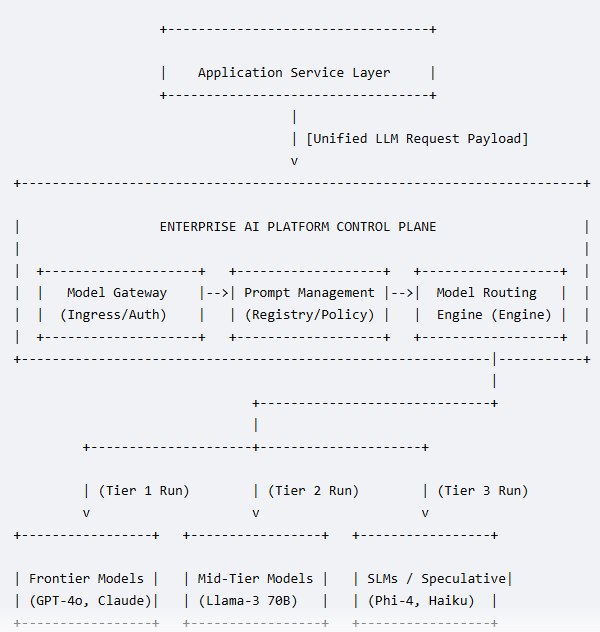
The Model Routing layer is the intelligent runtime engine of the Enterprise AI Platform. Operating directly within the ingress control plane, it decouples the consuming application from specific model endpoints. It intercepts incoming semantic payloads, evaluates operational constraints, and dynamically dispatches requests to the most optimal model execution target.
By abstracting model selection away from application logic, enterprise engineering teams can execute real-time optimization across the three vectors of the AI trade-off triangle: Cost, Latency, and Accuracy.
1. Architectural Foundations of Abstracted Routing
To achieve publication-grade resilience, the routing engine must handle requests without introducing appreciable latency overhead (< 5ms routing decision time). It acts as a reverse proxy specialized for tokenized, stateful, and streaming workloads.
The Decoupled Contract
Applications must never invoke a specific model string, such as anthropic.claude-3-5-sonnet-v1:0, directly within their codebase. Instead, they target a logical capability URI or semantic alias exposed by the platform gateway:
// Application Payload sent to Platform Gateway
{
  "routing_alias": "customer-support-summarization",
  "priority": "high",
  "messages": [
    {"role": "user", "content": "Process transaction log... "}
  ]
}
The Model Routing engine maps this alias against real-time operational policies, tenant entitlements, and backend health vectors to determine the target provider endpoint.
State and Telemetry Dependency
An effective routing engine cannot operate in a vacuum. It maintains a low-latency, in-memory state store, typically backed by distributed key-value infrastructure such as Redis, to track:
- Provider Rate Limits: Token-per-minute (TPM) and Requests-per-minute (RPM) consumption windows.
- In-Flight Concurrency: The number of parallel streaming connections currently bound to a specific model pool.
- Historical P99 Latency: Moving averages of Time-to-First-Token (TTFT) and Total Execution Time across backend clusters.
- Error Rate Exponentials: HTTP
429(Too Many Requests),503(Service Unavailable), and provider-specific timeouts.
2. Baseline Routing Mechanics
Baseline routing patterns rely on deterministic, rule-based configurations. These serve as the backbone for baseline enterprise availability and contractual cost management.
Static Cost and Weight-Based Distribution
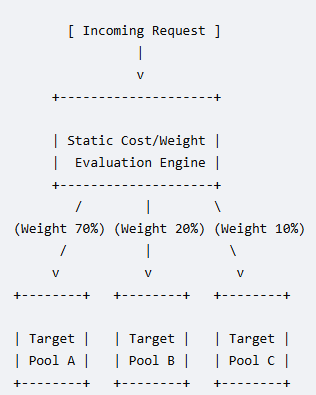
Static distribution balances traffic across multiple identical model deployments or symmetric providers to maximize throughput and utilize contracted capacity commitments, such as AWS Bedrock Provisioned Throughput.
- Weighted Round-Robin: Allocates requests based on pre-configured percentages, such as sending 70% of production volume to an internal self-hosted open-source cluster and 30% to a managed cloud provider instance to handle spillover.
- Tiered Cost Structuring: Prioritizes routing through the cheapest available endpoint that fulfills the minimum architectural context window requirements, shifting only when capacity thresholds are breached.
Failover Topologies and Circuit Breakers
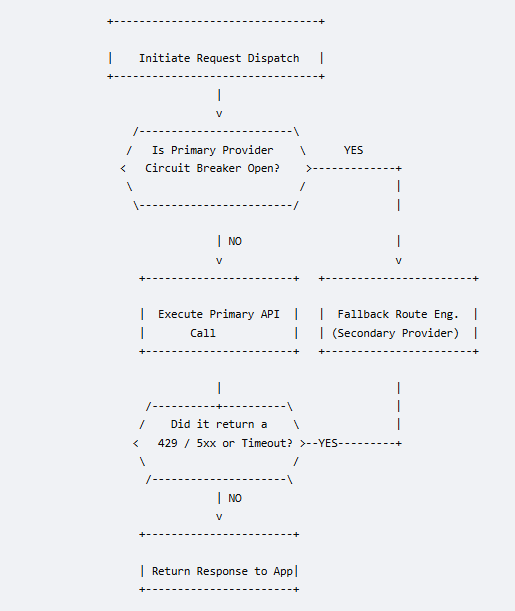
To prevent backend outages from impacting users, the routing engine implements a strict circuit breaker pattern tailored for LLM behaviors.
-
Symmetric Provider Failover: If an API call to a specific provider model, such as a model hosted on Azure OpenAI, returns a
502or503, the routing engine intercepts the error, rolls back the stream, and mutates the request target to an identical model running in a separate region or on a distinct cloud platform, such as the OpenAI native API. -
Degraded Failover: If the primary frontier model encounters hard rate limiting (
429), the system transparently routes the request to a slightly smaller, more available model within the same ecosystem, appending a system prompt modifier to enforce stricter behavioral compliance to offset structural model differences.
3. Advanced Dynamic Routing Patterns
While baseline routing addresses infrastructure availability, advanced dynamic patterns optimize for the semantic properties of the request context, economic constraints, and runtime telemetry.
Semantic Intent and Complexity Routing
Not every prompt requires a multi-billion-parameter frontier model. A simple classification or structural parsing request can be executed efficiently by a Small Language Model (SLM). Dynamic semantic routing introduces a two-phase evaluation pipeline:
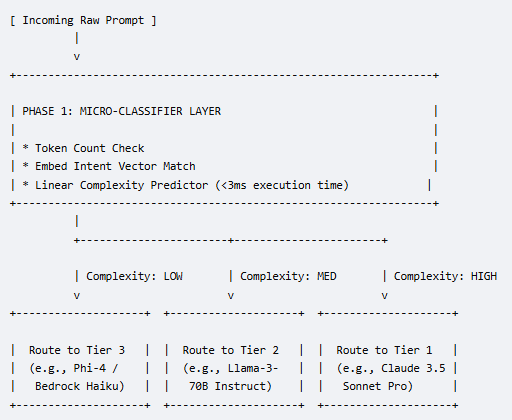
- The Intent Classifier: A lightweight, sub-millisecond classification step, utilizing structured logit-bias constraints or small embedding distance evaluations, calculates the intent of the incoming text.
- Routing Logic: If the intent is flagged as standard text extraction or formatting, the payload is transferred to an SLM. If the intent is flagged as complex multi-hop reasoning, mathematical deduction, or strategic coding, the payload is escalated to Tier 1 frontier models.
Multi-Model Speculative Execution
For time-critical enterprise workflows, such as real-time customer-facing interfaces, waiting for a slow frontier model response creates a poor user experience. Speculative execution runs models in parallel:
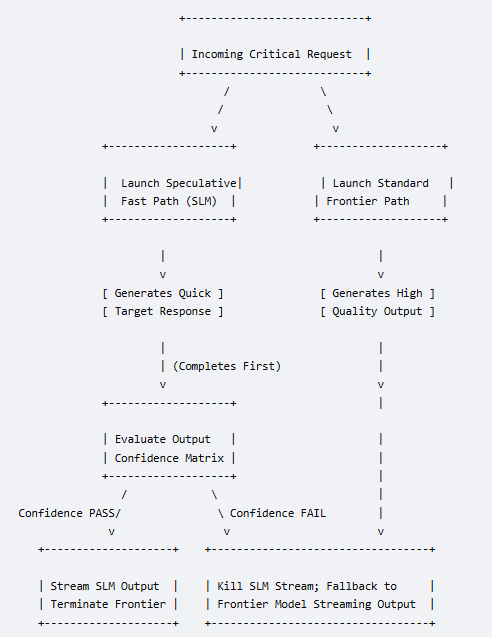
- The platform fires the request simultaneously to a fast model (SLM) and a deep reasoning model (Frontier).
- If the fast model passes internal confidence guardrails, such as structural evaluation or high log-probability scores, its output streams directly to the client, and the engine drops the slower connection, saving downstream context calculation costs.
Real-Time Financial Optimization (FinOps Routing)
Dynamic routing configurations evaluate context size before matching against provider pricing tiers. Since input tokens and output tokens have distinct cost weightings across cloud vendors, the engine computes an estimated financial footprint:
Estimated Cost = (Input Tokens x UnitCost_In) + (Predicted Target Output Tokens x UnitCost_Out)
If a tenant's remaining budget envelope is constrained, or the prompt size approaches an expensive token pricing tier, the engine applies cost-preserving routing matrices, shunting the payload to highly optimized, token-efficient private endpoints.
4. Reference Implementation Case Study: AWS Bedrock Dynamic Routing
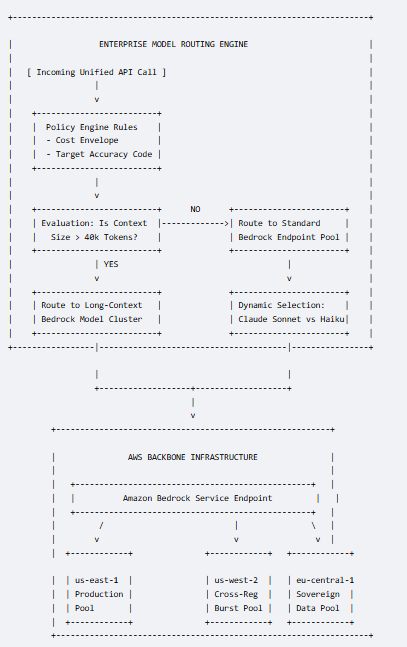
Enterprise platforms can implement these abstracted routing principles by utilizing infrastructure primitives such as AWS Bedrock Routing, including Amazon Bedrock cross-region inference and model routing rules, combined with a bespoke control plane proxy.
The architecture below illustrates how the Platform Routing Engine wraps AWS Bedrock endpoints to provide seamless, policy-driven dispatching:
Implementation Mechanics
- Abstraction Execution: The proxy evaluates whether the request requires strict data sovereignty. If a localized European profile is tagged, the router automatically restricts choices to endpoints within
eu-central-1. - Traffic Bursting: When the primary
us-east-1provisioned throughput limit approaches a saturation point, indicated by near-zero capacity availability metrics, the routing logic instantly moves incoming non-sensitive transactional request streams onto cross-region inference profiles inus-west-2. This bypasses regional throttle limits while preserving identical model execution consistency.
5. Asynchronous Routing and Queue Management
While synchronous real-time requests require sub-second routing decisions, enterprise platforms must also process high-volume offline batch jobs, long-running agent workflows, and priority-queued inference backlogs. Merging these asymmetric workloads into a single synchronous routing lane inevitably triggers downstream resource exhaustion, cascading timeouts, and severe starvation for interactive consumer-facing applications.
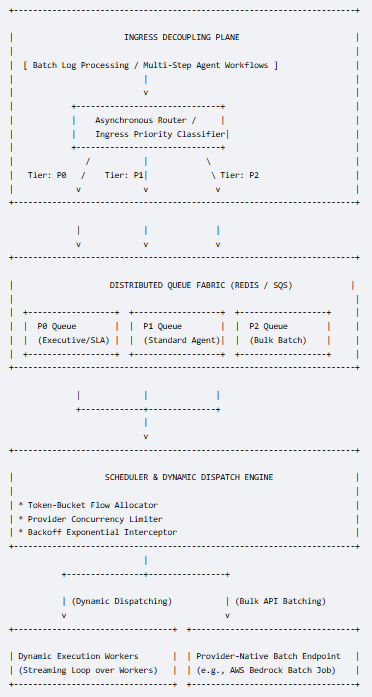
Asynchronous routing patterns isolate execution topologies by implementing message-driven queueing infrastructure and intelligent token-bucket throttles directly within the platform's control plane.
Multi-Tier Priority Queuing Mechanics
To manage complex enterprise backlogs effectively, incoming asynchronous requests are evaluated at the platform ingress layer and explicitly assigned a specific priority tier:
- Priority 0 (P0) - Executive Execution / Strict SLA: High-priority, user-triggered asynchronous tasks, such as an on-demand report generation requested by an executive. These payloads bypass normal queues, jumping directly to dedicated reserved concurrency pools.
- Priority 1 (P1) - Standard Agent Workflows: Multi-step autonomous agent loops, such as automated code generation or multi-document summarization. The routing engine assigns a time-to-live (TTL) and dynamically schedules execution based on current real-time cluster workloads.
- Priority 2 (P2) - Bulk Offline Batching: Low-priority tasks without time-critical requirements, such as nightly vector embedding synchronization or historical log analysis. These requests are heavily buffered and dispatched exclusively during non-peak operational windows or shunted onto cheaper provider-native batch APIs.
Token-Bucket Leaky Flow Control
To shield upstream and downstream APIs and provider pools from crashing under sudden spikes in agent-driven recursion loops, the router applies a distributed token-bucket algorithm at the queue consumer level.
Instead of routing messages as fast as workers pick them up, the dispatcher queries the central platform state store to verify the tenant's allocated token limits. If the tenant's real-time consumption velocity approaches their designated Requests-per-Minute (RPM) or Tokens-per-Minute (TPM) limit, the system gracefully delays dequeue actions. This approach ensures steady, predictable throughput while preventing upstream 429 (Too Many Requests) errors.
Hybrid Mode Selection: Worker Dispatching vs. Provider Batching
The asynchronous routing layer evaluates the size and urgency of incoming task sets to automatically select the optimal processing methodology:
- Managed Worker Dispatching: For workflows requiring continuous validation and step-by-step intermediate guardrail checks, the routing engine keeps tasks within internal queues. It systematically streams sections of the workload through normal, live provider inference pools, relying on auto-scaling worker groups to process the queues.
- Provider-Native Batching: For massive datasets that do not require real-time output observation, the router converts internal queue payloads into a standardized structure, such as a multi-line JSONL file. It uploads this data directly to cloud object storage, such as Amazon S3, and calls the provider's dedicated batch endpoint, such as Amazon Bedrock Batch Inference. This structural shift can save up to 50% in standard execution costs while freeing up internal gateway capacity for critical real-time application pipelines.
6. Semantic Cache-Integrated Routing: Bypassing the Inference Engine
In high-throughput enterprise environments, a significant portion of user interactions contains duplicate or semantically overlapping intents. Routinely executing raw foundation model inference for identical queries, such as recurring customer service complaints, identical compliance checks, or standardized data extraction requests, is highly inefficient. It leads to unnecessary token expenditure, introduces avoidable network latency, and strains backend model rate limits.
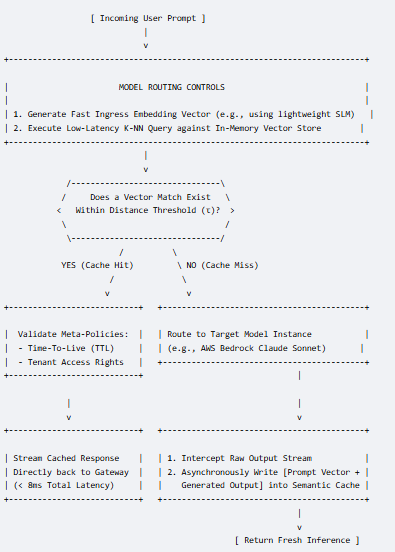
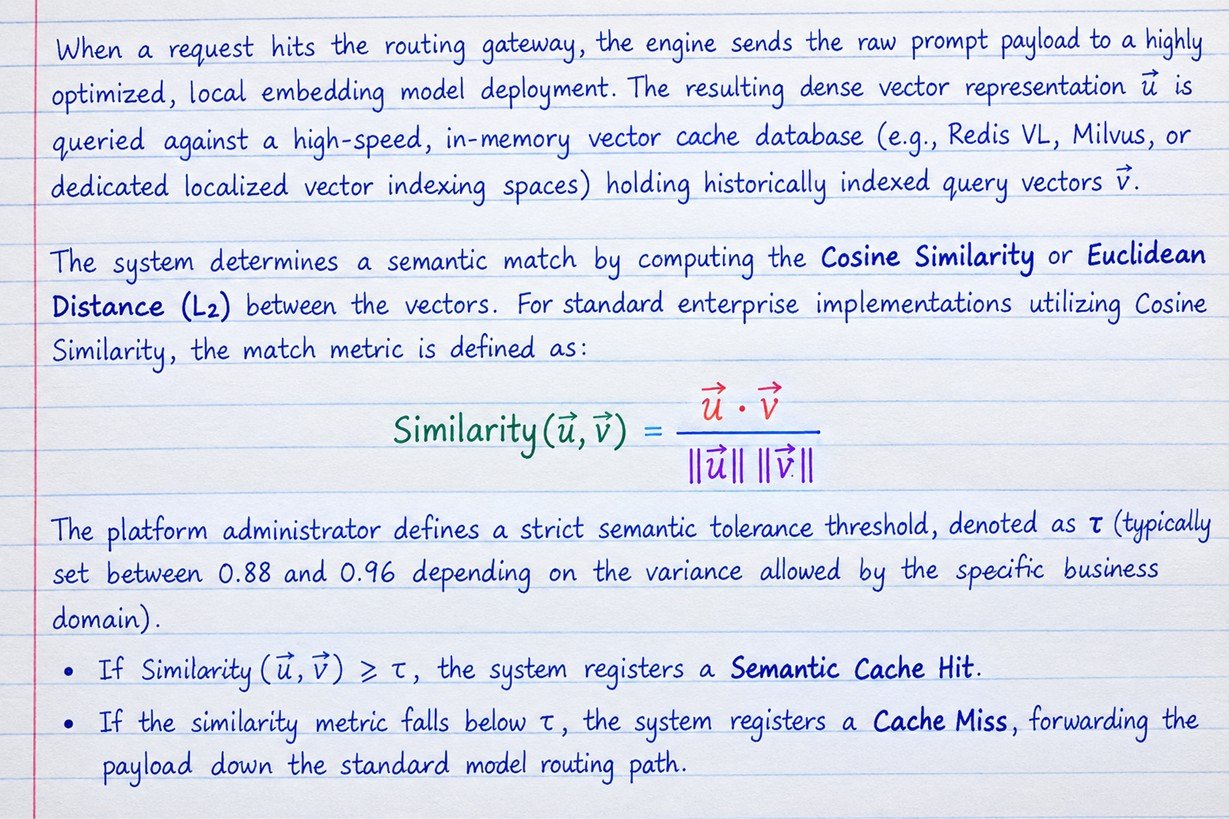
Semantic Cache-Integrated Routing addresses this by inserting a low-latency vector abstraction layer directly into the execution path of the Model Routing engine. Unlike traditional deterministic key-value web caches that require an exact character-for-character string match, a semantic cache evaluates the conceptual meaning of an incoming prompt using embedding vectors and distance metrics. If the underlying intent has already been processed within an acceptable semantic window, the router completely intercepts the transaction, bypassing downstream model invocation and returning the cached response in single-digit milliseconds.
The Mathematics of Semantic Matching
Handling Cache Eviction and Temporal Degradation (TTL)
Enterprise systems deal with changing real-world conditions, meaning static semantic answers can quickly become outdated. A semantic routing layer must implement strict cache control protocols:
- Symmetric Multi-Tenant Isolation: To ensure rigorous security boundaries, the system automatically appends a cryptographically signed tenant ID metadata filter (
tenant_id == X) to every vector search query. This isolation ensures users never receive cached answers generated by entirely different organizational departments or distinct client accounts. - Deterministic and Dynamic Time-to-Live (TTL): Every cached item is assigned a maximum temporal lifespan. For example, general internal policy answers might carry a 24-hour TTL, whereas financial market inquiries decay after only 5 minutes.
- Active Eviction via Webhooks: When an underlying source document or enterprise database changes, the platform fires an asynchronous cache invalidation event. The system scans the vector space using the document's ID metadata and removes all associated semantic vectors, ensuring outdated information is immediately purged from the routing layer.
7. A/B Testing, Canary Deployments, and Traffic Shadowing
In an industrialized Enterprise AI Platform, upgrading a model, switching vendors, or introducing a newly fine-tuned variant cannot be treated as a simple, atomic service swap. Because Large Language Models behave probabilistically, a new model version may introduce subtle prompt regressions, degraded reasoning capabilities, unexpected token consumption, or increased Time-to-First-Token (TTFT). The Model Routing engine acts as the primary safety valve, allowing enterprise architecture teams to roll out, validate, and compare models safely against real-world workloads without altering client application logic.
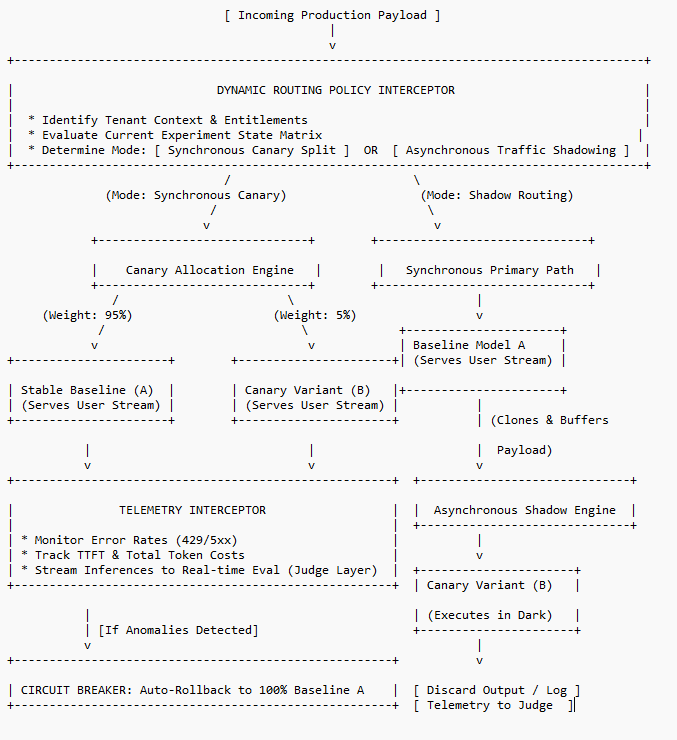
By leveraging the routing layer as an abstraction control point, platforms can execute progressive traffic shifting, run controlled behavioral experiments, and conduct dark launches using real-time traffic replication.
Synchronous Canary Splits and Blast-Radius Mitigation
Canary routing partitions a tiny fraction of active, user-facing production traffic away from the established baseline model to a candidate variant. The routing layer enforces this through stateful session management or stateless probabilistic distributions:
- Stateless Weight-Based Splitting: The router assigns a fixed mathematical probability constraint, such as (95%) of traffic to Model A and (5%) to Model B. As requests enter the control plane, a low-overhead pseudo-random number generator selects the destination.
- Context-Aware Target Pinning: To prevent an inconsistent user experience where a single user receives different model behaviors across successive turns, the router pins traffic based on metadata. By evaluating incoming JSON Web Tokens (JWTs) or organization IDs, the engine locks specific subsets of clients, such as internal power users or non-critical test tenants, to the canary track, isolating the blast radius of any unexpected model regressions.
Asynchronous Traffic Shadowing (Dark Launching)
When evaluating models for highly sensitive workflows, such as automated financial compliance or medical data parsing, even a (1%) synchronous canary deployment exposes the enterprise to unacceptable operational risks. The Model Routing layer solves this through Traffic Shadowing.
- Payload Replication: The router intercepts the production payload and handles it through two distinct asynchronous execution threads.
- Primary Path Execution: The primary thread forwards the request to the stable baseline model (
Model A). This path handles the user interaction synchronously, maintaining standard SLAs and system performance boundaries. - Shadow Path Execution: The secondary thread duplicates the token payload, strips any high-urgency delivery requirements, and transmits the cloned request asynchronously to the test target (
Model B). - Isolation and Disposal: The output generated by
Model Bis systematically intercepted by the routing engine's egress control plane. It is completely blocked from returning to the consuming client and is routed instead to the platform's background logging and evaluation frameworks. This setup allows platform engineers to observe exactly how a candidate model performs under real-world volumes, latency constraints, and prompt formatting variations without impacting production stability.
Automated Rollback Policies and Telemetry Interceptors
Every canary deployment or A/B experiment managed by the routing engine is coupled with an automated rollback monitor. The routing layer tracks key operational metrics at the proxy level:
- Hard Infrastructure Breaches: If the canary model encounters an unexpected spike in HTTP
429(Rate Limited) or5xx(Provider Server Errors) that causes the running error metric to cross a pre-configured threshold, such as (>0.5%) over a rolling 2-minute window, the router automatically breaks the circuit. - Performance and Latency Degradation: If the P99 Time-to-First-Token (TTFT) or total generation time increases by more than a specified performance threshold compared to the baseline, the experiment halts.
- Automated State Reset: When a threshold is violated, the router instantly rewrites its internal routing table in memory, shifting all traffic back to the stable baseline model within milliseconds. This programmatic rollback protects downstream applications from extended operational disruptions while alerting engineering teams to perform offline forensic analysis.
8. Geographic and Sovereign Compliance Routing: Enforcing Data Residency at the Wire
In a globalized enterprise environment, model routing decisions cannot be dictated solely by optimization of cost, latency, or accuracy. Regulated industries operating across multi-jurisdictional landscapes must treat international data privacy frameworks, such as the European Union's General Data Protection Regulation (GDPR), the California Consumer Privacy Act (CCPA), and various national sovereignty acts, as non-negotiable architectural constraints.
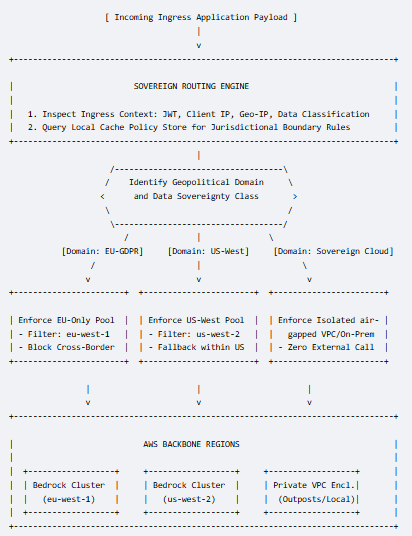
Passing cross-border payloads that contain Personally Identifiable Information (PII) or protected corporate data to an unauthorized geographic region is a severe compliance violation. The Model Routing layer acts as the authoritative compliance gatekeeper, embedding jurisdictional logic into the execution path to ensure tokenized payloads never cross defined geopolitical boundaries.
Metadata Extraction and Compliance Tagging
Before a request payload is parsed for semantic intent or cost efficiency, the routing engine runs it through a deterministic Compliance Classification Pipeline. This operation executes in single-digit milliseconds by examining structured metadata attached to the ingress envelope:
- Geo-IP and Origin Telemetry: The proxy resolves the user's current geographic coordinates or origin IP against an in-memory geolocation database to detect the initiating regulatory zone, such as the European Union, Switzerland, or specific US states.
- Tenant Identity Context: The router decodes claims within the client's cryptographically signed JSON Web Token (JWT) to identify corporate data residency requirements, such as
residency_requirement: "eu-only"orsector: "federal". - Data Classification Flags: If an upstream platform guardrail or Data Loss Prevention (DLP) layer scans the prompt and flags localized PII, it appends a dynamic classification tag, such as
contains_pii: true, to the payload headers.
The Sovereign Routing Matrix
Once these tags are computed, the routing engine drops all cost- or performance-driven optimization profiles and matches the payload against a strict, immutable Sovereign Routing Matrix.
// Example Routing Policy Engine Rule Matrix
{
  "rule_id": "rule-eu-gdpr-strict",
  "match": {
    "geo_origin": "EU",
    "data_classification": "highly-confidential"
  },
  "enforcement": {
    "allowed_regions": ["eu-west-1", "eu-central-1"],
    "forbidden_providers": ["external-third-party-api-direct"],
    "encryption_required": "kms-customer-managed-key",
    "fallback_strategy": "fail-fast"
  }
}
If a rule dictates that data must stay within the European Union, the router restricts its runtime endpoint pool exclusively to model clusters deployed in regions such as eu-west-1 (Ireland) or eu-central-1 (Frankfurt). Even if a model instance in us-east-1 (N. Virginia) features lower queue depth, zero token constraints, and a 40% cheaper pricing profile, the router blocks that path.
Hard Isolation and Air-Gapped Fallback Behavior
For top-tier national sovereignty requirements or strictly regulated corporate environments, such as banking core processing or defense infrastructure, the router supports Air-Gapped Isolation Modes.
- Zero-External-Call Enforcement: If the payload is tagged with maximum classification requirements, the routing engine blocks all paths to public endpoints or third-party managed SaaS AI models.
- On-Premises / Local Infrastructure Shunting: The router mutates the request destination to point exclusively toward internal VPC endpoints, local inference clusters, such as self-hosted vLLM servers running open-source models inside an enterprise-controlled environment, or localized hardware configurations such as AWS Outposts.
- Compliant Fail-Fast Execution: If all compliant localized clusters are down or experiencing severe capacity limits, the routing engine explicitly rejects the request with a structured error (
HTTP 403 Forbidden - Data Residency Policy Violation). It chooses to fail the transaction safely rather than risking a compliance breach by falling back to an unapproved public cloud region.
9. Dynamic Cost-Caps and Token-Budget Routing: Financial Governance at Runtime
In an enterprise environment, unconstrained deployment of generative AI features is a major source of financial risk. Because LLM consumption costs scale directly with token volume rather than standard API call counts, autonomous agent loops, large document processing jobs, and uncontrolled end-user testing can rapidly drain a company's operational budget.
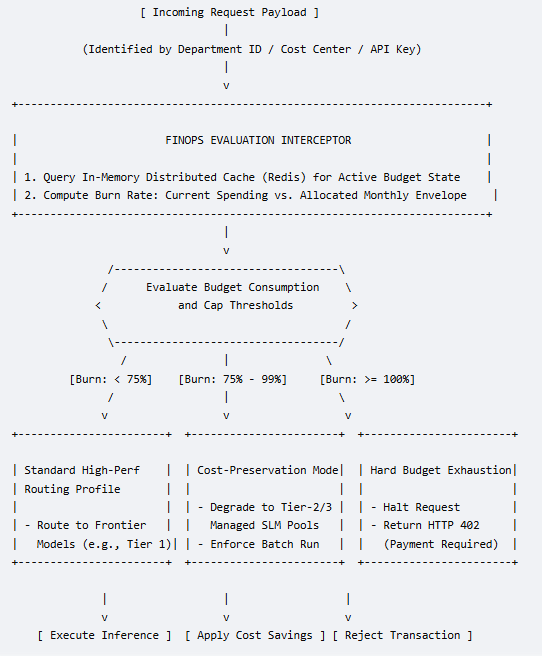
Dynamic Cost-Caps and Token-Budget Routing inserts real-time corporate financial governance directly into the execution path of the Model Routing engine. By continuously tracking financial metrics at the department, cost center, or API key level, the routing layer shifts from a simple infrastructure tool to a dynamic FinOps enforcement engine. It modifies routing paths in real time based on budget depletion, allowing organizations to maintain financial control without completely shutting down business services.
Real-Time Token Ledger and Burn-Rate Calculation
To prevent the routing engine from introducing latency overhead during financial checks, the platform maintains a high-speed, distributed ledger within an in-memory database such as Redis.
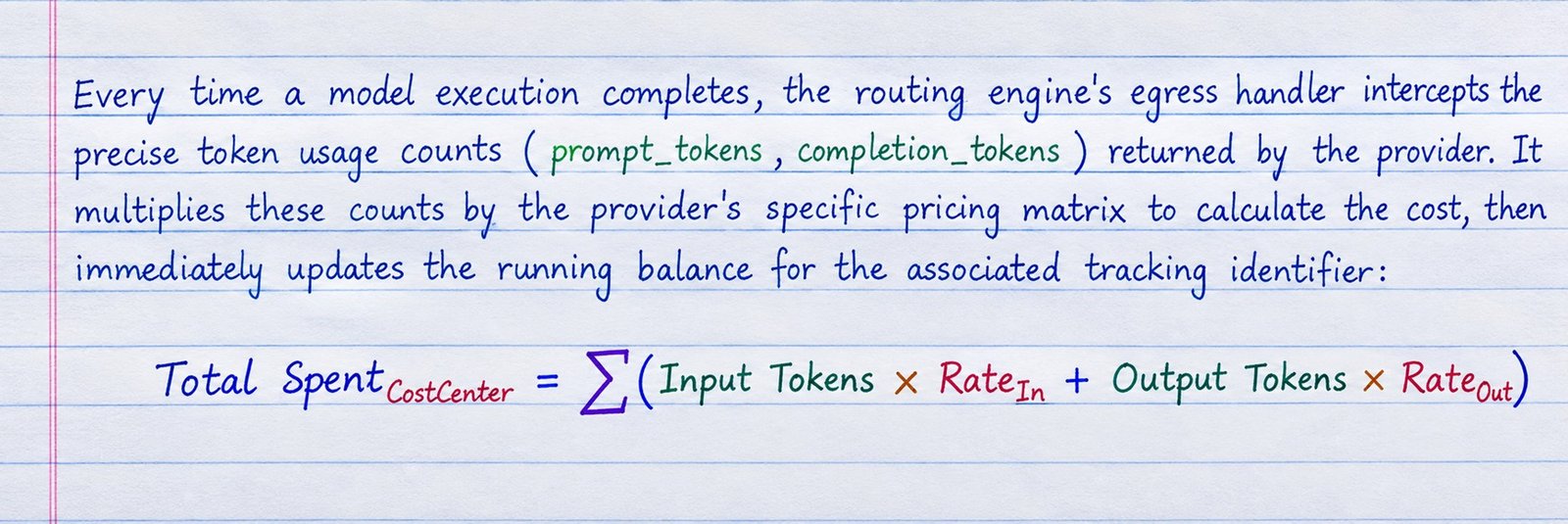
The FinOps Interceptor evaluates this data against predefined tier thresholds:
- Green Tier (Normal Operation): Total consumption is under 75% of the allocated budget. The router maintains standard performance profiles, sending requests to top-tier frontier models to maximize accuracy.
- Yellow Tier (Cost-Preservation Mode): Total consumption reaches 75% to 99% of the budget. The router triggers adaptive degradation rules to slow down spending.
- Red Tier (Budget Exhaustion): Consumption hits or exceeds 100% of the allocated limit. The router applies hard isolation rules to stop further spending.
Adaptive Financial Routing and Graceful Service Degradation
When a specific cost center or product API key enters the Yellow Tier, the routing engine applies automated fallback rules to lower the cash burn rate. Instead of blocking the user completely, it alters the routing topology to run cost-saving workflows:
- Symmetric Model Downgrading: The engine dynamically routes workloads away from expensive frontier models to smaller, highly optimized models, such as shifting from a Tier 1 Frontier model to a Tier 3 SLM. For example, a customer service summary task is transparently moved to a model that is 10 to 20 times cheaper, protecting the budget while keeping the service active.
- Forced Asynchronous Batching: The router intercepts non-urgent requests and switches them from real-time synchronous execution pools to asynchronous provider-native batch processing queues. This change leverages batch discount pricing, often up to 50% cheaper, to extend the remaining budget window.
- Strict Context Window Caps: The routing engine sets a maximum limit on incoming context sizes for accounts with high burn rates. It truncates non-essential historical messages or rejects exceptionally large documents before they can consume expensive input tokens.
Hard Budget Cap Enforcement and Isolation
When an API key or department hits the Red Tier (100% budget depletion), the routing engine stops forwarding requests to downstream model providers.
The router acts as a gatekeeper, intercepting the request at the ingress layer and immediately returning a structured error response: HTTP 402 Payment Required or a custom platform error code Enterprise_Budget_Exhausted. This hard stop isolates the financial risk instantly, protecting the organization from surprise cloud provider bills. It keeps the platform secure and cost-managed until an administrator explicitly reviews and adjusts the department's budget allocation.
10. Routing Engine Architecture: Avoiding the Latency Tax
Determining the correct model path must not introduce a processing bottleneck. To ensure the routing decision layer adds less than 10 milliseconds of overhead, the controller avoids calling heavy LLMs for intent classification. Instead, it relies on a dual-engine architecture:
- Deterministic Filter Chains: Inbound application metadata headers and regex-based routing configurations instantly map known programmatic tasks directly to their assigned model enclaves without inspecting payload semantics.
- High-Throughput Semantic Classifiers: For free-form text input, the proxy passes the prompt payload to a lightweight, highly responsive local embedding model. The system executes a fast cosine-similarity lookup against a localized, pre-cached intent vector matrix to declare the target destination tier locally at the edge.
11. Leadership Takeaways: Strategic Imperatives for the C-Suite
For technology executives (CTOs, VPs, and Directors), implementing an intelligent Model Routing layer is not merely a technical optimization task. It is a core business-resiliency strategy. Treating foundation models as commodity endpoints through abstract routing allows the enterprise to retain architectural sovereignty, control financial liabilities, and insulate product roadmaps from vendor lock-in.
When designing and funding this layer of the Enterprise AI Platform, engineering leaders must keep three strategic mandates in mind:
- Own the Routing Layer or Risk Vendor Lock-in: Letting an external application development framework or a single cloud provider control your routing logic hands over your architectural sovereignty. The enterprise must own the routing plane to seamlessly shift traffic between open-source models, private deployments, and frontier cloud APIs as market economics change.
- Decouple Capability from Specific Strings: Codebases must never reference specific model names. By wrapping model destinations behind logical platform aliases, such as
claims-processing-advanced, you allow infrastructure teams to upgrade, patch, or switch backend engines with zero disruption to production application code. - Balance Cost, Latency, and Accuracy Automatically: The standard practice of sending all enterprise prompts to the largest available frontier model is financially unsustainable. High-performing engineering teams must use the routing engine's automated features, such as semantic caching, micro-classification, and adaptive downgrading, to balance the cost-performance equation automatically at runtime.