Prompt Management - The Enterprise Prompt Registry and Lifecycle Engine
Introduction
Treating prompts as static strings hardcoded in application codebases causes operational friction, forcing full software recompilation and deployment cycles for minor tweaks. Mature enterprise AI architectures avoid this by treating prompts as decoupled assets via a centralized Enterprise Prompt Registry—similar to Docker Hub or npm—that separates prompt engineering from application deployment.
To achieve production-scale efficiency, the enterprise AI platform must treat prompts as first-class, decoupled corporate assets. Prompt Management must be architected as an Enterprise Prompt Registry, a centralized, version-controlled artifact repository analogous to Docker Hub or an enterprise npm registry.
This engine completely decouples prompt engineering from application deployment, introducing a dynamic, managed lifecycle plane.
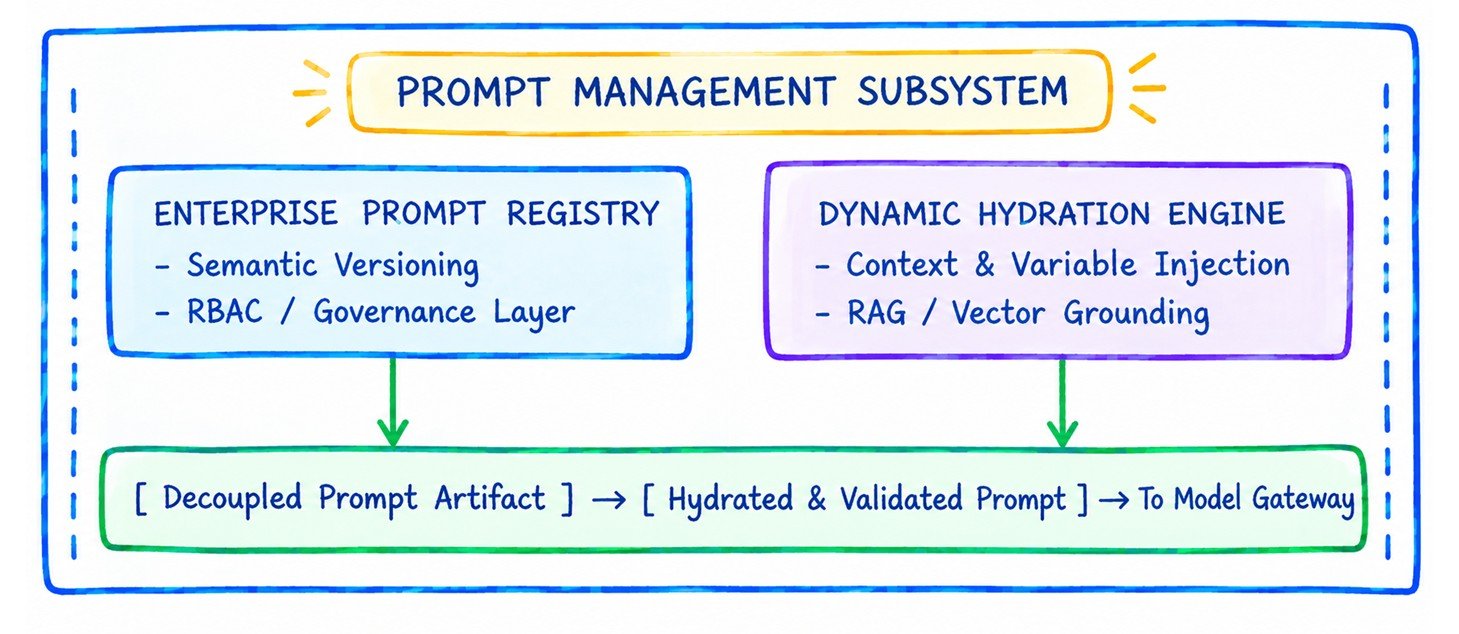
The Prompt Registry Architecture: Versioning and GitOps Pipelines
The registry uses SemVer and GitOps pipelines, storing prompts as JSON or YAML schemas with variables and parameters. It provides a dual-mode consumption model:
- Immutable Hash Fetching: Applications use unique hashes for mission-critical tasks to prevent prompt drift.
- Dynamic Tag Routing: Mutable alias tags (e.g.,
:production) enable real-time updates and A/B testing without code changes.
# Sample Enterprise Prompt Artifact Schema (v1.2.0)
meta:
  prompt_id: "customer-risk-assessment"
  version: "1.2.0"
  owner: "risk-modeling-team"
model_configuration:
  intelligence_tier: "tier-1-frontier"
  temperature: 0.1
templates:
  system: |
    You are an enterprise risk assessment assistant operating under strict compliance guidelines.
    Analyze the following customer history: {{customer_profile}}.
    Cross-reference with retrieved legal context: {{compliance_context}}.
1. Semantic Versioning for Prompts
The platform enforces strict version controls to protect system stability:
- Patch Changes (v1.2.1): Minor wording adjustments or formatting updates that do not alter the expected input variables or significantly impact output structure.
- Minor Changes (v1.3.0): The addition of optional input variables or new formatting rules, such as requesting a JSON response instead of Markdown.
- Major Changes (v2.0.0): Structural overhauls that modify mandatory parameters, change the core persona, or rely on a different foundational model tier.
2. The CI/CD Promotion Pipeline
Prompts advance through the enterprise environment using an automated GitOps lifecycle. This ensures every prompt change is systematically validated before hitting production.
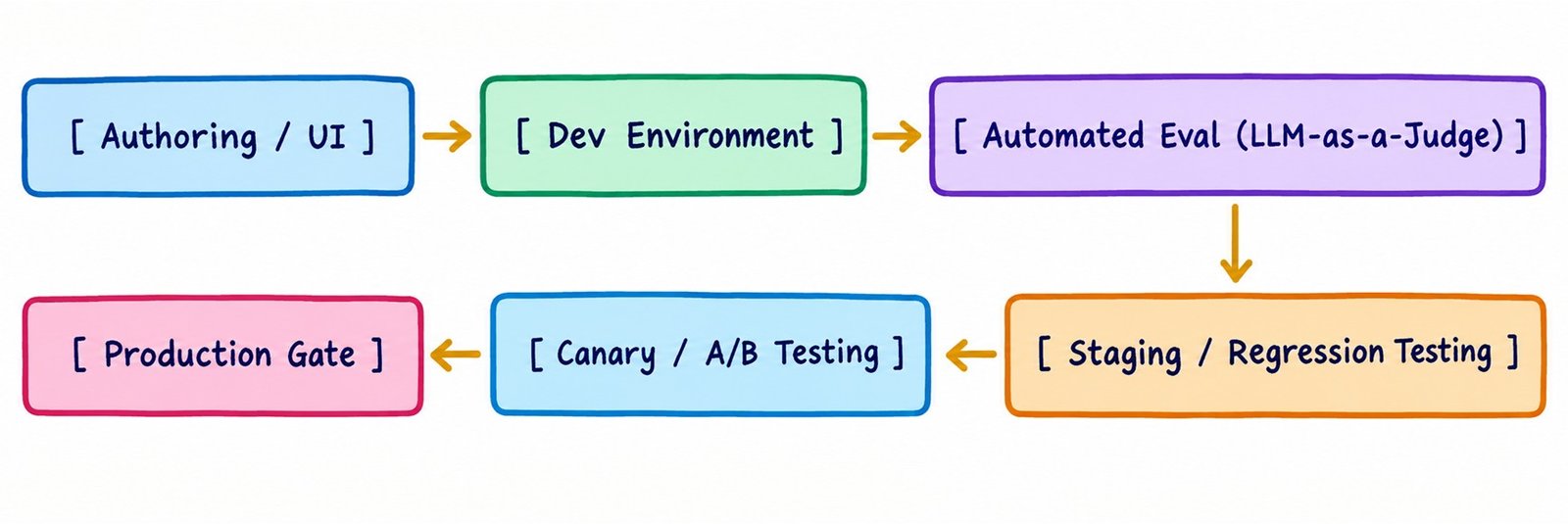
- Development & Evaluation: Prompt engineers or product managers design and iterate on templates inside an authoring playground. Changes are checked into a Git repository, triggering automated evaluation pipelines, using LLM-as-a-Judge architectures, to catch regressions in accuracy or tone.
- Staging and Regression Testing: The prompt is pushed to Staging, where it runs against a golden evaluation dataset to measure performance against previous versions.
- Production Canary Deployments: The prompt is promoted to Production using automated release patterns. The platform can route a small percentage of traffic, such as a 5% canary slice, to the new prompt template to monitor real-time behavior before completing a full rollout.
Dynamic Hydration and Runtime Context Injection
At runtime, an application does not pass a raw string to the Model Gateway. Instead, it sends an identifier, such as customer-risk-assessment:v1.2.0, along with client-side parameters. The Prompt Management subsystem is responsible for Dynamic Hydration, assembling the final, grounded prompt from multiple real-time enterprise data streams.
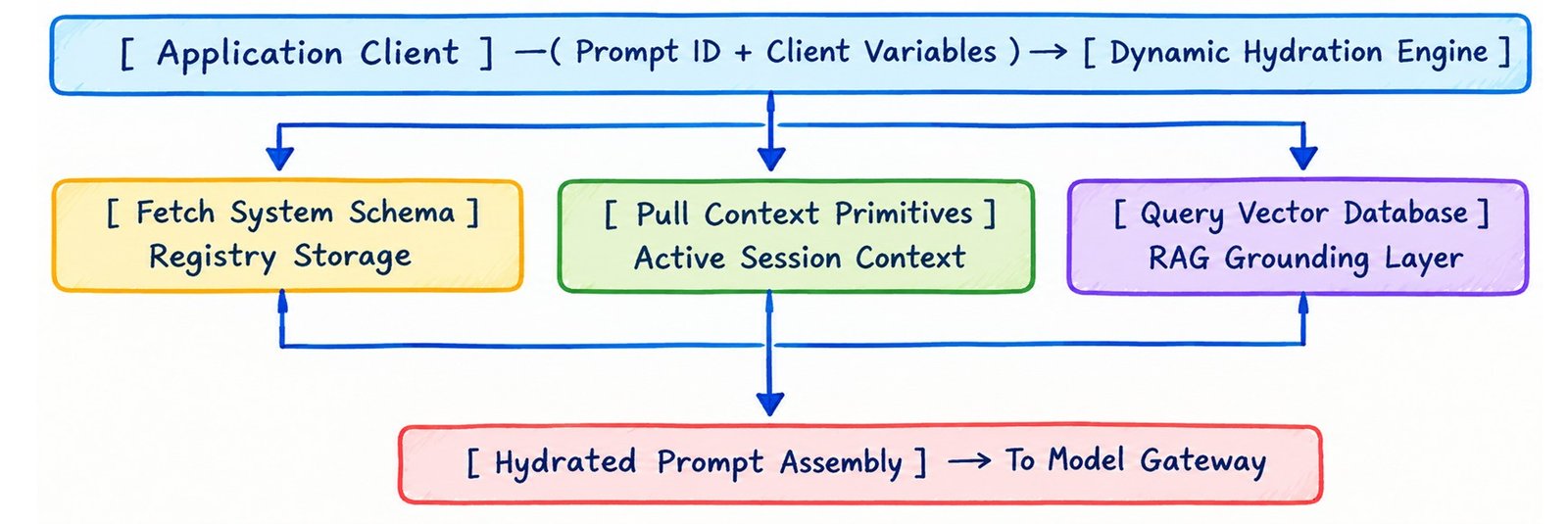
- Schema Retrieval: The platform extracts the canonical system prompt and orchestration template for the requested version from the database.
- Context Resolution: The runtime engine maps client-supplied variables, such as a unique
customer_id, and hydrates the prompt with live enterprise data, such as active session data or authorization levels. - Knowledge Grounding Integration: For RAG applications, the hydration engine interacts with the enterprise knowledge layer, running a vector semantic search using the user's intent. It parses the most relevant document chunks and embeds them directly into the template's context block, such as replacing the
{{compliance_context}}placeholder. - Gateway Ingress Preparation: The completely assembled, grounded prompt is passed directly to the Model Gateway for sanitization, security evaluation, and model routing.
Role-Based Access Control (RBAC) and No-Code Governance
To maximize business agility, the platform removes engineers from the daily prompt optimization loop by introducing a secure, audited management plane accessible to non-technical stakeholders.
Enterprise Prompt Access Rights
| Role | Dev Environment | Staging Environment | Prod Environment |
|---|---|---|---|
| Product Manager | Read / Write | Read / Test | Read Only |
| Prompt Engineer | Read / Write | Read / Write | Promote Only |
| Platform Admin | Full Control | Full Control | Full Control |
- No-Code Management Interface: The platform provides a managed web UI allowing product managers, domain experts, and risk officers to view active templates, adjust system wording, and tweak model variables directly.
- Strict Governance and Audit Trails: Any adjustments made inside the management console are securely written back to the underlying Git repository. The platform logs who initiated the change, what modifications were introduced, and what evaluation criteria were satisfied.
- Zero-Redeployment Updates: Because applications consume prompts dynamically via an internal configuration API, saving and promoting a version
v1.2.1template instantly updates downstream application behaviors across the enterprise footprint without requiring a single line of application code to be redeployed.
Operational Blueprint: The Lifecycle Comparison
| Architectural Attribute | Hardcoded Application Prompts | Centralized Prompt Registry |
|---|---|---|
| Release Velocity | Tied to application deploy cycles (hours to weeks). | Instantaneous; decoupled from code releases via configuration APIs (seconds). |
| Version Enforcement | Weak; non-standard string formatting across different teams. | Strict; mandatory Semantic Versioning backed by GitOps configuration schemas. |
| Testing Paradigms | Ad-hoc manual verification by developers. | Automated LLM-as-a-Judge evaluations, regression suites, and canary testing. |
| Access & Collaboration | Restricted to developers with direct access to application repositories. | Democratic; RBAC-driven interfaces allowing product and risk teams direct access. |
| Runtime Assembly | Done client-side; fragments how applications fetch vector and session data. | Done platform-side; centralized context resolution and dynamic RAG hydration. |
Conclusion
The Prompt Management subsystem shifts an organization from unmanaged prompt strings to a highly disciplined, version-controlled architecture. By establishing a centralized Prompt Registry, enforcing strict semantic versioning, and using dynamic context hydration, the enterprise AI platform treats prompt logic with the same operational rigor as production software. This system gives product teams the agility to continuously optimize their AI applications while maintaining total governance and system stability.