Reusable AI Capabilities - The Microservice-to-Composite Architecture
Introduction
In the initial phases of enterprise AI adoption, individual engineering teams typically build generative capabilities inside isolated silos. A customer support team might construct a custom text-summarization pipeline, while the legal team simultaneously engineers a separate document-extraction tool, and the operations division manually wires together a sentiment analysis loop. This fragmented approach leads to massive redundant engineering spend, fractured prompt governance, duplicate model configurations, and inconsistent quality baselines across the organization.
To move from isolated projects to an industrialized AI enterprise, the platform must treat intelligence as a collection of reusable corporate assets. The Reusable AI Capabilities service acts as the platform's modular service catalog. It establishes a decoupled, multi-tier Microservice-to-Composite Architecture that exposes standardized text and vision processing blocks as shared corporate utilities.
By centralizing these building blocks within an enterprise-wide hub, organizations eliminate redundant development cycles, enforce unified policy controls, and allow developers to assemble complex business applications quickly using pre-vetted AI microservices.
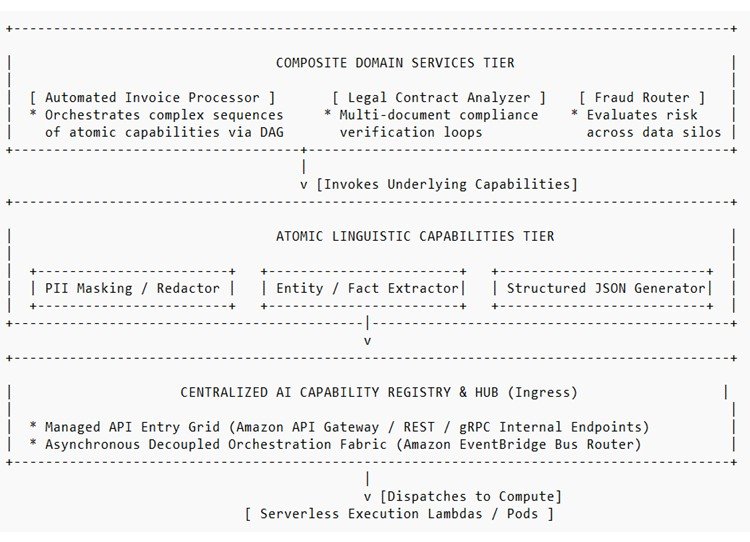
1. The Multi-Tier Capability Taxonomy
The platform organizes its reusable intelligence catalog into a strict, two-tiered functional taxonomy to ensure clear separation of concerns, high code reusability, and maintainable prompt lifecycles.
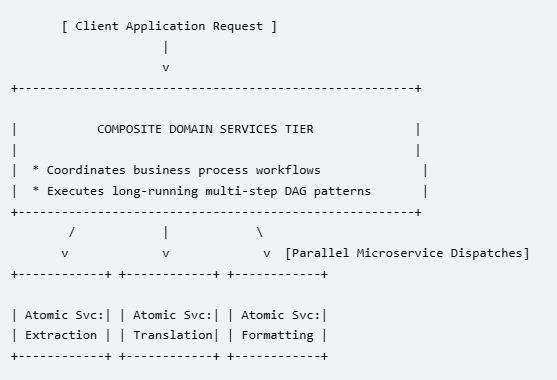
Tier 1: Atomic Linguistic Capabilities
Atomic capabilities function as stateless, single-purpose microservices. They target foundational text or image manipulation tasks and execute without any specific awareness of the broader business domain or transactional context.
- Structured JSON Generator: Accepts unstructured document text and outputs a strictly verified, schema-compliant JSON file matching a defined schema footprint.
- Entity and Fact Extractor: Scans raw data payloads to find and extract designated key-value metrics, names, quantities, or product identification numbers.
- Semantic Translation Service: Translates incoming text elements into target languages while preserving industry-specific terminology and context.
Tier 2: Composite Domain Services
Composite services function as stateful, process-aware orchestrators. They combine multiple underlying Atomic Linguistic Capabilities with specific enterprise rules and private databases to execute complex, multi-step business transactions.
- Automated Invoice Processor: Coordinates a structured workflow that extracts table items via the Entity Extractor, matches the values against an internal ERP database tool, runs a compliance scan using a validation block, and generates an automated accounting ledger update.
- Legal Contract Analyzer: Orchestrates multi-document comparisons, scanning draft contracts against master corporate compliance sheets to flag missing liability terms, indemnification breaches, or out-of-bounds geographic clauses.
2. The Centralized AI Capability Registry & Hub Pattern
To eliminate shadow engineering spend and maximize reuse across business lines, the platform exposes these capabilities through an enterprise-wide Centralized AI Capability Registry & Hub.
Every atomic capability and composite service is registered as a logical, decoupled service endpoint. These endpoints are wrapped in a shared corporate catalog, allowing any authenticated internal application to consume intelligence via standardized interfaces.
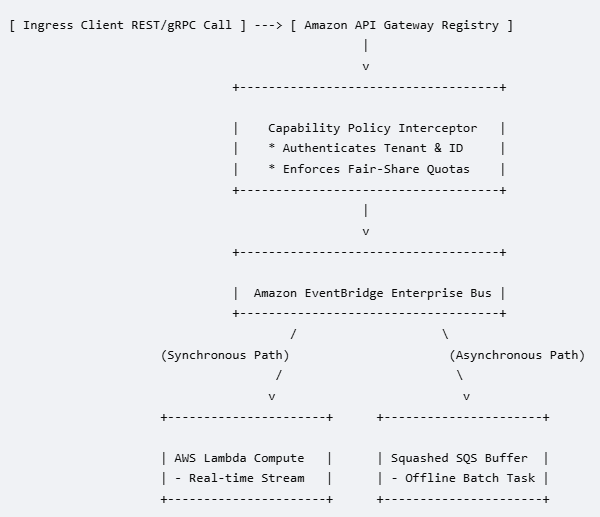
The API Registry Entry Grid
The platform uses Amazon API Gateway to expose its central capability directory. Internal microservices and business applications connect using high-performance gRPC protocols or standard REST configurations.
The gateway handles operational plumbing, such as API key validation, cross-tenant log routing, and rate-limiting enforcement, at the wire level. This decouples the core capability compute layers from client-facing management tasks.
Event-Driven Asynchronous Orchestration
Complex composite services require loose coupling between steps to handle model latency variations and prevent connection timeouts. The hub achieves this by routing transactions through an event-driven bus powered by Amazon EventBridge:
- Event Ingress: When an application initiates a workflow, the API gateway publishes a structured event, such as
Capability_Execution_Requested, to the central EventBridge bus. - Decoupled Rule Routing: EventBridge evaluates the event payload and matches it against registry routing rules, dispatching the transaction to the correct compute resource, such as an automated serverless AWS Lambda function or a containerized worker pool.
- State Management Over Queues: For long-running batch processing or high-volume workflows, the system uses Amazon SQS queues to buffer tasks. This buffering shields backend foundation models from sudden spikes in execution demand and ensures reliable, message-driven delivery.
3. Reference Implementation: The Standardized JSON Extraction Service
The practical implementation diagram below showcases an Atomic Linguistic Capability designed to accept unstructured contract text and output a strictly verified, schema-compliant JSON file.
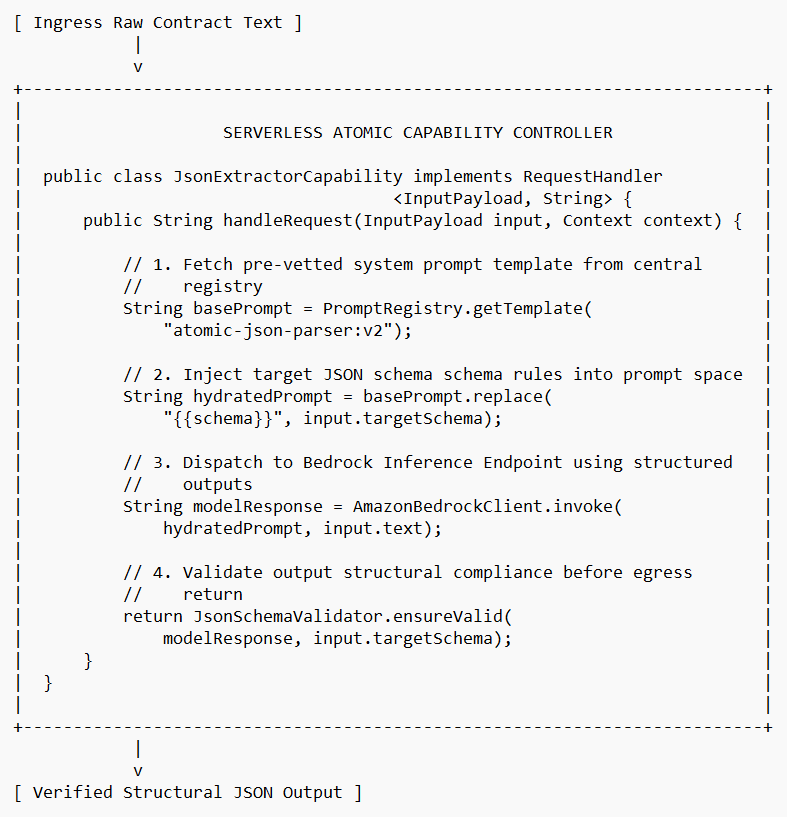
Architectural Execution Flow
- Stateless Template Isolation: The capability codebase contains zero hardcoded prompt strings or model configuration profiles. It calls a central registry to pull pre-vetted prompt templates and schema instructions at runtime.
- Enforced Input/Output Compliance: The Lambda function coordinates model invocation using native structured output settings, such as JSON mode or logit bias alignment. Before returning the response to the client application, the function runs a schema validation check to guarantee structural compliance, shielding downstream systems from formatting issues.
4. Leadership Takeaways: Strategic Imperatives for the C-Suite
For technology executives, establishing a reusable AI capability catalog is the primary mechanism for ending duplicate development costs, accelerating secure delivery speeds, and building a unified intelligence fabric across the organization.
To drive this shift successfully, technology leaders must focus on four core strategic mandates:
- Mandate Central Registration to Eliminate Siloed Spending: Ban the practice of individual teams building custom prompt loops and model connections from scratch. Force all development teams to register their functional workflows as reusable, microservice-style components within a central platform hub to maximize efficiency and asset reuse.
- Decouple Text Capabilities from Core Business Logic: Keep your core business software independent of changing prompt structures and model variations. Build a multi-tier architecture where foundational text tasks operate as stateless, atomic microservices, allowing your infrastructure teams to optimize prompts and swap underlying models without breaking production code.
- Use Event-Driven Architectures to Manage Model Latency: Probabilistic AI operations introduce fluid and unpredictable latency patterns compared to traditional database calls. Use event-driven message buses and distributed queuing frameworks to orchestrate composite workflows asynchronously, protecting your core systems from connection timeouts and capacity overload.
- Enforce Strict Input/Output Verification at the Microservice Edge: Never let unverified model outputs pass directly into downstream corporate software systems. Ensure every reusable capability validates structural output integrity at the edge of the service boundary, delivering dependable, clean data across all business operations.