Secrets Management - Cryptographic Isolation in GenAI and Tool-Execution Planes
Introduction
In legacy enterprise architectures, secrets management is a well-understood problem. Applications read passwords or API keys from a secure vault at startup, keep them in protected environment variables, and use them to authenticate predictable server-to-server connections.
In an Enterprise AI Platform running dynamic LLM tool-calling and autonomous agents, this classic model fails completely. If an active agent loop is allowed to read raw system passwords or third-party API keys directly, those credentials enter the volatile prompt context window. This creates a massive vulnerability: a simple indirect prompt injection attack from an untrusted document could force the agent to print out the corporate access keys in plain text, compromising the enterprise network.
To eliminate this threat vector, a production-grade AI platform must treat secrets management as a fully decoupled, zero-trust injection proxy plane. This service implements a comprehensive cross-plane that combines dynamic runtime tool token orchestration with automated provider credential cycling. This architecture ensures that neither the foundation models nor the autonomous agent runtimes ever have direct visibility into raw corporate credentials.
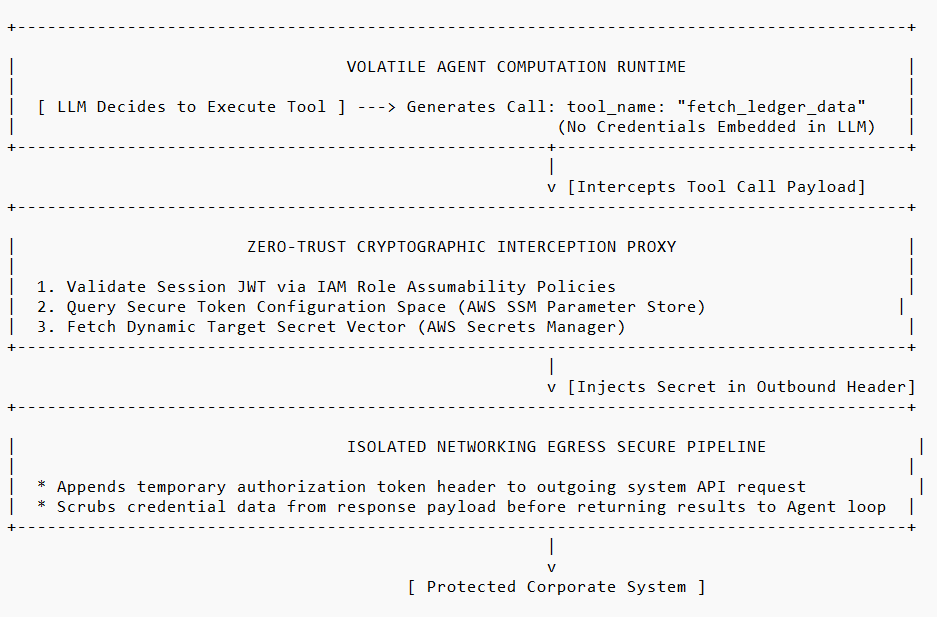
1. Dynamic Runtime Tool Token Orchestration
The runtime token orchestration plane ensures that autonomous agents can invoke enterprise APIs and databases securely without ever touching the actual credentials required to access those systems.
The Decoupled Interception Pattern
When a model generates a structured tool-calling payload, such as {"tool": "query_erp", "parameters": {"customer_id": 1029}}, the tool execution runtime intercepts the call. The agent does not manage or append API keys. Instead, the platform uses an out-of-band proxy to authorize the transaction:
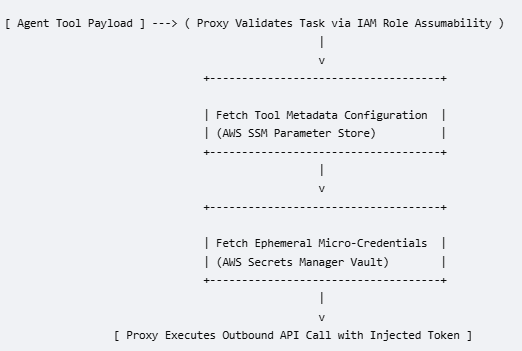
- Identity Verification: The tool proxy reads the agent's temporary execution context, verifying permissions using short-lived IAM Role Assumability principles.
- Configuration Lookup: The proxy queries AWS Systems Manager (SSM) Parameter Store to fetch non-sensitive tool metadata configurations, such as target endpoints, protocol types, and routing boundaries.
- Dynamic Vault Ingestion: The proxy contacts AWS Secrets Manager to extract the exact credential vector needed for the target resource.
- Egress Injection & Redaction: The proxy builds the outbound connection string, injects the credentials into the security headers, and sends the request to the target enterprise resource. When the system responds, the proxy logs the interaction, scrubs all security tokens from the text stream, and returns only the clean data payload to the volatile agent memory loop.
2. Provider Credential Cycling and Gateway Isolation
Beyond managing secrets for internal tool execution, the platform's control plane must secure the upstream keys used to authenticate with external model providers, such as OpenAI, Anthropic, Cohere, or custom vendor deployments.
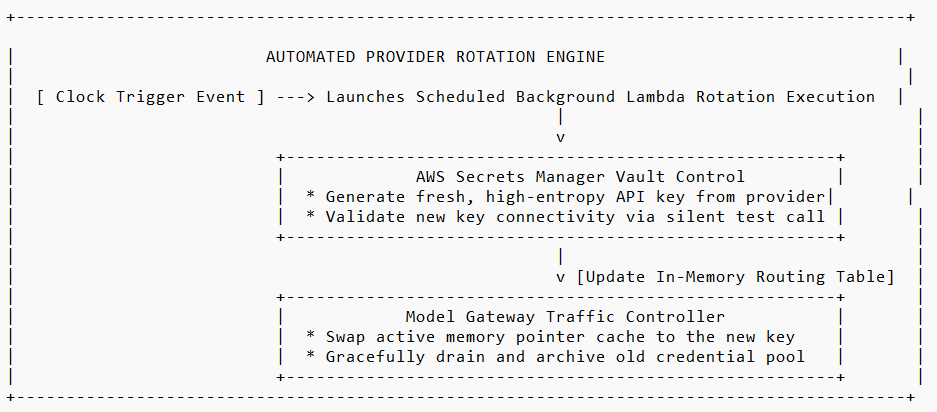
Zero-Downtime Rotations
Relying on static, hardcoded API keys for external model access leaves the enterprise vulnerable to credential exposure. The platform eliminates this risk by running automated rotation workflows through AWS Secrets Manager:
- Programmatic Key Generation: At scheduled intervals, such as every 30 days, a background Lambda worker connects to the model provider's administrative endpoint to generate a fresh, high-entropy API key.
- Connectivity Validation: The rotation worker runs a silent test request using the new credential vector to confirm valid connectivity, authentication, and throughput bounds.
- Atomic Pointer Swapping: Once validated, the worker writes the new key to the secure secrets repository. The core Model Gateway receives an in-memory update event, instantly swapping its routing pointer cache to use the new key for active production traffic. The older key is systematically deactivated and archived with zero platform downtime.
Cross-Tenant Secret Isolation
To support multi-tenant governance, the platform organizes its configuration trees strictly by tenant namespace within AWS SSM Parameter Store and AWS Secrets Manager. Access controls enforce rigid resource path isolation policies:
// IAM Least-Privilege Assumability Restriction
{
    "Version": "2012-10-17",
    "Statement": [
        {
            "Effect": "Allow",
            "Action": "secretsmanager:GetSecretValue",
            "Resource": "arn:aws:secretsmanager:*:*:secret:/ai-platform/tenant-delta/*"
        }
    ]
}
This strict path containment ensures that an agent running within the tenant-delta context is cryptographically blocked from ever reading or interacting with keys belonging to separate organizational environments, preventing cross-tenant access leaks.
3. Reference Implementation: The Zero-Trust Tool Proxy
The practical deployment mapping for the platform's secrets abstraction plane relies on a secure serverless design built with native AWS primitives.
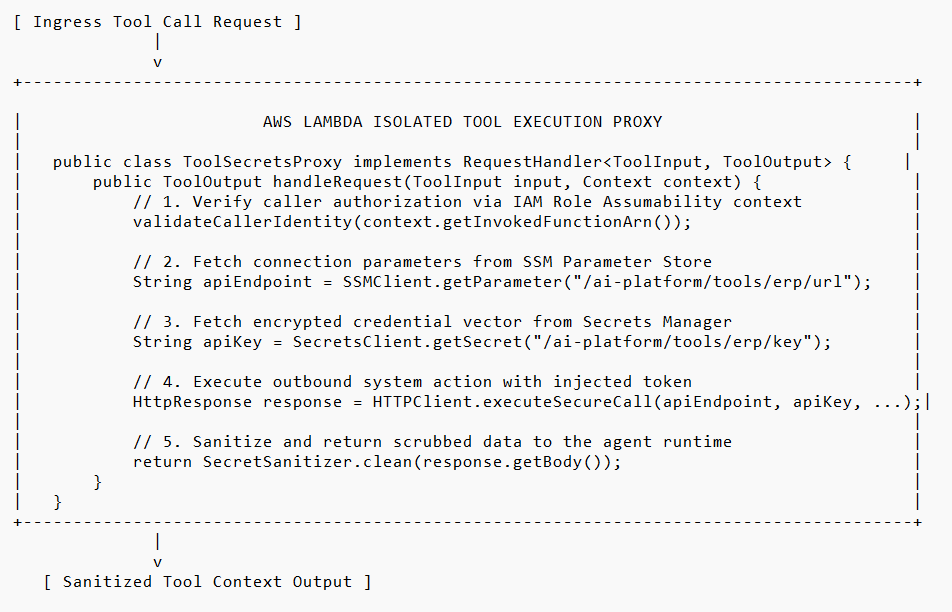
Architecture Implementation Mechanics
- Decoupled Vault Isolation: The agent runtime never communicates directly with the enterprise secrets vault. It operates inside a walled compute sandbox with no external networking access to the vault layer.
- Proxy-Driven Execution: When a tool call executes, the isolated AWS Lambda Tool Proxy handles the transaction. It authenticates using its own execution role, retrieves the necessary configuration details from the SSM Parameter Store, pulls the active keys from AWS Secrets Manager, and manages the external system interaction entirely out-of-band. This process keeps sensitive access tokens safely insulated from the volatile model space.
4. Leadership Takeaways: Strategic Imperatives for the C-Suite
For technology executives, establishing an automated, zero-trust secrets management plane is a critical security mandate for eliminating data exfiltration risks and scaling safe autonomous workflows.
To enforce robust cryptographic control across the ecosystem, technology leaders must drive three core strategic imperatives:
- Enforce Complete Credential Isolation from the AI Runtime: Never allow raw API keys, passwords, or database string configurations to pass into an agent's volatile memory or system prompt windows. The platform must use decoupled, out-of-band proxy layers to inject credentials at the network wire level, keeping security tokens invisible to the LLM environment.
- Automate Upstream Provider Key Rotations Programmatically: Relying on permanent, static tokens for third-party foundation models introduces severe operational risk. Mandate the use of secure vaults to automate key rotation cycles natively, ensuring regular, zero-downtime credential switching across all connected vendors.
- Isolate Resource Paths by Organizational Namespace: Multi-tenant platform deployments require strict boundary management. Ensure your technical teams map all configuration parameters and secret vectors to isolated resource paths protected by explicit IAM policies, blocking cross-tenant credential exposure or unauthorized system access at the infrastructure layer.