Cloud and Hybrid Deployment Patterns - Topologies for Resilient Enterprise AI
Introduction
Deploying an Enterprise AI Platform requires moving past the architectural assumption that all model inference, data retrieval, and state management can live within a single public cloud region. Large-scale corporate AI workloads are bound by conflicting forces: they need the elastic compute capacity of public hyperscalers, yet they must comply with strict data sovereignty laws, corporate network compliance, and localized data isolation mandates.
If an organization defaults to a naive, single-region deployment footprint, it leaves itself exposed to catastrophic failure modes: localized region outages, network latency bottlenecks for global users, and regulatory non-compliance under frameworks like GDPR or national defense rules.
A production-grade Enterprise AI Platform addresses these issues by deploying a Multi-Region, Sovereign, and Hybrid Deployment Pattern. This architecture treats cloud and on-premises infrastructure as a unified fabric. By isolating data processing planes, structuring secure cross-boundary network channels, and containerizing model serving layers, the platform delivers high availability and compliance across any geographical footprint.
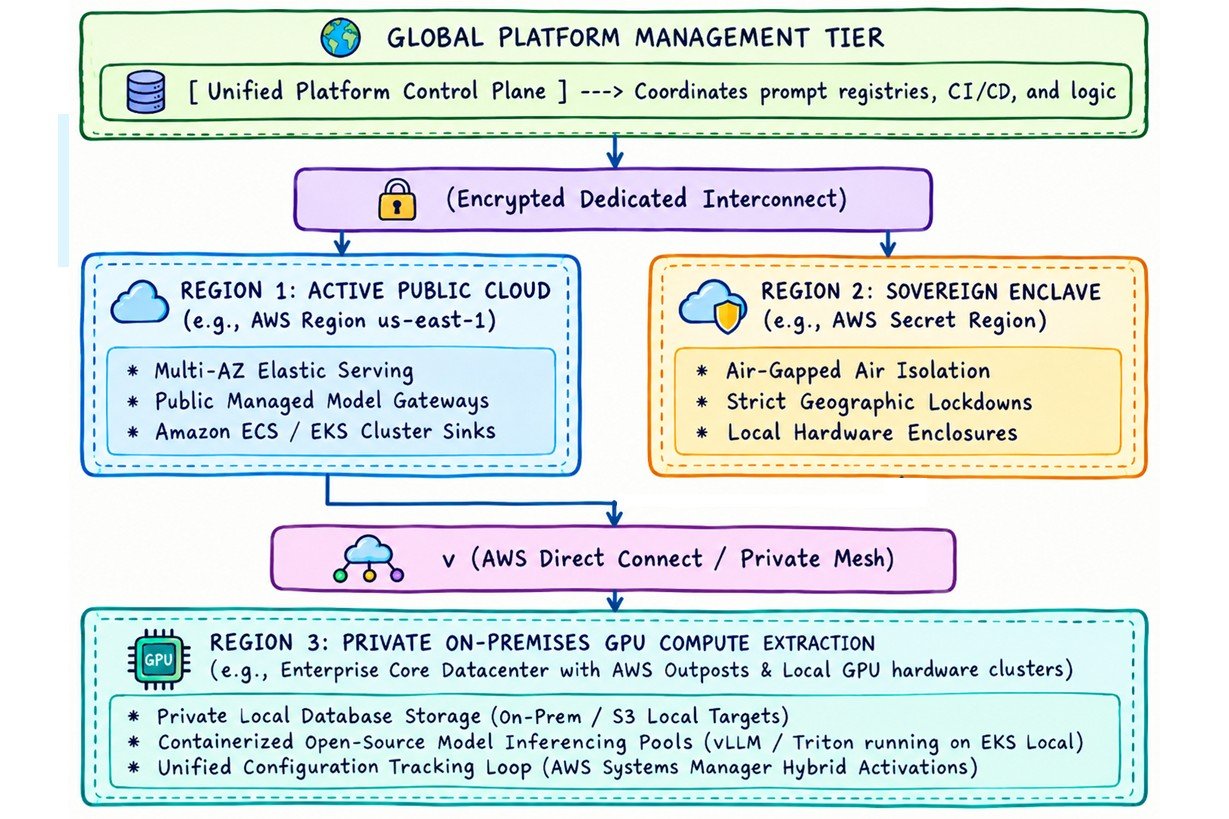
1. Pure Public Cloud Multi-Region Topologies
To guarantee continuous availability for customer-facing interfaces, the platform utilizes an active-active, multi-region architecture across public hyperscaler networks.
Active-Active Service Mesh Configuration
The core Model Gateway, semantic cache, and routing engines are deployed symmetrically across separate geographic regions (e.g., load balancing across us-east-1 and us-west-2).
- Multi-Availability Zone (AZ) Resilience: Within each independent region, compute layers are hosted inside isolated containers utilizing Amazon Elastic Container Service (Amazon ECS) or Amazon Elastic Kubernetes Service (Amazon EKS). These containers scale automatically across multiple underlying AZs to survive localized hardware infrastructure failures.
- Decoupled Local Caching: To minimize network cross-region latency, every region operates its own localized read-through semantic cache. Regional transactions update their local caches instantly, maintaining rapid response profiles for nearby user applications.
2. Sovereign Cloud and Isolated Topologies
For defense workloads, state intelligence processing, or sectors bound by strict national data regulations, public cloud pools are legally unviable. The platform adapts to these constraints by deploying isolated, air-gapped regional instances.
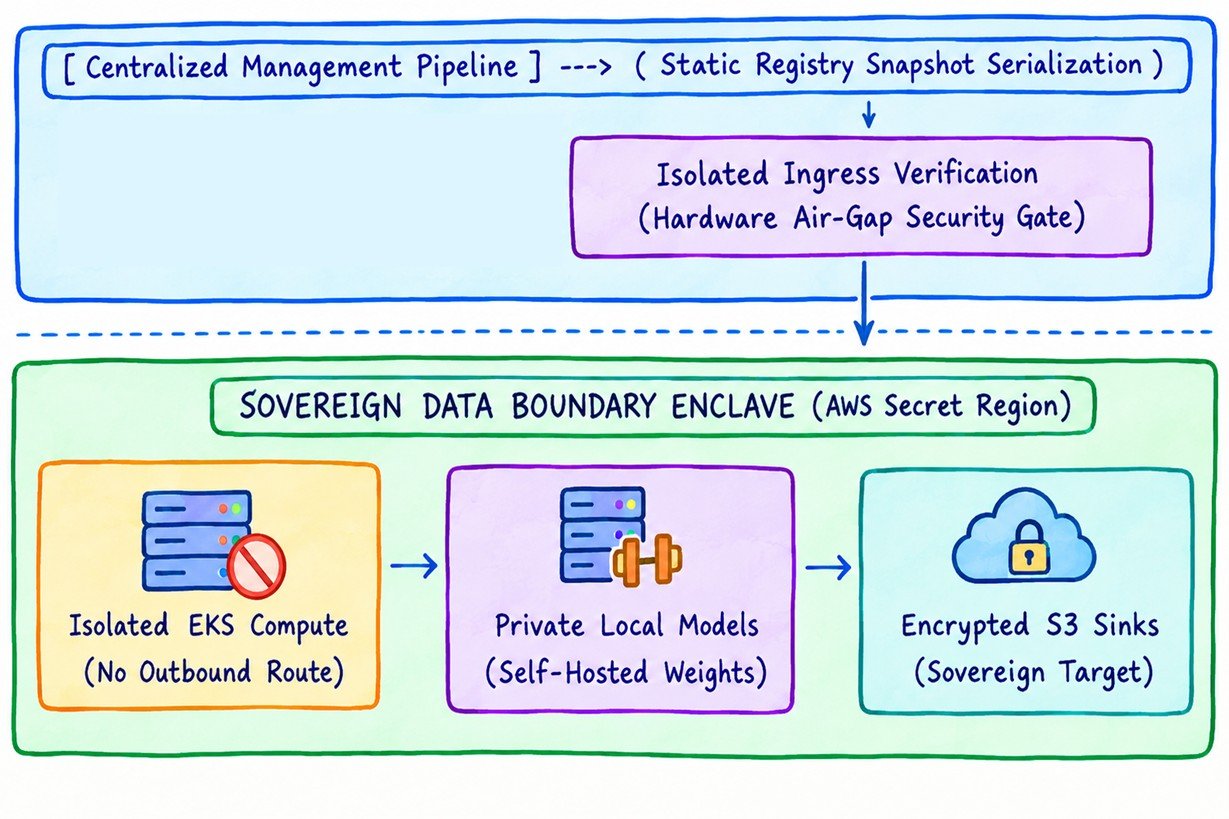
Local Ingress and Registry Hardening
- Snapshot Ingress Processing: Because standard Git-driven network pipelines cannot access the isolated network, updates follow a secure serialization path. Core platform updates, pre-vetted system prompt files, and code container images are compiled into encrypted file system snapshots.
- Verification Gates: These snapshots are transferred through specialized hardware security gates, where automated code scanners inspect the payloads for vulnerabilities before allowing them to deploy to the sovereign EKS compute rings.
- Local Sovereign Inference: Once verified inside the enclave, the local Model Gateway manages requests entirely within the isolated environment. The application runs against locally stored open-source weights or secure, region-locked model endpoints, ensuring sensitive payloads never leak across borders.
3. True Hybrid Enterprise Architecture
Many organizations maintain massive on-premises GPU compute hardware footprints or hold critical core databases that cannot move to public storage infrastructure. The platform unifies these disparate worlds by executing a True Hybrid Enterprise Architecture.
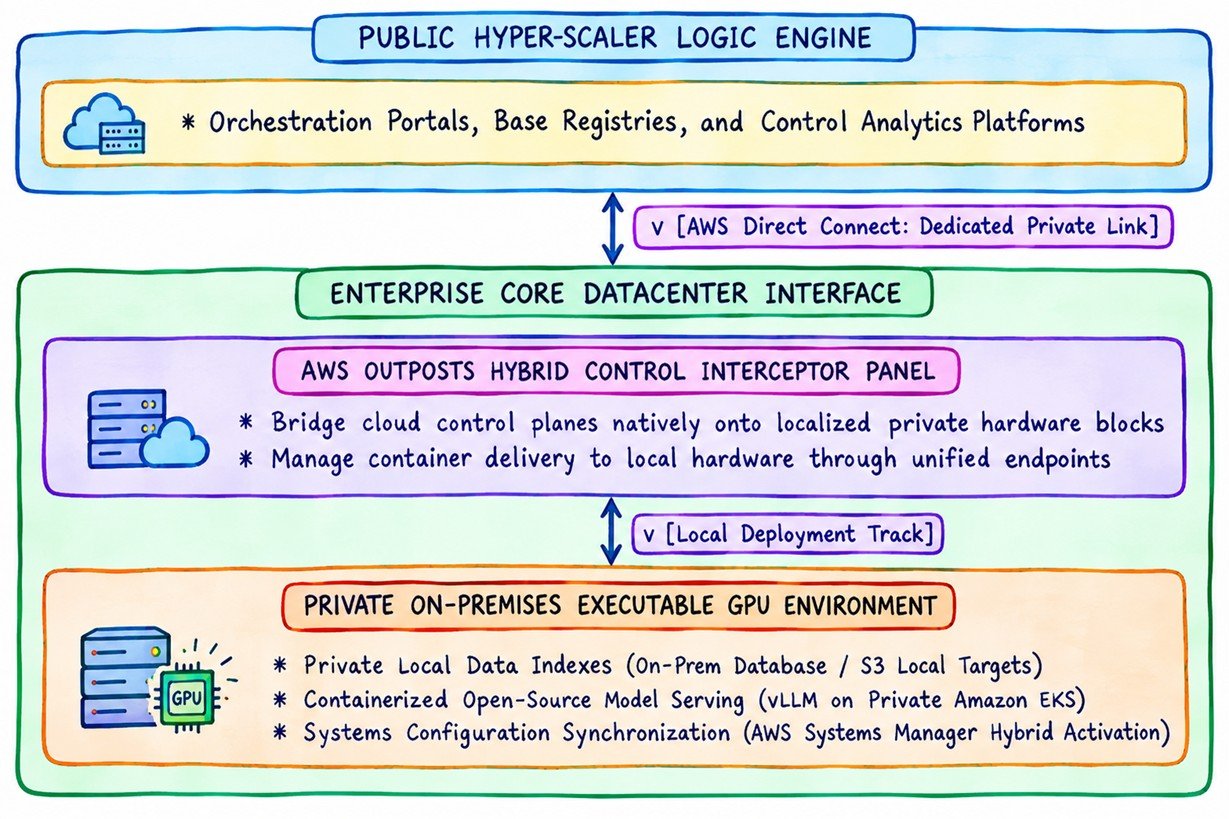
Extending Cloud Control Planes Natively (AWS Outposts)
The platform uses AWS Outposts to bring cloud-native deployment patterns directly into the physical corporate data center. AWS Outposts provides managed hardware racks that sit directly inside the company's private server rooms, running identical APIs, container execution rules, and security controls used in the public cloud. This consistency allows engineering teams to deploy microservices, retrieval handlers, and model proxies onto private infrastructure without rewriting code.
Private On-Premises Containerized Model Serving
Heavy inference execution runs inside a local Amazon EKS / Amazon ECS Anywhere cluster configured to utilize on-premises GPU infrastructure.
- Optimized Local Inferencing Engines: Models are deployed inside custom container environments running optimized open-source serving tools like vLLM or Triton Inference Server.
- Local Data Boundary Enforcement: The RAG retrieval pipeline and vector search mechanisms look only at on-premises data sinks and local databases. Prompt assembly, contextual enrichment, and final model synthesis execute entirely inside the private hardware loop, keeping sensitive source data fully protected within the organization's physical perimeter.
4. Private Networking & Ephemeral Cross-Boundary Synchronization
To connect these fragmented deployment zones safely without exposing transactions to the public internet, the platform builds a dedicated private network mesh paired with anonymized state coordination.
Hybrid Dedicated Interconnects (AWS Direct Connect)
The enterprise data center establishes a direct physical fiber connection to the cloud network using AWS Direct Connect. This dedicated link bypasses public internet paths entirely, providing high-bandwidth, low-latency, and predictable network transport for background coordination tasks.
Ephemeral State Synchronization and Hybrid Parameter Configuration
To manage platform configurations consistently across public, sovereign, and private instances, the architecture implements a centralized synchronization pattern driven by AWS Systems Manager (SSM) Hybrid Activations:
// Example SSM Hybrid Activation State Registration
{
  "ActivationId": "act-98402-bb81",
  "ManagedInstanceId": "mi-0123456789abcdef0",
  "Region": "us-east-1",
  "HybridConfiguration": {
    "target_on_premises_cluster_id": "corp-core-gpu-dc-01",
    "synchronization_protocol": "amqp-encrypted-mesh",
    "enforced_policy_profile": "sovereign-data-isolation-strict"
  }
}
- Unified Configuration Management: Through SSM Hybrid Activations, the centralized control plane manages on-premises server containers and sovereign endpoints as unified enterprise assets.
- Secure Variable Propagation: When an administrator updates a global system prompt, modifies a guardrail parameter, or pushes a security patch, the configuration change is pushed securely across the private interconnect network.
- Data-Blind Sync Verification: The local nodes receive the updated configuration array, update their local components, and return an anonymized cryptographic confirmation hash to the main management plane. This ensures that while system controls remain unified and audit-ready globally, the actual semantic data payloads remain strictly isolated within their designated regional boundaries.
5. Leadership Takeaways: Strategic Imperatives for the C-Suite
For technology executives, selecting cloud and hybrid deployment patterns is a major strategic choice that defines the platform's long-term business resilience, global performance, and compliance boundaries.
To execute a successful infrastructure strategy, technology leaders must drive four core strategic mandates:
- Treat Infrastructure Topology as a Regulatory Control: Infrastructure deployment choices must align directly with data sovereignty and legal frameworks. Implement a decoupled, multi-region, and hybrid deployment architecture to ensure your system can scale dynamically while keeping sensitive information strictly within its required physical and geopolitical borders.
- Enforce Uniform Execution Engines Across Every Environment: Avoid building split deployment pipelines for cloud and on-premises software. Use containerized orchestration frameworks (like Amazon EKS or AWS Outposts) to ensure your model proxies, guardrails, and RAG components execute identically across public nodes, sovereign zones, and private data centers.
- Isolate Volatile AI Compute Loops at the Local Wire: Protect your core company data from public network transit risks. Ensure your engineering teams position vector indexes, enterprise retrieval layers, and open-source model inference engines within the local private data center perimeter, keeping the entire lifecycle loop securely inside corporate walls.
- Centralize Control Systems While Isolating Data Payloads: Use hybrid management frameworks (such as AWS Systems Manager Hybrid Activations) to manage configurations, code versions, and compliance rules from a single pane of glass, while keeping raw text data fully isolated within localized regional zones.