Platform-as-a-Product - The Operational Framework for Scaled Enablement
Introduction
Building a highly capable Enterprise AI Platform is only half the battle. The greatest architectural engineering feat remains completely useless if application developers find the system too rigid, security teams find it unvetted, or business units bypass it entirely to build unmanaged shadow AI wrappers. To survive at scale, the Enterprise AI Platform must pivot away from being treated as a static internal IT infrastructure dumping ground. It must be operated as an internal Platform-as-a-Product (PaaP).
Operating the platform as a product means assigning dedicated Platform Product Managers to treat internal application developers as their target consumers. The platform must offer a frictionless user experience, clear self-service discovery, and quantifiable value metrics. By minimizing onboarding friction while enforcing default compliance boundaries, the platform transforms from an enforcement mechanism into an accelerator that product lines want to use.
1. The Self-Service Developer Portal and Catalog Framework
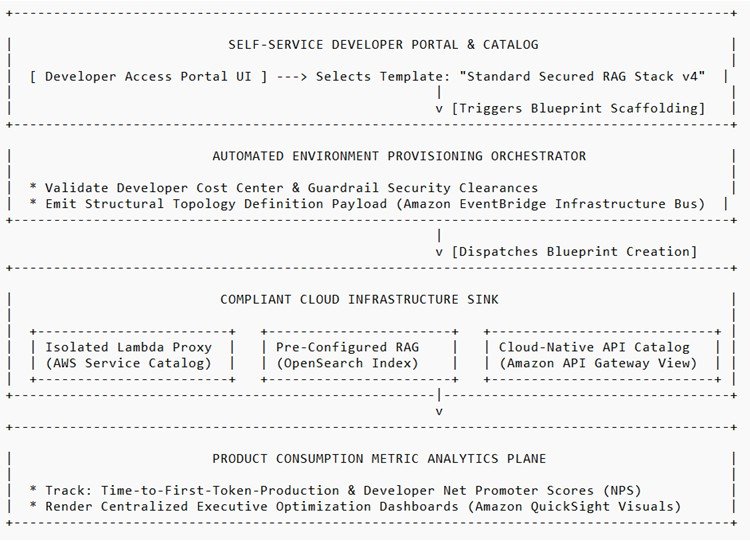
The core deliverable of a Platform-as-a-Product operating model is a centralized, self-service developer portal. This portal serves as the single entry point where engineers discover reusable AI capabilities, launch sandbox environments, and scaffold production-ready code structures using pre-vetted corporate compliance blueprints.
Automated Blueprint Scaffolding
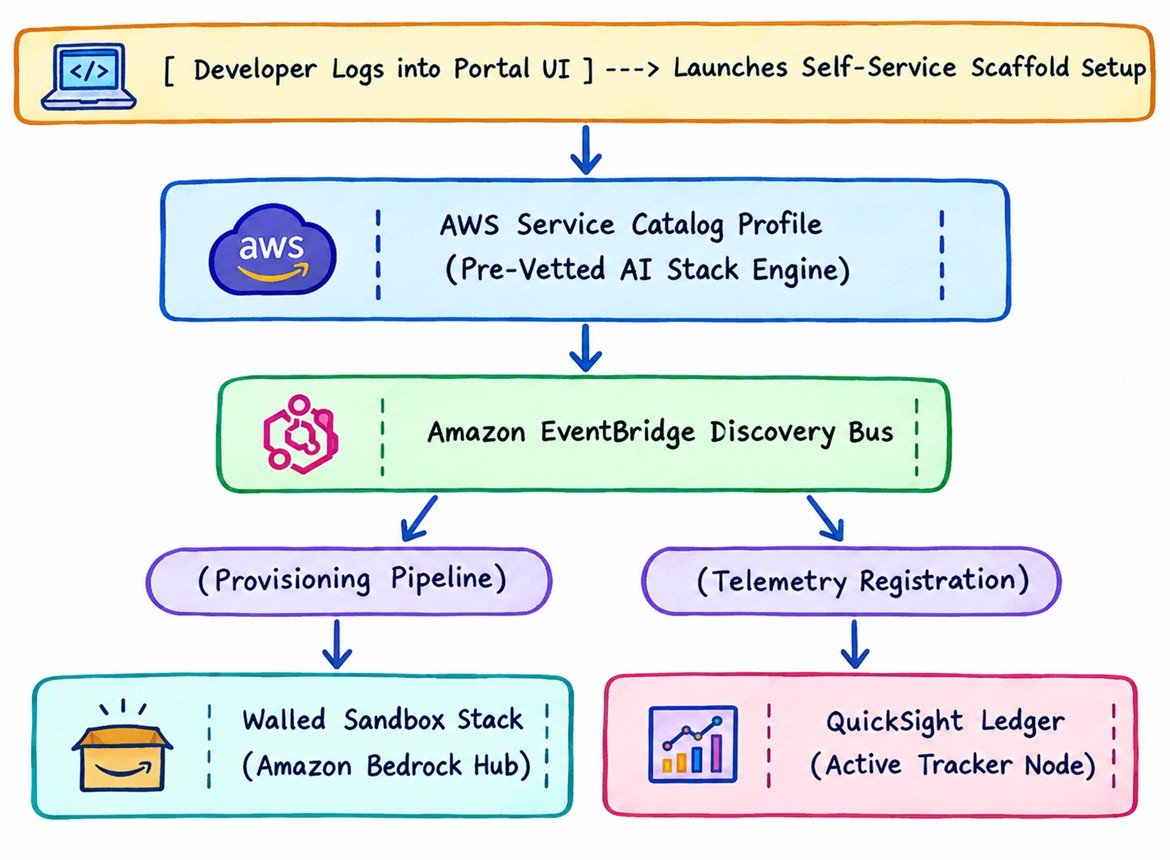
Instead of forcing developers to configure security roles, network isolation boundaries, and vector index settings manually, the catalog provides pre-built, click-to-deploy AI Stack Blueprints managed via AWS Service Catalog:
- The Secured RAG Micro-Stack: Instantly provisions an isolated vector namespace in Amazon OpenSearch Service, binds it to an AWS Lambda retrieval proxy, locks down access using pre-configured Attribute-Based Access Control (ABAC) rules, and registers the deployment to the central platform gateway.
- The Isolated Autonomous Agent Box: Spins up an ephemeral, non-routing worker container equipped with temporary IAM Role Assumability settings and hooks it directly into the platform's credential injection proxy.
Instant Playground Sandbox Provisioning
Through the portal, developers can spin up sandboxed testing environments with a single click. These sandboxes are configured to pull mock vector data automatically from the platform's data minimization proxies, allowing developers to test prompt strategies and build visual Directed Acyclic Graphs (DAGs) without submitting complex data governance requests.
2. The Comprehensive Product Metrics Matrix (DORA & North Star)
To maintain funding, prove operational efficacy, and drive product evolution, platform teams cannot rely on generic infrastructure uptime statistics. They must track a multi-dimensional matrix of AI-specific North Star and DORA metrics that measure real-world developer velocity, system reliability, and financial efficiency.
Developer Velocity and Onboarding Metrics (AI DORA Extensions)
- Time-to-First-Token-Production (TTFTP): Measures the duration from a developer creating an internal account to their application successfully executing its first secure, model-routed token transaction in the production layer. High-performing organizations minimize this metric from weeks to under 30 minutes using automated scaffolding templates.
- Deployment Frequency of AI Configurations: Tracks how often application teams modify prompts, adjust system instructions, or upgrade base model versions through automated CI/CD pipelines, capturing organizational agility.
- Change Failure Rate (AI Behavior): The percentage of prompt or model adjustments that trigger automated rollbacks during CI/CD metric gating because of quality drops or behavioral regressions.
Platform Quality and Operational Performance Metrics
- P99 Time-to-First-Token (TTFT): Measures the streaming response speed of backend model configurations to ensure live customer interfaces remain highly responsive.
- SLA Breach Frequency: Tracks how often downstream model providers or internal vector storage layers cross maximum latency or availability boundaries, triggering automated platform self-healing routines.
- Model Accuracy Retention Coefficient: Monitors real-time output accuracy and groundedness trends over time, helping operations teams catch and address subtle model degradation or semantic drift.
FinOps and Enterprise Business Value Metrics
- AI Redundant Spend Reduction Ratio: Measures the financial savings realized by consolidating isolated engineering workflows into shared platform utilities, eliminating duplicate cloud vendor connections.
- Task Success FinOps Coefficient: Tracks the exact token spend required to achieve a successful task resolution, such as a fully completed customer support thread or a successfully parsed document, allowing business leads to map AI costs directly to corporate ROI.
- Developer Net Promoter Score (NPS): Regular internal surveys that measure developer satisfaction with the platform's tools, SDK libraries, and debugging interfaces, ensuring the platform product team stays aligned with user needs.
3. Reference Implementation: The Unified Platform Value Dashboard
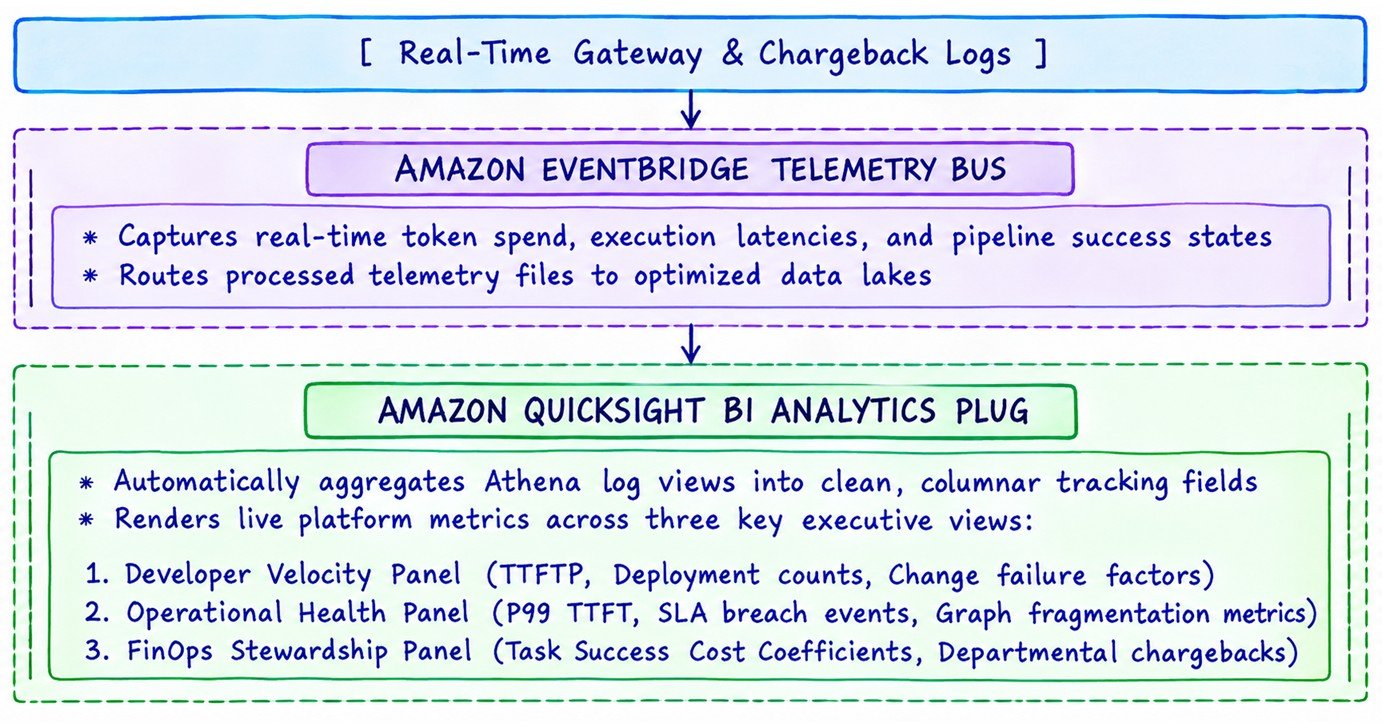
To make these metrics actionable for executive leadership, including CTOs, VPs, and financial officers, the platform channels all tracing, logging, and chargeback telemetry into a centralized analytics layer built on AWS primitives.
Executive Dashboard Mechanics
The tracking engine uses Amazon EventBridge to pull transaction logs directly from the Model Gateway. These files are processed and stored in an Amazon S3 data lake, where Amazon QuickSight ingests them to generate live, interactive executive dashboards.
This single pane of glass allows financial officers to audit departmental chargebacks in real time, enables engineering leaders to track developer velocity, and gives operations teams the visibility needed to monitor system health and provider SLAs across the entire enterprise.
4. The Platform Evangelism and Inner-Sourcing Model: Scaling Adoption Through Co-Creation
An internal platform cannot succeed via administrative mandate alone. Forcing fiercely independent business units or product lines to adopt a centralized AI infrastructure often triggers organizational resistance. Disconnected application teams frequently argue that their specific data profiles, performance requirements, or operational constraints are too unique to fit into a standardized platform architecture.
To overcome this friction, the platform team must shift from operating as a rigid enforcement body to acting as an open ecosystem coordinator. This transition is achieved by combining proactive Platform Evangelism with an Inner-Sourcing Model.
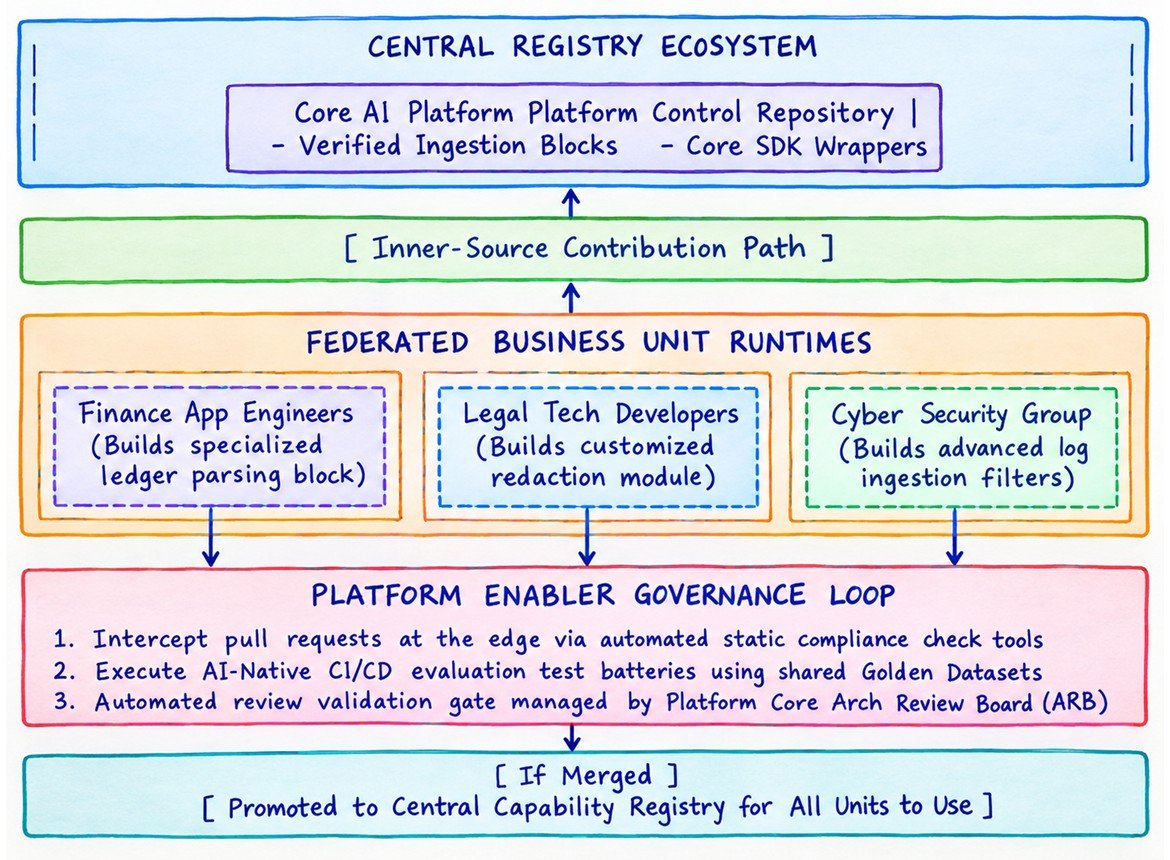
Instead of treating the platform as a locked-down, vendor-style system where feature requests stall in centralized engineering queues, inner-sourcing treats the platform's codebase, prompt libraries, visual components, and core API configurations as an internal open-source project. Any application developer within the enterprise can use, modify, and contribute custom capability blocks back to the central corporate catalog, turning former detractors into active co-creators of the system.
Establishing the Inner-Source Contribution Framework
Inner-sourcing shifts the internal governance model from absolute centralization to a federated, contributor-driven ecosystem. The framework operates through clear engineering practices:
- Universal Code Visibility: All repositories, including the core Model Gateway configurations, prompt management registries, custom SDK structures, and evaluation tool pipelines, are readable by all authenticated enterprise software engineers.
- Modular Contribution Schemas: The platform defines clear, programmatic contribution templates. For example, if the legal technology team engineers a hyper-specific contract-clause parsing block, they can bundle it as a platform-compliant component by following a standardized schema descriptor:
// Example Inner-Source Component Registry Entry Configuration
{
  "component_id": "corp-legal-clause-extractor:v1",
  "contributing_department": "corporate-legal-it",
  "interface_protocol": "grpc",
  "dependencies": {
    "platform_sdk_minimum_version": "3.4.0",
    "base_embedding_model": "amazon.titan-embed-text-v2"
  },
  "compliance_signatures": {
    "security_scan": "passed",
    "pii_redaction_verified": true
  }
}
- Fork and Request Workflows: Developers from any line of business clone the capability workspace, implement their required extensions locally, verify the modifications within their isolated playground sandboxes, and submit a pull request (PR) to merge the new capability block back into the primary corporate catalog.
Automated Contribution Gates and the Enabler Loop
To prevent unvetted inner-sourced configurations from degrading the platform's stability, cost controls, or safety perimeters, all code promotions are processed through a multi-stage Automated Ingress Evaluation Gate:
- Static Compliance Analysis: When a PR is opened, automated linters check the submission for security flaws, ensuring that it contains no hardcoded credentials, bypasses no guardrail layers, and maintains proper cross-tenant isolation parameters.
- Automated Performance Benchmarking: The submission triggers an automated execution run inside an isolated AWS CodePipeline stack. The component is tested against standard golden datasets to verify that it introduces no appreciable latency overhead and does not trigger unexpected model behavior or prompt regressions.
- Core Architecture Review (ARB): The core platform engineering team functions as "maintainers" of the open-source code. They review the automated test results and execute a final architectural review. Once approved, the new capability block is promoted to the enterprise-wide catalog, making it immediately discoverable and usable by every other department in the corporation.
Proactive Evangelism and Community Enablement
Inner-sourcing only works if developers know how to use it. The platform product team operates a deliberate Evangelism Program to build an active internal developer community:
- AI Architecture Scaffolding Guilds: Cross-functional technical groups meet regularly to share reusable capability code, resolve execution blockages, and showcase successful production implementations across distinct lines of business.
- Unified Developer Documentation and Starter Kits: The self-service developer portal includes clear code samples, step-by-step video tutorials, and click-to-deploy bootstrap templates. This enables application engineers to transition from writing local code to deploying fully compliant production workloads in under an hour, making platform alignment the natural path of least resistance.
5. Multi-Cloud Sovereign Expansion Strategy: Architectural Mechanics of Hybrid Topologies
As enterprises scale their AI capabilities globally, a single-cloud deployment topology often becomes unviable due to data residency regulations, national security mandates, and strict corporate governance. A sovereign entity or highly regulated enterprise operating under strict compliance frameworks, such as the EU Cloud Rulebook, US FedRAMP High, or financial data isolation regulations, cannot allow sensitive core customer payloads or protected operational text metadata to leave its physical geographic borders or enter an untrusted public cloud region.
To address these non-negotiable compliance parameters, the Platform-as-a-Product framework must scale beyond a single-cloud infrastructure sink. It must implement a Multi-Cloud Sovereign Expansion Strategy. This architecture relies on a Decoupled Unified Control Plane / Federated Data Plane model. The primary platform control interface, developer portal, and global metric aggregation dashboards run within a highly scalable public cloud footprint, such as AWS global regions. Meanwhile, the volatile execution loops, localized vector indexes, database stores, and model inference nodes are deployed within isolated, sovereign cloud zones or localized, air-gapped on-premises data centers, such as AWS Outposts or private hardware enclosures.
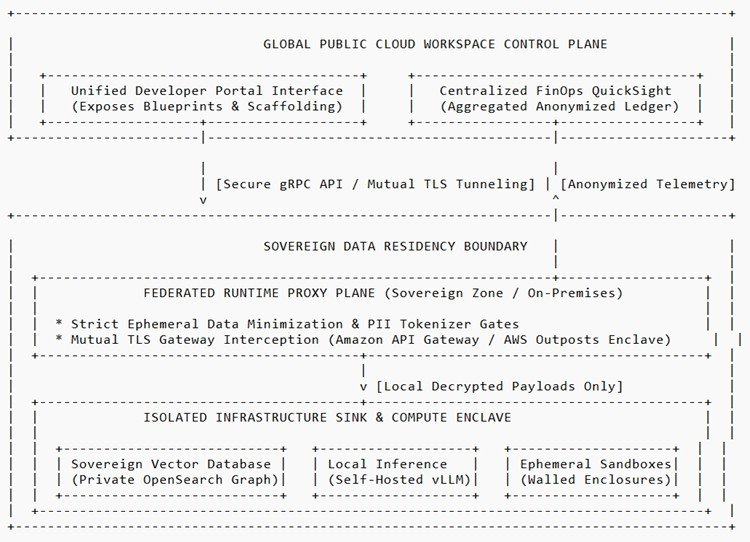
The Decoupled Control-Plane vs. Federated Data-Plane Architecture
To balance platform consistency with regional isolation, the multi-cloud architecture strictly decouples management logic from the underlying semantic data streams:
- Centralized Management Plane: The Developer Portal, the Centralized Prompt Registry, configuration schemas, and the AI-Native CI/CD Orchestrator sit inside a primary public cloud infrastructure deployment. This ensures that developer tooling and platform delivery templates remain consistent globally across all engineering units.
- Federated Execution Planes: The actual runtime environments, including the Model Gateway proxy, the Guardrail Service, the RAG retrieval plane, and the vector storage databases, are deployed as local, self-contained runtimes inside target sovereign regions or on-premises data centers.
- Mutual TLS (mTLS) Mesh Routing: Communication between the public cloud control plane and the local execution planes is routed through a zero-trust network topology using secure, encrypted mTLS tunnels. The public control plane injects application blueprints and configuration files down to the local runtime environment out-of-band. The local environment processes user prompts locally; the raw text strings, private customer files, and sensitive output responses never travel back to the public cloud plane.
Localized Inference and Ephemeral Token Injection at the Edge
When an application deployed within a sovereign partition requests a model capability, the transaction is handled locally to prevent data leaks:
- Edge Tokenization Handlers: The local Model Gateway intercepts the request, runs the inline input guardrail, and sanitizes all data before processing. If an integration tool requires external credentials, the local runtime fetches them from a localized version of AWS Secrets Manager running on local hardware, such as AWS Outposts, keeping keys securely within the region.
- Air-Gapped Model Compute Sinks: The payload is shunted to local inference nodes, such as a dedicated cluster of private vLLM or Triton servers running open-source foundation models, such as Llama-3-70B or Phi-4, inside an air-gapped environment. This design completely bypasses external multi-tenant public APIs, ensuring that token compute loops remain entirely within the sovereign data center.
Anonymized Asynchronous Telemetry Aggregation
To keep the centralized FinOps dashboards and DORA metrics functioning without exposing sensitive regional data, the platform implements a secure telemetry aggregation pipeline:
- Semantic Hashing Filters: Before any log entries or trace data leave the sovereign zone to return to the centralized analytics pool, they pass through a strict sanitization proxy.
- Complete Text Stripping: All prompt text, model output tokens, context documents, and explicit user identifiers are completely scrubbed from the payload.
- Numeric Ledger Export: The local environment exports only anonymized, numeric metrics, such as
input_tokens: 410,output_tokens: 120,execution_latency_ms: 450, andcost_center: "CC-9012", to a distributed event stream, such as Amazon EventBridge. This design allows corporate leadership to audit financial chargebacks and monitor global platform utilization without ever risking a cross-border regulatory violation.
6. Leadership Takeaways: Strategic Imperatives for the C-Suite
For technology executives, transforming an internal AI platform into a product-driven ecosystem requires a profound shift in mindset. You are no longer merely provisioning static compute nodes or database instances; you are managing a living digital product designed to enable and protect your engineering organization.
To drive this shift successfully and eliminate shadow AI sprawl, technology leaders must execute four core strategic mandates:
- Fund the Platform as a Product, Not a Seasonal IT Project: Traditional project budgets end at deployment, leading to long-term tool degradation and developer abandonment. Treat the AI platform as an enduring product asset, complete with dedicated Platform Product Managers, continuous customer discovery roadmaps, and independent funding cycles to ensure long-term alignment with business needs.
- Prioritize the Developer Experience to Eliminate Shadow AI: If your internal security review and data access processes are frustratingly slow or manually complex, developers will inevitably bypass them to build unmanaged wrappers using public APIs. Build automated, self-service portals that allow engineers to spin up safe sandboxes instantly, making compliance the easiest path forward for application teams.
- Measure Strategic Efficacy Using AI-Specific North Star Metrics: Traditional infrastructure availability statistics, such as network uptime, cannot capture whether your generative applications are running efficiently. Force your organization to track product-specific metrics, such as Time-to-First-Token-Production (TTFTP) and the Task Success FinOps Coefficient, to prove real-world engineering velocity and track AI investments directly to corporate ROI.
- Enforce Enterprise Compliance Globally via Federated Hybrid Topologies: Do not let strict data sovereignty or cross-border privacy laws compromise your platform enablement strategy. Architect a decoupled framework that runs a centralized public cloud control plane for unified developer tooling alongside localized, federated data planes in sovereign zones or private data centers, ensuring absolute data residency enforcement without breaking architectural consistency.