The Model Gateway - The Intelligent Ingress Control Plane
Introduction
The first and most critical component of the Enterprise AI Platform is The Model Gateway. This layer serves as the single, authoritative point of ingress for all generative AI workloads across the corporate network footprint. In an enterprise system, applications must never couple themselves directly to downstream model endpoints, whether those endpoints are external commercial SaaS APIs or self-hosted models running inside private VPCs. Instead, all traffic passes through the Model Gateway.
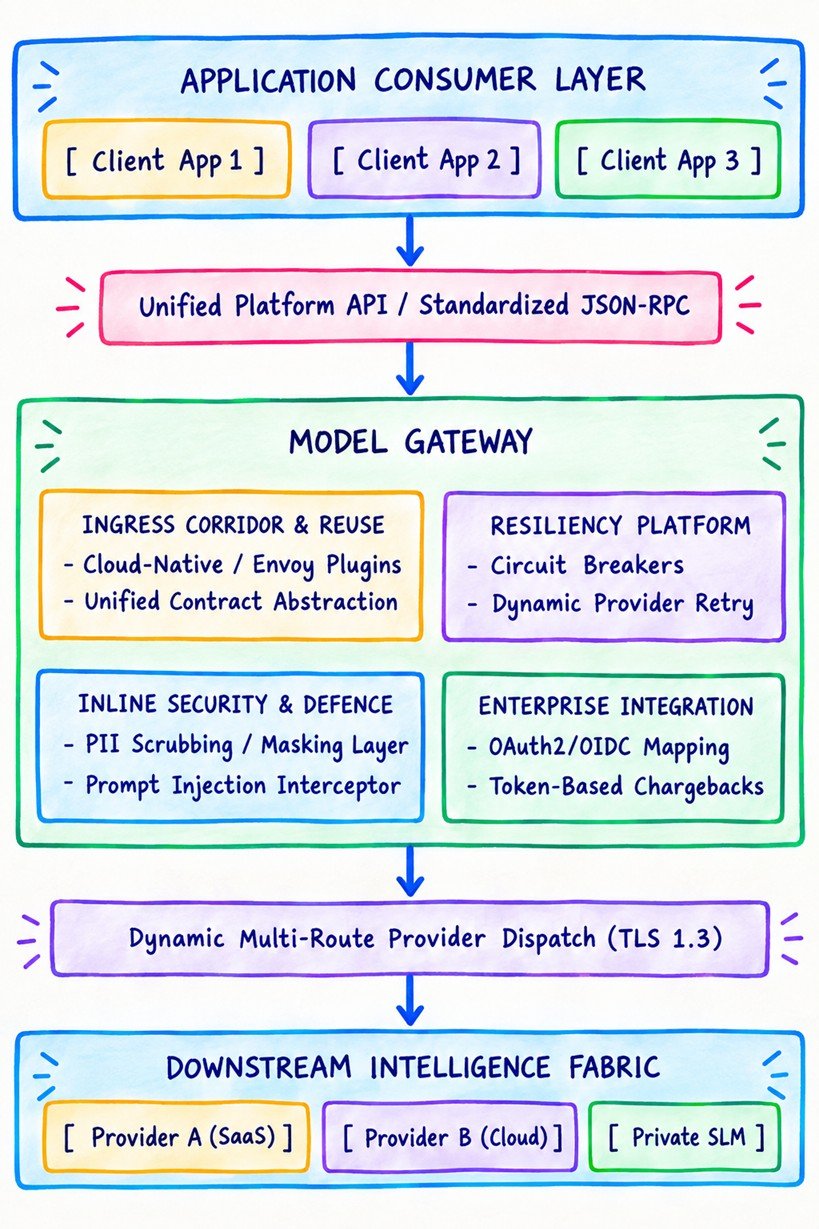
By functioning as a highly optimized reverse proxy, the Model Gateway provides two non-negotiable architectural benefits: Enterprise-Grade Resiliency Logistics and Deterministic Security Control. It unifies standard API gateway capabilities with deep context-aware intelligence, transforming volatile LLM APIs into dependable infrastructure.
Orchestrating Primitives: Extending the Enterprise API Grid
The Model Gateway does not require building an entire networking stack from scratch. Instead, it is built by extending proven enterprise infrastructure. The architecture leverages high-performance edge proxies, such as Envoy, Kong, or cloud-native management planes like AWS API Gateway and Azure API Management (APIM), and enhances them with customized, AI-native filter chains.
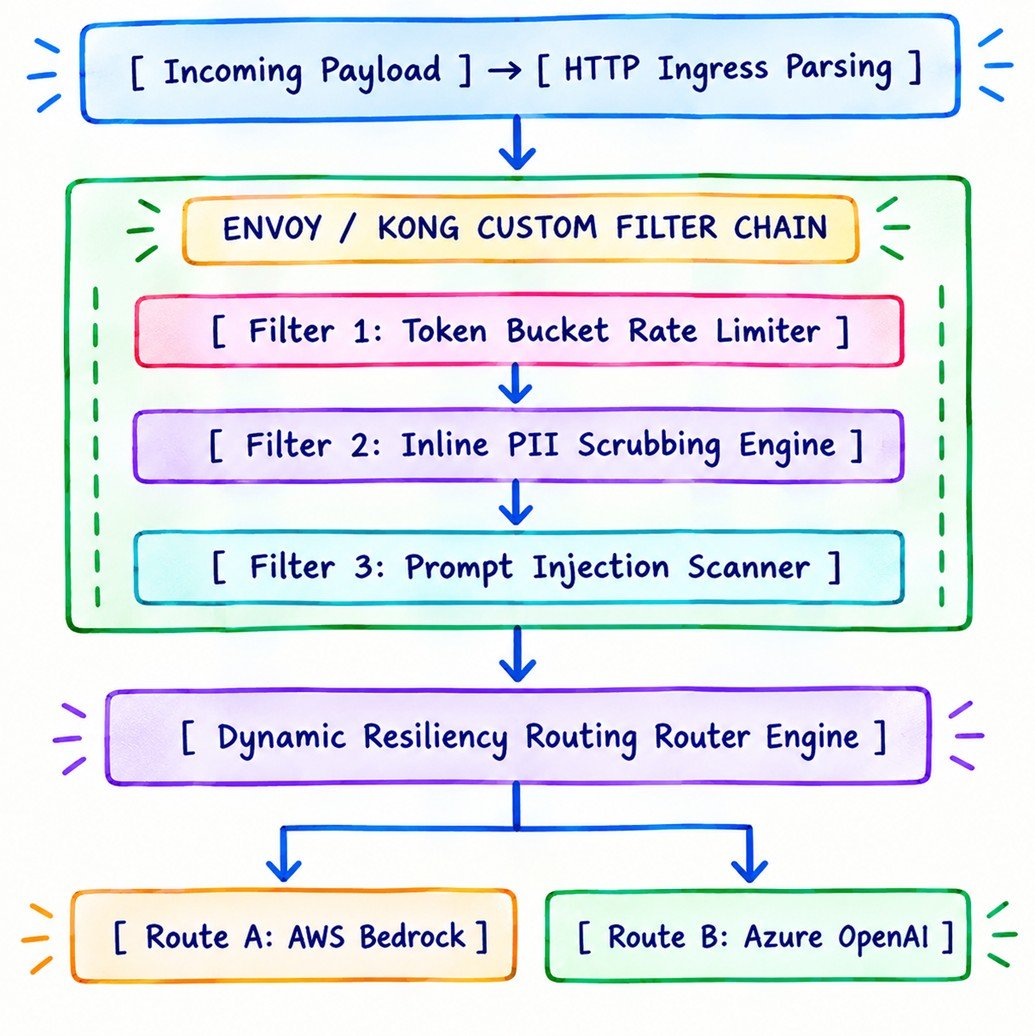
- Cloud-Native Implementations: For enterprise environments leveraging cloud-native architectures, the gateway utilizes managed services like Azure APIM with custom Liquid templates, or AWS API Gateway backed by highly optimized AWS Lambda or VPC-peered ECS authorizers. These configurations inspect headers, handle routing metrics, and manage token footprints.
- Custom Proxy Topologies: For hybrid-cloud or high-throughput scenarios, a containerized deployment of Envoy or Kong is preferred. Engineers write custom WebAssembly (WASM) filters or Lua plugins to parse JSON request bodies in real time, extract prompt lengths, apply security checks, and execute advanced routing logic without adding significant latency.
Resiliency Patterns and Failover Logistics
Foundation model APIs frequently exhibit unpredictable availability, unpredictable latency spikes, and strict rate-limiting caps. The Model Gateway isolates consuming applications from these issues by wrapping all downstream requests in robust resiliency patterns.
1. API Abstraction and Unified Contract Standardisation
Every model provider uses a slightly different format for its API requests and responses. The Model Gateway removes this complexity by presenting a single, vendor-neutral API schema to internal development teams.
/* Standardized Enterprise Gateway Request Contract */
{
  "enterprise_tenant_id": "hr-analytics-04",
  "required_intelligence_tier": "tier-1-frontier",
  "prompt_context": "Analyze the attached standard compliance metrics...",
  "parameters": {
    "determinism_level": "strict",
    "max_token_ceiling": 2048
  }
}
The gateway accepts this unified format, looks up the active configuration, and translates the payload into the provider-specific format required by the target model. This allows engineering teams to focus on core functionality without tracking vendor-specific API updates.
2. Circuit Breaking and Dynamic Provider Failover
When a downstream model provider experiences a major slowdown or service outage, the Model Gateway prevents the failure from cascading into internal systems. It continuously monitors response status codes, such as HTTP 429 Too Many Requests, 502 Bad Gateway, or 504 Gateway Timeout.
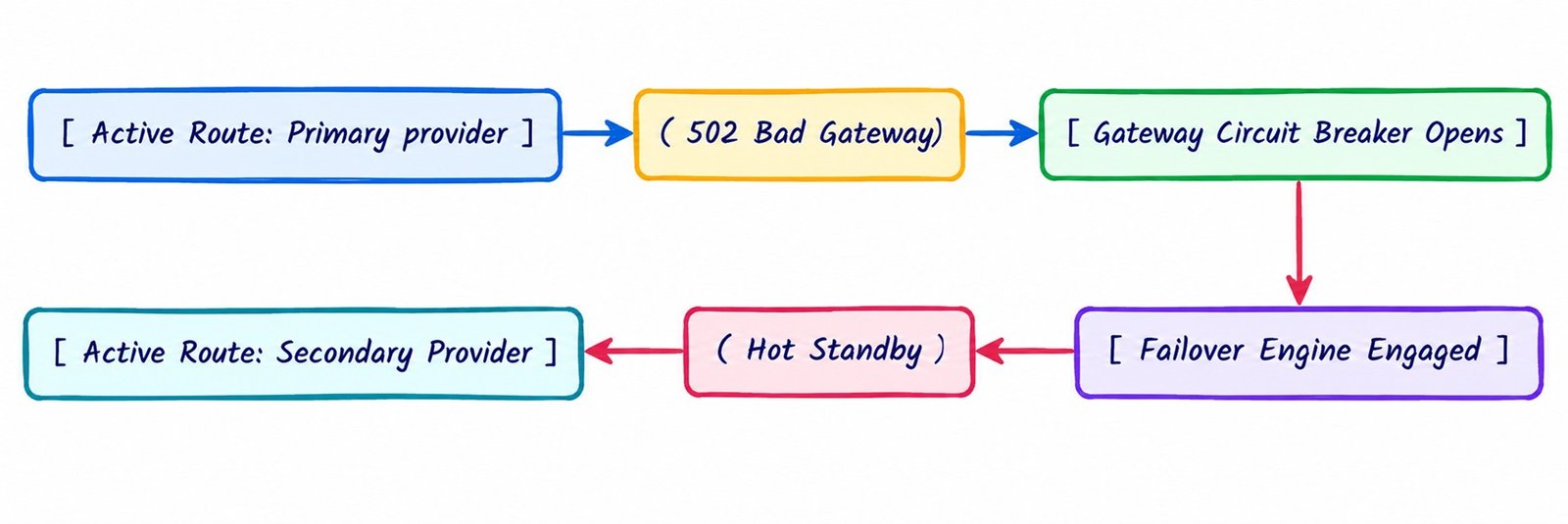
- The Circuit Breaker Pattern: If a model endpoint returns a high percentage of error codes within a specific time window, the gateway trips the circuit breaker for that route.
- Hot-Standby Fallback Routing: Instead of returning an error to the user, the gateway transparently redirects the request to an alternative provider or region, such as switching from Azure OpenAI US-East to AWS Bedrock US-West, that delivers the same level of capability.
3. Rate-Limiting Mitigation via Token Bucket Leaking
Standard API gateways rate-limit traffic based solely on the number of HTTP requests over time. However, foundation models are restricted by Tokens Per Minute (TPM).
To handle this, the Model Gateway implements an advanced Token-Aware Leaky Bucket Engine.
The gateway estimates the token cost of incoming prompts before dispatching them to the provider. It queues or delays requests when traffic approaches the provider's TPM capacity, ensuring the enterprise safely maximizes its throughput without triggering rate-limiting errors.
Security Controls: Perimeter Enforcement at the Proxy
Because the Model Gateway is the single point of entry for AI workloads, it serves as the ultimate enforcement point for corporate data protection and security compliance.
1. Inline PII Scrubbing and Masking Layer
To meet strict regulatory standards like HIPAA, GDPR, and the EU AI Act, sensitive or personal data must be intercepted before it leaves the enterprise network. The Model Gateway processes all incoming prompts through an inline sanitization engine.
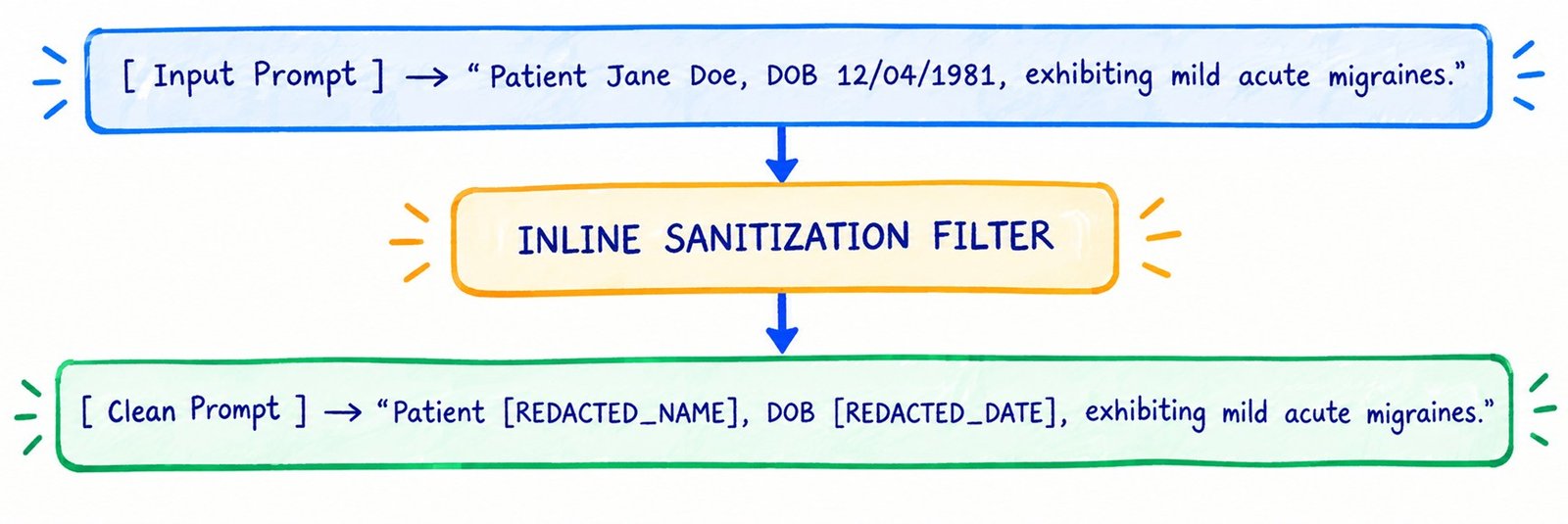
- Deterministic Masking: The proxy scans text payloads using regex patterns and high-throughput Named Entity Recognition (NER) models to identify PII, PHI, or internal credentials.
- Token Re-identification: Sensitive data is replaced with secure cryptographic tokens. When the model generates a response, the gateway performs a reverse lookup to restore the original values before returning the text to the client application.
2. Prompt Injection Interception
The Model Gateway acts as a firewall against prompt injection attacks, where malicious inputs try to bypass model guardrails or extract confidential data.
The gateway analyzes incoming payloads using heuristic filters and lightweight classification models trained to spot adversarial language patterns. It blocks suspicious tokens, jailbreak attempts, or system prompt overrides at the network edge, protecting downstream systems from exploitation.
3. Tenant Token Bucket Allocations and Fair-Share Queuing
To prevent a single, unoptimized application from consuming the entire enterprise model quota, the gateway enforces strict multi-tenant resource controls.
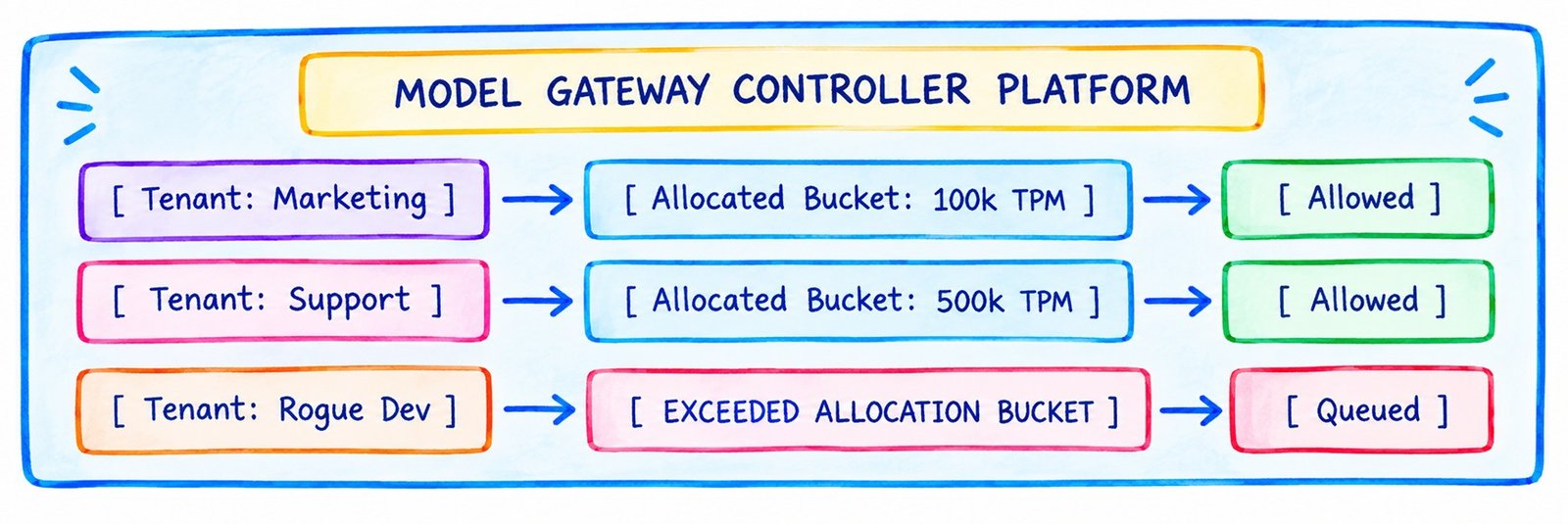
- Tenant Isolation: Every application is assigned a specific token budget based on its business priority and funding.
- Fair-Share Queuing: When traffic spikes, the gateway uses priority queues to make sure business-critical systems get processing preference, while lower-priority development workloads are throttled or queued automatically.
Enterprise API Integration Layer (Macro Gateway Controls)
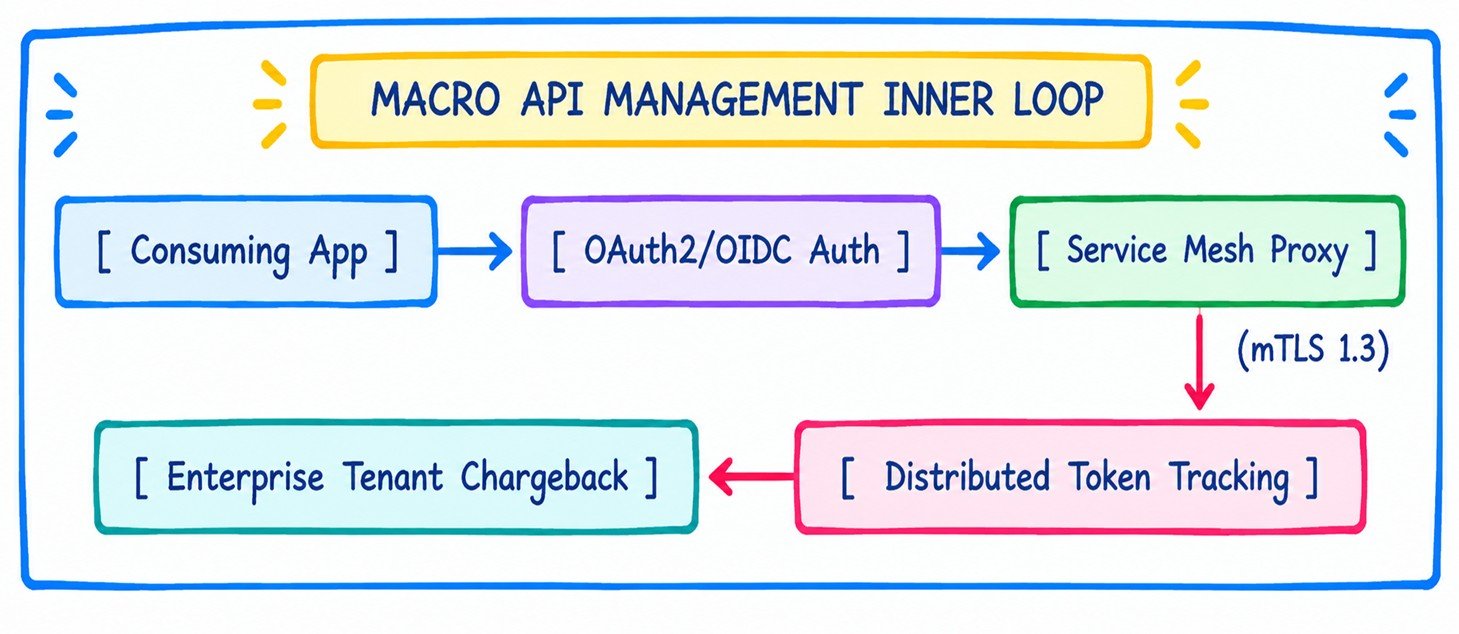
To truly achieve Addison-Wesley publication-grade architecture, the Model Gateway must absorb macro-level API management patterns. It acts as the bridge connecting modern non-deterministic LLM traffic to traditional enterprise integration infrastructure.
1. Unified Authentication, Identity Mapping, and Credential Isolation
Consumer applications must never possess or present downstream model credentials, such as vendor API keys or cloud IAM session tokens.
- Enterprise Auth Corridors: Consuming applications authenticate against the Model Gateway using standard corporate identity mechanisms, specifically OAuth2 client credentials or JSON Web Tokens (JWT) issued by an enterprise Identity Provider (IdP) like Okta or Azure AD.
- Credential Isolation: The Model Gateway validates the inbound token, extracts the tenant identity context, and internally injects the appropriate model provider credentials out-of-band. This completely protects downstream API keys from accidental developer exposure.
2. Native Service Mesh Alignment
In complex corporate topographies, traffic does not exist in isolation. The Model Gateway is built to align with global enterprise service meshes like Istio, Linkerd, or Apigee.
- Traffic Transparency: By terminating inbound mTLS 1.3 communication from internal microservices, the gateway allows the enterprise service mesh to track AI-bound network packets using the same logging and firewall fabrics that handle traditional transactional traffic.
- Telemetry Consistency: This guarantees that standard SRE tools, such as Prometheus and Grafana, can map AI request failures alongside normal enterprise service components.
3. Token-Aware Financial Chargebacks and Quota Control
Traditional API gateways measure resource depletion through bytes transferred or requests per second. For generative applications, this metric is structurally useless. The Model Gateway implements a dedicated Token Accounting Processor.
- Granular Usage Attribution: On every successful response, the gateway parses the token usage metrics metadata returned by the provider.
- Cost Center Reconciliation: These values are streamed instantly to an enterprise event bus, such as Apache Kafka, mapped against the tenant's corporate billing cost center. This enables real-time chargebacks, automated cost tracking, and precise budget capping per division, preventing runaway token consumption.
Operational Blueprint: Core Architectural Matrix
| Architectural Capability | Standard API Gateway (Envoy/AWS/Azure Base) | Intelligent Model Gateway (Enhanced AI Platform) |
|---|---|---|
| Traffic Shaping Metric | Requests Per Second (RPS). | Tokens Per Minute (TPM) and Tokens Per Second (TPS). |
| Payload Analysis | Header verification and basic structural JSON validation. | Deep semantic parsing, inline PII masking, and prompt injection filtering. |
| Resiliency Target | Endpoint availability status checking. | Intelligent failover across model tiers and cloud regions with programmatic translation. |
| Tenant Accountability | Network bandwidth tracking. | Granular cost allocation based on token consumption patterns. |
| Identity Paradigm | Basic OAuth2 validation. | OAuth2 identity mapped to secure, isolated downstream provider secrets. |
Conclusion
The Model Gateway converts unpredictable, external foundation model APIs into a highly stable and secure internal utility. By handling abstraction, failover management, token allocation, and real-time security scanning at the network edge, it gives enterprise technology leaders total visibility and control over their AI infrastructure. With this ingress control plane in place, the platform can safely expand to manage downstream caching, routing, and intelligence strategies.