AI Developer Platform - Engineering the Innovation-to-Production Highway
Introduction
The acceleration of generative AI across an enterprise creates a fundamental friction point between developer velocity and architectural governance. When line-of-business software engineering teams are forced to build AI capabilities from scratch, they routinely fall back on fragmented patterns: hardcoding raw vendor API keys into local environments, manually copying prompt strings across Git repositories, writing bespoke code to interface with unstructured vector storage, and deploying unverified models into production. This ad hoc approach introduces severe operational vulnerabilities, including shadow AI expenditures, compliance gaps, and unmonitored prompt regressions.
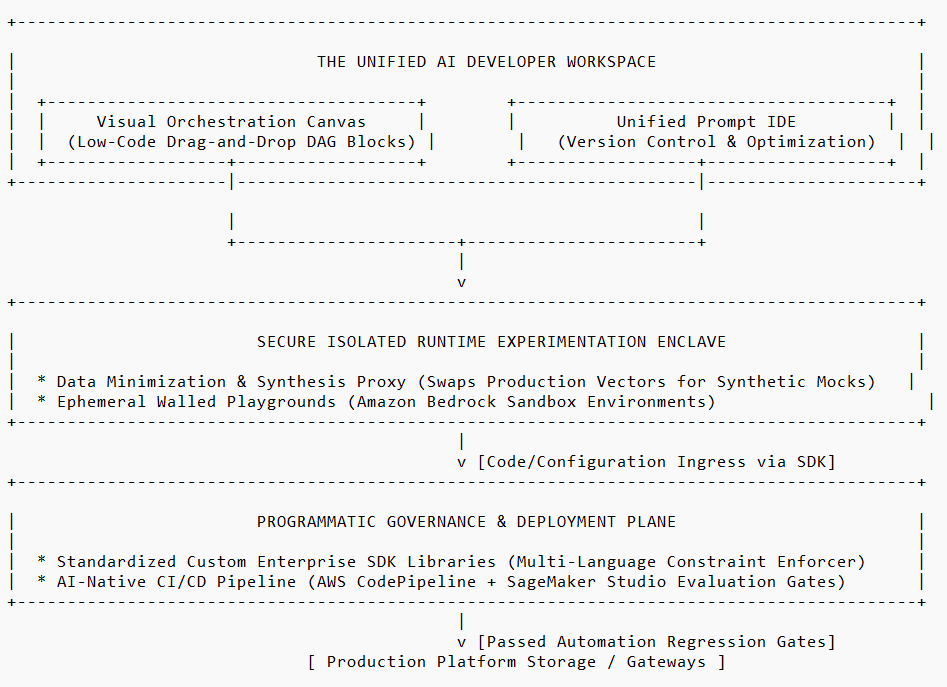
The AI Developer Platform serves as the centralized enablement and control center of the Enterprise AI Platform. It abstracts complex infrastructure mechanics away from engineering teams, providing a unified workspace that bridges rapid visual prototyping with rigorous, automated programmatic governance.
By separating the developer's design canvas from underlying infrastructure configurations, the platform allows developers to experiment rapidly while ensuring that every prompt, chain, and agent loop automatically complies with corporate security, cost, and quality guardrails.
1. The Low-Code Visual Orchestration and Workspace Plane
To accelerate time-to-market for AI applications, the platform must provide non-specialist software engineers with high-level abstractions that streamline compound chain configuration and prompt engineering.
Drag-and-Drop Directed Acyclic Graph (DAG) Interfaces
The platform features a visual canvas, architecturally structured after Amazon SageMaker Canvas and SageMaker Studio, allowing developers to map out multi-step agentic workflows and retrieval loops visually.
- Component Modularity: Developers drag and drop pre-configured platform blocks representing core services, such as a RAG Service block, a specific Guardrail Service profile, an evaluation matrix, or a Model Routing alias.
- Visual DAG Compilation: The canvas links these blocks together visually to form a Directed Acyclic Graph (DAG). The underlying canvas engine automatically serializes this layout into a standardized, declarative configuration file, such as a JSON or YAML schema. This schema handles formatting, token management, and infrastructure configurations behind the scenes, leaving the developer free to focus on application logic.
Unified Prompt IDE and Collaborative Sandboxes
Prompt engineering must move out of scattered text files and into a dedicated, version-controlled developer workspace.
- The Prompt Playground Architecture: Modeled after Amazon Bedrock Playgrounds, this unified development environment allows engineers to test system instructions side by side across multiple concurrent model routing profiles.
- Variable Extraction and Token Optimization: The IDE parses prompt inputs dynamically, separating fixed system parameters from application variable buckets. It analyzes text structures in real time, calculating token counts and estimating run costs before the developer fires a single test query.
- Collaborative Workspaces: Prompts are treated as software configurations. When a developer finishes adjusting a prompt sequence, the IDE saves it directly to the central Platform Prompt Registry, assigning a cryptographically signed version tag. This mechanism provides full lineage tracking and allows separate engineering teams to collaborate safely on prompt designs without risking configuration overrides.
2. Secure Isolated Runtime Experimentation Sandboxes
Providing developers with access to flexible testing environments introduces a critical compliance risk: the accidental ingestion of live client records or protected corporate assets into unverified playground systems. The AI Developer Platform solves this vulnerability by building Ephemeral Walled Sandboxes paired with intelligent data obfuscation layers.
Data Minimization and Synthesis Strategies
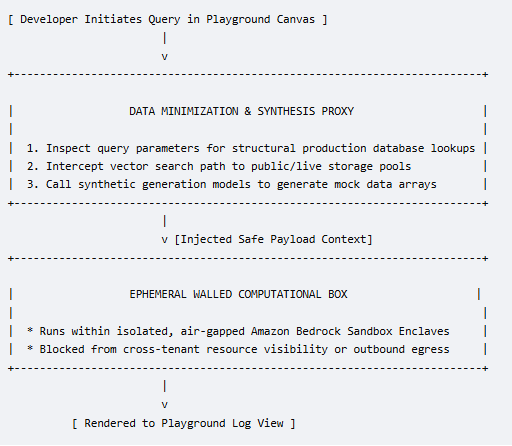
To protect enterprise data integrity, developers are barred from running playground or testing sessions against active production storage indexes. When an application configuration references an enterprise vector or database lookup, the platform's Data Minimization and Synthesis Proxy steps in:
- Vector Search Interception: The proxy hooks into the playground's retrieval path, intercepting data queries before they can reach live customer pools.
- On-the-Fly Data Synthesis: The proxy passes the query structure to a background mock generator. This service builds synthetic data tables and mock vector arrays that mimic the data structure and embedding distances of real documents without containing any actual private text strings.
- Mathematical Context Masking: The developer receives contextually accurate, structurally identical test data. This enables realistic prompt testing and behavioral verification within the workspace while keeping sensitive production systems completely insulated.
Ephemeral Walled Sandboxes
Playground runtimes operate inside secure, sandboxed enclaves with strict runtime isolation boundaries:
- Network Isolation: Containers are deployed into private, non-routing subnets with zero external internet access. They communicate exclusively through verified, internal service endpoints managed by the platform gateway.
- Auto-Expiring Lifespans: Sandbox infrastructure is ephemeral. When a developer closes their session or remains inactive for a configured period, such as 30 minutes, the platform terminates the environment automatically, clearing all temporary caches, model logs, and synthetic data frames to prevent resource drift or exposure.
3. The Programmatic SDK and API Governance Plane
While low-code visual tools speed up early prototyping, moving applications to production requires strict programmatic governance. The platform achieves this by wrapping all interaction paths in a standardized, custom enterprise SDK.
Standardizing Custom Enterprise SDK Libraries
Enterprise development teams are prohibited from making direct calls to external provider APIs or raw model strings. Instead, the platform mandates the use of a custom, multi-language corporate wrapper library, such as standardized custom Python and TypeScript SDK packages.
// Example Secure Execution Path via Enterprise SDK
import { EnterpriseAIPlatformClient } from "@corp-ai/platform-sdk";

const platformClient = new EnterpriseAIPlatformClient({
    applicationId: "compliance-bot",
    costCenter: "CC-7482"
});

// The SDK forces execution through platform alias endpoints, completely
// hiding raw vendor URLs and direct model connection strings.
const response = await platformClient.executeCapability({
    capabilityAlias: "customer-contract-summarization",
    promptVariables: {
        documentBody: uploadedContractText
    }
});
By enforcing this SDK wrapper structure, the platform ensures that essential enterprise patterns, such as trace context propagation, tenant isolation tags, identity tokens, and compliance metrics, are automatically embedded into every network request without requiring manual developer configuration.
Managing Semantic Multi-Language Dependencies
The programmatic governance plane acts as a structural package gatekeeper. It monitors internal artifact registries, ensuring that downstream projects only pull verified, pre-compiled platform libraries.
If an application tries to import an unapproved library, an unvetted open-source orchestration tool, or an uncached wrapper version, the platform's compliance scanner flags the dependency and blocks the compilation step, preventing software supply-chain vulnerabilities from reaching production layers.
4. The AI-Native CI/CD Deployment Pipeline
Traditional software development deployment pipelines are ill-equipped to evaluate probabilistic AI applications. A code deployment might pass all standard unit tests and syntax checks, yet still introduce severe prompt regressions, higher token consumption patterns, or increased hallucination rates.
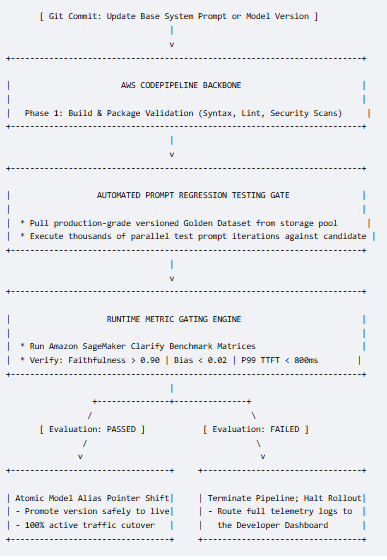
To bridge this gap, the AI Developer Platform enforces a comprehensive, automated AI-Native CI/CD Pipeline built on AWS CodePipeline and Amazon SageMaker Studio primitives.
AI-Native Promotion Mechanics
- Automated Prompt Regression Testing: When a configuration change or prompt modification is committed to code control, AWS CodePipeline triggers an automated testing loop. The pipeline pulls a version-controlled Golden Dataset containing real-world corporate test cases from secure storage. It executes thousands of parallel test prompt iterations against the candidate configuration, measuring output variance.
- Runtime Metric Gating: The test outputs flow directly into a validation engine driven by Amazon SageMaker Clarify. The engine evaluates the responses against strict corporate performance thresholds:
- Faithfulness Score Gate: Must maintain an accuracy rating greater than 0.90 against the ground-truth dataset.
- Bias and Fidelity Monitoring: SageMaker Clarify verifies that the model's behavioral alignment index remains clean, with a bias factor below 0.02.
- Infrastructure SLA Verification: The P99 Time-to-First-Token (TTFT) must remain below 800 milliseconds to meet active user SLAs.
- Atomic Model Alias Pointer Shifts: If the candidate setup violates any metric gate, the pipeline halts immediately, drops the build, and routes the telemetry logs to the developer dashboard for analysis. If the build passes all regression gates, the pipeline executes a clean production cutover. It updates the platform's central gateway routing tables, shifting the active model alias pointer to the new version with zero application downtime.
5. Reference Implementation: The Enterprise Platform Control Matrix
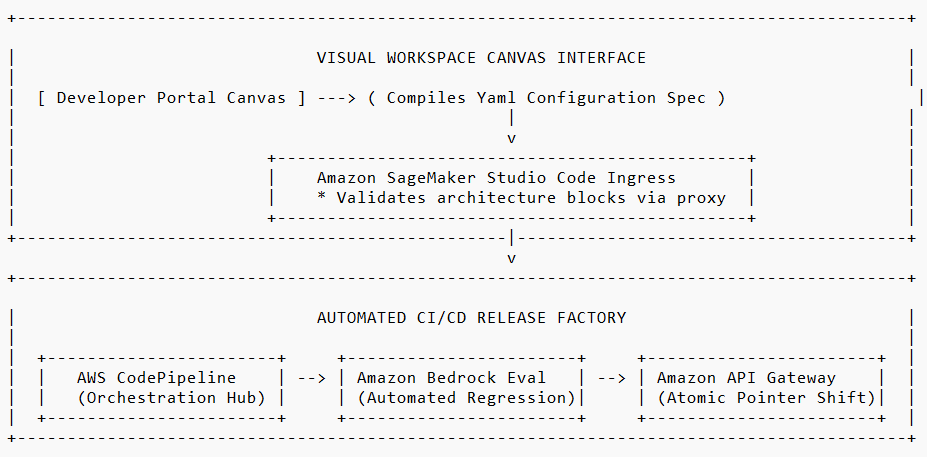
The technical design for this unified development and release fabric integrates serverless AWS engineering tools to automate continuous integration and enforce access governance at scale.
Implementation Flow Mechanics
- The Ingress Canvas: Developers configure their applications visually within a secure Amazon SageMaker Studio portal. The canvas engine compiles their layout choices into version-controlled repository files.
- The Validation Pipeline: When code updates are pushed, AWS CodePipeline initiates the build sequence, launching parallel validation tests inside Amazon Bedrock Model Evaluation environments to spot behavioral regressions.
- The Cutover Execution: Once the candidate build passes all verification gates, the pipeline updates the centralized Amazon API Gateway configurations. This step shifts the active production routing paths to the new deployment smoothly, ensuring stable, uninterrupted system access.
6. Leadership Takeaways: Strategic Imperatives for the C-Suite
For technology executives, an AI Developer Platform is a critical organizational capability necessary for stopping shadow AI development, accelerating secure engineering velocity, and maintaining absolute control over the production lifecycle.
To drive this transformation successfully, technology leaders must focus on four core strategic mandates:
- Enforce Complete Platform Abstraction via Custom SDKs: Never let individual engineering teams connect directly to third-party vendor APIs or hardcode model endpoints in local applications. Force your development teams to interface exclusively through a standardized, custom enterprise SDK wrapper to ensure security, identity tracking, and billing controls are handled uniformly at the infrastructure wire level.
- Insulate Testing Environments via Strict Data Minimization: Providing access to realistic development playgrounds cannot come at the cost of data security. Build automated data minimization and synthesis proxies that intercept repository lookups, swapping sensitive production files with high-fidelity synthetic vectors so developers can test prompts thoroughly without compliance risk.
- Lock Production Promotion Behind AI-Native Metric Gates: Traditional software code checks cannot detect probabilistic regressions or model drift. Enforce an automated, AI-native CI/CD pipeline that measures qualitative metrics, such as faithfulness, response relevance, and bias metrics, against versioned golden datasets before allowing any model change to reach production.
- Consolidate Tools Behind a Single Pane of Glass: Fragmented toolsets create siloed data structures and invite governance failures. Consolidate your engineering workflows into a unified platform developer workspace that connects visual canvas builders with code controls, giving your architecture team total visibility over the entire innovation-to-production highway.