Enterprise AI Platform Reference Architecture - The Ultimate Convergence Blueprint
Introduction
To finalize the technical blueprint of Chapter 11: The Enterprise AI Platform Architecture, all isolated sub-components must converge into a singular, integrated topological engine. Moving from a fragile, unmanaged Proof of Concept (PoC) to a resilient enterprise production utility requires a zero-trust, multi-layered reference architecture.
This section presents the master blueprint, explicitly mapping the flow of tokenized data all the way from Ingress Edge APIs, down through the Security Proxy Planes and Orchestration Compute Engines, and finally into the AWS-Native / Hybrid Core Infrastructure Sinks.
1. The Master End-to-End Visual Topology
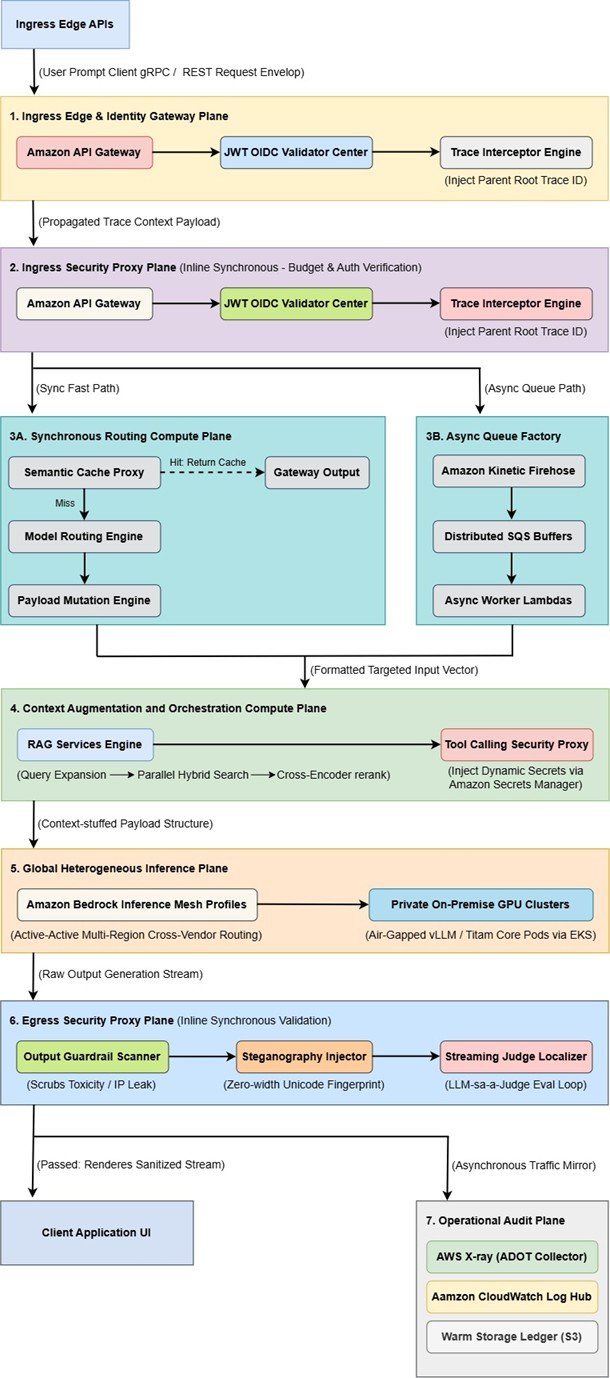
The following comprehensive ASCII schematic details the synchronous and asynchronous execution paths, trace injection boundaries, and security perimeters governing the execution context of every transactional payload:
2. Explicit End-to-End Data Flow Mechanics
Step 1: Ingress Edge, Identity, and Trace Context Injection
Every transaction begins when an application service transmits a natural language request packet to the enterprise platform's front-end Amazon API Gateway. The gateway intercepts the token, extracts the user's OIDC access credentials, and passes them to AWS IAM Identity Center to decode user claims. [1, 2, 3]
Once identity is verified, the Trace Interceptor Engine automatically generates a unique, immutable parent Root Trace ID (trace_id). This trace token is stamped directly into the metadata headers of the runtime envelope, establishing the permanent link across all systems.
Step 2: Synchronous Ingress Policy Evaluation
Before the prompt text can be processed or routed, it passes through three sequential inline validation gates in under 20 milliseconds:
- FinOps Budget Interceptor: Connects to an Amazon ElastiCache for Redis memory layer to verify that the department's real-time Token-Per-Minute (TPM) budget cap has not been depleted.
- Amazon Verified Permissions: Runs an Attribute-Based Access Control (ABAC) check driven by the Cedar policy language, ensuring the user's role and data-residency status clear access rules.
- Input Guardrail Filter: Performs semantic sequence classification to detect and block malicious prompt injections, jailbreaks, and sensitive PII anomalies before they can reach downstream code blocks.
Step 3: Compute Routing Optimization and State Trapping
Cleaned prompts pass into the primary Model Routing Engine.
- Synchronous Path: The router checks the Semantic Cache Proxy. If a matching query intent exists within the vector tolerance range ((\tau)), the system extracts the cached response from the Redis store, completely bypassing downstream model execution. On a cache miss, the Payload Mutation Engine takes over, mapping the unified request contract on the fly into the specific syntax required by the target model.
- Asynchronous Path: Bulk batch queries or long-running agent loops are shunted out-of-band. They flow into Amazon Kinesis Data Firehose, which streams the payloads into Amazon SQS buffers for steady processing by background worker Lambdas, protecting core gateways from load spikes.
Step 4: Context Augmentation and Least-Privilege Orchestration
The mutated payload enters the RAG Services Engine. The pipeline expands the prompt, triggers a parallel hybrid search across dense vector and sparse lexical text indexes, and refines the results through a Cross-Encoder Reranker to pull the top verified data chunks.
If the transaction requires calling an enterprise database or system API, the execution loop communicates with the Tool Calling Security Proxy. The proxy reads the short-lived session token, queries AWS Systems Manager (SSM) Parameter Store for endpoint layouts, and pulls the necessary credentials securely from AWS Secrets Manager, keeping sensitive access tokens fully hidden from the volatile model space.
Step 5: Inference Execution and Multi-Cloud Sovereignty
The context-stuffed prompt structure is dispatched to the chosen inference destination managed by Amazon Bedrock Inference Mesh Profiles.
- If the request is unrestricted, it balances dynamically across multi-region public cloud endpoints.
- If the payload is tagged with data sovereignty constraints, it routes across a private connection mesh (such as AWS Direct Connect) to run exclusively inside an air-gapped Private GPU Enclave running vLLM or Triton servers inside an on-premises Amazon EKS Anywhere framework, keeping data fully secure inside the physical corporate boundary.
Step 6: Egress Guardrails, Steganography, and Logging Pipelines
The raw response generated by the model passes through a final synchronous cleaning sequence:
- Output Guardrail Scanner: Checks text blocks to intercept toxic content, brand violations, or proprietary source code leaks.
- Steganography Injector: Embeds invisible zero-width Unicode tracking signatures into the output text string to bind the response permanently to the active user session ID.
- Streaming Judge Localizer: An independent, fast reasoning model scores the response for factual accuracy and groundedness against the original RAG source chunks, writing the score directly to the session metadata.
The clean stream is then delivered to the user interface. Simultaneously, a mirror copy of the complete transaction packet drops into AWS X-Ray (via OpenTelemetry ADOT collectors) and Amazon CloudWatch, archiving an unalterable record inside an Amazon S3 WORM Storage Ledger for long-term security compliance audits.
3. Operational Performance, Latency Budgets, and Availability Matrices
To allow enterprise architects to execute clear platform audits, the architecture must operate within rigid, predictable non-functional metrics. The table below outlines the maximum allowable time footprint (Latency Budget) allocated to each processing junction:
| Processing Architectural Hop | Maximum Allowable Latency Budget (Target Baseline) | Operational Infrastructure Component |
|---|---|---|
| Edge Access & IAM Validation | < 5ms | Amazon API Gateway + AWS Identity Center |
| Ingress Security Proxy (ABAC & Guardrails) | < 15ms | Amazon Verified Permissions + Input Scanners |
| Semantic Cache Evaluation | < 3ms | Amazon ElastiCache for Redis Graph Index |
| Payload Mutation & Routing Logic | < 5ms | Model Routing Proxy Engine |
| RAG Augmentation Pipeline | < 120ms | OpenSearch Hybrid Query + Cross-Encoder Rerank |
| Tool Proxy Secrets Injection | < 10ms | AWS Secrets Manager Interceptor Mesh |
| Egress Security Verification | < 15ms | Output Guardrail + Steganographic Encoding |
| Total Platform Overhead (Excluding Inference) | < 173ms | Cumulative Engine Overhead |
Platform Non-Functional Requirements (NFR) Availability Matrix
- Global Architecture Availability SLA: 99.99% Availability across all core platform gateways and multi-region model routing paths.
- Target Mean Time to Repair (MTTR): < 50ms for infrastructure failovers. Any drop in provider connectivity or a spike in errors trips local circuit breakers instantly, re-routing traffic to alternate cloud vendors or local fallback pools within milliseconds.
- Maximum Data Exfiltration Blast Radius: Zero-tolerance boundaries. The enforcement of hard tenant database namespaces, runtime PII tokenization, and dynamic secrets masking limits any potential configuration exploit to a single session context, keeping the core enterprise network fully insulated.
4. Leadership Takeaways: Strategic Imperatives for the C-Suite
For the technology leadership team (CTOs, VPs, Directors, and Principal Architects), this reference architecture represents the definitive blueprint for transforming probabilistic AI into an industrialized, production-grade corporate utility. Building a resilient environment requires enforcing four absolute operational mandates:
- Enforce Zero-Trust Interception Globally at the Wire: Do not allow application teams to write custom, unmanaged integrations or build direct links to model vendors. The enterprise must route all AI traffic through a unified, centralized control plane proxy to ensure that identity tracking, cost tracking, security guardrails, and compliance logs are applied uniformly across the entire ecosystem.
- Separate the Management Plane from the Data Plane: Ensure your platform uses a decoupled control-plane architecture. By managing prompts, code versions, and templates from a centralized portal while keeping volatile text data isolated inside localized, sovereign data planes, you can scale operations globally while complying perfectly with strict data residency laws.
- Audit Platform Efficiency Using Strict Latency Budgets: AI infrastructure introduces new performance challenges. Hold your engineering teams accountable to strict latency budgets per hop, using advanced optimizations like semantic caching, micro-classification, and tiered cascade routing to lower operating costs and deliver high-performance user interfaces.
- Lock Production Operations Behind Permanent WORM Ledgers: AI systems are probabilistic and carry unique security risks. Treat compliance as a core architectural feature by logging every model turn, prompt mutation, and automated agent action to permanent, tamper-proof WORM storage ledgers, ensuring your platform is completely transparent and audit-ready for corporate legal reviews.