The Model Lifecycle - Ingest Evaluation & Model Approval
Introduction
The foundation of any high-scale, corporate Generative AI architecture is not the software layer written by internal teams, but the underlying intelligence engine driving the application workflows. In an environment where open-weights architectures, proprietary cloud endpoints, and micro-language models are released on a near-daily cadence, the core threat to the enterprise is unregulated model sprawl. When product spokes are allowed to independently ingest unvetted models directly from public repositories or external cloud providers, they expose the enterprise to severe licensing violations, toxic output risks, unmapped security backdoors, and catastrophic cost variation.
For technology executives, including CTOs, Chief Data Officers (CDOs), and Chief Information Security Officers (CISOs), the antidote to this operational friction is an institutionalized Model Lifecycle: Ingest Evaluation & Model Approval process.
Operating under the explicit authority of the Model & Tool Approval Forum, this subsystem defines the exact technical gates, legal criteria, and compliance evaluations required to graduate a foundation model from an unverified public release into the hardened, secure Enterprise Model Catalog. By standardizing this ingestion fabric, the enterprise treats foundation models as governed platform infrastructure, enabling rapid experimentation without compromising the corporate risk profile.
1. The Model Lifecycle Ingestion Funnel
A production-grade enterprise catalog treats base models as dynamic assets that move through an automated, four-stage architectural pipeline managed by the central AI Center of Excellence (CoE).
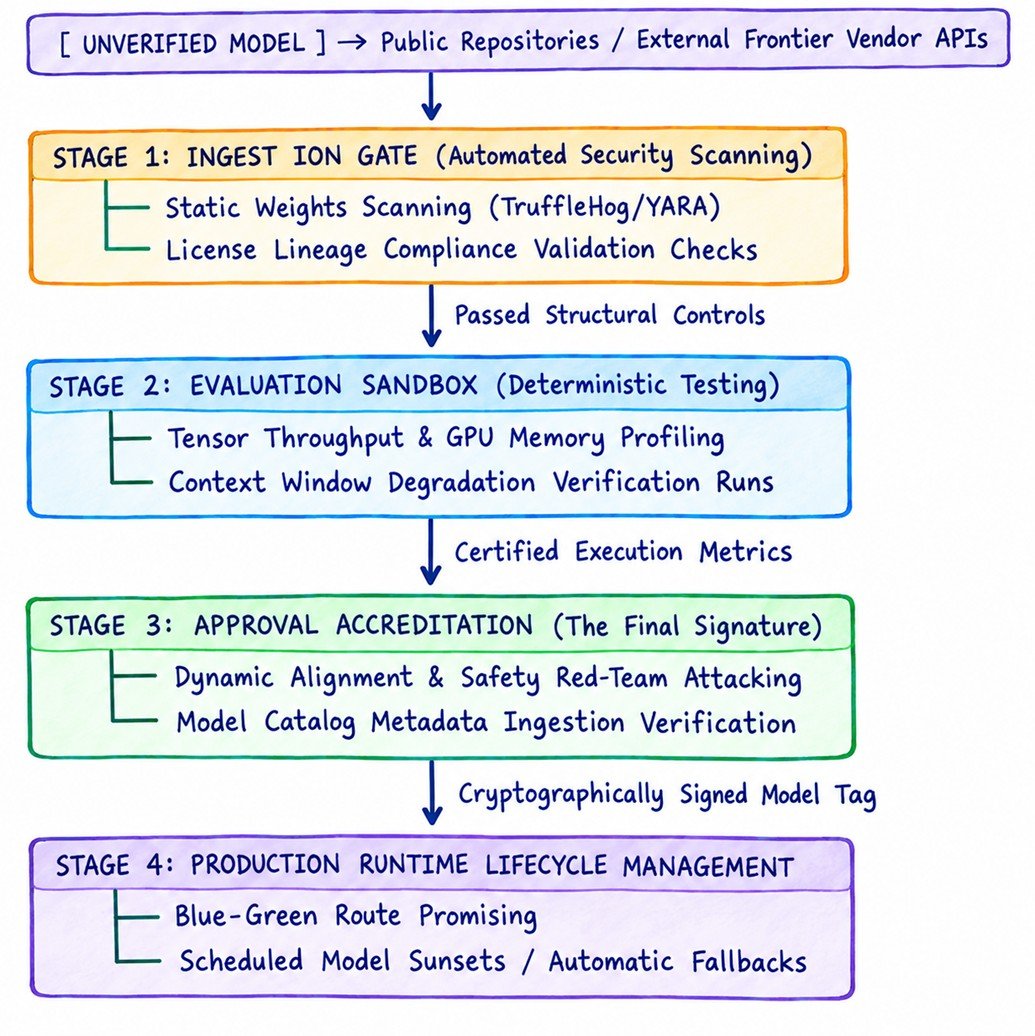
1.1 Stage 1: Ingestion & Structural Scans
The ingestion phase acts as the initial perimeter gate for the enterprise repository.
- Static Weights Vulnerability Scanning: Before an open-weights model is unarchived onto internal GPU clusters, the system runs automated YARA and signature scans across the weight tensors to identify malicious code injection vectors, hidden pickle deserialization payloads, or hardcoded secrets.
- Legal License Alignment Screening: The ingestion controller cross-examines the model's software license against corporate compliance parameters. Open-source models matching restrictive licenses, such as standard unmodified AGPL variants that could force corporate source code exposure, are systematically blocked from entering the cluster network.
1.2 Stage 2: Evaluation Sandbox Performance Profiling
Models that pass the initial structural checks are deployed into an isolated computing sandbox for rigorous performance analysis.
- Tensor Throughput Optimization Metrics: Engineers profile the model's compute footprint, measuring tokens per second, peak GPU memory utilization under batch operations, and time-to-first-token (TTFT) latency profiles.
- Context Window Validation Checks: The sandbox tests the model's performance under heavy prompt tracking conditions using synthetic Needle-in-a-Haystack (NIAH) benchmarks. This verification determines whether the model suffers severe attention loss or accuracy degradation when retrieval contexts are buried in the middle of a massive token sequence.
1.3 Stage 3: Approval Accreditation & Catalog Registration
The Model & Tool Approval Forum reviews the gathered sandbox telemetry to make a definitive promotion decision.
- Adversarial Alignment Evaluation: Red-team automation attempts to trick the candidate model using complex jailbreaks, systemic toxicity generation prompts, and data extraction inversion attempts to establish its baseline behavioral alignment.
- Cryptographic Vault Tagging: Approved models receive cryptographic signatures and enterprise tracking tags, updating the Enterprise Model Catalog for secure federated access via the unified gateway. As detailed in the referenced documentation, streamlining this path protects the Spoke's Idea-to-Staging Time (ITS) metric, ensuring engineers can query new layers within their 5-day window.
1.4 Stage 4: Production Runtime Lifecycle Management
Once live, the model is monitored continuously for runtime viability.
- Active Traffic Promotion: The system shifts workloads to newly promoted models using blue-green deployment strategies to ensure zero application downtime.
- Scheduled Deprecation and Fallback Execution: When a model tier reaches its operational end-of-life or an external cloud vendor sets a retirement deadline, the gateway's routing controller triggers automated fallback pathways, transparently shifting application requests to modern replacement endpoints.
2. Ingestion Evaluation Criteria Matrix
To ensure evaluation stays perfectly objective, the Model & Tool Approval Forum runs every candidate model through a quantitative Accreditation Scorecard.
Enterprise Model Accreditation Scorecard
| Evaluation Dimension | Minimum Compliance Expectation | Technical Verification Method |
|---|---|---|
| Legal Licensing Integrity | Fatal Dimension: Commercial reuse clearance with explicit commercial data indemnity protections. | Automated software bill of materials (SBOM) license validation scans. |
| Context Retention Accuracy | Minimum score of ( \geq 0.98 ) accuracy across the full context window size parameters up to 32K tokens. | Synthetic Needle-in-a-Haystack token injection evaluation suites. |
| Compute Efficiency Thresholds | Time-to-First-Token (TTFT) must average ( \leq 180 ) milliseconds under peak enterprise concurrent loads. | High-precision hardware logging via cluster vLLM instrumentation nodes. |
| Safety Alignment Profile | Deflection of ( \geq 0.995 ) on standard toxicity and optimization attack vector variations. | Automated red-team jailbreak prompt payload generation test suites. |
| Fine-Tuning Viability | Clear architectural capability for LoRA / QLoRA adapter ingestion without catastrophic weight drift. | Supervised Fine-Tuning (SFT) gradient mapping run logs parsing audits. |
3. The Enterprise Model Ingestion Declaration Schema
To register models into the centralized infrastructure catalog using infrastructure-as-code patterns, the platform team enforces a strict configuration format.
3.1 Live Catalog Registry Profile (model_catalog_entry.yaml)
This production configuration manifest defines the metadata boundaries, hardware tier requirements, and compliance metrics for an approved enterprise model instance.
# =====================================================================
# Enterprise Model Catalog Definition & Ingestion Profile
# =====================================================================
model_identity:
  catalog_tracking_id: "mod-ent-reasoning-llama3-70b-v2"
  formal_architecture_name: "Meta-Llama-3-70B-Instruct"
  ingestion_timestamp: "2026-09-13T19:30:00Z"
  model_origin_tier: "open-weights-self-hosted"

legal_compliance_fingerprint:
  license_type: "Llama3-Community-Commercial-License"
  commercial_use_cleared: true
  data_residency_restriction: "EU-Data-Boundary-Compliant"
  indemnity_coverage_confirmed: true

sandbox_performance_benchmarks:
  verified_context_window_tokens: 32768
  needle_in_haystack_min_score: 0.991
  average_tokens_per_second_per_user: 55.4
  peak_gpu_vram_footprint_gb: 140.0

gateway_routing_profile:
  assigned_platform_tier: "tier-2-mid-tier-preferred"
  supported_inference_engines:
    - "vllm-core-tensor-parallel-2"
    - "triton-inference-cluster"
  fallback_redirection_endpoint: "mod-cloud-fallback-frontier-api"

safety_guardrail_baseline:
  jailbreak_deflection_rate: 0.998
  enforced_system_prompt_version: "sys-prompt-safety-v2.1"
  output_grammar_constraint_supported: true
4. Integrating Model Approvals with TOGAF ADM Life-Cycles
The model lifecycle does not operate in an operational silo; its stages correspond directly with the broader milestones of the TOGAF 10 ADM framework.
Preliminary Phase: Defining Architecture Footprint & Standards
During the Preliminary Phase, the AI CoE configures the enterprise baseline rules for all model types. The team defines the non-negotiable software licenses, data privacy requirements, and structural perimeters that dictate whether a newly released model can even be downloaded onto corporate infrastructure clusters.
Phase E: Opportunities & Solutions
During Phase E, the architecture function conducts the build-vs-buy evaluations for specific application tracks. The AI Architect references the Accreditation Scorecard to determine if an enterprise spoke can build its feature using a self-hosted, open-weights Small Language Model (SLM) to lower token costs, or if the logic demands a cloud-hosted frontier reasoning API.
Phase H: Architecture Change Management
Phase H dictates continuous health logging and adaptation. When an upstream provider deprecates an API version or production logs indicate a model's performance has degraded, Phase H protocols manage the automatic failover, re-routing system calls to equivalent alternative endpoints to prevent application downtime.
Architectural Disclaimer
This architectural guide and its associated configuration schemas are intended exclusively for educational and strategic planning purposes. Computing with foundation models involves non-deterministic, probabilistic responses that change dynamically based on software configurations, input data variants, and version updates. Establishing a production-grade ingestion catalog requires deep, independent technical validation, detailed security audits, and thorough legal reviews matching your specific organizational landscape and regulatory requirements.