Cross-Functional KPIs & FinOps Alignment Matrices
Introduction
Establishing a secure model catalog, configuring low-latency runtime gateways, and mapping clear human workflows are critical phases in operationalizing enterprise intelligence. However, an operating model that lacks a rigorous, unified measurement framework will eventually fail. In classical software engineering, key performance indicators (KPIs) were highly decoupled: infrastructure teams tracked service uptime and CPU load, software developers focused on sprint velocity and code coverage, while business units monitored customer satisfaction.
This siloed approach collapses when applied to probabilistic systems.
Because Generative AI applications introduce variable token consumption costs, dynamic latency spikes, and unpredictable output drift, a technical optimization made by an engineering team can instantly destroy a product's operating margin. For example, a software team utilizing an unconstrained agentic looping pattern to improve answer precision can trigger an exponential surge in token consumption, rendering the product financially non-viable.
For technology executives, including CTOs, CFOs, Chief Product Officers, and Chief Data Officers, the blueprint for scaling intelligence sustainably is the institutionalization of Cross-Functional KPIs & FinOps Alignment Matrices. This section outlines the quantitative metrics required for each corporate persona, establishes the calculation framework for the definitive AI metric, Cost per Successful Task (CPST), and maps these parameters directly to TOGAF Phase D (Technology Architecture) and Phase G (Implementation Governance).
1. Persona-Specific Performance Matrices
To drive corporate alignment, the enterprise target operating model must decouple high-level corporate goals into explicit, measurable KPIs across the eight core AI personas.
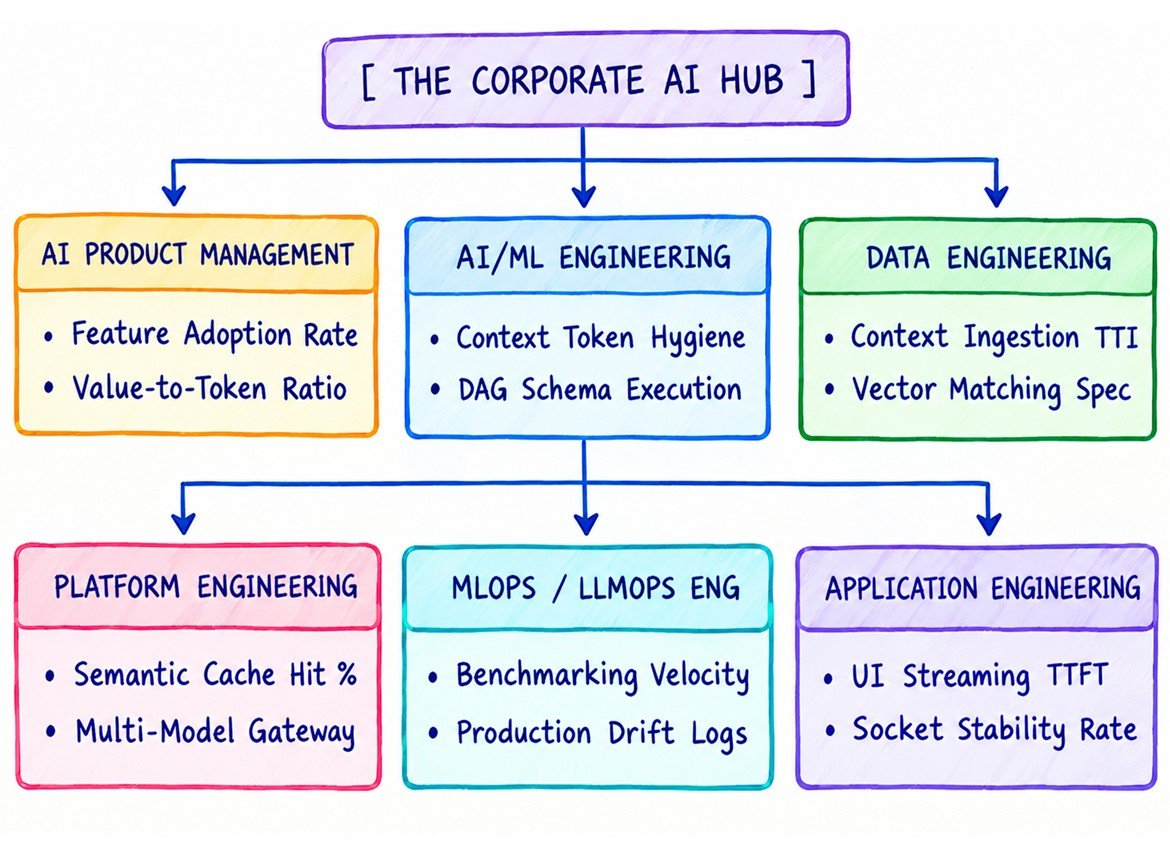
1.1 AI Product Management (AI-PM)
The AI Product Manager focuses on commercial viability and strategic execution.
- Value-to-Token Efficiency Ratio: Measures the dollar-value yield generated per million tokens consumed. It prevents teams from building complex, expensive multi-agent systems when simpler deterministic code or minor prompt engineering would suffice.
- Feature Adoption and Retention Rate: Tracks the percentage of active users who repeatedly engage with an AI-infused feature over a rolling 30-day window.
1.2 AI/ML Engineering (AI-MLE)
The AI/ML Engineer monitors the efficiency and correctness of the non-deterministic software loop.
- Context Window Packing Factor: The ratio of highly relevant background context to total tokens injected into a model prompt. High padding indicates poor context engineering.
- DAG State Machine Execution Success Rate: The percentage of multi-agent graph runs that reach an approved termination state node without triggering a timeout error or caught loop exception.
1.3 Data Engineering for AI (DE-AI)
The Data Engineer oversees the freshness and structural precision of the knowledge layer.
- Context Ingestion Time-to-Inference (TTI): The duration it takes for an updated source document in a repository, such as SharePoint or a wiki, to be parsed, chunked, embedded, and indexed into the production vector store.
- Vector Retrieval Precision (Top-K Recall Match): The frequency with which the semantic search index returns chunk arrays that are explicitly flagged as relevant by an automated testing suite.
1.4 AI Platform Engineering (PE-AI)
The Platform Engineer is measured by infrastructure efficiency and standard developer enablement.
- Semantic Cache Interception Hit Percentage: The percentage of incoming production prompts successfully answered by the memory cache layer within similarity thresholds.
- Gateway Multi-Model Routing Latency Overhead: The time addition introduced by the central proxy gateway to compute routing, run firewalls, and check token bucket counters. Target overhead must remain ( \leq 15 ) milliseconds.
1.5 MLOps/LLMOps Engineering (LLMOps)
The LLMOps Engineer manages build stability, drift tracking, and deployment safety.
- Benchmarking Validation Automation Velocity: The time required to execute an automated regression evaluation run across corporate Golden Datasets during a CI build phase.
- Production Semantic Drift Mean Time to Identify (MTTI): The speed at which the observability engine identifies that real-world user queries have drifted significantly away from versioned baseline clusters.
1.6 Application Engineering (App-Eng)
The Application Engineer ensures a responsive, stable user experience.
- Frontend SSE Stream Client-Side Time-to-First-Token (TTFT): The time elapsed between a user clicking "submit" and the first word fragment rendering on the screen via Server-Sent Events.
- Socket Reconnection Stability Rate: The percentage of long-running client-to-proxy connection sessions that survive momentary network interruptions without losing application state records.
2. The Core FinOps Alignment Matrix
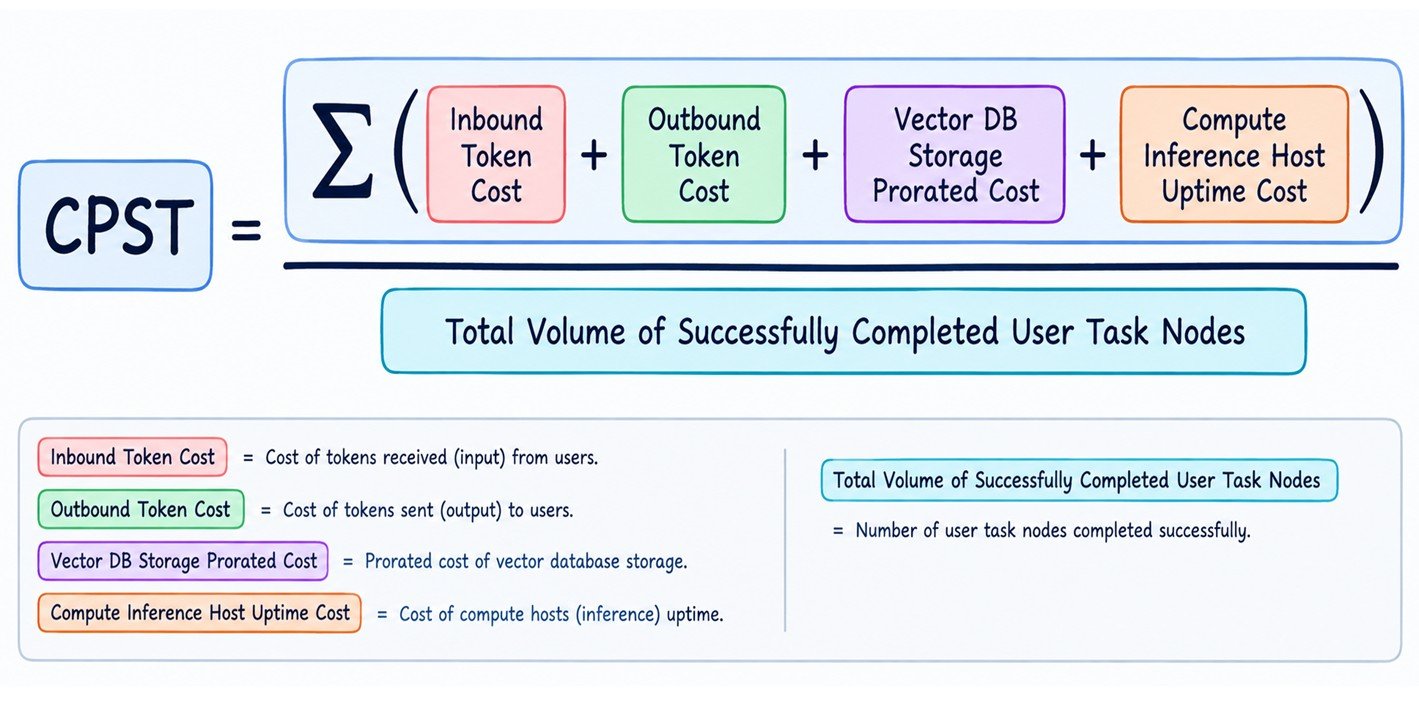
To drive true economic sustainability across all business divisions, the enterprise tracks a single, cross-functional metric: Cost per Successful Task (CPST). Traditional cloud computing costs are measured by static resources, such as compute node uptime per hour. AI token costs are variable, and calculating them requires tracking execution paths across intermediate network attempts.
Comprehensive Operational KPI Cross-Reference
| Corporate Persona | Primary Operational KPI | Target Production Baseline | Target FinOps Impact |
|---|---|---|---|
| AI Product Manager | Value-to-Token Yield Ratio | ( \geq 3.5\times ) ROI multiplier over cost | Drives long-term feature profit margins. |
| AI/ML Engineer | Context Window Packing Factor | ( \geq 0.85 ) relevant token weight profile | Limits token waste and model drift. |
| Data Engineer | Context Ingestion Time-to-Inference | ( \leq 15 ) minutes from source commit | Eliminates hallucination from stale data. |
| Platform Engineer | Semantic Cache Interception Hit % | ( \geq 35% ) across common enterprise endpoints | Lowers external model token expenses. |
| LLMOps Engineer | Automated Benchmarking Run Velocity | ( \leq 8 ) minutes per standard CI pipeline push | Minimizes developer deployment gridlock. |
| Application Engineer | Frontend Client-Side Stream TTFT | ( \leq 250 ) milliseconds visual response latency | Prevents user abandonment token losses. |
3. The Enterprise FinOps Declarative Budget Schema
To enforce these economic boundaries inside automated delivery systems, the platform engineering office injects structural tracking manifests into every code repository.
3.1 Live Financial Ingestion Manifest (finops_budget_profile.yaml)
This production file declares the token budgets, target model pricing tiers, semantic cache parameters, and automated alert limits required to run a specific corporate feature spoke.
# =====================================================================
# Enterprise AI FinOps Economic Allocation Manifest
# =====================================================================
financial_context:
  spoke_allocation_id: "fin-spoke-wealth-management"
  corporate_cost_center: "BU-RETAIL-INVEST-04"
  active_currency: "USD"
  billing_cycle_period: "MONTHLY_ROLLING"

token_economic_ceilings:
  maximum_allowable_monthly_spend: 25000.00
  hard_stop_circuit_breaker_threshold: 30000.00
  cost_per_successful_task_target: 0.14

model_tier_pricing_rules:
  primary_gateway_route: "tier-2-mid-tier-preferred"
  fallback_route: "tier-3-premium-reasoning-restricted"
  max_allowable_prompt_tokens_per_call: 8192
  max_allowable_completion_tokens_per_call: 2048

optimization_levers:
  semantic_cache_enforced: true
  minimum_cache_cosine_similarity: 0.96
  cross_encoder_rerank_limit: 5
  context_pruning_mode: "STRICT_AGGRESSIVE"

automated_billing_alerts:
  warning_threshold_percentage: 0.75
  action_on_warning: "EMIT_TELEMETRY_LOG_TO_FINOPS"
  critical_threshold_percentage: 0.90
  action_on_critical: "THROTTLE_CLIENT_API_RATE_LIMITS"
4. Integrating Performance Tracking with TOGAF ADM
These tracking frameworks map cleanly back to the core milestones of the TOGAF 10 ADM lifecycle, linking human execution metrics directly to enterprise standard processes.
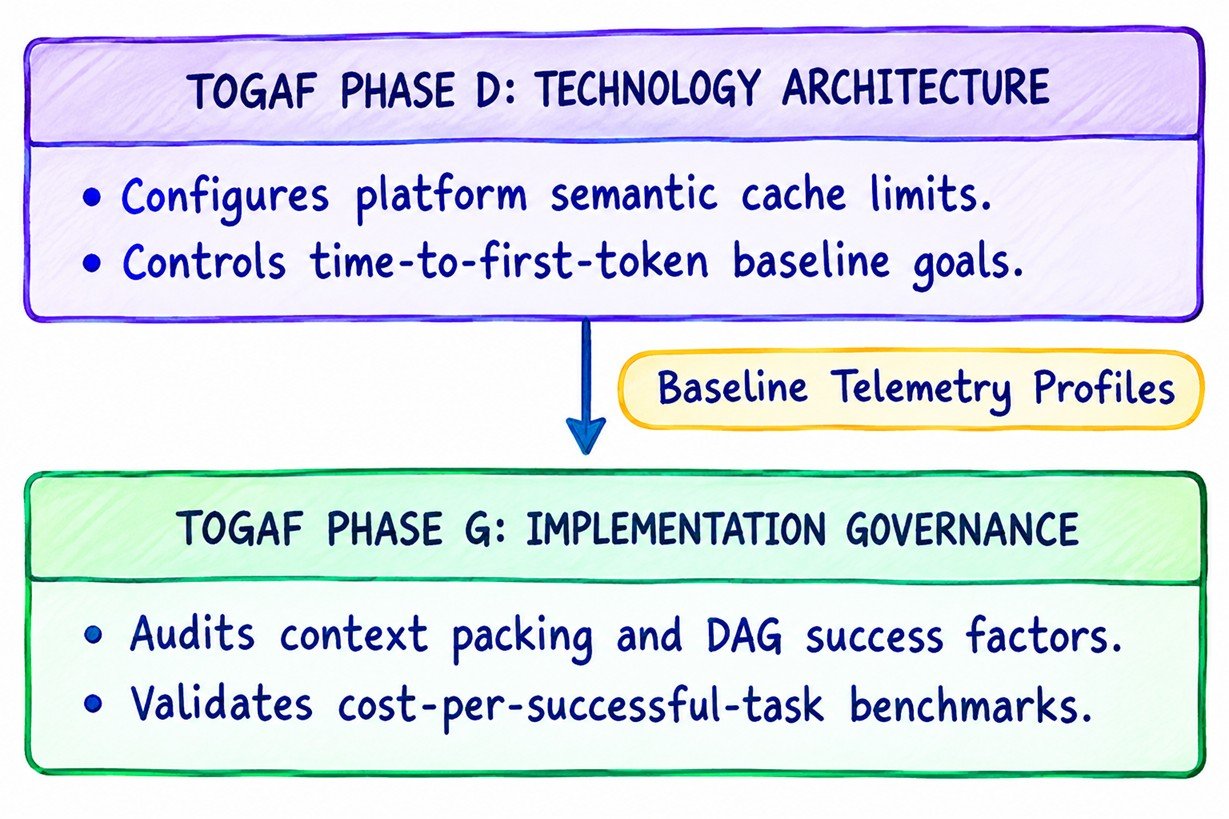
Phase D: Technology Architecture
During Phase D, the architecture function designs the underlying infrastructure layouts required to hit platform targets. The AI Platform Engineer maps out network topologies, provisioning clusters such as vLLM or Triton Server instances, and semantic cache memory nodes to guarantee that time-to-first-token and cache hit metrics align with corporate service-level agreements (SLAs).
Phase G: Implementation Governance
Phase G acts as the definitive enforcement step before production release, where the LLMOps Engineer validates the candidate build against economic expectations, including context packing, schema parsing stability, and the Cost per Successful Task (CPST).
Failing these hurdles triggers an automated deployment freeze that protects corporate capital and throttles the Spoke's Idea-to-Staging Time (ITS) metric. You can find the full replacement details in the referenced web document.
Architectural Disclaimer
This architectural guide and its referenced financial tracking configurations are intended exclusively for educational and strategic enterprise planning purposes. Probabilistic AI runtimes introduce fluid interaction paths, variable text generations, and changing token consumption traits that change dynamically based on environment data context, prompt setups, and underlying model versions. Implementing a corporate FinOps matrix requires extensive, independent technical analysis, budget audits, and financial validation matching your organization's specific operational requirements and local accounting structures.