AI Enterprise Team Topologies & Hub-and-Spoke Mechanics
Introduction
Establishing optimized model gateway subsystems, deploying semantic context fabrics, and enforcing strict cross-functional RACI lifecycles form the architectural pillars of an industrialized AI capability. Yet, the ultimate success of an enterprise Target Operating Model (TOM) depends on how human engineering talent is organized, structured, and scaled. A common failure mode for scaling firms is treating AI talent as a monolithic resource pool, either grouping all engineers into an isolated data science research laboratory or scattering them across lines of business without a common technical core.
The former approach creates an ivory tower detached from real business value; the latter breeds extreme architectural fragmentation, duplication of basic infrastructure, and runaway operational debt.
For technology executives, including CTOs, VPs of Engineering, and Chief Operating Officers, the blueprint for structuring human capital is the integration of AI Enterprise Team Topologies with a highly structured Hub-and-Spoke Operational Model. By applying the structural patterns of modern Team Topologies, including Stream-aligned, Platform, Complicated-subsystem, and Enabling teams, to the unique demands of probabilistic engineering, this section details how to organize human interfaces, optimize communication pathways, and establish clear organizational boundaries to scale AI safely across products, teams, and business units.
1. Mapping Team Topologies to the AI Enterprise
Traditional software engineering teams cannot simply absorb probabilistic AI responsibilities without a structural update to their communication boundaries. Large language models, real-time context streaming, and agentic workflows require deep specialized engineering that must be separated into clear, productized organizational teams.
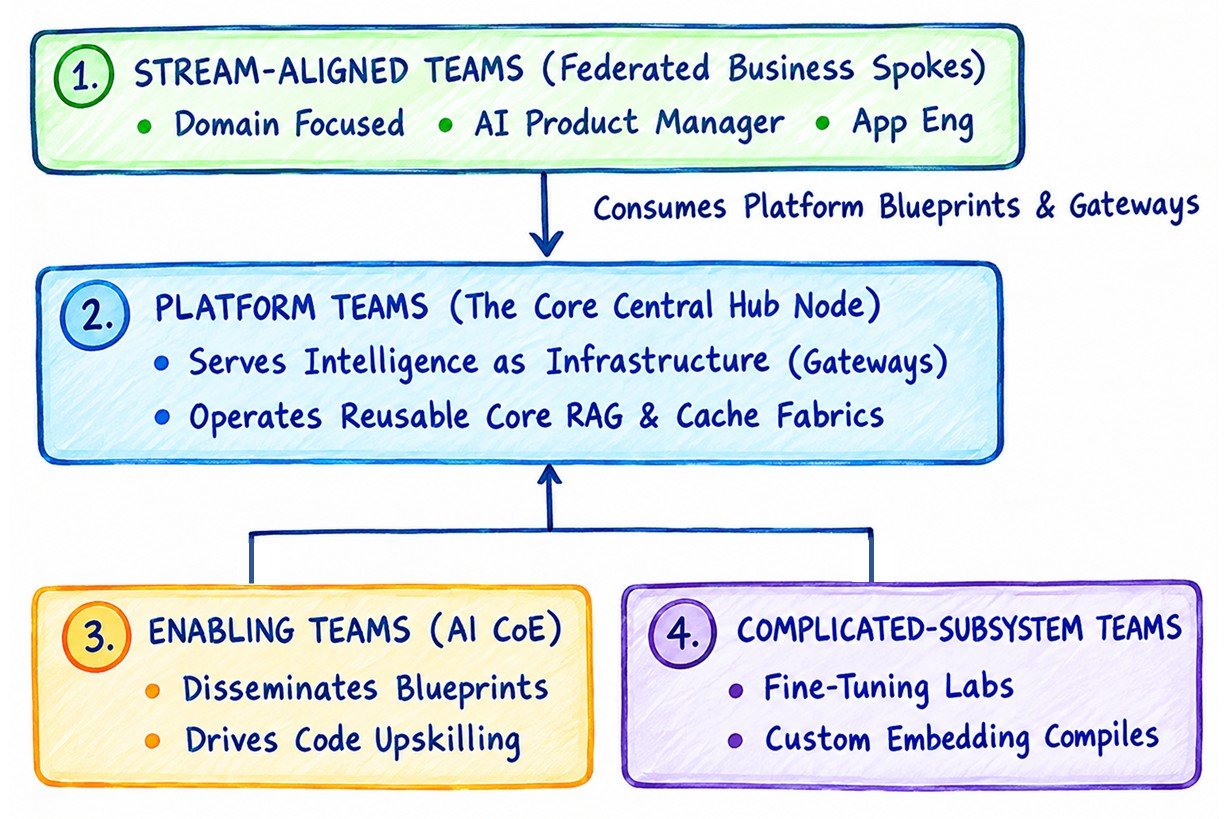
1.1 Stream-Aligned Teams (The Federated Spokes)
These are your domain-focused product engineering pods embedded directly within specific lines of business, such as Claims Ingestion, Wealth Management, and Retail Credit Underwriting.
- Team Composition: Led by an AI Product Manager and staffed primarily by Application Engineers and embedded AI/ML Engineers.
- Operational Mandate: To deliver business value by building domain-specific, AI-infused application logic. Stream-aligned teams do not build custom gateways or maintain individual vector database clusters; they consume these resources directly from the central platform.
1.2 Platform Teams (The Core Central Hub)
The Platform team treats intelligence as an infrastructure product, building and scaling the shared systems consumed by the stream-aligned teams.
- Team Composition: Staffed by AI Platform Engineers, Data Engineers, and LLMOps Release Specialists.
- Operational Mandate: To reduce engineering friction for the spokes. They operate the centralized multi-model API Gateways, maintain the high-scale Vector Database Clusters, productize the shared Semantic Caches, and own the automated CI/CD Continuous Evaluation Runners.
1.3 Enabling Teams (The AI Center of Excellence Core)
Enabling teams act as consulting specialists that bridge the knowledge gap between the Platform team and federated Stream-aligned teams.
- Team Composition: Composed of Lead Enterprise AI Architects and Senior Developer Evangelists.
- Operational Mandate: To drive enterprise-wide upskilling and prevent architectural fragmentation. They embed with stream-aligned spokes for short execution cycles, such as 2-4 week sprints, to implement complex design blueprints, teach advanced context management practices, and ensure the spoke passes the required Architecture Review Board (ARB) stage-gates.
1.4 Complicated-Subsystem Teams (The Specialized Labs)
A highly specialized team focused on tasks requiring deep mathematical or hardware-level domain expertise.
- Team Composition: Highly dense clusters of Core Data Scientists and GPU Performance Engineers.
- Operational Mandate: This team exists only when the scale of the enterprise demands it. They handle specialized tasks like optimizing low-level tensor processing kernels, training highly customized local embedding models, or managing complex parameter tuning runs for internal open-weights Small Language Models (SLMs).
2. Hub-and-Spoke Interaction Patterns
A high-scale AI operating model lives or dies by its interaction patterns. Teams must maintain crisp communication boundaries to prevent the centralized Hub from becoming an engineering bottleneck or allowing the federated Spokes to execute unvetted, insecure releases.
Hub-and-Spoke Interaction Modes
| Interaction Mode | Core Participants | Operational Mechanic |
|---|---|---|
| X-as-a-Service | Central Hub (Platform) → Federated Spokes (Stream) | The Hub exposes stable APIs, prompt registries, and caches for autonomous consumption. |
| Facilitation | Central Hub (Enabling AI CoE) → Federated Spokes (Stream) | Senior architects embed inside spokes to bootstrap new RAG or multi-agent DAG engines. |
| Collaboration | Central Hub (Platform/Subsystem) ↔ Federated Spokes (Stream) | Joint short-term task forces are formed to design new platform capabilities or evaluate tools. |
2.1 The "X-as-a-Service" Interface Strategy
The dominant, day-to-day operating mode of a mature AI enterprise. The Central Platform Hub treats its services as hardened, documented internal products.
- Execution: A federated team building an underwriting application consumes model routing, token-level data masking, and vector storage space purely via self-service API keys, schema configurations, and IaC scripts managed by the Hub. There are no lengthy deployment ticket queues; interaction is defined entirely by programmatic contracts.
2.2 The "Facilitation" Upskilling Pattern
Used during initial onboarding phases or when a spoke is tackling a highly complex, strategic use case.
- Execution: The Enabling AI CoE team actively facilitates growth by embedding an architect into the spoke's sprint cycle. The architect's objective is not to write the application code, but to educate the spoke on implementing defensive structured outputs, managing context windows efficiently, and passing the AISRB security gates.
2.3 The "Collaboration" Evolution Loop
When multiple federated spokes identify a common engineering requirement that does not exist within the centralized platform infrastructure.
- Execution: The Platform Hub and the Stream-aligned spokes form a temporary collaboration team. For a bounded period, such as one sprint, they co-design and develop the new capability, such as a standardized multi-agent orchestration state chart pattern. Once the capability is verified, the Platform team absorbs ownership, refactors it into a core platform tool, and serves it back to the wider enterprise via X-as-a-Service.
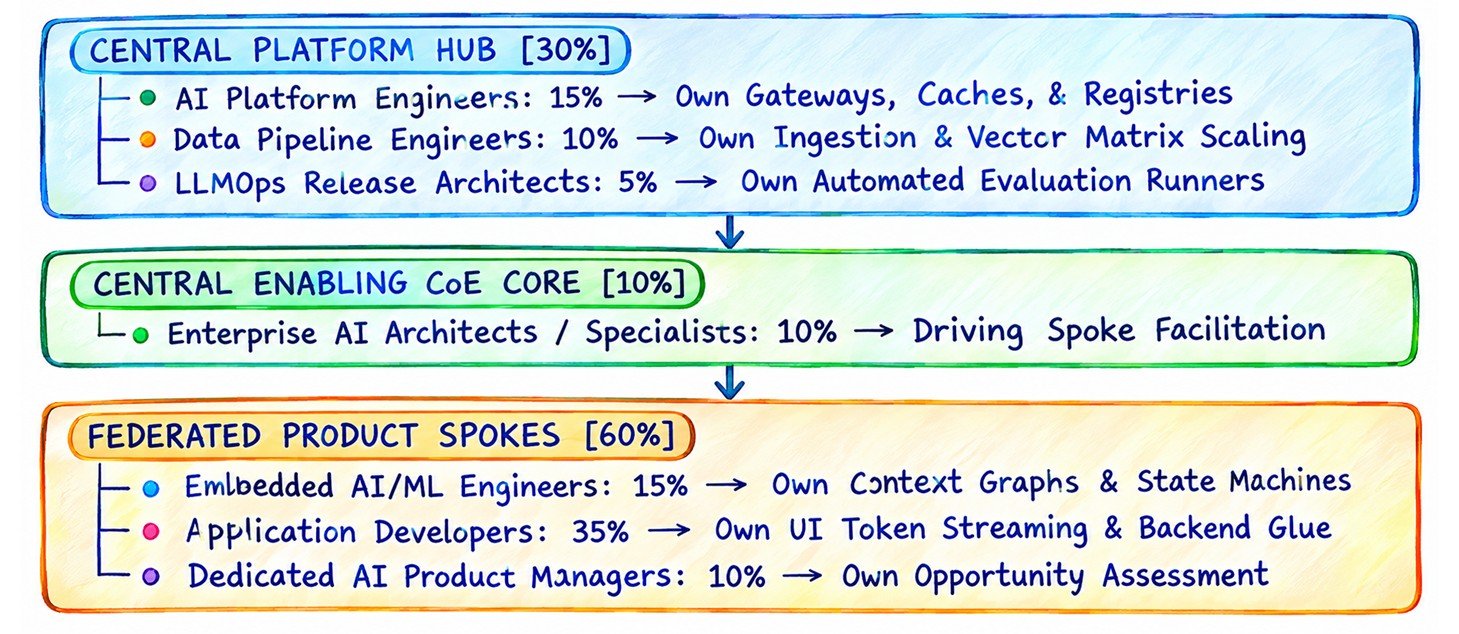
3. Team Size and Talent Density Allocation Blueprint
To optimize headcount spend and maximize engineering velocity, technology executives must balance talent density across the enterprise nodes. The following blueprint represents the recommended talent distribution ratio for a balanced 100-person enterprise AI delivery unit.
4. Institutionalizing Topologies with Infrastructure-as-Code
To automate the governance of these team boundaries, the AI CoE deploys a declarative infrastructure manifest file within the central governance cluster registry.
4.1 Organizational Topology Definition Profile (team_topology_manifest.yaml)
This configuration file maps the specific team interactions, platform resource spaces, and mandatory enabling embedding schedules required to govern a federated application spoke.
# =====================================================================
# Enterprise AI Team Topology & Interaction Specification
# =====================================================================
topology_context:
  spoke_team_identifier: "team-spoke-commercial-underwriting"
  parent_business_unit: "Risk & Credit Operations"
  maturity_classification_tier: "TIER_2_INTERMEDIATE"

team_composition_registry:
  assigned_ai_product_manager: "user-id-pm-underwrite-09"
  lead_embedded_ai_ml_engineer: "user-id-mle-underwrite-14"
  application_engineering_count: 4

hub_interaction_interfaces:
  primary_operating_mode: "X-as-a-Service"
  assigned_platform_namespace: "ns-platform-shared-underwriting"
  gateway_access_token_reference: "vault-token-spoke-underwrite-prod"

coe_enabling_engagement:
  facilitation_embedding_required: true
  assigned_enabling_architect: "user-id-coe-arch-02"
  engagement_window:
    start_date: "2026-10-01"
    target_end_date: "2026-10-28"
  primary_facilitation_objective: "Bootstrap parent-child RAG and stateful agent DAG patterns"

architectural_gate_dependencies:
  mandatory_review_cadence: "weekly-arb-sprint"
  assigned_architecture_board: "board-coe-arb-core"
  target_production_approval_gate: "gate-3-security-evaluation"
5. Integrating Team Topologies with TOGAF ADM Life-Cycles
These human organizational boundaries align directly with the core development milestones of the TOGAF 10 ADM lifecycle, ensuring that team structures mirror system architecture processes.
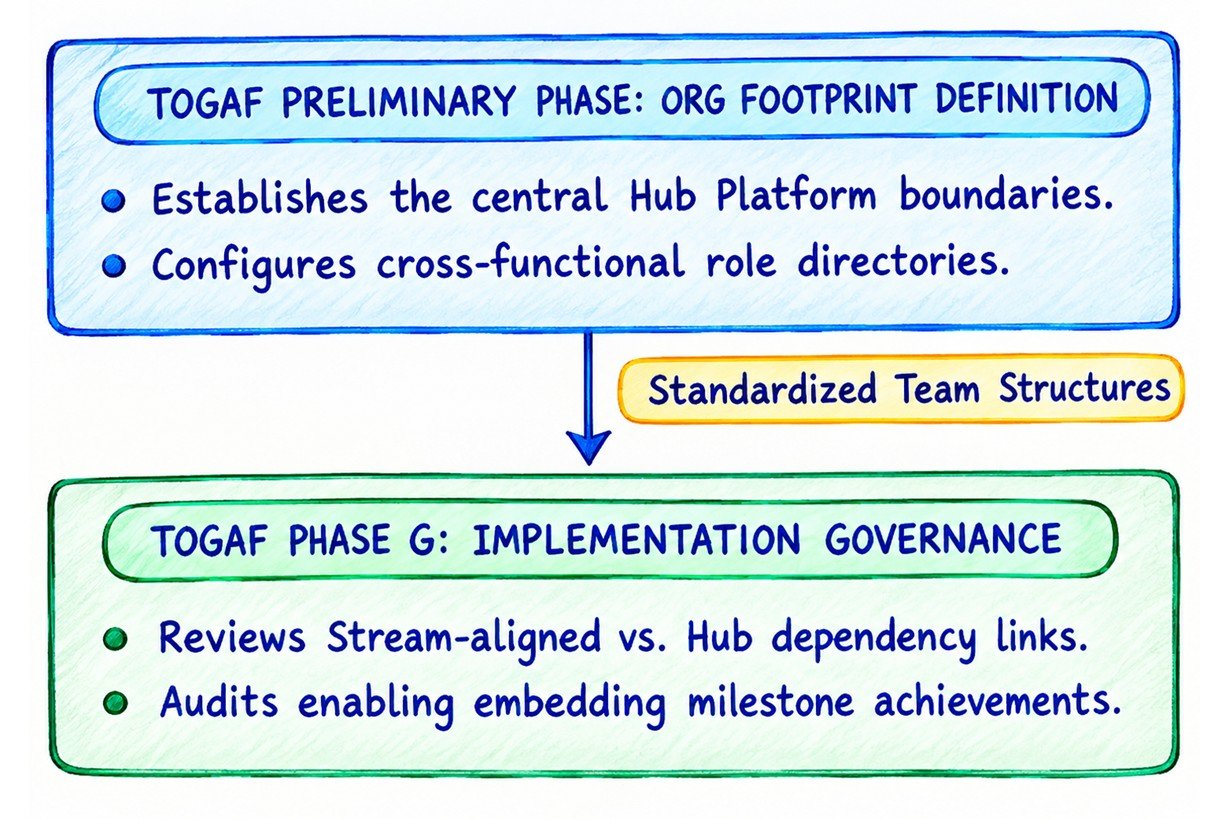
Preliminary Phase: Organizational Footprint Definition
During the Preliminary Phase, the enterprise architecture office defines the scope and baseline skills required for each organizational team node. The team designs the structural separation of duties, provisions shared platform environments, establishes access-rights boundaries, and defines the centralized X-as-a-Service interface standards that allow federated spokes to build code safely later on.
Phase G: Implementation Governance
Phase G acts as the verification gate evaluating team alignment, utilizing automated pipeline blocks to throttle the Spoke's Idea-to-Staging Time (ITS) metric until any shadow configurations or structural imbalances are remediated.
Architectural Disclaimer
This architectural guide and its associated organizational configuration blueprints are intended exclusively for educational and strategic enterprise planning purposes. Running high-scale human engineering teams across probabilistic computing platforms introduces complex communication paths, variable delivery velocities, and shifting execution dynamics that vary based on corporate cultures, technology selections, and project variables. Implementing a formal corporate team topology requires extensive organizational structure analysis, leadership consensus, and operational mapping tailored to your specific organizational constraints and resource layouts.