Enterprise AI Governance Forums & Stage-Gate Review Processes
Introduction
Standing up an Internal Developer Platform (IDP), enforcing structured Prompts-as-Code (PaC) schemas, and defining cross-functional RACI boundaries are critical foundational elements. However, an enterprise operating model remains stagnant without formal operational cadences to enforce accountability. In traditional corporate software development, release paths were gated by binary criteria, such as compile success, test coverage percentages, and static vulnerability scans.
Because Generative AI introduces non-deterministic, probabilistic runtimes, the path to production must be re-engineered.
For technology executives, including CTOs, VPs of Engineering, and Chief Risk Officers, the primary defense against production instability is the establishment of institutionalized Enterprise AI Governance Forums & Stage-Gate Review Processes. These forums act as the operational engine of the AI Center of Excellence (CoE). They ensure that every application spoke scaling intelligence across the enterprise follows uniform security, economic, and architectural guardrails.
1. The Governance Forum Cadence Framework
To maintain velocity while enforcing rigorous oversight, the operating model establishes a synchronized timeline of distinct corporate forums. These forums ensure that legal, security, and infrastructure concerns are addressed well ahead of release targets.
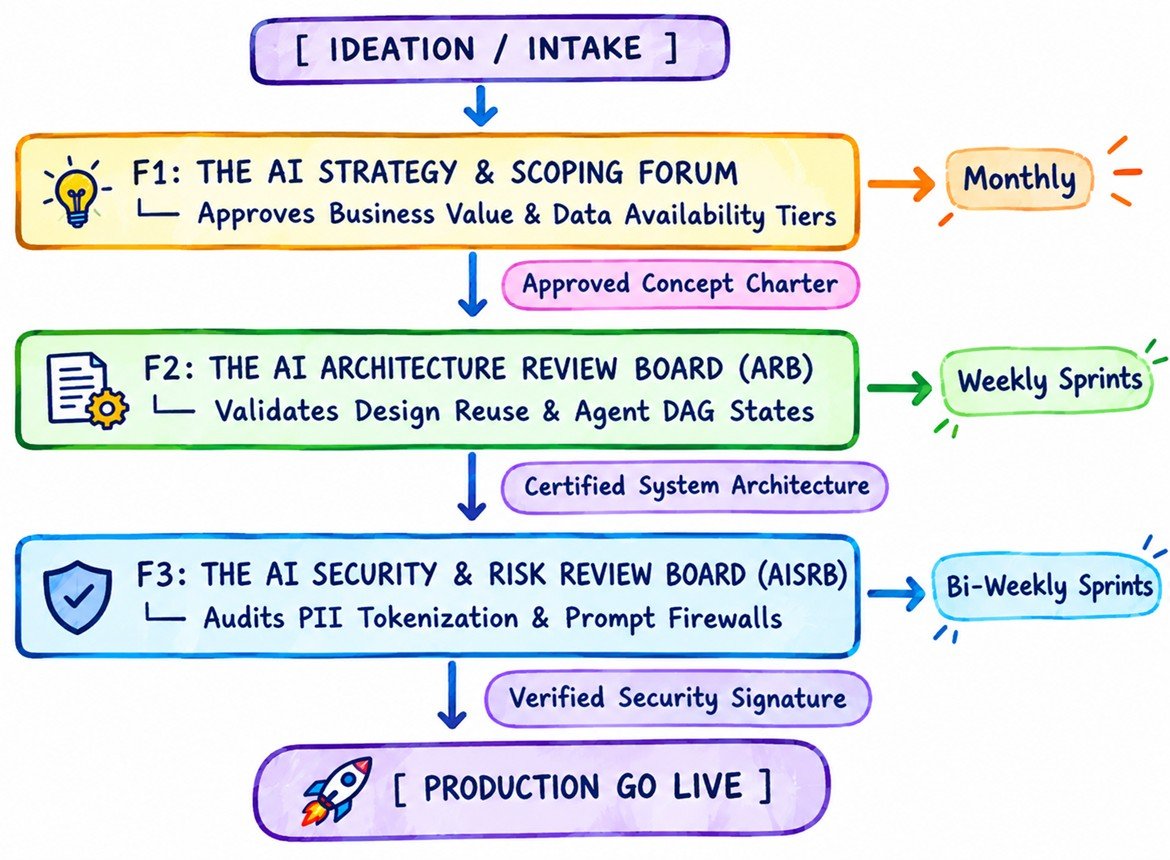
1.1 Forum 1: The AI Strategy & Scoping Forum
- Operational Frequency: Monthly.
- Chaired By: Chief Product Officer (CPO) and Chief Data Officer (CDO).
- Core Input Elements: Raw business use-case submissions and initial return-on-investment (ROI) calculations.
- Operational Focus: Evaluating new initiatives against the AI Opportunity Assessment Matrix. This step ensures the enterprise does not waste engineering capital on vanity experiments. It also verifies that the target business domains possess clean, ready-to-ingest data fabrics before developers write any code.
- Forum Veto / Escalation Authority: Veto power over speculative "AI-washing" initiatives. Escalation on cross-departmental data access blocks goes directly to the executive digital steering committee.
1.2 Forum 2: The AI Architecture Review Board (ARB)
- Operational Frequency: Weekly Sprints.
- Chaired By: Lead AI Enterprise Architect.
- Core Input Elements: System topology designs, context chunking schemas, and model dependency matrices.
- Operational Focus: Ensuring that federated project teams use the central platform's shared components, such as Semantic Caches, Multi-model Gateways, and Isolated Vector Fabrics, instead of building independent shadow IT solutions. The board evaluates the application against TOGAF Phases B, C, and D guidelines.
- Forum Veto / Escalation Authority: Authority to halt deployments that use direct, unconstrained agent execution loops or bypass core platform infrastructure. Any architectural veto issued by the board programmatically blocks the release pipeline, acting as an immediate upstream throttle that increases the Spoke's Idea-to-Staging Time (ITS) metric until design compliance is achieved.
1.3 Forum 3: The AI Security & Risk Review Board (AISRB)
- Operational Frequency: Bi-Weekly Sprints.
- Chaired By: Chief Information Security Officer (CISO) and Lead Compliance Counsel.
- Core Input Elements: LLM-as-a-Judge Evaluation Reports, data masking configurations, and global compliance audit logs, such as EU AI Act high-risk tracking manifests.
- Operational Focus: Verifying that the target system prevents data loss, protects user privacy, and blocks prompt injections before launch.
- Forum Veto / Escalation Authority: Absolute veto power over production deployments if the application fails to meet safety thresholds or lacks human approval gates for critical workflow modifications.
2. The Production Path: Four Stage-Gate Checks
To move an AI application from a promising prototype to enterprise-scale production, the operating model enforces a Four-Stage-Gate Lifecycle. Each gate requires concrete artifact submissions and objective technical sign-offs.
Gate 1: Concept & Feasibility Clearance (Ingress to Phase A)
- Mandated Review Body: AI Strategy & Scoping Forum.
- Entry Criteria: An unstructured business requirement draft submitted by a federated product spoke.
- Mandated Artifact Deliverables: Completed AI Opportunity Assessment Matrix and a verified AI Product Vision Canvas.
- Exit / Promotion Criteria: The project must establish a clear financial ROI. It must also explicitly match its use-case requirements to a specific intelligence tier to protect the organization from cost inflation.
Gate 2: Architectural Alignment Validation (Ingress to Phase B/C/D)
- Mandated Review Body: AI Architecture Review Board (ARB).
- Entry Criteria: An approved product vision charter cleared by Gate 1.
- Mandated Artifact Deliverables: System Integration Blueprints, declarative parent-child chunking schemas, and explicit agent state charts.
- Exit / Promotion Criteria: The project must prove total alignment with the AI Architectural North Star. The engineering team must demonstrate that all agentic workflows are bounded by deterministic Directed Acyclic Graphs (DAGs). The project must register all core parameters within the corporate Architecture Repository before proceeding.
Gate 3: Security & Evaluation Verification (Ingress to Phase G)
- Mandated Review Body: AI Security & Risk Review Board (AISRB).
- Entry Criteria: A compiled codebase candidate deployed within a secure staging environment.
- Mandated Artifact Deliverables: Automated CI/CE Pipeline Regression Logs and AI PoC-to-Production Readiness Scorecards.
- Exit / Promotion Criteria: The application code must pass automated benchmarking runs across versioned Golden Datasets. An independent LLM-as-a-Judge scoring matrix must confirm a faithfulness score ( \geq 0.95 ), and red-team testing must prove total deflection of active prompt injection techniques.
Gate 4: Operational Release Clearance (Ingress to Phase H Deployment)
- Mandated Review Body: Joint CoE Executive Committee (CTO, CISO, Lead Architects).
- Entry Criteria: A verified application signature cleared through Gate 3, running in shadow routing mode inside the production model gateway.
- Mandated Artifact Deliverables: Outbound Toxicity Scan traces, semantic drift tracking dashboards, and Cost per Successful Task (CPST) profiles.
- Exit / Promotion Criteria: The system must run smoothly under real-world shadow traffic without exceeding token budgets or causing platform performance degradation. Once approved, the model gateway releases traffic progressively (canary mode: 1% → 10% → 100%), finalizing the deployment loop.
3. The Enterprise Stage-Gate Enforcement Schema
To automate this stage-gate process, the platform office uses a structured configuration file to audit and verify gate metrics within the continuous deployment engine.
3.1 Live Production Gate Compliance Blueprint (stage_gate_governance.yaml)
This configuration file defines the mandatory evaluation targets, review board identifiers, and artifact validation tokens required to advance an AI application through the enterprise release gates.
# =====================================================================
# Enterprise AI Stage-Gate Lifecycle Governance Manifest
# =====================================================================
application_context:
  spoke_identifier: "spoke-retail-credit-underwriting"
  target_environment: "production-secure-zone"
  active_governance_version: "gov-v4.1.2"

gate_1_concept:
  forum_identifier: "ai-strategy-scoping-board"
  status: "VERIFIED_COMPLIANT"
  approved_artifacts:
    - canvas_id: "apvc-credit-underwrite-04"
      type: "AI_PRODUCT_VISION_CANVAS"
  intelligence_tier_restriction: "tier-2-mid-cloud-llm"

gate_2_architecture:
  forum_identifier: "ai-architecture-review-board"
  status: "VERIFIED_COMPLIANT"
  approved_artifacts:
    - blueprint_id: "ansb-underwrite-dag-v2"
      type: "SYSTEM_TOPOLOGY_BLUEPRINT"
  constraints_audit:
    autonomous_loop_allowed: false
    semantic_cache_bound: true
    fallback_slm_cluster_registered: true

gate_3_security_evaluation:
  forum_identifier: "ai-security-risk-review-board"
  status: "PENDING_REVIEW_SIGN_OFF"
  required_benchmarks:
    golden_dataset_reference: "gd-underwriting-stress-v2.1"
    minimum_llm_judge_faithfulness: 0.96
    adversarial_jailbreak_deflection_floor: 1.0
  validation_logs:
    ci_pipeline_run_id: "pipeline-run-uuid-88319"
    current_faithfulness_score: 0.972
    current_jailbreak_deflection_rate: 1.0

gate_4_operational_release:
  forum_identifier: "coe-joint-executive-committee"
  status: "BLOCKED_BY_PREVIOUS_GATE"
  deployment_strategy:
    pattern: "progressive-canary-route"
    initial_traffic_percentage: 0.01
    canary_evaluation_window_hours: 48
  finops_economic_ceilings:
    maximum_cost_per_successful_task: 0.18
4. Formal Governance Forums Meeting Minutes Templates
To maintain an unbroken audit trail for regulatory bodies such as the European Central Bank, the US Federal Reserve, or EU AI Act validation inspectors, the AI CoE mandates that all sessions of the AI ARB and AISRB be logged using standardized, machine-readable Markdown templates. These minutes serve as legal evidence of architectural and security due diligence.
Template A: AI Architecture Review Board (ARB) Minutes Template
markdown
# AI ARCHITECTURE REVIEW BOARD (ARB) — OFFICIAL SESSION MINUTES

## 1. SESSION METADATA
*   **Session Reference Identifier:** ARB-2026-0913-S42
*   **Date / Timestamp:** September 13, 2026 | 14:00 UTC
*   **Chairperson:** Lead AI Enterprise Architect
*   **Quorum Verification:** Verified (Minimum 3 Certified Architects + Platform Lead present)

## 2. ATTENDANCE REGISTRY
*   **Present Board Members:** [Name/Role], [Name/Role], [Name/Role]
*   **Sponsor / Presenting Spoke Team Lead:** [Name/Spoke Unit ID]

## 3. SOLUTION INTAKE REVIEW LOG
*   **Target Application Name:** [e.g., Automated Commercial Loan Evaluator]
*   **Associated Spoke ID:** [e.g., Spoke-Commercial-Lending]
*   **Current Target ADM Stage-Gate:** Gate 2: Architectural Alignment Validation

## 4. ARCHITECTURAL COMPLIANCE MATRIX EVALUATION
*   [PASS/FAIL] **Model Decoupling Check:** Application abstracts foundation layers via the Enterprise API Gateway interface.
*   [PASS/FAIL] **State Machine Validation:** Workflow logic is bound to a Directed Acyclic Graph (DAG) with explicit Human-in-the-Loop transitions.
*   [PASS/FAIL] **FinOps Component Optimization:** Semantic cache integration verified with an enforcement threshold configured at $\ge 0.95$ cosine similarity.
*   [PASS/FAIL] **Context Window Slicing Strategy:** Parent-Child tiered semantic chunking schema verified on OpenSearch data collections.

## 5. REJECTION BLOCKS / REMEDIATION REQUIREMENTS
*   *If applicable, detail the exact architectural reasons for blocking or deferring a project:*
    *   **Block Item 1:** Spoke attempted to implement an unconstrained autonomous loop for contract querying. *Remediation:* Must re-code using rigid state-charts before next review cycle.

## 6. BOARD DECISION SIGN-OFF
*   **Status Resolution:** [APPROVED FOR GATE 3 / DEFERRED PENDING REMEDIATION / REJECTED]
*   **Cryptographic Vault Signature Token:** `sha256:88319f391a27e99b0cdd12b1239958742b7890aae883c1212
Template B: AI Security & Risk Review Board (AISRB) Minutes Template
markdown
# AI SECURITY & RISK REVIEW BOARD (AISRB) — PROD ACCREDITATION REPORT

## 1. SESSION METADATA
*   **Session Reference Identifier:** AISRB-2026-0913-S11
*   **Date / Timestamp:** September 13, 2026 | 16:00 UTC
*   **Chairperson:** Chief Information Security Officer (CISO)
*   **Compliance Classification Target:** EU AI Act Title III High-Risk System / NIST RMF Tier 3

## 2. VERIFIED EVIDENCE & METRICS ARTIFACTS
*   **CI Pipeline Build Run URL:** `https://llmops.internal`
*   **Golden Dataset Benchmark Version:** `gd-underwriting-stress-v2.1`
*   **Independent LLM-as-a-Judge Faithfulness Score:** `0.972` (Threshold Requirement: $\ge 0.95$)
*   **Adversarial Jailbreak Deflection Rate:** `1.000` (Threshold Requirement: `1.00`)

## 3. COMPLIANCE & PRIVACY COMPLIANCE AUDIT
*   [YES/NO] **PII Masking Verification:** Inputs automatically tokenized via Regex/NER filters at the platform proxy layer.
*   [YES/NO] **Copyright Risk Evaluation:** The underlying foundation model license guarantees indemnity for enterprise usage profiles.
*   [YES/NO] **Human Approval Gate Presence:** A hard validation state exists blocking model-driven transaction execution without a licensed adjuster's physical token signature.

## 4. AUDIT COMPLIANCE STATEMENT
*   "The board has examined the automated evaluation logs and verified that the target solution does not introduce data leakage or unmitigated adversarial risks to the firm's data perimeter."

## 5. BOARD DECISION SIGN-OFF
*   **Status Resolution:** [ACCREDITED FOR PRODUCTION GATE 4 / QUARANTINED]
*   **Cryptographic Vault Signature Token:** `sha256:bc89110294eef882199cb11239840bbacde1127361929948`
6. Detailed Compliance Matrix Criteria
To remove subjectivity from review sessions, the AISRB judges candidate applications against an explicit, quantitative scoring matrix. A failure in any single Fatal Dimension results in an automatic quarantine block, regardless of business value or project deadlines.
AISRB TECHNICAL COMPLIANCE CRITERIA
| Evaluation Dimension | Compliance Metric Requirement | Verification Artifact Source |
|---|---|---|
| Data Sovereignty Boundaries | Fatal Dimension: Zero unencrypted text egress outside corporate VPC endpoints to multi-tenant models. | Gateway Route Transport TLS Audit Logs. |
| Tokenized Security Guardrails | Automated detection and removal of 100% of PII/PCI fields before data streams pass the proxy boundary. | Synthetic Injection Test Payload Run Data. |
| Hallucination Drift Baselines | Verified Faithfulness Score of > =0.95 across 500+ standard golden dataset evaluation records. | LLM-as-a-Judge Staging Regression Report. |
| Attack Surface Resilience | 100% block rate against automated prompt mutation jailbreak scripts. | Adversarial CI Pipeline Stress Test Run Logs. |
| Model Licensing Clearance | Fatal Dimension: Models must hold commercial-use clearance with explicit data indemnity clauses. | Legal Registry Catalog Ingestion Token. |
| Agentic Execution Guardrails | Hard-coded transition limits, with a maximum of 5 concurrent tool loops before triggering automatic termination. | Workflow Graph Configuration Code Manifest. |
Verification Protocols
-
The Zero-Trust Isolation Check: Architects verify compliance by pulling the routing deployment configuration files. The system must prove that it uses a secure connection, such as AWS PrivateLink or an Azure Private Endpoint, to communicate with external foundation model APIs. This ensures that no data packets traverse the public internet without corporate inspection or encryption controls.
-
Evaluating Hallucination Risks: The candidate application must run an automated check against a pre-selected group of testing records, known as the Golden Dataset. An independent model grades the outputs to ensure the system is not inventing information. If the application's accuracy score falls below the required target during testing, the build is blocked from production until the developers optimize the retrieval pipeline.
Architectural Disclaimer
This architectural guide, including its governance frameworks, compliance criteria, and meeting templates, is intended exclusively for educational and strategic enterprise planning purposes. Probabilistic computing systems introduce dynamic operational risks, non-deterministic performance shifts, and variable token economics that change based on environmental data context, prompt configurations, and underlying model versions. Implementing corporate governance forums requires comprehensive legal, regulatory, cybersecurity, and financial analysis tailored to your organization's specific operational requirements and local regulatory constraints.