AI Product Management for Enterprise
Introduction
Investing in high-performance platform clusters, clean data fabrics, and disciplined engineering pipelines establishes a highly scalable infrastructure footprint. However, building scalable technical infrastructure is pointless if the applications it supports do not solve real business problems. In an era where foundation model capabilities are rapidly commoditizing, the defining competitive differentiator is not knowing how to build an AI application, but knowing what to build, what not to build, and exactly how much intelligence a specific product task requires.
For technology leaders, including CTOs, Chief Product Officers (CPOs), and line-of-business Directors, defining this direction is the core responsibility of AI Product Management for Enterprise. Traditional product management patterns fail when applied to probabilistic systems. Standard product frameworks assume deterministic logic, stable feature scopes, and linear release cadences. AI Product Management, however, requires professionals to design software where user interfaces are conversational, system behaviors are unpredictable, accuracy is measured statistically, and computing expenses change continuously based on token economics.
This section details how to institutionalize an executive-grade AI product management practice, outlining value qualification matrices, human-AI interaction canvases, and product discovery frameworks that align with TOGAF Phase A (Architecture Vision) governance models.
1. The Core Paradigm Shift in AI Product Management
Traditional enterprise product managers are accustomed to writing deterministic requirements: "When the user clicks Button A, the system must write Record B to the database." When building features driven by Generative AI, product managers must transition from managing imperative specifications to managing probabilistic behavioral boundaries.
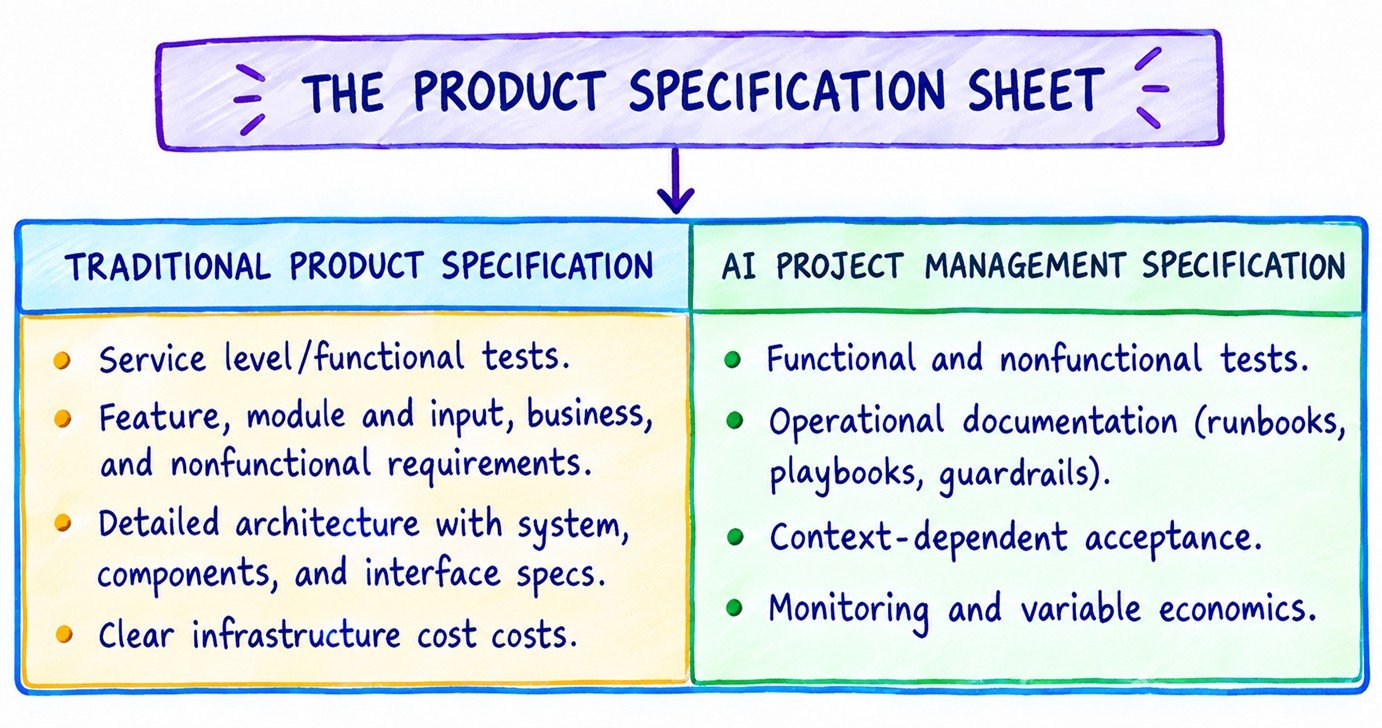
This fundamental transition forces AI Product Managers to master a new set of baseline product disciplines:
- Acceptance Criteria Shifts: Instead of defining absolute passes or fails, product managers write statistical criteria: "The customer account extraction agent must maintain a minimum accuracy rate of 95% across historical datasets without exceeding an average execution latency of 2.4 seconds."
- Managing the User "Disillusionment" Loop: In traditional software, user frustration stems from bugs or poor interface choices. In AI systems, frustration occurs when a model hallucinates, misunderstands conversational context, or returns unformatted summaries. The AI Product Manager must design defensive user experience (UX) layers that prepare users for variations in output, rather than promising absolute accuracy.
2. The AI Product Discovery & Qualification Framework
To prevent teams from spending capital on speculative AI experiments that cannot scale, the AI Product Manager uses a structured discovery loop to screen incoming requests before they reach engineering queues.
2.1 The AI Opportunity Assessment Matrix
Every potential AI initiative is plotted onto a matrix that compares Strategic Business Value (cost reduction, customer satisfaction spikes, time-to-market acceleration) against Technical Feasibility (data readiness, model capability alignment, security profile matching).
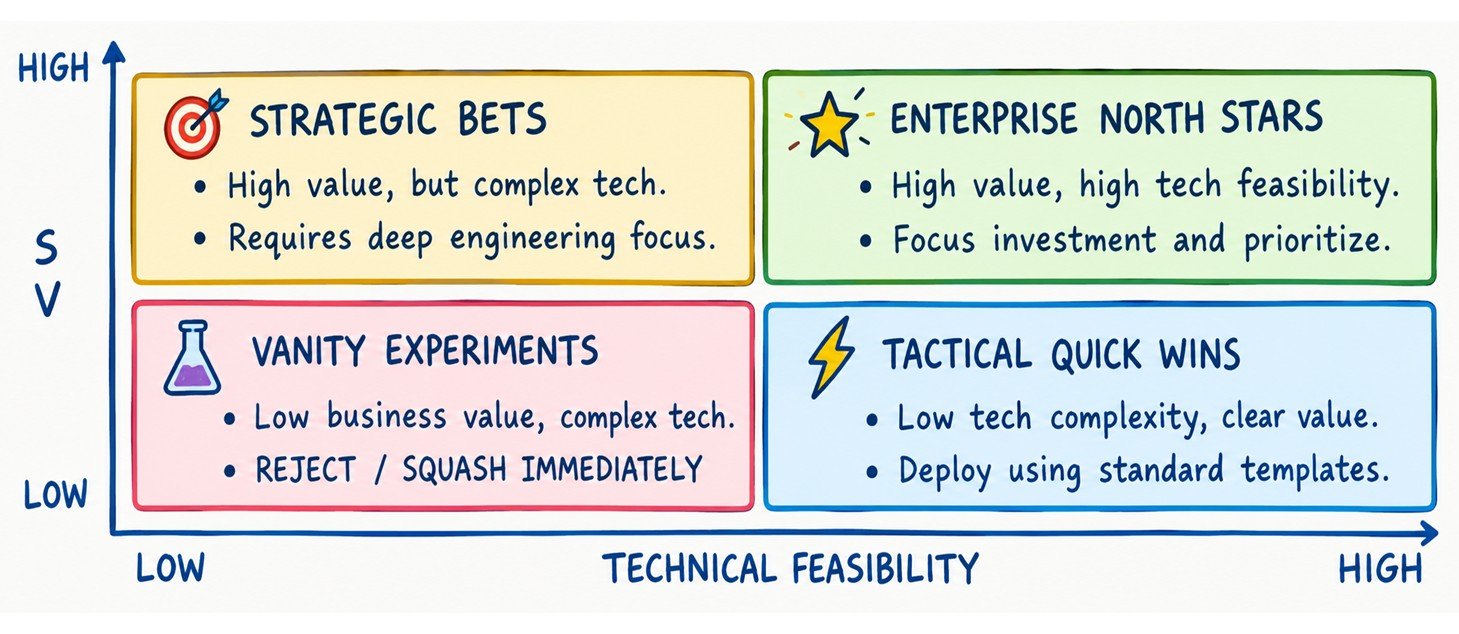
- Enterprise North Stars (High Value, High Feasibility): Core workflows where data is clean, documentation is rich, and a reasoning model provides immediate optimization, such as automated regulatory contract compliance indexing.
- Tactical Quick Wins (Low Complexity, Clear Value): Standard internal tools that can be addressed by basic prompt templates or pre-configured corporate patterns, such as standard HR document summaries.
- Vanity Experiments (Low Value, High Complexity): Projects driven by market hype rather than real business needs. The AI Product Manager kills these requests during discovery to keep resource pools focused.
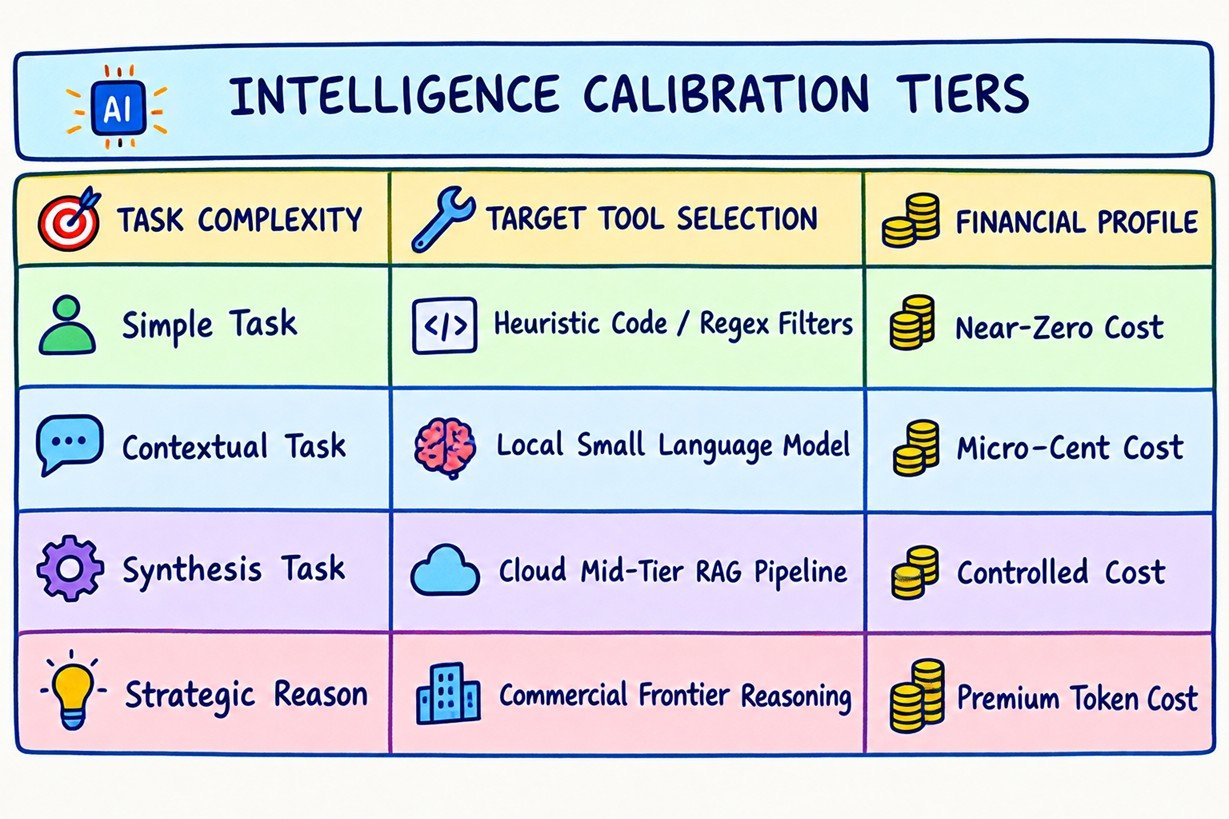
2.2 Calibrating the Intelligence Tier Strategy
A common mistake in AI product design is using premium frontier models for low-level application tasks. AI Product Managers explicitly match use-case complexities to specific intelligence tiers to protect product operating margins.
3. The AI Product Vision Canvas Blueprint
To translate abstract ideas into structured requirements that engineers can build against, the AI Product Manager synthesizes information into a formalized canvas template.
# =====================================================================
# Enterprise AI Product Vision Specification Archetype
# =====================================================================
product_meta:
  initiative_name: "Automated Institutional Claims Assessor"
  business_unit: "Commercial Operations & Insurance Ingress"
  product_owner: "AI Product Management Core Office"
  target_deployment_quarter: "2026-Q4"

problem_statement: |
  Processing high-value claims requires corporate compliance adjusters to manually read
  hundreds of unstructured policy pages, cross-referencing ledger tables. This creates
  processing backlogs, increases handling costs, and drives inconsistent policy application.

intelligence_strategy:
  core_interaction_model: "Human-in-the-Loop (HITL) Assistive Draft Generation"
  required_capabilities:
    - "Layout-aware tabular data extraction from incoming multi-format corporate PDFs"
    - "Semantic reference retrieval matching clauses against core underwriting guidelines"
  intelligence_tier: "Tier-2 Cloud Mid-Tier LLM paired with specialized Cross-Encoder Rerankers"

operational_guardrails:
  maximum_token_budget_per_transaction: 4000
  pii_masking_requirement: "Strict. All client identify metrics must be scrubbed at ingress."
  unacceptable_failure_modes:
    - "Direct autonomous processing approval without an internal human signature token."
    - "Altering core numerical figures extracted from primary financial ledgers."

success_metrics:
  target_accuracy_rate: 0.96
  expected_processing_time_reduction: "45% decrease in end-to-end adjustment backlogs."
  target_cost_per_successful_task: "$0.12 maximum token cost baseline per completed claim."
4. Mapping AI Product Management to TOGAF Phase A (Architecture Vision)
To guarantee that new product definitions integrate smoothly with broader enterprise planning, the AI Product Manager's discovery outputs map directly to TOGAF Phase A (Architecture Vision).
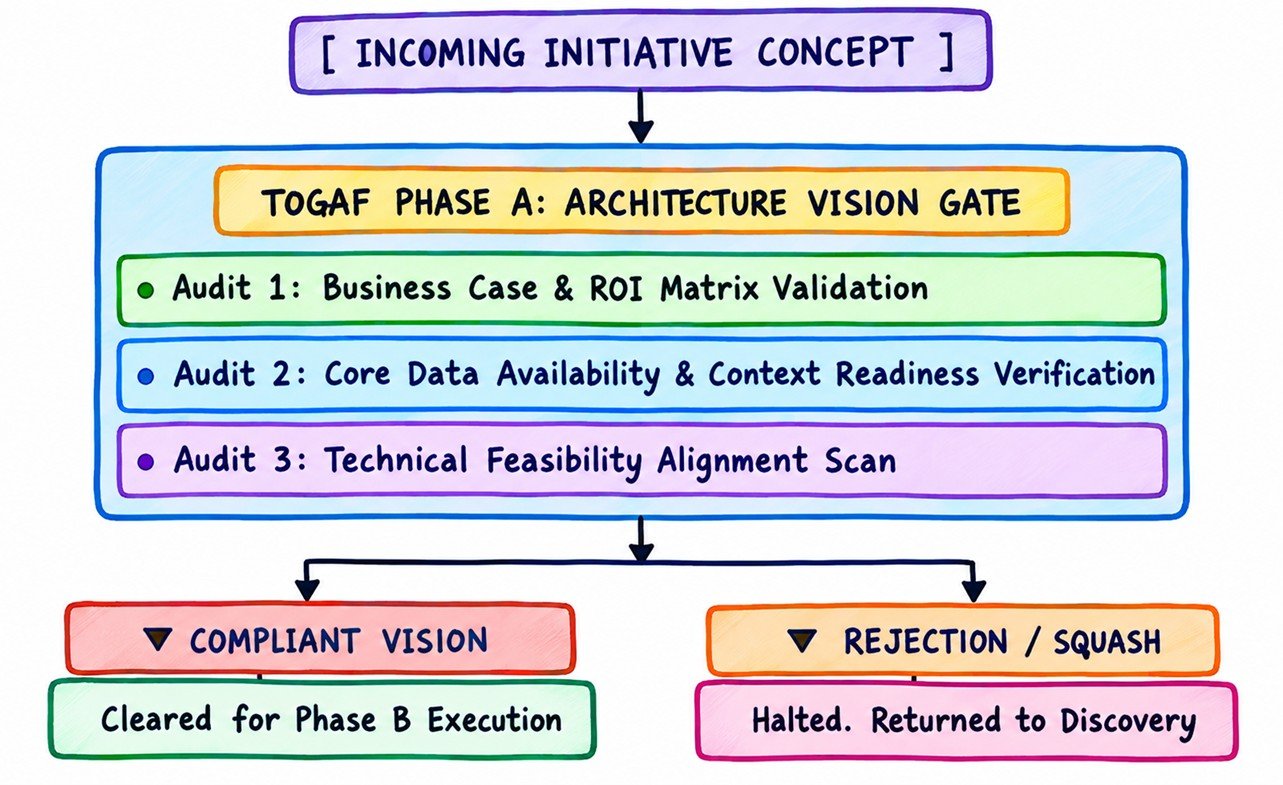
The AI CoE reviews the product definition during Phase A using three clear criteria:
- Business Case & Return on Investment (ROI) Validation: The product manager must prove the business value of the initiative using the AI Opportunity Assessment Matrix. The CoE checks that the project addresses a real operational bottleneck rather than just implementing AI for the sake of novelty.
- Core Data Availability and Context Readiness Verification: A product vision cannot advance if its required data pipelines do not exist. The product team must show that the necessary source documents are accessible, clear, and ready for ingestion by the core data fabric without requiring custom infrastructure rebuilds.
- Technical Feasibility Alignment Scans: The CoE checks the planned interaction model and model tiers against the enterprise AI Architectural North Star Blueprint. This step ensures the design relies on the platform's shared components, avoiding model sprawl and preserving long-term system maintainability.
A product manager’s failure to pass any of these three Phase A validation gates results in an immediate freeze of the project's Architecture Vision charter by the CoE.
This systemic block acts as an upstream throttle on the Spoke's Idea-to-Staging Time (ITS) metric. By arresting poorly scoped "Vanity Experiments" or data-starved initiatives before they enter the engineering queue, this gatekeeping mechanism forces product managers to respect architectural boundaries and model-tier economics from day one to protect their organizational velocity KPIs.
Architectural Disclaimer
This architectural guide and its referenced product management canvases are intended exclusively for educational and strategic organizational design planning purposes. Probabilistic AI systems introduce variable output qualities, fluid performance metrics, and fluctuating token consumption costs that change based on model contexts, inputs, and environment configurations. Implementing an enterprise product discovery framework requires independent compliance, legal risk, and financial validation tailored to your specific corporate landscape and operational mandates.