Enterprise AI Architecture & Governance Forums
Introduction
Investing in high-performance platform subsystems, automated data fabrics, and type-safe application engineering layers establishes the necessary engineering execution capabilities for the digital firm. However, technical execution capabilities without architectural alignment lead directly to operational fragmentation, vendor lock-in, unmitigated model risk, and structural architecture debt. In traditional software paradigms, enterprise architects enforced compliance through static system dependencies, predictable relational database integration schemas, and deterministic infrastructure sizing models.
The integration of probabilistic systems fundamentally breaks these classical governance patterns.
For technology executives, including CTOs, Enterprise Architects, and Tech VPs, the primary organizational mechanism to prevent AI chaos is the institutionalization of Enterprise AI Architecture & Governance Forums. This section details the modernized domain of the AI Architect, the functional cadences of institutionalized review bodies, and the exact architectural stage-gate framework required to govern non-deterministic systems within the TOGAF 10 Architecture Development Method (ADM) context.
1. The Modern Role of the Enterprise AI Architect
The introduction of large language models and cognitive agent frameworks demands a structural evolution of the Enterprise Architect persona. The modern Enterprise AI Architect does not sit in a silo issuing abstract mandates; they act as a systems engineering strategist who bridges classical corporate architecture disciplines with the realities of probabilistic computing.
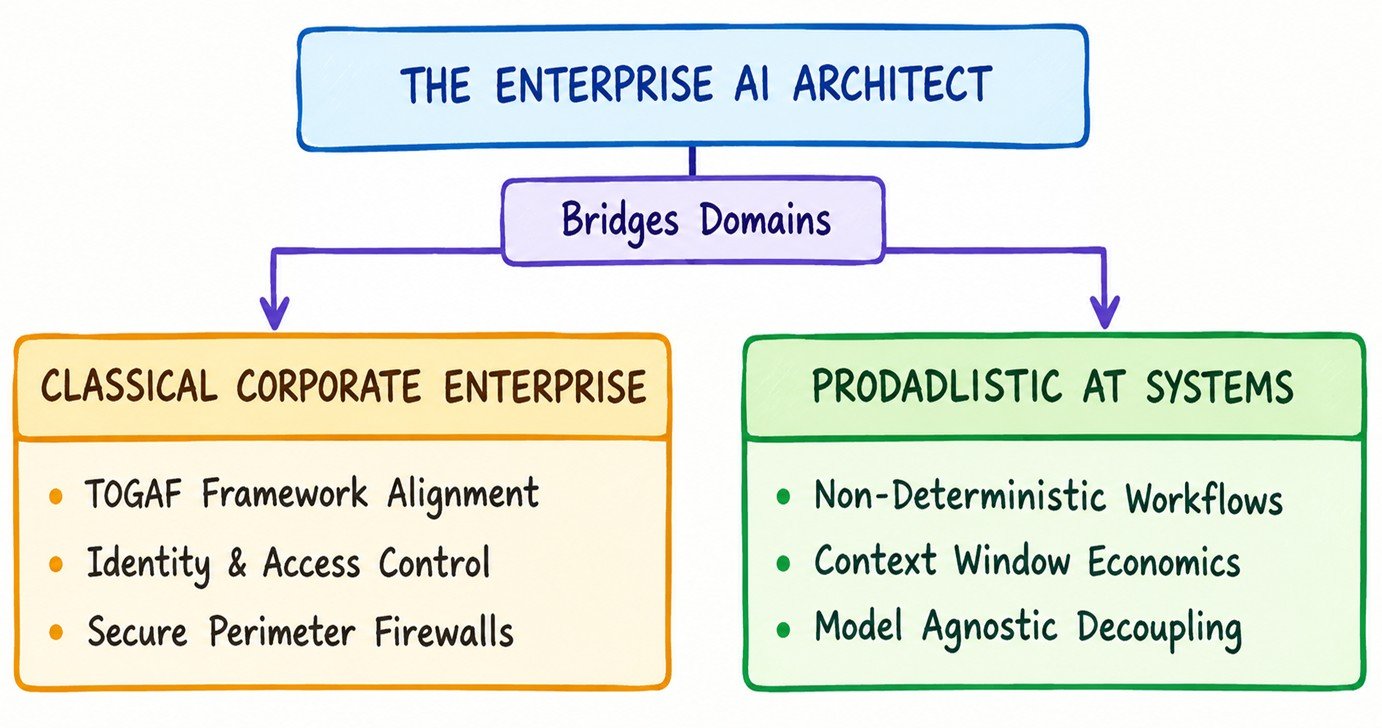
The AI Architect must master specific capabilities to effectively govern the Hub-and-Spoke enterprise operating model:
- Stochastic System Modeling: The architect must move away from expecting absolute binary passes or fails in software interactions, designing instead for statistical distributions, fallback thresholds, and graceful performance degradation layers.
- Abstraction Layer Enforcement: The architect's primary technical mandate is to prevent downstream application spokes from tightly coupling code to proprietary model vendor APIs, ensuring long-term multi-cloud portability and token cost control.
2. Core Governance Forums: The Operational Cadences
To govern a multi-business-unit AI delivery ecosystem without choking innovation velocity, the enterprise operating model establishes two formal, highly structured architectural review forums.
2.1 The AI Architecture Review Board (ARB)
The AI ARB is the ultimate technical authority for approving system designs across all federated application spokes.
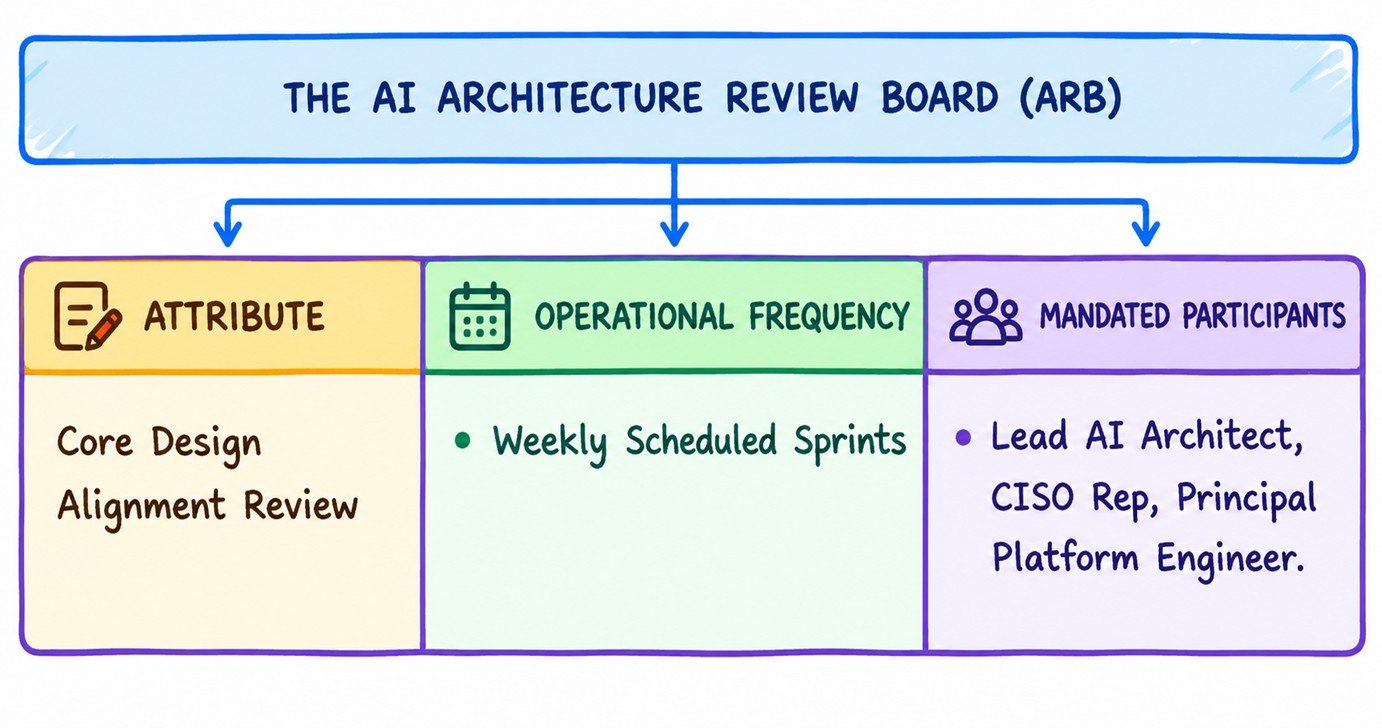
- Forum Objectives: The AI ARB reviews systemic integration blueprints submitted by product teams. It validates that spokes are natively leveraging the central platform's Semantic Cache, Gateway Firewalls, and Multi-tenant Vector Fabrics rather than standing up rogue shadow IT infrastructure.
- Review Criteria: No solution clears the ARB without proving its structural fallback compliance, documenting its prompt vulnerability defense metrics, and providing a verifiable token FinOps consumption forecast.
2.2 The Model & Tool Approval Forum
As the global open-weights and commercial model landscape shifts, the entry of raw foundation assets into the enterprise catalog must be strictly regulated.
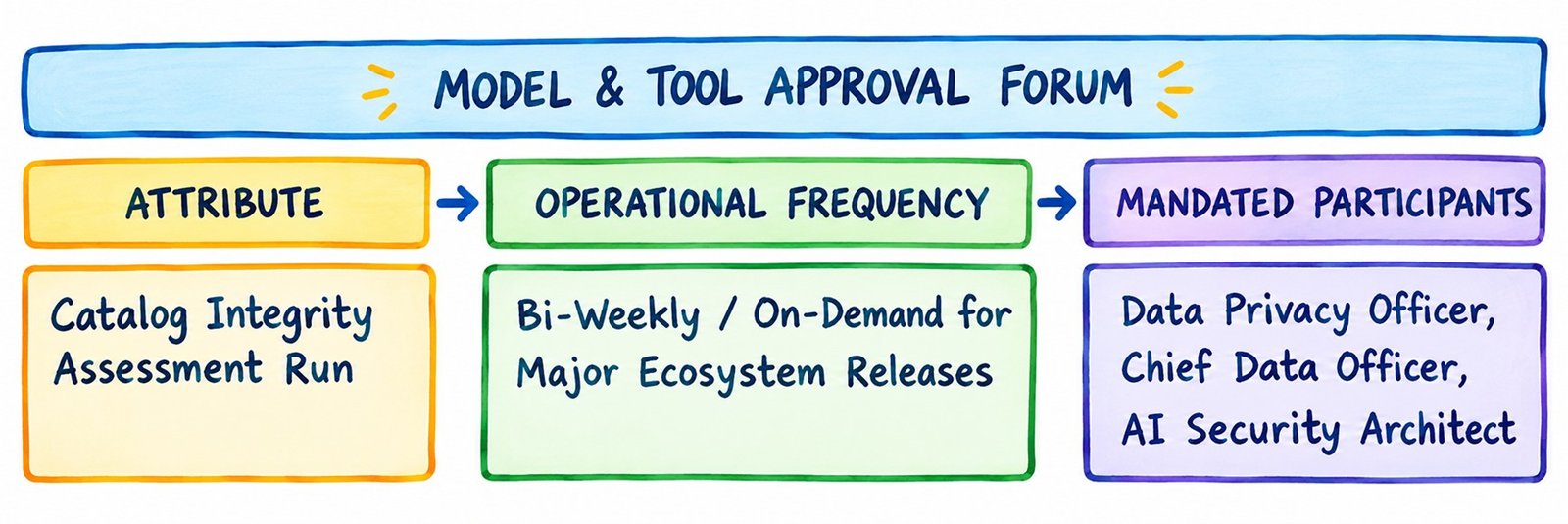
- Forum Objectives: This specialized body acts as the legal and risk gatekeeper for base model layers.
- Review Criteria: Models are cross-examined across three parameters: License Lineage Transparency (ensuring zero copyright contamination risk), Data Sovereign Isolation Fit (verifying data privacy boundaries do not leak data during external model execution runs), and Vulnerability Baselines (auditing weights for hidden backdoor vectors or data poisoning susceptibilities). Approved models receive a cryptographic signature and are added directly to the central Model Gateway Registry.
3. The Architectural Stage-Gate Framework (Mapped to TOGAF)
To ensure systemic compliance throughout the project development lifecycle, the AI Architecture function applies a rigid Stage-Gate Framework directly corresponding to the standard TOGAF ADM Phases.
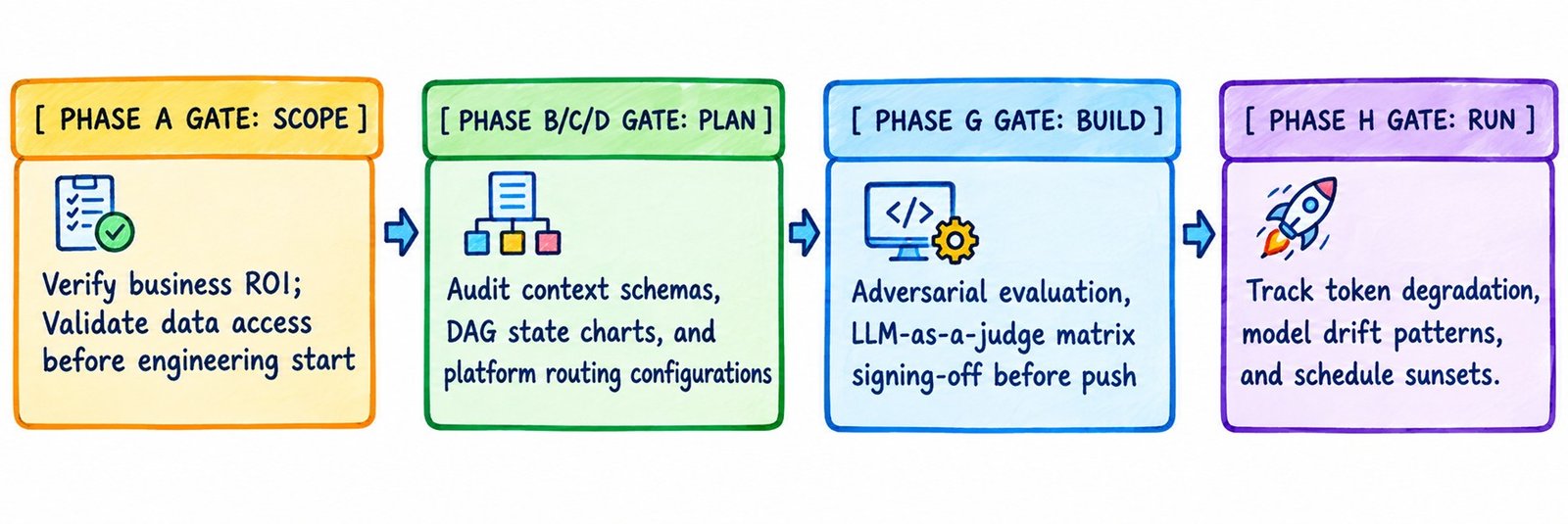
Stage-Gate 1: Phase A Validation (Scope & Concept)
- Review Objective: Before engineering teams write code, the project vision is rigorously screened to establish its strategic and architectural alignment.
- Mandated Artifact Deliverables: A completed AI Opportunity Assessment Matrix and a fully defined AI Product Vision Canvas.
- Governance Checkpoint: The architect verifies that the business case is grounded in objective metrics rather than speculative market hype. The team must prove that the project utilizes appropriate intelligence tiers and that the target source data is readily available for context fabric consumption. Any rejection at this initial checkpoint freezes the project charter, acting as an immediate upstream filter that increases the Spoke's Idea-to-Staging Time (ITS) metric, thereby enforcing architectural compliance early in the lifecycle.
Stage-Gate 2: Phase B, C, & D Validation (System Planning)
- Review Objective: Auditing the structural layout configuration of the solution components.
- Mandated Artifact Deliverables: System Topology Architecture Diagrams mapping interaction flows through the core Platform Ingress, Context Chunking schemas, and explicit Agent State Charts.
- Governance Checkpoint: The ARB verifies that the application completely avoids direct unconstrained autonomous loops. All workflow components must be bound to Directed Acyclic Graphs (DAGs) featuring hard-coded compliance thresholds and explicit Human-in-the-Loop (HITL) approval states for operations modifying data records.
Stage-Gate 3: Phase G Validation (Deployment Readiness)
- Review Objective: The final pre-production quality gate evaluates application code and pipeline orchestration before clearing promotion to the live environment.
- Mandated Artifact Deliverables: Automated CI/CD Regression Evaluation logs and signed AI PoC-to-Production Readiness Scorecards.
- Governance Checkpoint: The application is deployed into an isolated staging sandbox and executed against enterprise Golden Datasets. The independent LLM-as-a-Judge matrix must return a faithfulness score >= 0.95 and demonstrate absolute deflection of active prompt injection attacks through semantic firewall verification scripts before production promotion clearance is granted. Automated gate failures act as an infrastructural throttle, directly halting the pipeline and increasing the Spoke's Idea-to-Staging Time (ITS) metric until compliance errors are resolved.
Stage-Gate 4: Phase H Validation (Continuous Lifecycle Governance)
- Review Objective: Real-world operations and model retirement tracking.
- Mandated Artifact Deliverables: Production Metric Analytics Traces displaying live semantic drift distributions, token error frequencies, and updated Cost per Successful Task (CPST) graphs.
- Governance Checkpoint: The architecture office continuously tracks performance metrics. When production data indicates model degradation or when an external API vendor sets a deprecation timeline, Phase H protocols mandate automated failover route redirection, ensuring system continuity during core model lifecycle updates.
4. The Enterprise Architecture Review Matrix
To institutionalize these decisions, architects leverage structured definition frameworks to rate solution configurations and track compliance footprints across the enterprise.
4.1 Automated Architecture Compliance Blueprint (architecture_review_manifest.yaml)
This configuration schema defines the complete architectural metadata state of an application spoke, outlining its model dependency trees, storage topologies, and mandatory stage-gate clearance tokens.
# =====================================================================
# Enterprise AI Architecture Compliance Declaration Manifest
# =====================================================================
system_meta:
  application_spoke_id: "spoke-wealth-management-adviser"
  business_domain: "Retail Consumer Investment Services"
  lead_solutions_architect: "solutions-eng-lead-04"
  togaf_lifecycle_phase: "Phase-G-Implementation-Governance"

platform_dependency_alignment:
  ingress_gateway_enforced: true
  gateway_routing_policy: "tier-2-mid-tier-preferred"
  semantic_cache_enabled: true
  semantic_similarity_threshold: 0.95

context_data_topology:
  vector_store_cluster_identifier: "cluster-shared-enterprise-opensearch"
  index_namespace_isolation: "wealth-management-secure-tenant"
  access_control_lists_bound: true
  chunking_strategy_declared: "recursive-parent-child-tiered"

agent_orchestration_boundary:
  workflow_pattern: "directed-acyclic-graph-state-machine"
  autonomous_loop_allowed: false
  human_in_the_loop_states:
    - node_id: "state_execute_portfolio_allocation"
      approval_role: "licensed-wealth-adviser-role"
    - node_id: "state_dispatch_client_email"
      approval_role: "automated-compliance-verifier"

pre_production_evaluation_metrics:
  golden_dataset_version: "gd-wealth-v3.4"
  llm_judge_faithfulness_minimum_score: 0.96
  adversarial_injection_deflection_rate: 1.0
  target_cost_per_successful_task_ceiling: 0.15
Architectural Disclaimer
This architectural guide and its referenced governance review matrices are intended exclusively for educational and strategic enterprise planning purposes. Probabilistic computing paradigms introduce fluid interaction patterns, variable execution conditions, and changing token consumption economics that vary based on environmental parameters, prompt configurations, and underlying model behaviors. Implementing a formal architecture review board requires comprehensive legal, cybersecurity, data sovereignty, and financial compliance monitoring tailored to your specific organizational constraints and regional regulatory obligations.