AI Platform Engineering
Introduction
The ultimate point of failure for an enterprise Generative AI strategy is not a lack of data science talent or a shortage of foundation model access. The true point of failure is infrastructure friction. When an enterprise relies on federated product teams to independently integrate APIs, spin up vector databases, design custom prompt versioning systems, and build bespoke telemetry layers, the outcome is predictable: architectural fragmentation, unmitigated security vulnerabilities, and runaway token expenses.
For technology executives (CTOs, VPs of Engineering, and Enterprise Architects), the antidote to this fragmentation is AI Platform Engineering. The AI platform team operates as the core "Hub" within the enterprise target operating model, responsible for productizing an internal developer platform (IDP) that abstracts the complexities of probabilistic computing.
By treating intelligence as infrastructure, AI Platform Engineering lowers the activation energy of product delivery, enabling software teams to shift focus from low-level API orchestration to high-value domain logic.
1. The Core Architectural Subsystems
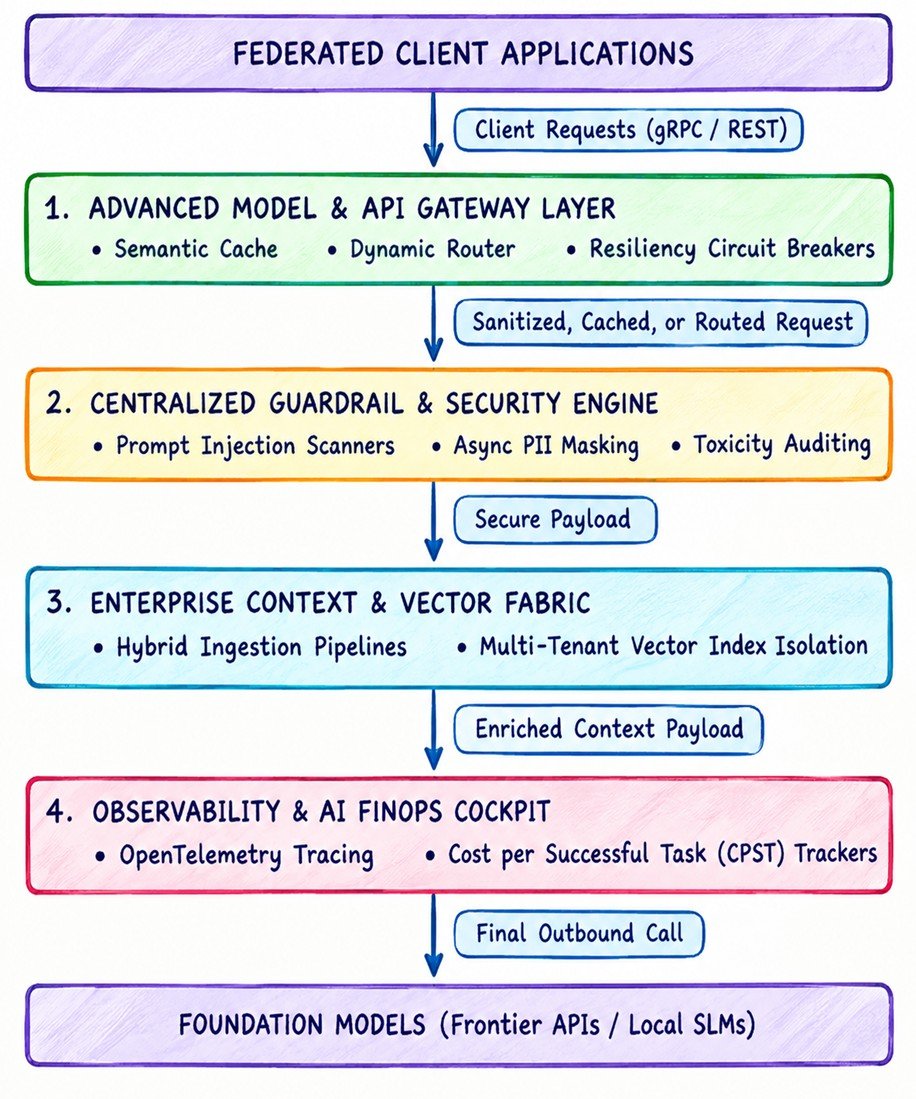
A production-grade Enterprise AI Platform is comprised of four decoupled, highly specialized subsystems. These layers sit between the federated application layer and the underlying foundation models, acting as a hardened, standardized, and secure intermediary runtime.
IMAGE-12-16
1.1 The Advanced Model & API Gateway Layer
The Model Gateway is the single entry point for all enterprise intelligence requests. It is built to solve three severe problems inherent to commercial model APIs: unpredictable latency spikes, vendor lock-in, and raw HTTP timeout vulnerabilities.
- Dynamic Multi-Model Routing: The gateway tracks the availability, latency, and token pricing of upstream endpoints in real time. It uses policy-driven routing rules to match incoming payloads to the most cost-effective tier capable of fulfilling the task, such as routing simple classification work to local Small Language Models while reserving heavy reasoning logic for commercial frontier APIs.
- Semantic Caching Mechanics: Traditional key-value caches fail in natural language environments due to textual variation. The Model Gateway addresses this by computing the mathematical vector embedding of incoming user strings. It stores historical query-response pairs inside a high-throughput memory database. When an incoming prompt matches a historical query within an acceptable cosine similarity threshold, such as ( \geq 0.96 ), the gateway instantly intercepts the call and serves the cached response, reducing latency to sub-10 milliseconds and cutting token expenses to zero.
- Resiliency and Circuit-Breaking: The gateway protects downstream consumers from upstream outages by enforcing exponential backoff with jitter, automated token bucket rate-limiting per consumer API key, and immediate circuit-breaking failover to secondary cloud zones or alternative model providers.
1.2 The Centralized Guardrail & Security Engine
Because large language models are susceptible to structural manipulation, a centralized, programmable verification layer must defend the enterprise boundary.
- Prompt Injection Scanners: The engine screens incoming text payloads for jailbreaks, system prompt overrides, and adversarial prompt injections before they reach the model orchestration layer.
- In-Flight PII Masking: Performs synchronous, inline interception to scrub sensitive entities like PII, PCI, and health data using deterministic placeholder tokens via stateful hashing before crossing the enterprise boundary. The proxy decodes hashes and re-injects original data upon token return.
- Input/Output Toxicity Compliance Auditing: Outbound completions generated by foundation models are checked for hallucination indicators, compliance failures, or toxic content before reaching consumer-facing frontends.
1.3 The Enterprise Context & Vector Fabric
An enterprise RAG system requires a foundational layer that can scale across billions of tokens while respecting strict organizational privacy boundaries.
- Hybrid Ingestion Pipelines: The fabric decouples file ingestion from the core application layer. It processes multi-format documents, including PDFs, corporate wikis, and database dumps, using decoupled consumers, applying advanced text layout extractors, metadata tagging, and customizable semantic chunking strategies.
- Multi-Tenant Vector Index Isolation: To prevent data exfiltration, the platform enforces strict isolation models at the vector layer. User identity contextual headers, such as JWT payloads, are bound to vector query definitions, ensuring that a user searching the database can only retrieve vector embeddings derived from source data they have explicit permissions to read in the primary system of record.
1.4 The Observability & AI FinOps Cockpit
Standard application performance monitoring (APM) systems cannot effectively capture the operational traits of probabilistic runtimes. The AI platform team replaces generic metrics with specialized tracking solutions.
- OpenTelemetry Tracing Integration: The platform tracks user queries across all middleware components, logging semantic database lookups, prompt template hydration runs, model execution times, and guardrail checks into unified trace graphs.
- AI FinOps Tracking (Cost per Successful Task): The platform attributes exact token counts and operational costs to specific client API keys. Crucially, it tracks Cost per Successful Task (CPST), filtering out expenses generated by network retries, system errors, or hallucinations rejected by output guardrails to give executives clear visibility into true AI product margins.
2. Infrastructure Comparison Matrix
Choosing the technical foundation for your internal platform requires evaluating the trade-offs between managed convenience, infrastructure scale, and operational control. The table below provides a comprehensive comparison of popular modern cloud architectures.
| Dimension | Option A: Native Cloud Ecosystem (e.g., AWS Bedrock + SageMaker + OpenSearch) | Option B: Cloud-Agnostic High-Scale Stack (e.g., Kubernetes + Triton Server + Qdrant) | Option C: Modern LLMOps Specialist Stack (e.g., Langfuse / LiteLLM + Pinecone) |
|---|---|---|---|
| Architectural Complexity | Low to Medium. Managed cloud control planes abstract underlying cluster operations. | Extremely High. Requires deep platform experience in container orchestration and GPU scheduling. | Low. Designed for maximum developer velocity with lightweight abstraction layers. |
| Vendor Dependency | Absolute. Applications are bound to cloud-specific IAM, KMS, and API architectures. | Zero. Fully portable across on-premises clusters, private clouds, and public infrastructures. | High. Bound to vendor software-as-a-service availability and pricing structures. |
| Throughput & GPU Control | Coarse-grained. Bound to cloud provider instance profiles and managed API queues. | Fine-grained. Dynamic memory batching, multi-instance GPU partitioning (MIG), and direct kernel tuning. | Low to Medium. Relies entirely on underlying foundation model cloud endpoints. |
| Data Privacy Boundaries | High. Inherits enterprise VPC compliance, PrivateLink connections, and regional boundaries. | Maximum. Complete control over memory states, data storage layouts, and network boundaries. | Variable. Requires thorough legal evaluation of data residency and multi-tenant hosting risks. |
| Optimal Enterprise Scale | Mid-Market to Large Enterprises seeking zero-infrastructure operational models. | Large-scale Enterprises executing hybrid strategies or running private, fine-tuned model deployments. | Rapid-growth startups or individual business units focusing on fast time-to-market. |
3. Prompts-as-Code (PaC) Infrastructure
One of the most dangerous anti-patterns in early AI engineering is hardcoding system prompts directly inside application code repositories or treating them as static configuration strings. Prompts are executable code blocks that dictate the functional runtime of a probabilistic engine. They must be decoupled from application software files and managed with strict software engineering discipline.
Prompts-as-Code (PaC) is the architectural paradigm where system instructions, few-shot examples, and output schemas are treated as structured configuration files managed inside version-controlled repositories, tested via continuous integration pipelines, and deployed independently of the application layer.
3.1 The Prompts-as-Code Lifecycle Pipeline
IMAGE-12-17
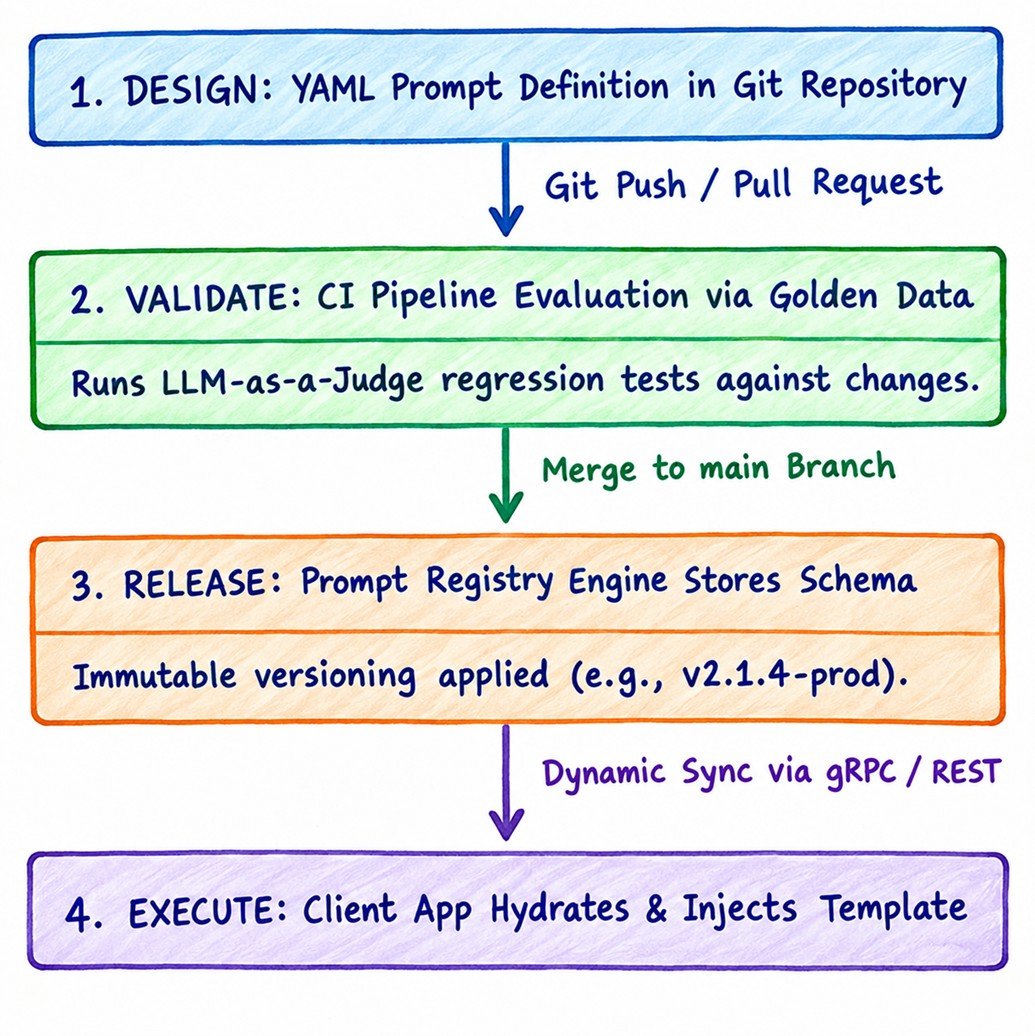
- Design & Declare: Platform and domain teams write system prompt templates inside version-controlled YAML files, defining strict schema types for variable injections.
- Validate & Test: A Pull Request triggers a CI pipeline that runs regression evaluations using Golden Datasets and LLM-as-a-Judge scoring matrices to ensure modifications do not introduce regressions.
- Release & Store: Merged changes are automatically pushed to an enterprise central Prompt Registry engine, generating an immutable semantic version identifier, such as
v2.1.4. - Execute & Hydrate: Client applications request the prompt by its unique key and version string. The platform registry streams the raw template, which is hydrated with real-time runtime variables before execution.
4. Engineering Blueprints & Configurations
To translate these concepts into a production-grade implementation, the platform team provides explicit configuration files and proxy execution software blueprints.
4.1 Prompt-as-Code Structural Blueprint (customer_onboarding.yaml)
This configuration file defines an immutable system prompt version, complete with structured variable definitions, model constraints, and expected output parsing schemas.
meta:
  prompt_key: "enterprise.customer.onboarding_agent"
  version: "2.1.4"
  author: "AI-CoE-Platform-Team"
  description: "Core intake validation agent for processing institutional client accounts."
  model_constraints:
    recommended_min_tier: "tier-2-mid-tier"
    temperature: 0.0
    max_tokens: 1024

system_instruction: |
  You are an expert institutional account onboarding agent representing the enterprise.
  Your primary objective is to review incoming customer intake notes and extract verified
  organizational entities while validating regulatory compliance alignment.

  CRITICAL ENFORCEMENT RULES:
  1. Only evaluate the unstructured text block provided in the {{ client_payload }} variable.
  2. Do not infer details not explicitly stated. If data points are missing, flag them as null.
  3. Ensure your response adheres strictly to the JSON schema defined below.

variables:
  - name: "client_payload"
    type: "string"
    required: true
  - name: "compliance_region"
    type: "string"
    required: true

output_format:
  type: "json_object"
  schema:
    type: object
    properties:
      organization_name:
        type: string
      tax_identifier:
        type: string
      is_compliant:
        type: boolean
      missing_fields:
        type: array
        items:
          type: string
    required: ["organization_name", "tax_identifier", "is_compliant"]
4.2 Model Gateway Reverse-Proxy Blueprint (gateway_proxy.py)
The following Python script provides a concrete runtime implementation of an enterprise API Gateway proxy. It demonstrates the technical orchestration of Semantic Firewall integration, Semantic Caching, and Resiliency-Driven Multi-Model Failover Routing.
import os
import json
import logging
import numpy as np
from typing import Dict, Any, Optional

# Mocking Enterprise SDK Interfaces for Architectural Demonstration
class SemanticCacheEngine:
    """Evaluates vector similarity of inputs against historical transaction records."""

    def lookup(self, text: str) -> Optional[str]:
        # Implementation checks corporate vector store index
        # Returns cached string completion if Cosine Similarity >= 0.96
        return None

    def store(self, query: str, response: str) -> None:
        pass


class SemanticFirewall:
    """Scans structural prompt strings for malicious injections or policy violations."""

    def inspect(self, text: str) -> bool:
        # Returns True if the prompt is clean, False if it violates security constraints
        if "ignore your previous instructions" in text.lower():
            return False
        return True


class FrontierProviderClient:
    """Primary Enterprise Model Provider API Client Interface."""

    def generate(self, prompt: str) -> str:
        # Simulates primary cloud model execution layer
        return json.dumps({
            "organization_name": "Acme Corp",
            "tax_identifier": "12-34567",
            "is_compliant": True
        })


class SecondaryFallbackProviderClient:
    """Alternative Model Provider API Client Interface invoked during primary failure."""

    def generate(self, prompt: str) -> str:
        return json.dumps({
            "organization_name": "Acme Corp",
            "tax_identifier": "12-34567",
            "is_compliant": True,
            "source": "fallback"
        })


class EnterpriseModelGatewayProxy:
    def __init__(self):
        self.cache = SemanticCacheEngine()
        self.firewall = SemanticFirewall()
        self.primary_provider = FrontierProviderClient()
        self.fallback_provider = SecondaryFallbackProviderClient()
        self.logger = logging.getLogger("EnterpriseAIPlatformGateway")

    def execute_inference_pipeline(
        self,
        request_payload: Dict[str, Any]
    ) -> Dict[str, Any]:
        """
        Executes safe, optimized, and resilient inference across the
        enterprise platform fabric.
        """
        user_prompt = request_payload.get("prompt", "")
        client_id = request_payload.get("client_id", "anonymous")

        # 1. Enforcement of Centralized Security Edge Guardrails
        if not self.firewall.inspect(user_prompt):
            self.logger.warning(
                f"Security Alert: Blocked prompt injection attack vector "
                f"from client: {client_id}"
            )
            return {
                "status": "error",
                "error_code": "SECURITY_VIOLATION",
                "message": (
                    "The incoming payload violated corporate security "
                    "and alignment policies."
                )
            }

        # 2. High-Velocity Interception via Semantic Cache Lookup
        cached_completion = self.cache.lookup(user_prompt)

        if cached_completion:
            self.logger.info(
                f"FinOps Optimization: Semantic Cache Hit for client: "
                f"{client_id}. Token cost: $0.00"
            )
            return {
                "status": "success",
                "source": "semantic_cache",
                "completion": json.loads(cached_completion)
            }

        # 3. Dynamic Inference Run Execution with Resilient Automated Failover Routing
        try:
            self.logger.info(
                f"Routing request from client {client_id} "
                f"to primary frontier endpoint."
            )

            raw_completion = self.primary_provider.generate(user_prompt)

            # Persist successfully generated response to cache
            # for downstream optimization.
            self.cache.store(user_prompt, raw_completion)

            return {
                "status": "success",
                "source": "primary_frontier_model",
                "completion": json.loads(raw_completion)
            }

        except Exception as primary_exception:
            self.logger.error(
                f"Primary endpoint failure: {str(primary_exception)}. "
                "Triggering failover circuit breaker."
            )

            try:
                # Execution switches immediately to decoupled backup
                # engine infrastructure.
                raw_fallback_completion = self.fallback_provider.generate(
                    user_prompt
                )

                return {
                    "status": "success",
                    "source": "fallback_provider_endpoint",
                    "completion": json.loads(raw_fallback_completion)
                }

            except Exception as secondary_exception:
                self.logger.critical(
                    f"System Degradation: High-level failure on all "
                    f"upstream model infrastructure: {str(secondary_exception)}"
                )

                return {
                    "status": "failure",
                    "error_code": "UPSTREAM_INFRASTRUCTURE_UNAVAILABLE",
                    "message": (
                        "All coordinated computing clusters failed to fulfill "
                        "the request. Escalating to SRE telemetry cockpits."
                    )
                }


# Demonstration Execution Trigger
if __name__ == "__main__":
    logging.basicConfig(level=logging.INFO)

    gateway = EnterpriseModelGatewayProxy()

    sample_request = {
        "client_id": "institutional-wealth-onboarding",
        "prompt": (
            "Extract entity details for Acme Corp, Tax ID 12-34567, "
            "clear compliance review."
        )
    }

    response = gateway.execute_inference_pipeline(sample_request)
    print(json.dumps(response, indent=2))
5. The AI Platform Reference Architecture Diagram
To ground these systems in a clear execution model, enterprise architects must establish a unified structural topology. The following diagram illustrates the flow of synchronous and asynchronous traffic through the internal platform fabric, detailing how a federated client application interacts with the platform layers down to the underlying compute infrastructure.
[ FEDERATED CLIENT APPLICATION LAYER ]
  │
  ├─── User Interface (React / Mobile App / Web Widget)
  ├─── Federated Spoke microservice (gRPC / REST Client)
  │
  ▼  (Ingress Traffic via API Gateway Endpoint)
┌──────────────────────────────────────────────────────────────────────────────┐
│                  AI PLATFORM INGRESS & ABSTRACTION FABRIC              │
├──────────────────────────────────────────────────────────────────────────────┤
│  [ Enterprise API Gateway ]                                                  │
│    │── Transport Layer Security (TLS 1.3 termination)                        │
│    │── OAuth2 / OIDC Identity Validation & IAM Entitlement Context Filters   │
│    └── Rate Limiter (Token-Bucket Throttle per Client API Key)               │
└──────┬───────────────────────────────────────────────────────────────────────┘
       │
       ▼  (Authenticated Request Context)
┌──────────────────────────────────────────────────────────────────────────────┐
│                    SYNCHRONOUS COMPUTE RUNTIME PROXY                         │
├──────────────────────────────────────────────────────────────────────────────┤
│  [ Semantic Cache Engine ]                                                   │
│    ├── Text-to-Embedding Encoder (Fast Edge Model)                           │
│    └── High-Throughput Memory store Similarity Match Lookups                 │
│          ├── Cache Hit  ──> [Instantly Return Stored Output Response Data]   │
│          └── Cache Miss ──> [Forward Payload to Firewall Processing]         │
│                                   │                                          |
│  ┌────────────────────────────────▼──────────────────────────────────────┐   │
│  │ [ Centralized Guardrail & Security Engine ]                           │   │
│  │   ├── Prompt Injection Signature Scanners                             │   │
│  │   ├── Asynchronous Input PII & Sensitive Entity Masking Processor     │   │
│  │   └── Regulatory Adherence and Compliance Policy Interceptor          │   │
│  └────────────────────────────────┬──────────────────────────────────────┘   │
│                                   │                                          |
│  ┌────────────────────────────────▼──────────────────────────────────────┐   │
│  │ [ Prompt Engine & Hydration Manager ]                                 │   │
│  │   ├── Prompts-as-Code (PaC) Immutable Scheme Downloader               │   │
│  │   └── Variable Injection & System Instruction Hydration Assembly      │   │
│  └────────────────────────────────┬──────────────────────────────────────┘   │
└───────────────────────────────────┼───────────────────────────────────────── ┘
                                    │
                                    ▼  (Secure Context-Ready Payload)
┌──────────────────────────────────────────────────────────────────────────────┐
│                     CONTEXT RETRIEVAL & VECTOR MATRIX                        │
├──────────────────────────────────────────────────────────────────────────────┤
│  [ Enterprise Context & Vector Fabric ]                                      │
│    ├── Multi-Tenant Vector Index Isolation Filter                            │
│    ├── Semantic Distance Query Engine (Cosine Similarity / Dot Product)      │
│    └── Reranking Accelerator Node (Cross-Encoder Output Optimization)        │
└──────┬───────────────────────────────────────────────────────────────────────┘
       │
       ▼  (Enriched Prompt Template: Context + Sanitized Input)
┌──────────────────────────────────────────────────────────────────────────────┐
│                 DYNAMIC MODEL ROUTING & RESILIENCY ENGINE                    │
├──────────────────────────────────────────────────────────────────────────────┤
│  [ Resilient Multi-Model Dynamic Router ]                                    │
│    ├── Real-Time Upstream Endpoint Latency and Availability Tracker          │
│    ├── Active Circuit-Breaker State Controllers                              │
│    └── Cost-Optimization Allocation Engine (SLM vs. Frontier LLM Routing)    │
└──────┬──────────────────┬──────────────────┬─────────────────────────────────┘
       │                  │                  │
       ▼ (Route Tier 1)   ▼ (Route Tier 2)   ▼ (Route Tier 3)
┌────────────────┐ ┌────────────────┐ ┌────────────────────────────────────────┐
│  LOCAL COMPUTE │ │ CLOUD HOSTED   │ │ COMMERCIAL FRONTIER APIs               │
│  INFERENCE     │ │ ENTERPRISE LLMs│ │ (Contractually Isolated Multi-Tenant)  │
│  (Private SLM) │ │ (Private Node) │ │                                        │
│  [vLLM Core /  │ │ [Triton Cluster│ │ [ frontier-reasoning-endpoint ]        │
│   Ollama Node] │ │  AWS/Azure]    │ │ [ frontier-vision-endpoint ]           │
└──────┬─────────┘ └──────┬─────────┘ └──────┬─────────────────────────────────┘
       │                  │                  │
       └──────────────────┼──────────────────┘
                          │
                          ▼  (Raw Unstructured Token Stream)
┌──────────────────────────────────────────────────────────────────────────────┐
│                  EGRESS PROCESSING & TELEMETRY SYSTEMS                       │
├──────────────────────────────────────────────────────────────────────────────┤
│  [ Guardrail Engine: Output Inspector ]                                      │
│    ├── Toxicity & Bias Detection Scanners                                    │
│    ├── Asynchronous Entity De-masking (Re-injecting original data values)    │
│    └── Hallucination Metric Verification Node                                │
│                                                                              │
│  [ Observability & FinOps Analyzer Cockpit ]                                 │
│    ├── OpenTelemetry distributed span generator                              │
│    ├── Ingress/Egress Token Tracker Matrix Logging                           │
│    └── Cost per Successful Task (CPST) Accounting Database                   │
└──────┬───────────────────────────────────────────────────────────────────────┘
       │
       ▼  (Hardened, Traced, and Validated Application JSON)
[ RETURN TRANSACTION DESCRIPTOR TO CLIENT INTERFACE ]
Subsystem Execution Flow Breakdown
To fully interpret the reference architecture topology, the operational flow must be analyzed across three clear systemic boundaries:
- The Ingress Protection Path: When a client application submits a request, it enters through the AI Platform Ingress & Abstraction Fabric. The Enterprise API Gateway handles structural verification, checking identity authentication and validating caller tokens to enforce corporate rate-limiting policies before parsing the string data payload down to the compute proxies.
- The Runtime Optimization and Enrichment Loop: Once inside the proxy, the system attempts to resolve the request via the Semantic Cache Engine to avoid unnecessary downstream costs. If a cache miss occurs, the query runs through the Centralized Guardrail & Security Engine to catch jailbreaks or mask sensitive data. The sanitized variables are then merged with the immutable template fetched from the Prompts-as-Code Registry. The Vector Fabric extracts relevant internal documents using identity isolation filters to build the final enriched context payload.
- The Egress Resilience and Accounting Architecture: The Dynamic Router evaluates cloud endpoint status and sends the request to the most cost-effective tier capable of handling the task. When the chosen model finishes generating tokens, the output goes through the Egress Processing Systems. This step runs safety screening, swaps placeholder tokens back to their original values, and logs the transaction details to the Observability and FinOps Cockpit to calculate exact corporate operational costs before returning the finalized response to the user application.
6. Platform Infrastructure Provisioning & Lifecycle Management
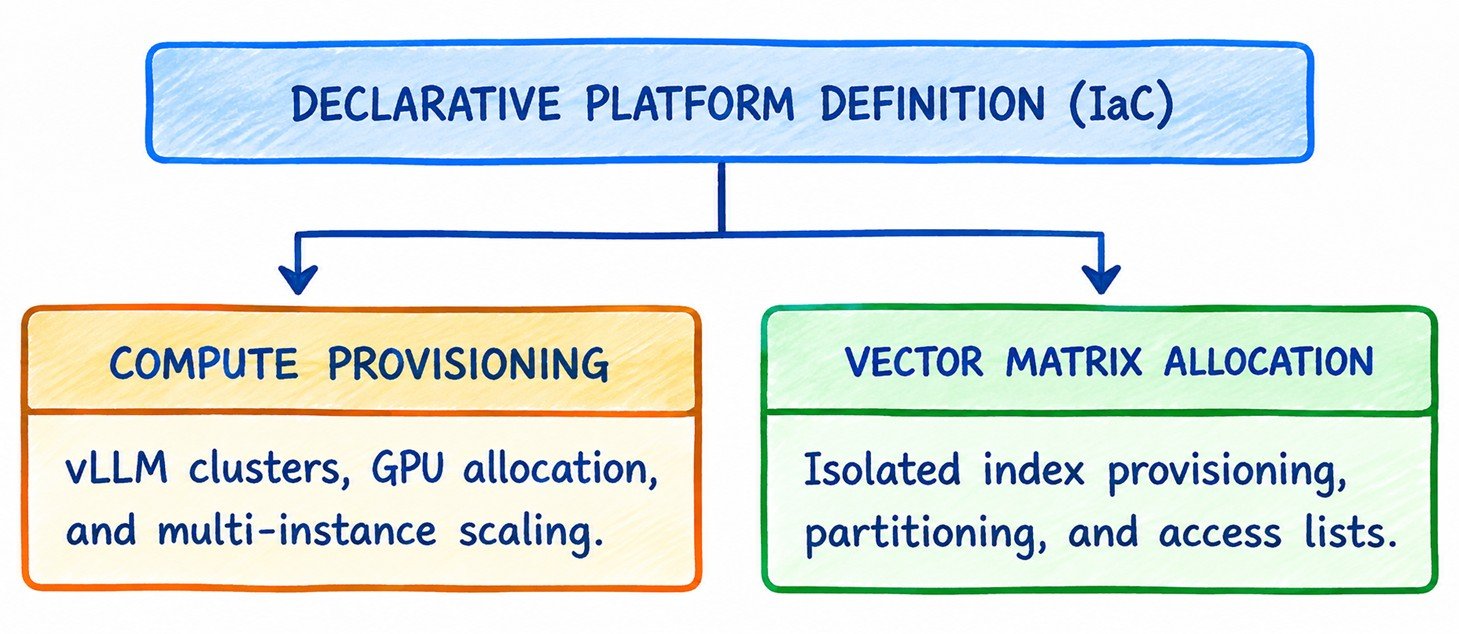
Managing an enterprise AI platform requires moving away from manual configuration dashboards and treating every asset, including model weights, vector indexes, semantic firewall rules, and prompt configurations, as software components. The AI Platform Engineering team applies the core discipline of Infrastructure as Code (IaC) to probabilistic systems, defining the platform's state through declarative configuration files managed inside version-controlled repositories.
IMAGE-12-19
Declarative Resource Orchestration
The platform team uses orchestration tools, such as Terraform or cloud-native resource definitions, to automate the deployment of the entire runtime footprint. This blueprinting ensures that environment setups, including Development, Staging, and Production, remain consistent across the enterprise, preventing configuration drift from introducing subtle performance variations in downstream applications.
- Compute Cluster Provisioning: Automating the setup of auto-scaling container groups, such as vLLM or Triton Inference Server nodes running on Kubernetes, managed by GPU scheduling rules.
- Vector Matrix Provisioning: Declaratively creating collections, partitioning schemas, and security access control lists (ACLs) within the enterprise vector infrastructure.
The Model Lifecycle Pipeline: Deprecation and Promotion
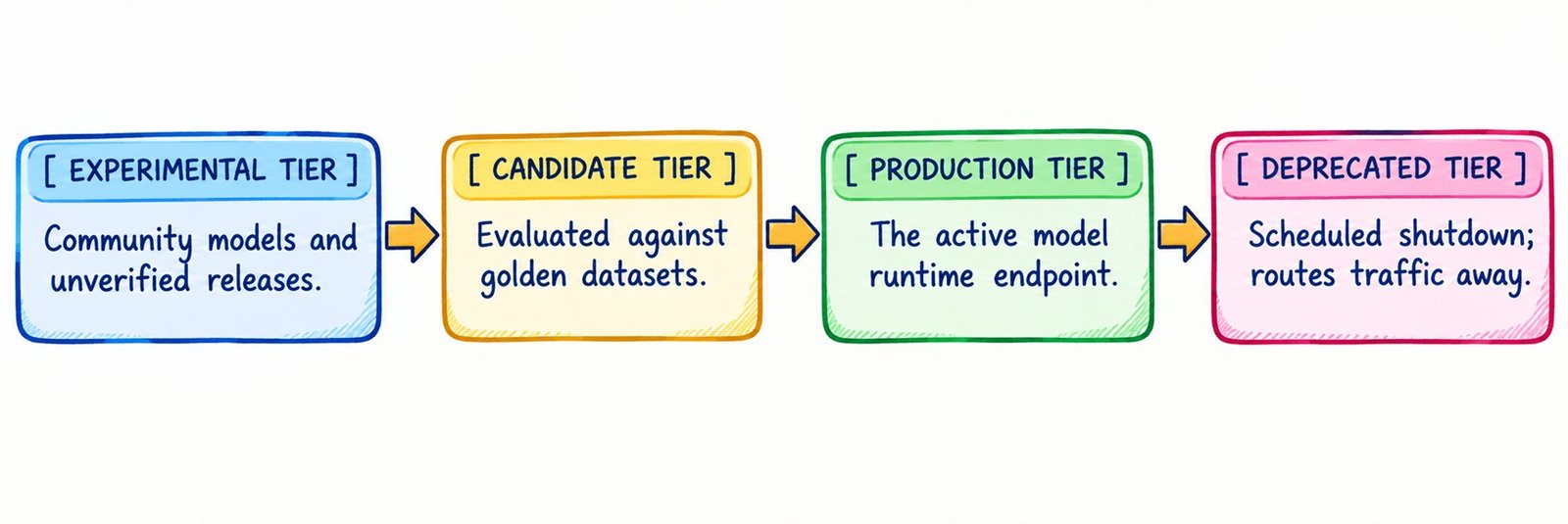
Foundation models do not remain static. Cloud providers deprecate older versions, and open-weight models are updated frequently. To prevent these changes from breaking production applications, the platform team enforces a structured, four-tier model lifecycle:
IMAGE-12-20
-
Experimental Tier: New models or community releases are made available in a sandboxed environment for exploratory testing by federated data teams.
-
Candidate Tier: Models undergoing promotion are subjected to automated evaluation suites running across the platform's Golden Datasets. The model must match or exceed the performance benchmarks of the current production model across accuracy, safety, latency, and token economics before it can be approved for promotion.
-
Production Tier: The model is registered as an active runtime endpoint within the Model Gateway. Traffic routing rules are updated transparently via blue-green deployment strategies, shielding application teams from underlying endpoint configuration changes.
-
Deprecated Tier: When a model reaches its end-of-life, the gateway triggers warning headers to consumer applications, updates platform metrics trackers, and schedules a definitive sunset date. If an application fails to migrate before the deadline, the gateway's routing controller uses predefined fallback rules to redirect requests to an equivalent modern model tier, preventing system-wide hard failures.
Architectural Disclaimer
This architectural guide and its referenced configuration blueprints are intended exclusively for educational and strategic planning purposes. Generative AI runtimes introduce complex, non-deterministic behaviors that vary based on environmental data context, model versioning shifts, and downstream dependencies. Implementing an internal developer platform requires extensive, independent data protection audits, rigorous network penetration scanning, and comprehensive financial validation tailored to your specific organizational compliance requirements and infrastructure conditions.