Centralized vs. Federated AI Organizations
Introduction
As an enterprise scales past its first handful of successful Generative AI Proofs of Concept (PoCs), the structural cracks in the organization inevitably begin to show. The core architectural challenge shifts from technical feasibility to structural execution: How should the enterprise organize its talent, platform assets, and governance frameworks to maximize AI throughput while minimizing architectural divergence, risk, and runaway unit economics?
Technology leaders are routinely forced into an artificial, binary choice: build a highly centralized AI powerhouse that guarantees compliance but stifles business unit (BU) agility, or allow a completely federated, wild-west ecosystem where BUs move at lightning speed but duplicate infrastructure, fracture the enterprise data estate, and create systemic risk.
For the modern enterprise, both extremes represent architectural failure modes. This section provides an opinionated, production-tested framework for resolving this tension, mapping organizational topologies directly to platform ownership models and the TOGAF 10 Architecture Development Method (ADM).
1. The Core Topologies: Structural and Economic Trade-offs
To architect a sustainable operating model, leaders must first understand the structural, financial, and operational trade-offs inherent in pure centralized and pure federated organizational boundaries.
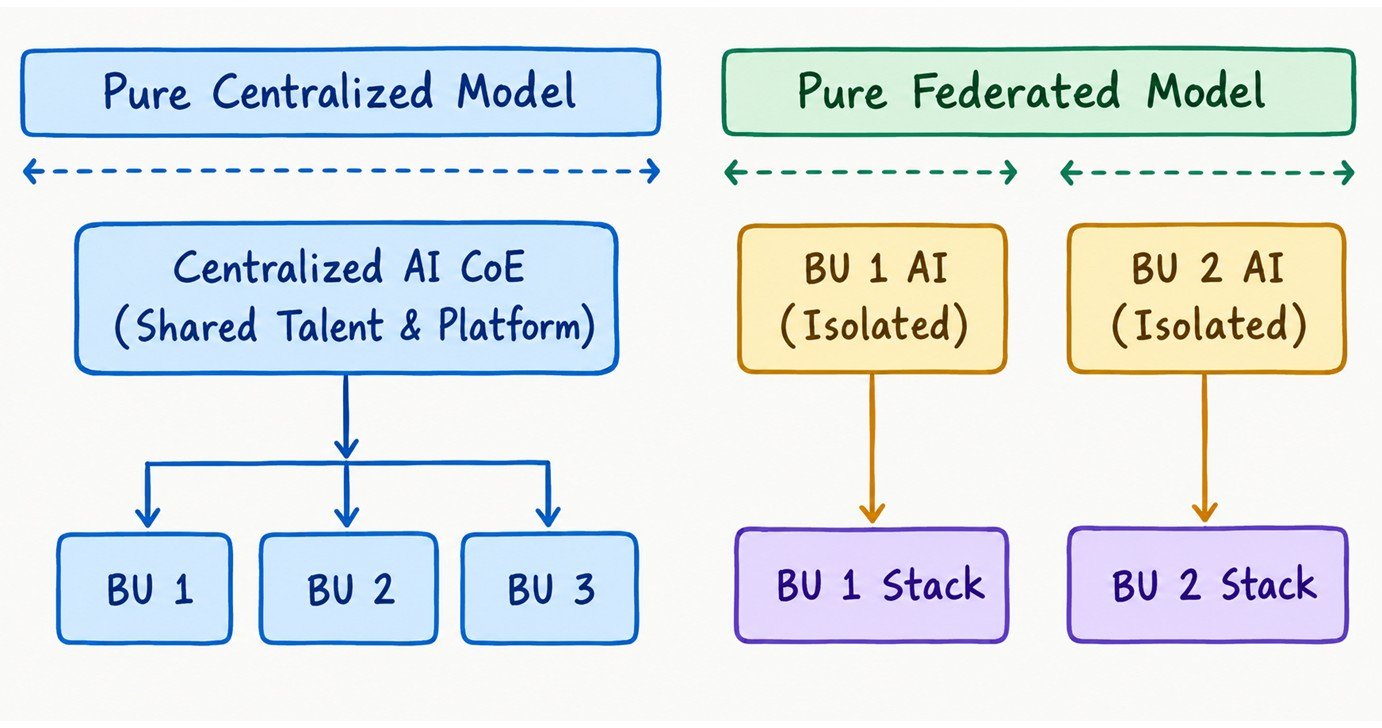
The Centralized AI Organization
In a pure centralized topology, a single, monolithic AI Center of Excellence (CoE) owns all data engineering, data science, ML/LLM engineering, and platform infrastructure. Business units function strictly as internal clients, submitting requests to a centralized queue.
- Structural Mechanics: All specialized AI talent is pooled under one organizational umbrella. BUs provide domain expertise during the discovery phase, but execution is entirely managed by the core team.
- Platform Ownership: The core platform infrastructure, including model gateways, vector databases, guardrail engines, and observability pipelines, is fully single-tenant or logically partitioned multi-tenant, completely managed by the central team.
- Economic Footprint: High upfront capital expenditure (CapEx) to establish the core capability, balanced by highly optimized operational expenditure (OpEx) driven by centralized semantic caching, bulk token purchasing discounts, and zero architectural duplication.
- Failure Modes: The central CoE rapidly becomes a chronic operational bottleneck. Lacking deep business-context domain knowledge, the central team often delivers technically sound but commercially irrelevant systems.
The Federated AI Organization
A pure federated topology distributes all autonomy, engineering capacity, and budget directly to individual business units or product lines.
- Structural Mechanics: Each BU hires its own embedded data scientists, prompt engineers, and software developers. The central IT organization is relegated to a basic cloud infrastructure provider, exercising minimal oversight over how AI workloads are engineered.
- Platform Ownership: Decentralized and fragmented. BUs independently spin up distinct, isolated instances of AI platforms, often selecting completely different vector databases, orchestration frameworks (e.g., one BU standardizes on LangChain, another on LlamaIndex), and model providers.
- Economic Footprint: Low friction and negligible upfront enterprise cost, leading to an initial explosion of localized PoCs. However, this is rapidly followed by exponential, hidden OpEx scaling driven by duplicated platform components, unoptimized RAG pipelines, and fragmented model API billing across the enterprise.
- Failure Modes: Rapid architectural divergence. The organization suffers from catastrophic "shadow AI," data exfiltration via unsecured endpoints, severe regulatory compliance exposure, and a complete inability to reuse data embeddings or semantic assets across organizational silos.
Comparative Architectural Matrix
| Dimension | Pure Centralized Topology | Pure Federated Topology |
|---|---|---|
| Velocity to First PoC | Slow (governed by central intake queues) | Ultra-Fast (no centralized dependencies) |
| Velocity to Production Scale | Moderate (stalled by BU context alignment) | Extremely Slow for compliant deployments (stalled by late-stage security audits), or highly volatile due to catastrophic Shadow AI exposure |
| Token & FinOps Efficiency | High (global semantic caching, pooled quotas) | Low (isolated billing, duplicated calls, zero cache sharing) |
| Architectural Drift | Zero (strict adherence to monolithic standard) | High (fragmented stacks, tooling sprawl, custom wrappers) |
| Data Ingestion & RAG Risk | Low (centralized governance of data lakes) | High (isolated, unvetted data stores, compliance drift) |
| BU Context Integration | Superficial (detached from day-to-day operations) | Deep (fully integrated into domain workflows) |
2. The North Star Recommendation: The Federated Hub-and-Spoke Model
For enterprises operating at scale, the strategic objective is clear: maximize decentralized execution velocity while maintaining centralized architectural control, compliance, and economic leverage.
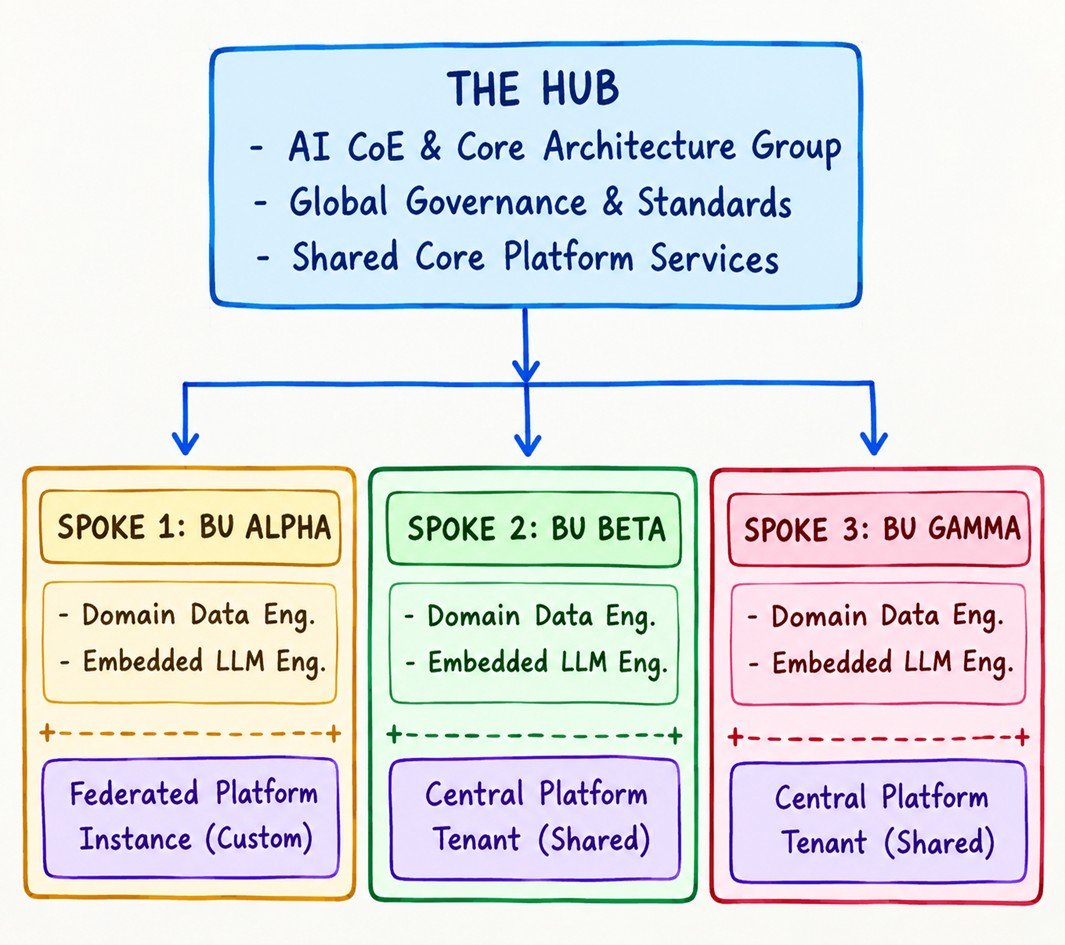
The optimal operational architecture to achieve this is the Federated Hub-and-Spoke Model. In this model, the Hub acts as the strategic, architectural, and governance engine, while the Spokes function as highly autonomous, cross-functional execution units embedded directly within the business lines.
The Mechanics of the Hub
The Hub is not an execution bottleneck; it is an enabling foundation. It is staffed by Enterprise Solution Architects, Chief Data Officers, Principal AI Engineers, and Security and Compliance leads. The Hub is strictly responsible for:
- Defining the AI Architectural North Star Blueprint.
- Negotiating global foundation model provider contracts and managing enterprise-wide API tier routing.
- Building and exposing Shared Core Platform Services (e.g., global telemetry endpoints, centralized compliance and safety guardrail models, enterprise knowledge graphs).
- Defining standard evaluation frameworks and maintaining the enterprise "Golden Datasets" used for baseline regression testing.
The Mechanics of the Spokes
Each Spoke represents a dedicated business unit or product organization (e.g., Risk Management, Customer Experience, Supply Chain). Spokes are fully funded by their respective business lines and contain dedicated product managers, embedded LLM engineers, application developers, and data engineers. The Spokes are responsible for:
- Owning the application lifecycle from ideation to production.
- Building and orchestrating domain-specific agent architectures and context-specific RAG pipelines.
- Managing localized business logic and human-in-the-loop interface paradigms.
Dynamic Platform Ownership: Centralized Tenants vs. Federated Instances
Unlike traditional IT models where the software platform is strictly centralized, the Federated Hub-and-Spoke model introduces an adaptable approach to platform infrastructure.
Depending on maturity, scale, and data residency constraints, a Spoke can choose one of two consumption models:
1. Central Platform Tenant (Shared-Services Model)
The Spoke consumes the Enterprise AI Platform as a fully managed multi-tenant SaaS. The Hub provisions a dedicated namespace, providing the Spoke with out-of-the-box access to model gateways, vector databases, and prompt management tools. This is ideal for standard business workflows and teams requiring rapid deployment with minimal operational overhead.
2. Federated Platform Instance (Sovereign/Decentralized Model)
When a business unit faces extreme latency, heavy data processing throughput, or strict regulatory/sovereign data constraints (e.g., processing sensitive clinical trials or cross-border financial transactions), the Hub permits the Spoke to spin up its own federated instance of the AI platform.
Under this model, the Spoke deploys the core platform infrastructure into its own isolated cloud VPC or on-premises environment. However, this sovereignty is tightly bounded by an immutable architectural constraint: The federated platform instance must implement the exact configuration manifests, base images, and API compliance contracts mandated by the Hub. It must stream all telemetry back to the Hub's global observability engine and route traffic through the Hub's global guardrail policies.
3. TOGAF 10 ADM Integration: Governing Centralized vs. Federated Boundaries
To prevent the Federated Hub-and-Spoke model from decaying into chaotic fragmentation, the organizational boundaries must be explicitly anchored into the enterprise's architectural lifecycle. The TOGAF 10 Architecture Development Method (ADM) provides the exact formal mechanism required to govern this tension, ensuring compliance without stalling innovation.
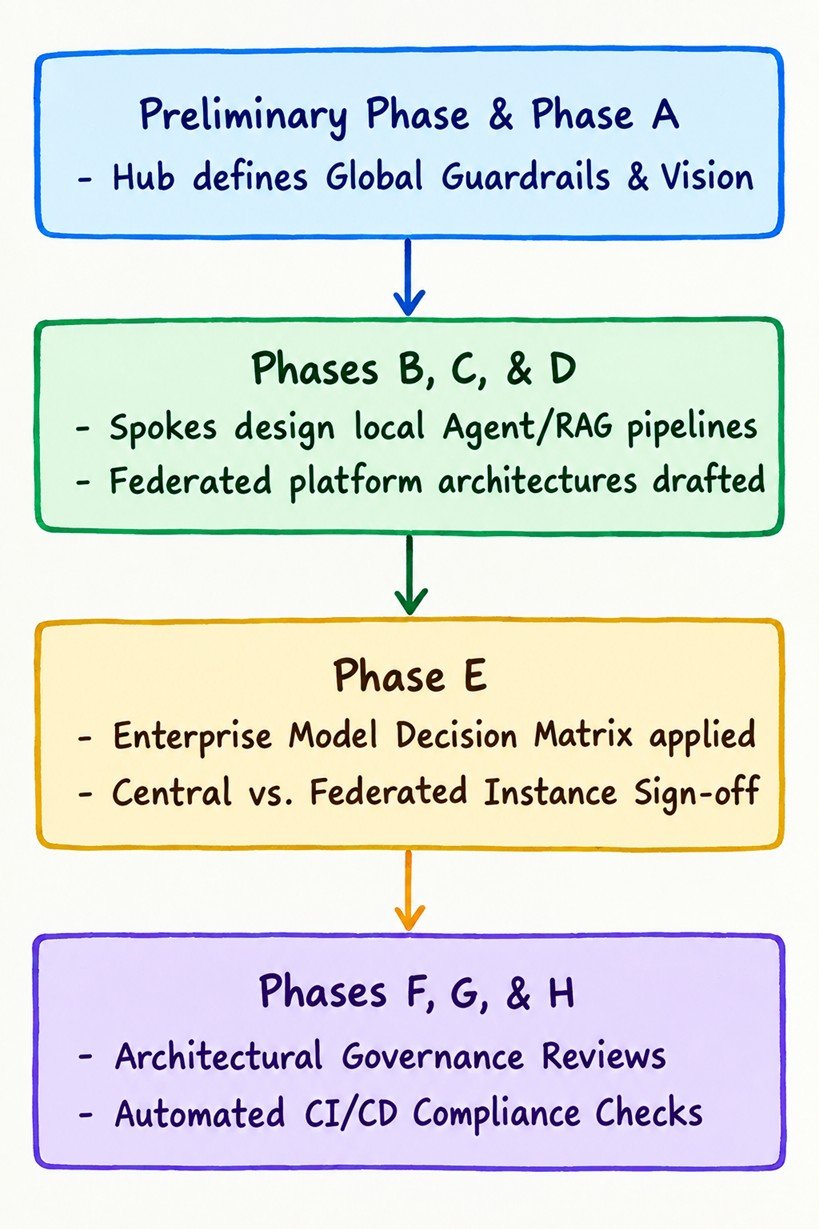
Preliminary Phase & Phase A (Architecture Vision)
- The Boundary Line: The Hub defines the global baseline. It establishes the enterprise-wide principles for probabilistic systems, data privacy baselines, and acceptable risk classifications.
- Governance Application: Any Spoke initiating an AI project must align its Statement of Architecture Work with the overarching AI Architectural North Star. Phase A ensures that the Spoke explicitly states whether it will consume the Central Platform Tenant or requires a Federated Platform Instance based on clear business criteria.
Phases B, C, & D (Business, Information Systems, and Technology Architectures)
- The Boundary Line: Spokes own the detailed design of their local business architectures, localized data schemas, and application integrations. The Hub provides reusable building blocks (Architecture Building Blocks - ABBs) such as standardized model API wrappers, reference chunking patterns, and base vector infrastructure templates.
- Governance Application: If a Spoke chooses a Federated Platform Instance, its Phase D (Technology Architecture) must comprehensively prove that its localized infrastructure topology maps identically to the Hub's AI Reliability & Observability Reference Architecture. The data architectures developed in Phase C must demonstrate compliance with enterprise-wide data governance, labeling, and lineage patterns.
Phase E (Opportunities & Solutions)
- The Boundary Line: This is where the structural "make vs. buy" and "central vs. federated" determinations are codified. The Spoke utilizes the Hub's Enterprise Model & Intelligence Decision Matrix to determine whether its use case warrants fine-tuning an isolated open-source model within its federated instance, or whether it should consume frontier models routed via the Hub's central gateway.
- Governance Application: The Hub's Architecture Review Board evaluates the Spoke's proposed Solution Building Blocks (SBBs). If the Spoke is building a federated platform instance, it must submit its infrastructure-as-code (IaC) manifests to the Hub for structural verification.
Phases F & G (Migration Planning & Implementation Governance)
- The Boundary Line: Spokes retain absolute execution ownership over localized production deployments. The Central Hub governs the integrity of the delivery pipeline through automated architectural compliance gates embedded directly into the enterprise infrastructure..
- Governance Application: During Phase G, architectural compliance transitions from a theoretical review into an automated gatekeeping mechanism within the CI/CD pipeline. The Hub implements non-negotiable policy-as-code checks. If a Spoke attempts to push an AI workload where the intelligence flow bypasses the Global AI Gateway, or where a RAG pipeline lacks corporate evaluation and safety guardrail layers, the deployment is automatically blocked. This programmatic enforcement directly impacts the Spoke's Idea-to-Staging Time (ITS) metric; unvetted, non-compliant architectures will stall in pipeline failures, forcing decentralized engineering leads to design for compliance from day one to safeguard their organizational velocity KPIs.
Phase H (Architecture Change Management)
- The Boundary Line: Continuous optimization and drift management. Both the Hub and Spokes monitor performance, costs, and model evolution.
- Governance Application: As foundation models degrade, face deprecation, or shift in economic value, Phase H processes dictate how changes are rolled out. If a Spoke discovers an optimization trick or experiences data drift in a localized agent pipeline, this insight is fed back into Phase H via the Hub to update the global reference architectures, benefiting all other Spokes.
4. Operationalizing Compliance: The Architectural Guardrail Matrix
To ensure clear operational execution across these organizational models, the following matrix defines the boundaries of ownership, consultation, and enforcement between the Central Hub and the Autonomous Spokes.
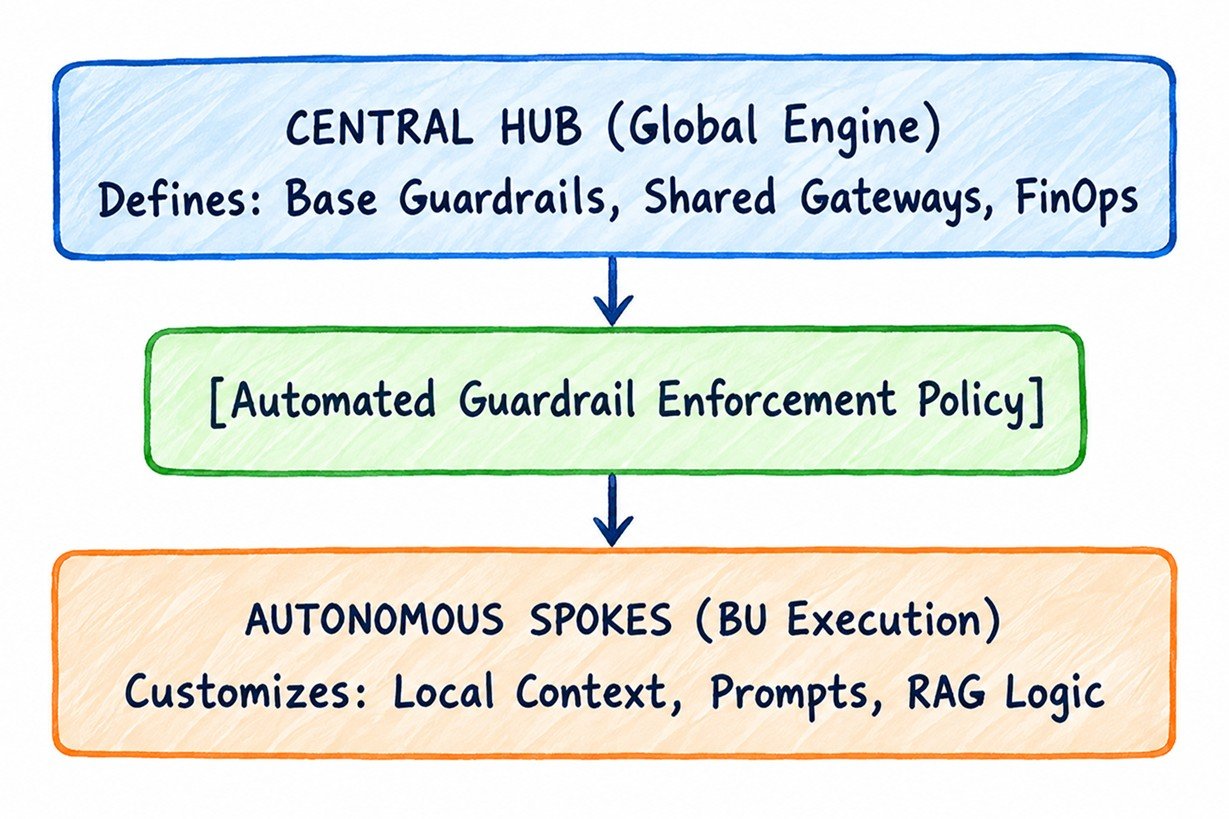
Global Model Gateways vs. Local Context Ingestion
- The Policy: Every single token exiting the enterprise network or entering a third-party LLM endpoint, regardless of whether it runs on a Central Platform Tenant or a Federated Platform Instance, must pass through a model gateway validating compliance.
- Execution: The Hub provides the base gateway container image and enforces global system prompts (e.g., PII masking, toxicity filtering). The Spokes are granted full autonomy to inject local context, customize application-level system prompts, and manage localized semantic caches within their respective platform boundaries to optimize performance.
Centralized FinOps Oversight vs. Local Budget Accountability
- The Policy: Financial accountability is completely localized; architectural visibility is strictly centralized.
- Execution: The Spokes fund their own AI infrastructure, token usage, and fine-tuning compute costs. However, all telemetry metrics regarding token consumption, cache hit ratios, and cost per successful task must be exposed to the Hub's centralized FinOps dashboard. If a Spoke's federated instance exhibits unoptimized, runaway token consumption due to poor context engineering, the Hub retains the architectural authority to mandate an intervention under the TOGAF Phase H framework.
Automated CI/CD Compliance vs. Developer Autonomy
- The Policy: Developers within the Spokes should experience zero friction when writing code, up until the moment that code interacts with enterprise data or production environments.
- Execution: Spokes are free to experiment with new open-source packages, agentic libraries, and modeling techniques in sandbox environments. However, the Hub embeds automated security scanners (e.g., prompt injection testing, dependency scanning, data lineage verification) into the corporate Git repository infrastructure. Code cannot be merged into staging or production branches without clearing the automated architectural checks established by the central CoE.
5. The AI RACI Matrix: Governance Across Hub and Spoke Boundaries
To eliminate operational ambiguity and prevent costly architectural friction, the intersection of the Central Hub and Autonomous Spokes must be governed by an explicit, executive-grade RACI (Responsible, Accountable, Consulted, Informed) framework.
Without a formalized matrix, enterprises inevitably face two critical operational failure modes: paralysis (where teams refuse to deploy capabilities due to unclear safety ownership) or rebellion (where Spokes bypass governance to avoid bureaucratic hurdles).
The Core Personas
- Hub Lead / Chief AI Architect (Central): Owns the enterprise-wide AI Architectural North Star, global risk compliance, and macro-level unit economics.
- Hub Platform Engineer (Central): Responsible for building, maintaining, and scaling the shared core infrastructure, baseline images, and global network infrastructure.
- Spoke Product Manager (Federated): Owns the business unit's localized product roadmap, business logic requirements, and application ROI.
- Spoke Lead / Embedded AI Engineer (Federated): Responsible for building agent logic, application integration, prompt engineering, and localized dataset assembly.
Executive Operational RACI Matrix
| Enterprise AI Lifecycle Task | Hub Lead / Chief Architect | Hub Platform Engineer | Spoke Product Manager | Spoke Lead / Embedded Eng |
|---|---|---|---|---|
| Fine-Tuning Base Frontier Models | A | R | C | C |
| Domain-Specific Fine-Tuning / LoRA Adapters | C | I | A | R |
| Global AI/API Gateway Provisioning & Routing | A | R | I | I |
| Managing Local Prompt Registries | I | I | A | R |
| Signing Off on Corporate Safety & Guardrail Filters | A | R | C | C |
| Customizing Local Application-Level Guardrails | C | I | A | R |
| Provisioning Central Platform Vector Instances | A | R | I | C |
| Provisioning Sovereign Federated Platform Instances | A | C | I | R |
| Enterprise Knowledge Ingestion & RAG Indexing | I | I | A | R |
| Continuous Automated Regression Testing & Evaluation | C | R | I | R |
Operationalizing the Matrix: Key Implementation Rules
1. The Separation of Model Control
The Central Hub remains strictly Accountable (A) and Responsible (R) for fine-tuning base frontier models (e.g., updating a highly secured, 70B parameter corporate model). This ensures that base model weights remain uncorrupted by biased data. Conversely, the Spokes maintain absolute autonomy, acting as Accountable (A) and Responsible (R), over domain-specific fine-tuning and LoRA (Low-Rank Adaptation) weights that layer onto the base models to serve hyper-localized business logic.
2. The Gateway Mandate
The Hub Platform Engineer is Responsible (R) for the provisioning, uptime, and underlying routing logic of the Global AI Gateway. Individual Spokes are merely Informed (I) of routing updates, as they have zero structural authority to bypass this pipeline. However, the Spoke Lead is fully Accountable (A) and Responsible (R) for managing their local prompt registries within that gateway architecture, giving them the agility to iterate on application behavior without central intervention.
3. Guardrail Enforcement Boundaries
Corporate safety filters (e.g., PII scrubbing, explicit content blockers, regulatory compliance filters) are non-negotiable. The Hub Lead retains absolute Accountability (A) for their signature and enforcement. However, if a specific business unit requires tighter constraints (for example, a Spoke in a highly regulated legal domain requiring zero tolerance for legal idioms), the Spoke Product Manager is Accountable (A) for defining and applying those extra localized guardrail configurations.
4. Platform Sovereignty Allocation
When a Spoke requires a Sovereign Federated Platform Instance due to data residency constraints, the Spoke Lead is Responsible (R) for executing the Infrastructure-as-Code (IaC) deployment. However, the Hub Lead remains Accountable (A) for approving the architecture design package prior to launch, ensuring that the federated instance maps perfectly to the enterprise TOGAF Phase E requirements and continuously streams telemetry to the central Hub.
6. The Matrix Rebalancing Trigger Framework: Operational Heuristics for Topology Shifting
An enterprise AI organizational structure is not a static architectural monument; it is a dynamic operating system. A common failure mode for CTOs and VPs of Engineering is treating their chosen topology, whether Centralized, Hybrid, or Federated, as a permanent state. Keeping an organization centralized for too long creates operational paralysis, while federating too early triggers architectural chaos, tooling sprawl, and unmitigated risk.
To prevent structural decay, technology leaders must deploy the Matrix Rebalancing Trigger Framework. This framework provides definitive, data-driven heuristics that indicate when an organization should transition from Centralized to Hybrid (Hub-and-Spoke), or from Hybrid to Federated Platform Instances.
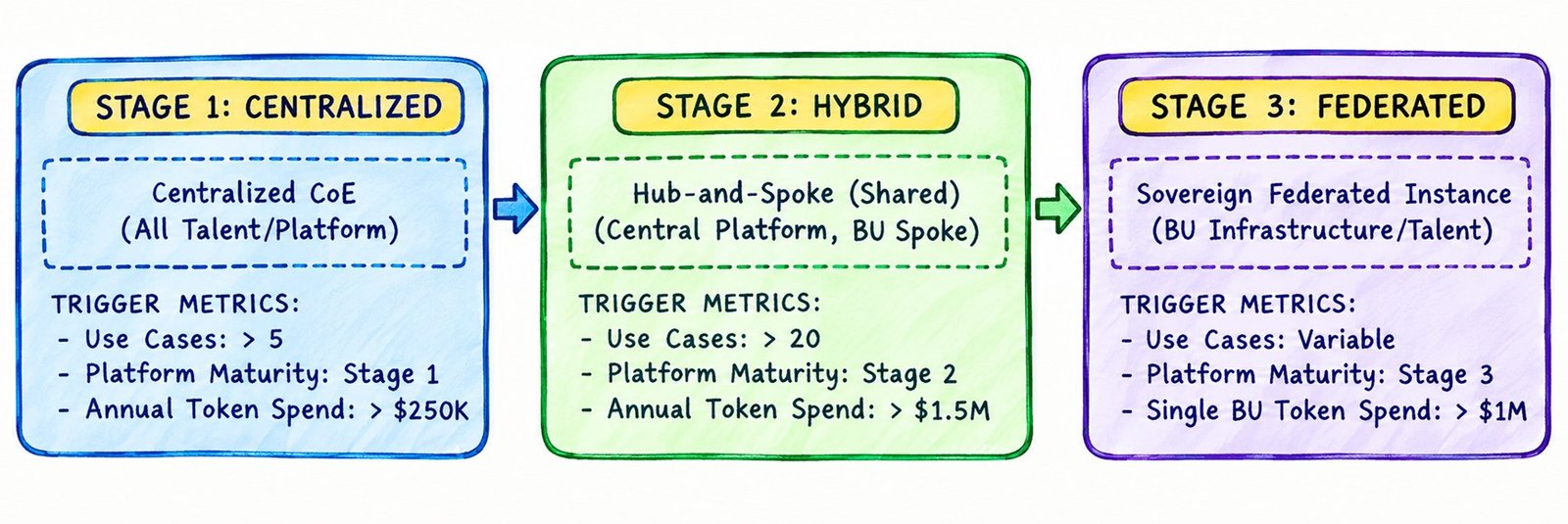
The Architectural Maturity Matrix & Structural Decision Framework
| Metric Category | Trigger Vector: Centralized → Hybrid | Trigger Vector: Hybrid → Federated |
|---|---|---|
| Use-Case Volume | Active Pipeline Threshold: > = 5 distinct LLM applications concurrently running in staging or production across multiple business units. Operational Bottleneck: The central CoE intake queue wait time exceeds 21 business days, causing BUs to build shadow AI alternatives. | Sustained Scale Threshold: A single business unit is actively maintaining > = 5 complex agentic/RAG workflows in production. Local Backlog: The Spoke's internal product roadmap requires custom orchestration pipelines that diverge from the shared platform templates. |
| Platform Maturity | Capability Baseline: The core team has stabilized the global AI/API Gateway, configured standard enterprise CI/CD compliance scanners, and established baseline corporate guardrails. Multi-Tenancy Readiness: The platform can securely isolate data, prompt registries, and semantic caches using logical multi-tenant namespaces. | Infrastructure Standardization: The Hub's platform architecture is fully codified into production-grade Infrastructure-as-Code (IaC) manifests, such as Terraform and Helm charts. Telemetry Capability: The central Hub is capable of ingesting distributed OpenTelemetry streams, ensuring total observability over detached nodes. |
| Annual Token Spend | Enterprise Scale: Total aggregate token expenditure across all business units crosses $250,000 annually. FinOps Imperative: Token volume justifies the deployment of global semantic caching and the negotiation of dedicated enterprise throughput tiers. | BU Sovereign Economics: A single business unit's token spend alone crosses $1,000,000 annually. Local Optimization: The unit economics of the Spoke justify dedicated fine-tuning infrastructure, local semantic routing, and regional cloud hosting footprints. |
Operationalizing the Triggers
1. Transitioning from Centralized to Hybrid: The Velocity Trigger
In the early phases of Generative AI adoption, centralization is mandatory to prevent architectural fragmentation. However, the exact moment to break the monolith and shift to a Hybrid (Hub-and-Spoke) model occurs when aggregate token spend passes $250,000 and the central intake queue stalls project delivery.
- The Operational Signal: Business units are highly motivated, have identified validated business opportunities, but are actively blocked by a central data engineering or LLM engineering bottleneck.
- The Architectural Action: The CTO strips execution capacity out of the central CoE and reallocates those engineering heads directly into the business lines, forming the Spokes. The core CoE collapses down into the Hub, focusing strictly on building out the multi-tenant namespaces within the Enterprise AI Platform and maintaining global guardrails.
2. Transitioning from Hybrid to Federated Platform Instances: The Sovereignty Trigger
The Hybrid model handles shared-services multi-tenancy exceptionally well. However, when a single business unit scales to the point of spending over $1,000,000 annually on tokens and infrastructure, or introduces extreme data residency constraints, it qualifies for a Federated Platform Instance.
- The Operational Signal: A Spoke's performance criteria demands sub-100ms end-to-end RAG latency, processes highly regulated data, such as local sovereign citizens' data, or executes heavy fine-tuning compute workloads that interfere with the performance of the central platform tenants.
- The Architectural Action: The Chief AI Architect grants the Spoke the authority to spin up an isolated clone of the AI platform infrastructure within the Spoke's VPC. The Spoke assumes full Responsibility (R) for infrastructure maintenance and uptime costs. However, architectural compliance is tightly maintained. The Spoke's instance is systematically locked to the Hub's central GitOps pipeline, ensuring that every global security patch, audit trail, and model routing update is automatically applied to the federated instance.
The Rebalancing Checklist for the CTO
Before signing off on an organizational realignment, the CTO must enforce a strict architectural gate:
Never federate a platform component or an engineering team if the underlying operational standards cannot be verified programmatically.
If a Spoke requests a federated instance but lacks the internal engineering maturity to manage an automated CI/CD pipeline or fails to expose its real-time FinOps telemetry to the central Hub, the rebalancing request must be denied.
Autonomy is earned through architectural compliance.
7. Strategic Blueprint for Enterprise Technology Leaders
When designing your enterprise AI operating model, avoid the temptation to enforce absolute uniformity or permit complete isolation. Implement the following pragmatic roadmap to establish the Federated Hub-and-Spoke Model:
- Establish the Hub with Immediate Architectural Guardrails: Do not wait to hire dozens of engineers. Form a lean, authoritative central team focused exclusively on establishing the core platform contracts, the global AI Gateway, and the automated CI/CD security checks.
- Classify Your Spokes by Architectural Maturity: Audit your business units. Assign standard workflows to the Central Platform Tenant to reduce overhead. Reserve the Federated Platform Instance option strictly for high-throughput, latency-critical, or regulatory-heavy business lines that possess the engineering capacity to manage their own infrastructure safely.
- Embed TOGAF 10 Gates Into the AI Pipeline: Force every AI project out of the sandbox and into a formal ADM lifecycle before it reaches real users. Use Phase A to control scope, Phase C/D to control platform choices, and Phase G to automatically enforce architectural compliance.
By formalizing these organizational boundaries, you ensure that your enterprise AI initiative transitions seamlessly from a collection of fragile, fragmented experiments into a highly scalable, secure, and industrialized production machine.