Data Engineering for AI
Introduction
An enterprise AI strategy is fundamentally constrained by the structural and semantic maturity of its underlying data pipelines. While AI Platform Engineering provides the runtime infrastructure and AI/ML Engineering builds the application orchestration layers, the system's output fidelity depends entirely on the data fed into it. In the context of large language models and probabilistic systems, the classic enterprise maxim holds true with a unique structural nuance: Garbage in, garbage out shifts to Unstructured garbage in, probabilistic hallucinations out.
For technology executives, including CTOs, Chief Data Officers (CDOs), and Enterprise Architects, the shift toward Generative AI requires a complete re-engineering of the enterprise data fabric. Traditional data engineering was optimized for structured schemas, relational transactional storage (OLTP), and analytical data warehousing (OLAP). Data Engineering for AI, however, introduces the requirement to process, clean, chunk, enrich, embed, and store massive volumes of unstructured corporate knowledge at scale while preserving strict metadata lineage and security permissions.
This section details how to architect an enterprise-grade AI data engine, including semantic extraction pipelines, vector lifecycle management, and metadata enrichment strategies required to pass the most stringent TOGAF Phase C (Information Systems Architecture: Data Architecture) governance reviews.
1. The Core Paradox of AI Data Pipelines
Traditional enterprise data engineering treats unstructured text, such as PDFs, corporate policies, internal wikis, and chat transcripts, as cold logs that are stored in object storage but rarely queried in real time. To make this information actionable for Retrieval-Augmented Generation (RAG) and agentic workflows, data engineers must transform unstructured text into high-dimensional vector representations while avoiding three core failure modes:
- Context Fragmentation: Naively slicing a document by a fixed character count, such as every 500 characters, destroys semantic relationships. If a critical financial table spans across that arbitrary cutoff point, the data becomes unreadable to the downstream retrieval model.
- Security and Entitlement Bleed: If access control permissions are stripped out during the data extraction and ingestion pipeline, the vector database becomes an engine for internal data leaks, allowing unauthorized personnel to retrieve sensitive data through natural language semantic search.
- Vector Index Staleness: Corporate wikis and product documentation change continuously. Without automated incremental update and synchronization pipelines, vector indices degrade over time, feeding outdated facts to the orchestration layer.
2. Architectural Subsystems of the AI Data Engine
A production-grade data engine for enterprise AI requires a modular pipeline design that cleanly separates ingestion, transformation, enrichment, and storage into decoupled components.
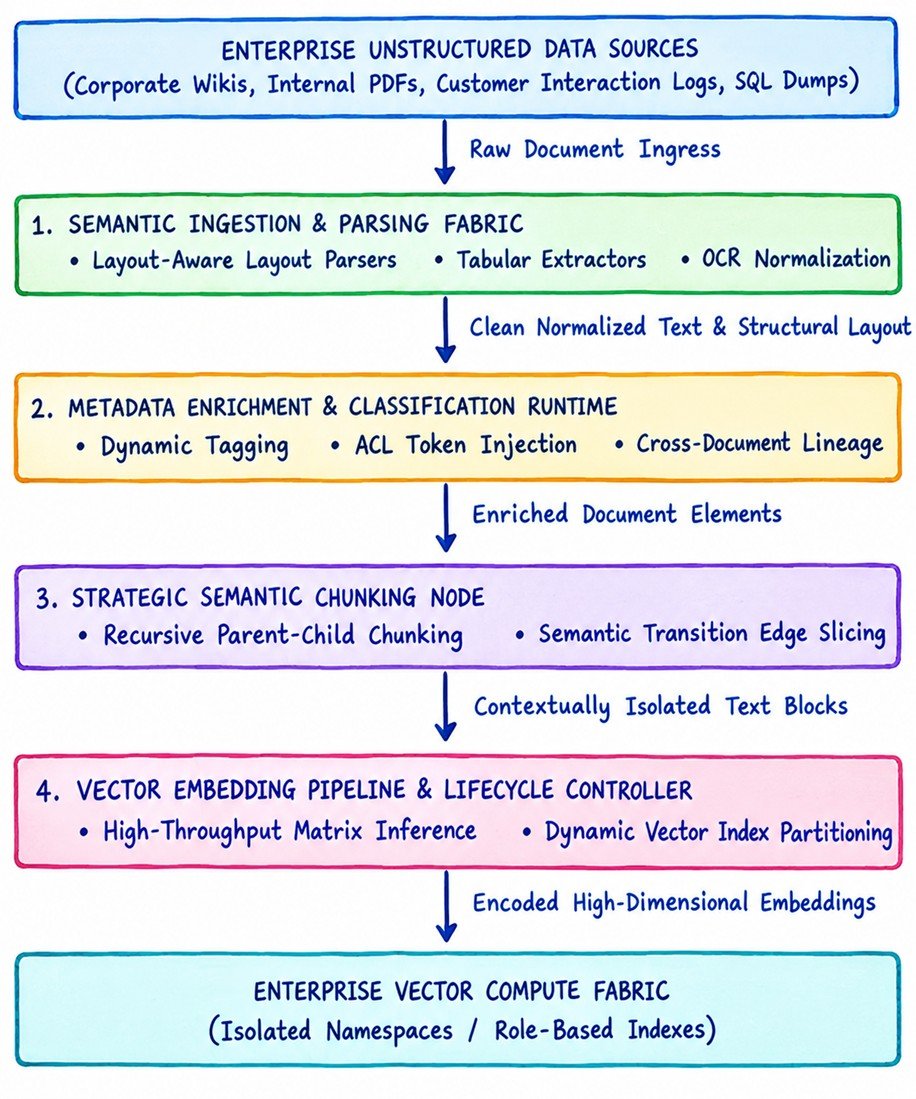
2.1 The Semantic Ingestion & Parsing Fabric
Documents are not flat blocks of text. They contain visual hierarchies, including headers, subheaders, bullet lists, footnotes, and complex analytical tables.
- Layout-Aware Extractors: The data engine avoids simple text dumping. It uses layout-aware parsers to convert documents into structured JSON syntax trees that capture reading order, visual boundaries, and font weights of text blocks.
- Tabular Normalization: Tables are highly problematic for vector search models. Converting a table into standard comma-separated text can strip away column-to-row relationships. The parsing fabric translates complex tabular data into structured HTML tables or Markdown formats before processing, ensuring the model can accurately interpret cell relationships.
2.2 The Metadata Enrichment & Classification Runtime
Before a text block is converted into a vector representation, the pipeline enriches it with descriptive tags. This structural step improves accuracy during downstream hybrid searches that combine conventional keyword filtering with vector semantic distance searches.
- Access Control List (ACL) Token Injection: The engine extracts security permissions from the host system, such as SharePoint, Confluence, or internal databases, and binds them directly to the metadata payload of the processed text block, for example,
"allowed_roles": ["finance-admin", "executive-leadership"]. - Document Lineage Tracking: Every text segment is stamped with its source origin URI, unique document hash, system generation timestamp, and version number to support enterprise audit trails and compliance requirements.
2.3 The Strategic Semantic Chunking Node
Rather than relying on fixed-size string chunkers, the data engine uses context-aware partitioning strategies to segment data streams:
- Recursive Character Chunking: The pipeline evaluates structural text boundaries iteratively, searching for paragraph marks (
\n\n), newlines (\n), spaces, and individual characters in sequence. This boundary scanning ensures text blocks fit within target token sizes without clipping words or sentences mid-thought. - Parent-Child Context Structuring: The engine implements a tiered data hierarchy:
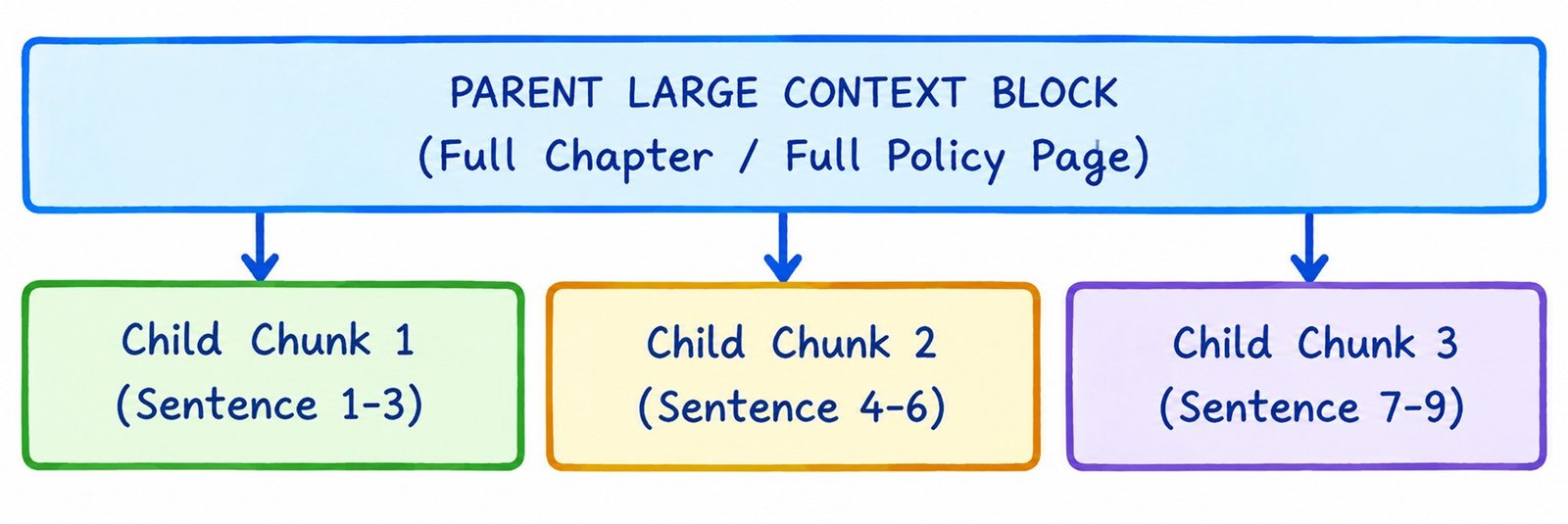
When running vector distance lookups, the system queries the smaller, highly focused Child Chunks to ensure rapid matching precision. However, when the matching segment is retrieved, the data engine swaps it out and passes the broader, enriched Parent Context Block to the language model gateway, ensuring the downstream application receives comprehensive background context.
2.4 The Vector Embedding Pipeline & Lifecycle Controller
Transforming raw text elements into deep embeddings requires dedicated compute allocation and structured change controls.
- Batch GPU Inference Optimization: The embedding controller collects text chunks into large arrays and processes them using dedicated compute nodes, such as models running on local Hugging Face TEI clusters or managed API endpoints, maximizing GPU hardware utilization.
- Vector Index De-duplication: To keep storage footprints low, the engine hashes the content of incoming text segments. If a file is uploaded multiple times or remains unchanged during a synchronization run, the database skips the embedding computation entirely, optimizing storage efficiency.
3. Data Infrastructure Comparison Matrix
Building a scalable data engine requires selecting the right storage architecture. The table below outlines the core options based on data density, access patterns, and query performance.
| Architectural Dimension | Option A: Specialized Native Vector Database (e.g., Qdrant / Pinecone) | Option B: Relational Vector Extension Stack (e.g., PostgreSQL with pgvector) | Option C: Multimodal Enterprise Search Engine (e.g., OpenSearch / Elasticsearch) |
|---|---|---|---|
| Primary Indexing Focus | High-throughput vector search optimization utilizing HNSW graphs. | ACID-compliant transactional operations merged with vector storage capabilities. | Distributed, high-scale text indexing with integrated hybrid vector extensions. |
| Hybrid Search Integration | Low to Medium. Requires manual setup or vendor-specific keyword additions. | Maximum. Allows standard SQL expressions to join text filters and vector metrics. | High. Built natively to execute BM25 lexical keyword scoring alongside vector distances. |
| Index Rebuild Mechanics | Dynamic. Performs incremental updates and memory refactoring automatically. | Resource-intensive. Requires background database workers to reconstruct index trees. | High Scale. Manages index mapping updates via robust segment-merging pipelines. |
| Horizontal Scale Fit | Maximum. Designed with sharded vector graphs optimized for distributed compute clouds. | Limited. Scale-out strategies depend on classic database clustering and replication nodes. | Excellent. Inherits proven distributed document management patterns. |
| Target Operational Scale | Over 50 million vector entities demanding ultra-low query latencies. | Under 10 million records requiring strict consistency and shared database operations. | Large enterprise footprints executing rich hybrid search and logging applications. |
4. Engineering Blueprints & Pipelines
To implement these architectural principles, data teams use automated extraction blueprints and clean structured configurations.
4.1 Enterprise Ingestion Ingress Schema (document_chunk.json)
This metadata schema defines a post-processed text element ready for embedding ingestion, complete with lineage markers, structural identification, and access permission arrays.
{
  "$schema": "https://json-schema.org",
  "title": "EnterpriseAIChunkMetadata",
  "type": "object",
  "properties": {
    "chunk_id": { "type": "string", "format": "uuid" },
    "parent_document_hash": { "type": "string" },
    "source_origin_uri": { "type": "string", "format": "uri" },
    "structural_context": {
      "type": "object",
      "properties": {
        "page_number": { "type": "integer" },
        "header_hierarchy": { "type": "array", "items": { "type": "string" } },
        "element_type": { "type": "string", "enum": ["paragraph", "table", "list_item"] }
      },
      "required": ["page_number", "element_type"]
    },
    "security_entitlements": {
      "type": "object",
      "properties": {
        "allowed_security_groups": { "type": "array", "items": { "type": "string" } },
        "is_public_within_tenant": { "type": "boolean" }
      },
      "required": ["allowed_security_groups", "is_public_within_tenant"]
    },
    "payload_content": { "type": "string" }
  },
  "required": ["chunk_id", "parent_document_hash", "source_origin_uri", "structural_context", "security_entitlements", "payload_content"]
}
4.2 Automated Semantic Processing Pipeline (data_pipeline.py)
The following Python implementation provides a concrete runtime data pipeline blueprint. It details Recursive Parent-Child Text Chunking, Cryptographic Data De-duplication, Identity Entitlement-Injected Tagging, and Dynamic Vector Store Upsert Routing.
import hashlib
import uuid
import logging
from typing import List, Dict, Any, Optional

# Mocking Enterprise Data Infrastructure Extensions
class EnterpriseEmbeddingClient:
    """Simulates a localized high-scale text embedding inference server runtime."""
    def generate_vector(self, text: str) -> List[float]:
        # Simulates a target 1536-dimensional float array generation run
        return [0.0123] * 1536

class EnterpriseVectorStoreCluster:
    """Simulates an enterprise sharded vector datastore collection boundary."""
    def __init__(self):
        self.ledger: Dict[str, Dict[str, Any]] = {}

    def upsert_entity(self, collection_name: str, payload: Dict[str, Any]) -> bool:
        entity_id = payload.get("id")
        self.ledger[entity_id] = payload
        return True

    def query_by_hash(self, doc_hash: str) -> Optional[Dict[str, Any]]:
        for item in self.ledger.values():
            if item.get("metadata", {}).get("document_hash") == doc_hash:
                return item
        return None


class AIDataPipelineProcessor:
    def __init__(self):
        self.embedding_engine = EnterpriseEmbeddingClient()
        self.vector_db = EnterpriseVectorStoreCluster()
        self.logger = logging.getLogger("DataEngineeringPipeline")

    def _compute_cryptographic_hash(self, text_payload: str) -> str:
        """Generates a tracking signature to prevent duplicate vector processing."""
        return hashlib.sha256(text_payload.encode('utf-8')).hexdigest()

    def execute_semantic_chunking(self, raw_text: str, maximum_chunk_size: int = 200) -> List[str]:
        """
        Executes a basic recursive text slicing pattern to preserve boundary sentences.
        """
        sentences = raw_text.split(". ")
        chunks = []
        current_chunk = ""

        for sentence in sentences:
            if len(current_chunk) + len(sentence) < maximum_chunk_size:
                current_chunk += sentence + ". "
            else:
                if current_chunk:
                    chunks.append(current_chunk.strip())
                current_chunk = sentence + ". "
        if current_chunk:
            chunks.append(current_chunk.strip())

        return chunks

    def process_and_ingest_document(self, data_package: Dict[str, Any]) -> Dict[str, Any]:
        """
        Processes unstructured documents defensively, generating enriched vector records.
        """
        raw_content = data_package.get("content", "")
        source_url = data_package.get("source_url", "unknown://source")
        acl_roles = data_package.get("read_permissions", ["domain-users"])

        # 1. Cryptographic De-duplication Check
        doc_hash = self._compute_cryptographic_hash(raw_content)
        existing_record = self.vector_db.query_by_hash(doc_hash)
        if existing_record:
            self.logger.info("FinOps Optimization: Duplicate document structure identified. Skipping embedding execution.")
            return {"status": "skipped", "reason": "DUPLICATE_CONTENT_HASH", "document_hash": doc_hash}

        # 2. Semantic Structural Slicing
        text_segments = self.execute_semantic_chunking(raw_content)
        processed_count = 0

        # 3. Vector Conversion and Metadata Enrichment Loop
        for index, segment in enumerate(text_segments):
            generated_uuid = str(uuid.uuid4())

            # Compute deep mathematical representation
            vector_embedding = self.embedding_engine.generate_vector(segment)

            # Construct corporate record schema object with identity markers
            vector_record = {
                "id": generated_uuid,
                "vector": vector_embedding,
                "metadata": {
                    "document_hash": doc_hash,
                    "source_origin_uri": source_url,
                    "chunk_index": index,
                    "security_entitlements": {
                        "allowed_security_groups": acl_roles,
                        "is_public_within_tenant": False
                    }
                },
                "payload_content": segment
            }

            # Commit data to enterprise secure repository bounds
            self.vector_db.upsert_entity(collection_name="enterprise_knowledge", payload=vector_record)
            processed_count += 1

        self.logger.info(f"Successfully processed and sharded document into {processed_count} vector records.")
        return {"status": "success", "chunks_ingested": processed_count, "document_hash": doc_hash}


# Demonstration Driver Execution Run
if __name__ == "__main__":
    logging.basicConfig(level=logging.INFO)
    pipeline = AIDataPipelineProcessor()

    raw_corporate_document = {
        "source_url": "https://sharepoint.internal",
        "read_permissions": ["compliance-officers", "risk-committee-members"],
        "content": "This policy governs enterprise operational risk tracking metrics. Step one requires mapping all application entry dependencies. Step two enforces automated rate-limiting checks across shared cloud APIs. Step three mandates independent cryptographic log validation runs annually."
    }

    # Run processing loop execution
    ingress_report = pipeline.process_and_ingest_document(raw_corporate_document)
    print("\n--- Ingestion Job Report Execution Output ---")
    print(json.dumps(ingress_report, indent=2))
5. Mapping Data Engineering Duties to TOGAF Phase C
To achieve audit alignment within the enterprise architecture framework, all data operations are mapped directly to TOGAF Phase C (Information Systems Architecture: Data Architecture).
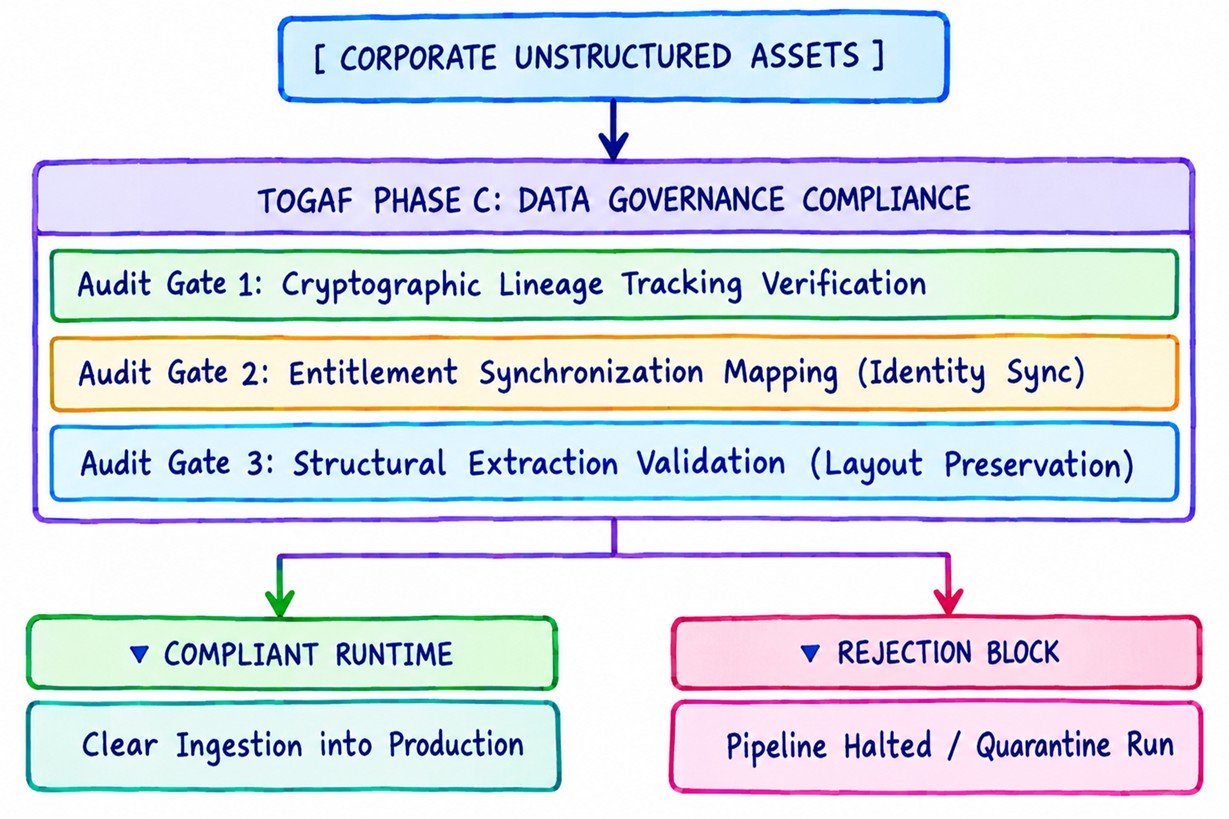
The Data Engineering team fulfills its Phase C governance commitments by passing three structural verification reviews:
-
Cryptographic Lineage Verification: Every vector index configuration must trace back to its primary document origin repository. If a data consumer requests an audit trace for a given vector slice, the pipeline must be capable of presenting the source file version hash, ensuring regulatory compliance.
-
Entitlement Synchronization Mapping: The data engine is audited to ensure that permission metadata updates on primary files are reflected inside the vector store. If a user's access group changes or a file is marked restricted, the ingestion loop must synchronize the entitlement tokens within the vector registry immediately.
-
Structural Extraction Validation: Engineers must verify that table extraction routines do not break row alignments. The data architecture team reviews chunk parsing logs to confirm that numerical entities and structural contexts are fully preserved before embedding compilation.
Architectural Disclaimer
This architectural guide and its referenced configurations are intended exclusively for educational and strategic planning purposes. Processing unstructured enterprise assets into probabilistic data arrays introduces variable semantic outcomes based on layout complexities, context splits, and embedding models. Implementing production pipelines requires independent database penetration scanning, extensive access rights validation, and compliance verification aligned with your organization's legal structures.