Scaling a 120+ Person AI Engineering/Practice Organization
Introduction
Building a highly tuned 100-person Hub-and-Spoke structure establishes a clear blueprint for engineering alignment. However, as an enterprise scales past 120+ practitioners, the organizational dynamics shift dramatically. At this scale, the primary bottleneck is no longer localized technical hurdles or team-level friction. Instead, the challenge expands to include organizational drag, communication fragmentation, talent density dilution, and the erosion of shared platform architectures.
When an organization surpasses 120 practitioners, it hits a structural communication threshold often described by Dunbar's Number. Individuals can no longer maintain context on every concurrent initiative across the firm. Left unmanaged, a 120+ person organization will naturally splinter into disconnected, tribal engineering teams. These groups will eventually bypass central platform governance, recreate redundant custom tooling pipelines, and introduce severe compliance exposure for the firm.
For technology executives, including CTOs, Senior VPs of Engineering, and Global Heads of AI Practice, managing this inflection point requires moving beyond simple team topologies and deploying Macro-Scale Organizational Architecture. This section details the organizational mechanics, communication models, talent density controls, and strategic investment structures required to scale a 120+ person AI footprint while preserving agility, standard compliance, and cost control across the enterprise fabric.
1. The Macro-Scale Team Matrix: Dual-Axis Governance
To prevent a large-scale AI practice from fracturing into chaotic silos, the enterprise operating model shifts away from single-threaded reporting lines and adopts a Dual-Axis Macro Structure. This model decouples tactical delivery execution from core technical standard governance.
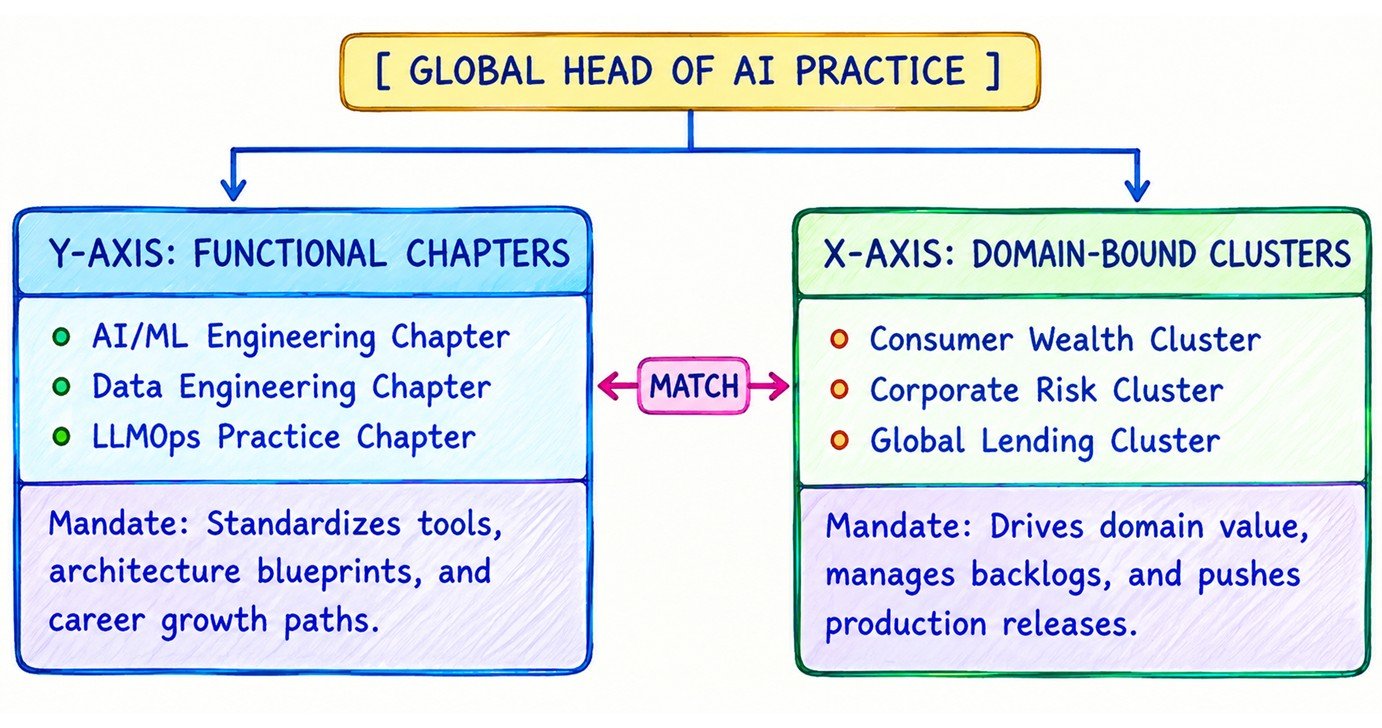
The Y-Axis: Functional Chapters (Capability Standards)
Practitioners are anchored within specialized, cross-functional Chapters led by a dedicated Chapter Lead, such as the AI/ML Engineering Chapter, the LLMOps Practice Chapter, or the Data Engineering Chapter. The chapter owns the technical baseline. It defines which programming frameworks are approved, creates reusable prompt schemas, maintains core coding patterns, and governs internal career progression tracks.
The X-Axis: Domain-Bound Business Clusters (Value Delivery)
For day-to-day execution, practitioners are deployed out of their chapters into Business Clusters, such as the Consumer Wealth Cluster, the Corporate Risk Cluster, or the Global Lending Ingress Cluster. Each cluster functions as an autonomous business line containing multiple stream-aligned product teams. The cluster focuses entirely on delivery execution: managing product backlogs, identifying business value opportunities, and releasing application code to production.
This design guarantees that while an AI/ML Engineer works autonomously inside a fast-moving credit underwriting pod, they remain structurally bound to the central chapter's architectural standards, preventing them from introducing unvetted shadow IT code into the production environment.
2. Macro-Scale Resource Allocation Blueprint (120+ Practitioners)
When structuring an enterprise-wide AI practice at this scale, human capital must be distributed across the core platform hub, enabling practices, and federated business delivery nodes using optimized resource profiles.
120+ Person Practice Allocation profiles
| Organizational Block | Headcount Percentage | Headcount Volume |
|---|---|---|
| Central Platform Hub | 25% Total Allocation | 30 Dedicated Leads |
| Enabling Architecture (CoE) | 10% Total Allocation | 12 Enterprise CoE |
| Federated Delivery Clusters | 65% Total Allocation | 78 Product Engineers |
2.1 The Central Platform Hub Node (25% - 30 Practitioners)
This core group treats intelligence as productized infrastructure for the entire organization.
- 12 Platform Engineers: Responsible for operating the global model gateways, managing memory caches, and optimizing token traffic routing layers.
- 10 AI Data Engineers: Responsible for building and maintaining scalable data ingestion loops and optimizing shared vector clusters.
- 8 LLMOps Platform Specialists: Responsible for managing the automated CI/CE evaluation runners and orchestrating shadow-routing setups across production regions.
2.2 The Central Enabling CoE Node (10% - 12 Practitioners)
The strategic core of the practice, responsible for enterprise alignment and framework modernization.
- 6 Enterprise AI Architects: Responsible for chairing the global Architecture Review Boards (ARB) and managing the target stage-gate frameworks.
- 6 Senior Developer Evangelists: Dedicated technical facilitators who embed within business clusters to run upskilling bootcamps and bootstrap early-stage product architectures.
2.3 Federated Delivery Clusters (65% - 78 Practitioners)
The decentralized execution muscle distributed across domain-specific lines of business.
- 12 AI Product Managers: Leading discovery sprints and defining product canvases within specific business verticals.
- 18 Embedded AI/ML Engineers: Building context-window pruning workflows and programming state-bound agent DAGs inside specific application modules.
- 48 Senior Application Engineers: Managing token streaming interfaces, Server-Sent Events, and deterministic application integrations.
3. Communication Pathways: Shifting from Interpersonal to Asynchronous
In a small engineering group, alignment happens through direct interaction and meeting syncs. In a 120+ person organization, synchronous meetings create communication overhead that paralyzes engineering speed. The practice leader must deliberately shift the team's culture toward Asynchronous, Code-First Communication Interfaces.
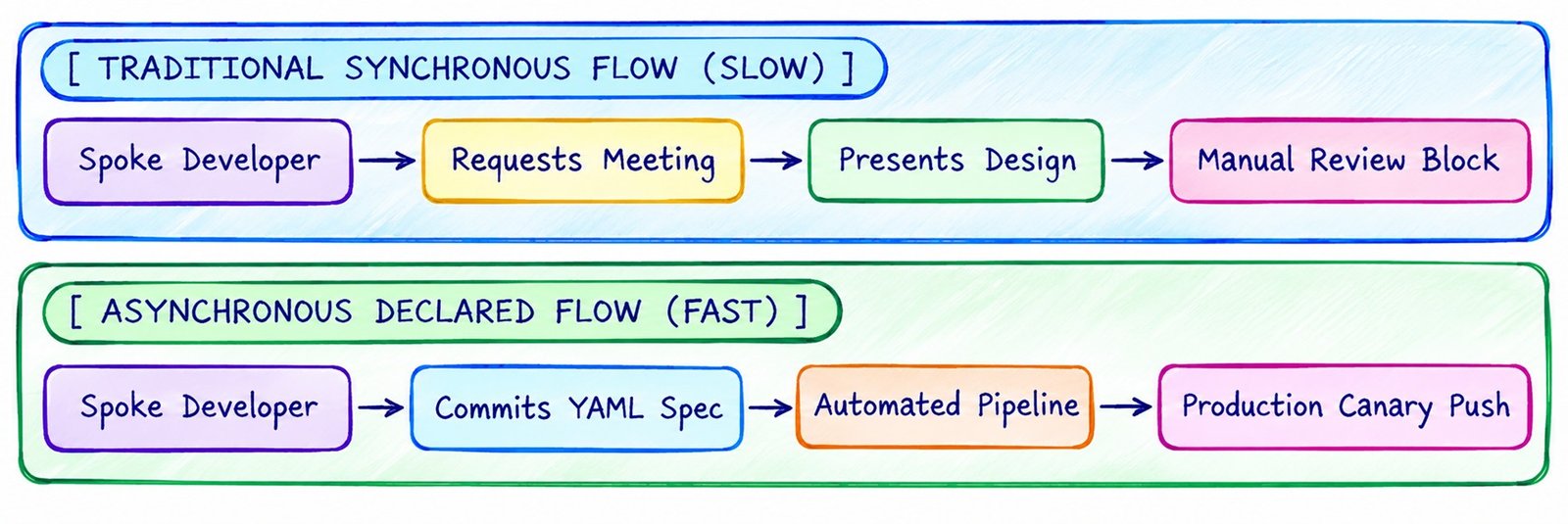
3.1 Inner-Source Code Repositories as Communication Channels
Instead of team leads holding weekly syncs to share what utilities they have built, the practice mandates an Inner-Source Core Asset Model. Custom prompt templates, token optimization snippets, and evaluation scripts are stored inside a single, inner-source enterprise catalog repository. If an engineer in the Wealth Management cluster creates an optimized prompt parser, they commit it to the shared repository, making it instantly discoverable and reusable by engineers in the Risk or Lending clusters without direct human intervention.
3.2 Declarative Intent via System Manifests
Communication between the platform hub and the federated spokes is mediated entirely through configuration syntax. When a delivery team needs to provision a new vector index partition, configure an upstream model failover route, or adjust a prompt firewall's similarity threshold, they do not open a support ticket. Instead, they submit a declarative YAML manifest to the platform repository. The platform's automated pipelines parse the file, validate it against corporate policy rules, and provision the infrastructure state automatically.
4. The Macro Practice Scaling Declaration Schema
To manage organizational alignment across massive teams using programmatic systems, the global practice office deploys an enterprise-wide portfolio specification manifest file.
4.1 Global Practice Allocation Manifest (practice_scale_governance.yaml)
This production configuration manifest defines the global headcount footprints, cluster domain authorizations, inner-source sharing constraints, and mandatory stage-gate forum hooks required to scale a 120+ person practice safely.
# =====================================================================
# Global AI Practice Scaling & Macro Governance Manifest
# =====================================================================
practice_portfolio_context:
  organization_name: "Enterprise Global Intelligence Group"
  total_active_practitioners: 124
  governance_framework_version: "scale-v12.4.0"
  last_compliance_audit_run: "2026-09-13T19:33:00Z"

macro_chapter_registry:
  ai_ml_engineering:
    global_chapter_head: "user-id-ch-mle-01"
    active_headcount: 22
    approved_core_frameworks: ["LangGraph-Enterprise", "Pydantic-Core"]
  data_engineering_ai:
    global_chapter_head: "user-id-ch-data-04"
    active_headcount: 14
    approved_vector_targets: ["OpenSearch-Shared-Cluster"]
  llmops_platform_practice:
    global_chapter_head: "user-id-ch-ops-02"
    active_headcount: 10
    approved_evaluation_judges: ["mod-ent-reasoning-llama3-70b"]

business_delivery_clusters:
  - cluster_id: "cluster-retail-wealth-operations"
    associated_cost_center: "CC-RETAIL-4402"
    cluster_engineering_lead: "user-id-lead-wealth-01"
    allocated_headcount_budget: 24
    inner_source_contribution_mandated: true
    authorized_intelligence_tiers:
      - "tier-1-local-edge-slm"
      - "tier-2-mid-cloud-llm"
  - cluster_id: "cluster-global-risk-compliance"
    associated_cost_center: "CC-RISK-9912"
    cluster_engineering_lead: "user-id-lead-risk-07"
    allocated_headcount_budget: 18
    inner_source_contribution_mandated: true
    authorized_intelligence_tiers:
      - "tier-1-local-edge-slm"
      - "tier-2-mid-cloud-llm"
      - "tier-3-premium-reasoning-restricted"

macro_governance_automation:
  inner_source_catalog_repo: "git://enterprise.internal/ai-coe/inner-source-catalog.git"
  enforce_declarative_infrastructure: true
  mandatory_stage_gate_forum: "global-ai-architecture-review-board"
  escalation_path_cto_threshold_usd: 50000.00
5. Integrating Large-Scale Operations with TOGAF ADM
Operating a 120+ person organization demands clear integration with established enterprise processes. The macro-scale team structures map directly to two core TOGAF 10 ADM lifecycles.
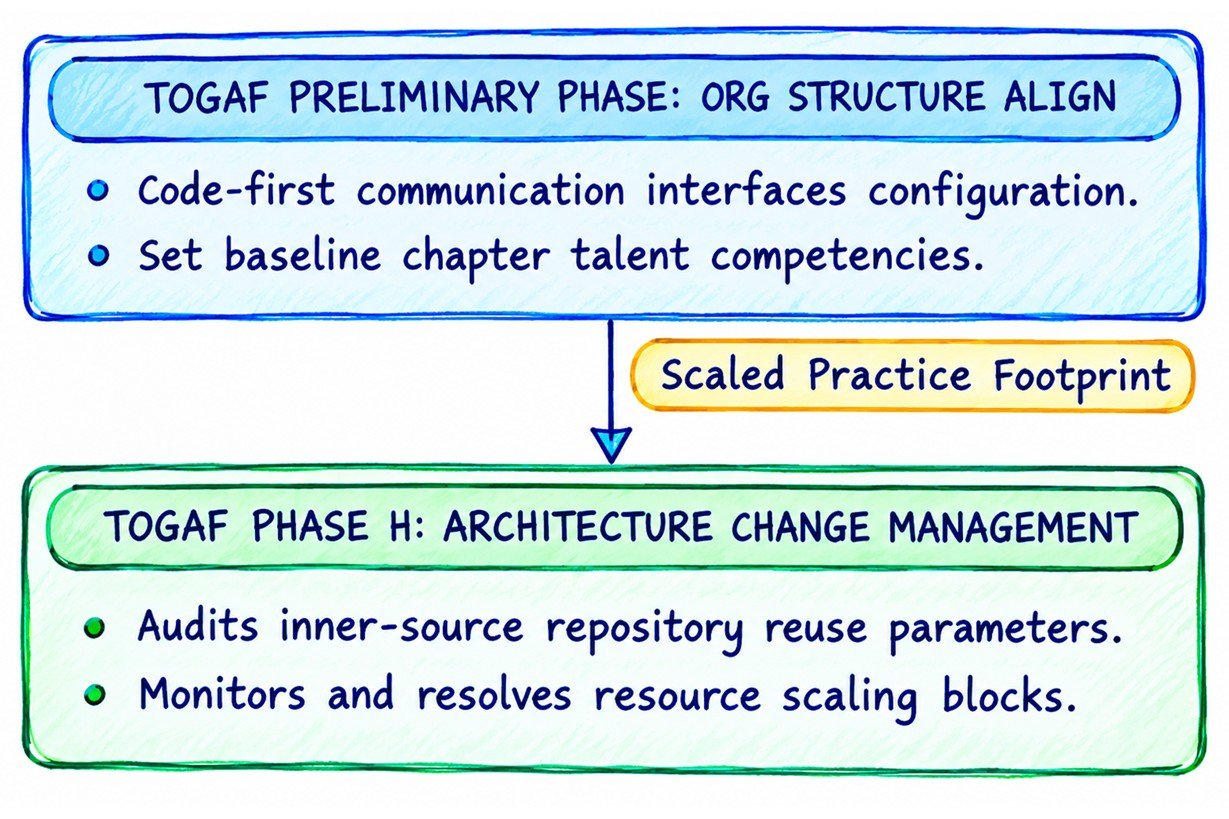
Preliminary Phase: Organizational Structure Alignment
During the Preliminary Phase, the global practice leadership configures the macro organizational boundaries. The team designs the dual-axis chapter/cluster reporting structures, establishes the shared inner-source repository permissions, and sets the baseline capability standards for each technical chapter, ensuring that team formations mirror target system architectures before launching large-scale development efforts.
Phase H: Architecture Change Management
Phase H governs continuous adaptation. As teams scale past 120 members, asset reuse metrics are evaluated to spot duplicate work across clusters. Automated refactoring loops require the central Hub to absorb redundant tools into standard platform components. This eliminates technical debt and safeguards practice velocity against declining Idea-to-Staging Time (ITS) metrics.
Architectural Disclaimer
This architectural guide and its associated macro-scale configuration blueprints are intended exclusively for educational and strategic enterprise planning purposes. Running high-scale human engineering networks across probabilistic computing platforms introduces complex communication paths, variable team velocities, and shifting structural execution profiles that change based on corporate cultures, technology selections, and leadership configurations. Scaling a 120+ person practice requires extensive organizational design verification, comprehensive budget validation, and operational risk monitoring tailored to your specific corporate landscape and institutional mandates.