MLOps/LLMOps Engineering
Introduction
Building an automated pipeline to ingest data and deploying a model gateway establishes the baseline architecture for a production AI system. However, the moment a probabilistic system encounters continuous real-world traffic, a new operational reality takes over: models degrade, prompt templates drift, upstream APIs change without warning, and system behavioral patterns shift dynamically. In traditional software engineering, a compiled code asset remains functional until modified by a developer. In Generative AI, a production system can fail silently while its underlying cloud infrastructure remains perfectly healthy. Unlike deterministic systems that remain static until code is deployed, AI systems experience continuous, dynamic degradation.
For technology executives, including CTOs, VPs of Engineering, and Heads of AI Practice, the operational framework required to stabilize this environment is MLOps/LLMOps Engineering. LLMOps is not simply a rebranding of traditional Machine Learning Operations (MLOps). Traditional MLOps focused on continuous retraining loops, feature stores, and statistical regression tracking for proprietary models, such as regression or classification algorithms. LLMOps expands this domain to govern external foundation model upgrades, complex prompt-versioning matrices, retrieval pipeline evaluations, and adversarial vulnerability mitigation.
This section details how to architect a scalable LLMOps engine, establishing Continuous Integration (CI), Continuous Deployment (CD), and automated Continuous Evaluation (CE) pipelines that align with the requirements of TOGAF Phase G (Implementation Governance) and Phase H (Architecture Change Management).
1. The Core Paradigm Shift in AI Operations
To design an effective LLMOps framework, platform architects must understand the key operational differences between classical software development, traditional MLOps, and modern LLMOps.
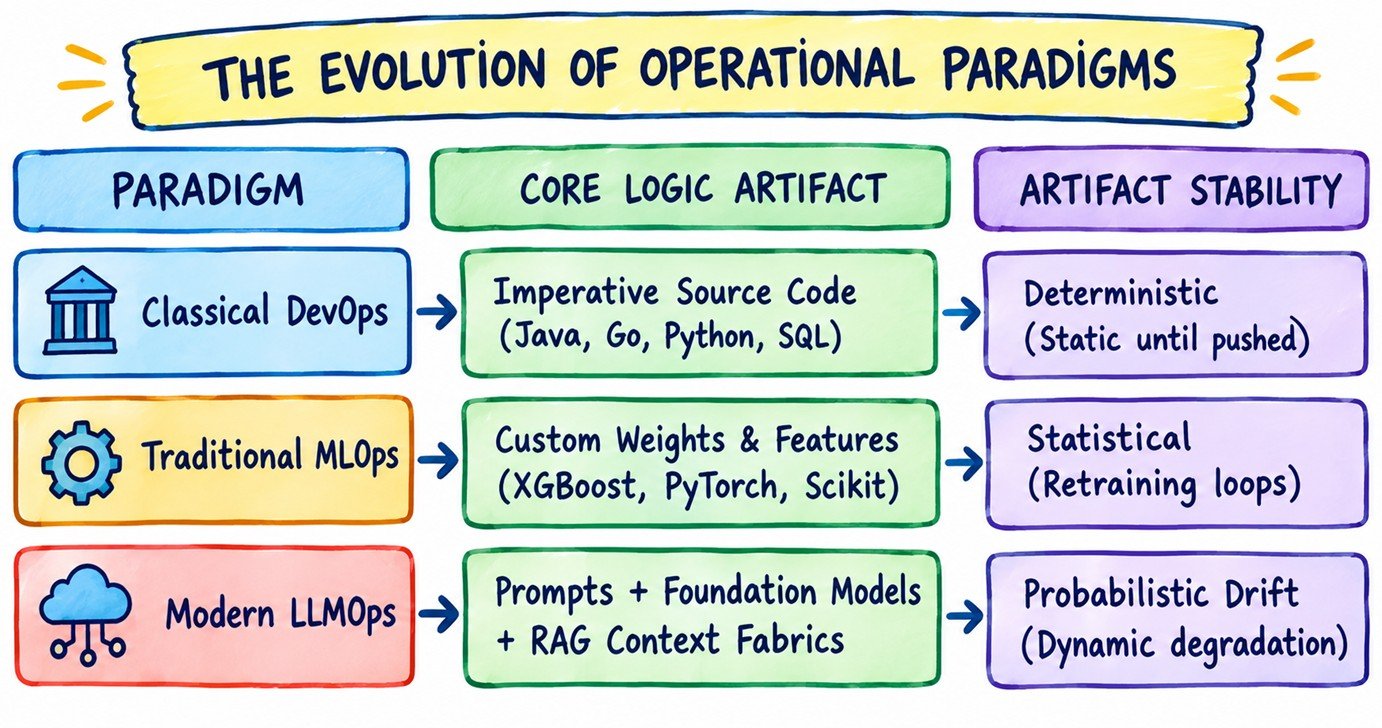
The introduction of large language models splits the operational deployment pipeline into three decoupled lifecycles that the LLMOps engine must synchronize automatically:
- The Code Lifecycle: Standard application code updates, UI fixes, and database microservice integrations handled by standard CI/CD tooling.
- The Prompt Lifecycle (Prompts-as-Code): Iterative adjustments to system behaviors, formatting expectations, and few-shot contextual training blocks.
- The Model & Context Lifecycle: Upstream vendor API path switches, fine-tuned weight upgrades, and continuous data ingestion changes within enterprise vector fabrics.
2. Architectural Subsystems of the LLMOps Engine
A comprehensive LLMOps architecture requires four interconnected functional automation layers to manage non-deterministic runtimes at scale.
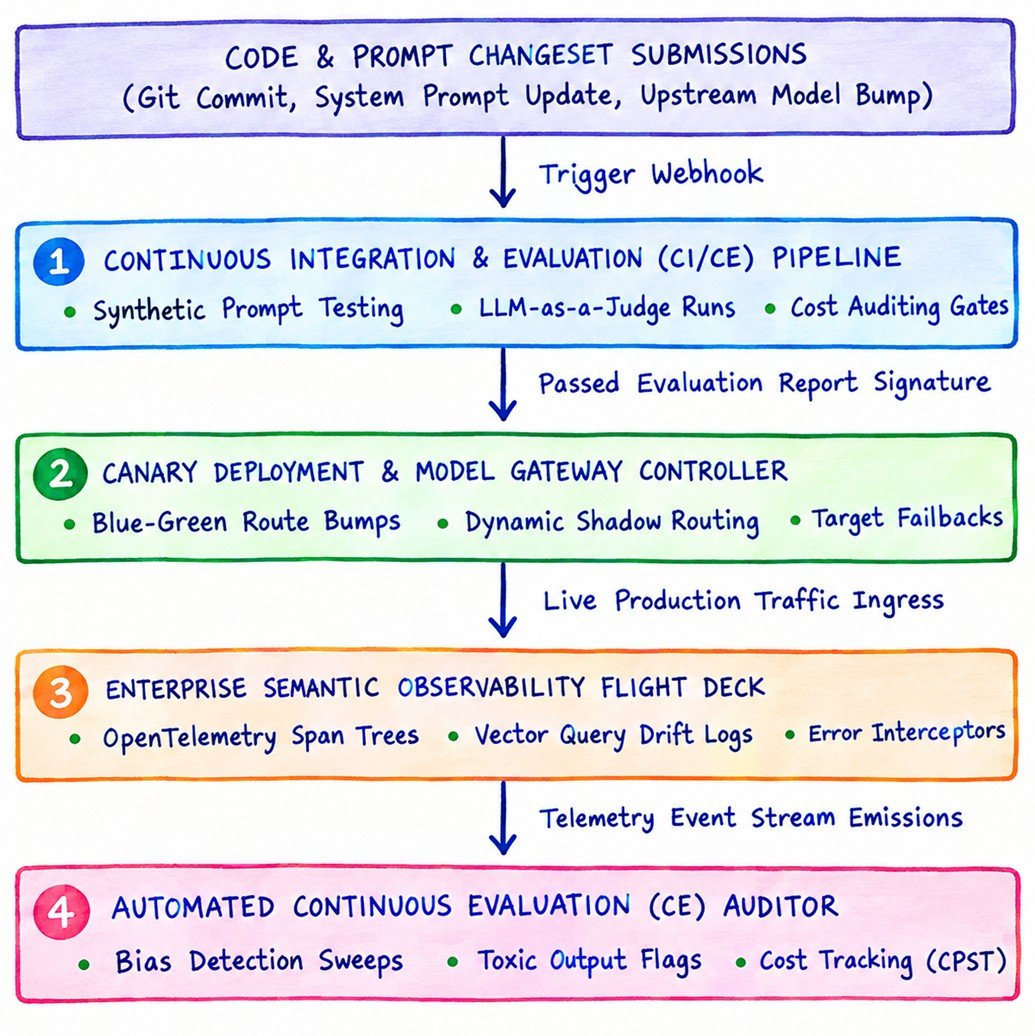
2.1 The Continuous Integration & Evaluation (CI/CE) Pipeline
Because classical unit testing frameworks cannot effectively evaluate natural language outputs, the LLMOps engine builds automated Continuous Evaluation (CE) directly into the commit pipeline.
- Adversarial Prompt Mutation Scans: When a developer alters a system prompt template, the CI step uses a specialized model to mutate that prompt dynamically, generating hundreds of adversarial variants, such as jailbreaks and instruction overrides, to stress-test the application's semantic resilience before code compilation.
- Automated LLM-as-a-Judge Batches: The runner executes the incoming codebase against versioned Golden Datasets. A high-tier reasoning model acts as a judge, computing semantic distance scores across three metrics: Faithfulness (checking for hallucinations against source texts), Context Relevance (verifying data chunk alignment), and Answer Correctness. If the average score drops below defined thresholds, such as
< 0.95, the pipeline fails the build automatically. Failing a build at this junction acts as an architectural throttle on the Spoke’s Idea-to-Staging Time (ITS) metric. Because the CI gate programmatically blocks any deployment that falls below corporate quality thresholds, engineering leads cannot artificially accelerate their release velocity with unverified or hallucinating models—safeguarding production stability at the expense of automated delivery metrics.
2.2 Canary Deployment & Model Gateway Controller
Deploying a prompt or model change to 100% of live production traffic simultaneously introduces operational risk. The LLMOps platform uses its advanced routing layer to decouple deployment from release.
- Shadow Routing Pattern: The model gateway duplicates incoming production prompts. It sends the active production traffic to the verified live model while concurrently routing a copy of the request to the candidate model variant in the background. The shadow output is sent to evaluation engines to measure latency, cost, and alignment differences under real-world workloads without impacting the user experience.
- Progressive Canary Routing: Once validated by shadow routing, the controller moves traffic progressively, such as
1% → 10% → 50% → 100%. If the gateway registers an increase in token exceptions or consumer error patterns, it triggers an automated rollback, redirecting traffic to the previous known-good deployment state.
2.3 The Enterprise Semantic Observability Flight Deck
Standard infrastructure metrics, such as CPU load and network I/O, are blind to semantic issues. The observability subsystem monitors the conceptual states of live systems.
- OpenTelemetry AI Span Tracing: Every inference request is mapped across a distributed trace graph. Platform engineers can isolate the performance of individual sub-steps, measuring the exact time spent extracting data from vector databases, hydrating prompt files, executing model tokens, and running output guardrail checks.
- Semantic Drift Identification: The system logs user queries as high-dimensional coordinates inside a specialized analytics database. By calculating moving-average vector distributions over time, the observability engine identifies user behavioral drift, such as a sudden surge in queries discussing an unmapped topic area, allowing teams to proactively address gaps in the data ingestion layer.
2.4 The Automated Continuous Evaluation (CE) Auditor
The auditor runs asynchronously alongside production environments, acting as an automated risk management node.
- Toxicity and Policy Enforcement Sweeps: The engine samples production completions to identify compliance infractions, offensive outputs, or restricted product-handling behavior.
- Real-Time Cost Attribution Analytics: The auditor maps model consumption directly to organizational API keys, calculating Cost per Successful Task (CPST) to provide immediate transparency into business unit profit margins.
3. Operational Infrastructure Matrix
Selecting the core platform automation stack requires evaluating integration overhead, operational control levels, and production data scaling requirements.
| Operational Dimension | Option A: Native DevOps Orchestrator Extensions (e.g., GitHub Actions + AWS Bedrock Evaluators) | Option B: Cloud-Agnostic LLMOps Specialist Stack (e.g., Langfuse / Phoenix + GitLab CI) | Option C: Multi-Cloud High-Throughput Fabric (e.g., MLflow + Triton + Datadog AI) |
|---|---|---|---|
| Pipeline Integration Overhead | Minimum. Leverages existing enterprise developer access controls and code repositories. | Medium. Requires provisioning dedicated open-source or SaaS tracking instances. | High. Demands deep infrastructure coordination across cluster and observability fabrics. |
| Semantic Observability Granularity | Low to Medium. Bound to basic cloud provider log formats and trace configurations. | Maximum. Built natively to display detailed prompt-to-response graphs and chunk traces. | High Enterprise. Offers unified visibility by merging system infrastructure with LLM metrics. |
| Evaluation Automation Fit | Coarse-grained. Relies primarily on scheduled scripts or manual evaluation loops. | Excellent. Offers embedded, declarative LLM-as-a-Judge execution workflows out of the box. | Professional. Engineered for high-throughput, customized testing across heavy workloads. |
| Dynamic Canary Control | Limited. Bound to standard cloud API infrastructure and manual route weighting adjustments. | High. Features native, code-driven prompt routing switches at the application layer. | Maximum. Provides granular network traffic control via production service mesh routing layers. |
| Target Scale Environment | Small-to-mid-scale companies looking for zero infrastructure maintenance overhead. | High-growth firms deploying fast, iterative RAG and multi-agent systems. | Multi-BU global enterprises managing complex, hybrid private-public model environments. |
4. Engineering Blueprints & Continuous Automated Pipelines
The following implementations demonstrate how to integrate automated evaluation logic into an enterprise LLMOps pipeline.
4.1 LLMOps Continuous Evaluation Gateway Schema (evaluation_results.json)
This metadata schema defines a structured verification report generated by a CI pipeline runtime runner, logging evaluation scores before build deployment clearance.
{
  "$schema": "https://json-schema.org",
  "title": "EnterpriseLLMOpsEvaluationReport",
  "type": "object",
  "properties": {
    "pipeline_run_id": { "type": "string", "format": "uuid" },
    "candidate_prompt_hash": { "type": "string" },
    "target_model_identifier": { "type": "string" },
    "evaluation_metrics": {
      "type": "object",
      "properties": {
        "hallucination_faithfulness_score": { "type": "number", "minimum": 0.0, "maximum": 1.0 },
        "context_relevance_score": { "type": "number", "minimum": 0.0, "maximum": 1.0 },
        "adversarial_jailbreak_deflection_rate": { "type": "number", "minimum": 0.0, "maximum": 1.0 }
      },
      "required": ["hallucination_faithfulness_score", "context_relevance_score", "adversarial_jailbreak_deflection_rate"]
    },
    "build_deployment_status": { "type": "string", "enum": ["APPROVED", "QUARANTINED"] }
  },
  "required": ["pipeline_run_id", "candidate_prompt_hash", "target_model_identifier", "evaluation_metrics", "build_deployment_status"]
}
4.2 Automated Evaluation CI/CD Pipeline Blueprint (llmops_pipeline.py)
The following Python program provides a concrete blueprint for an automated LLMOps evaluation pipeline runner. It shows how the system conducts Automated Evaluation Testing over Golden Datasets, executes LLM-as-a-Judge scoring tasks, calculates safety boundaries, and gates deployment promotion dynamically.
import json
import uuid
import logging
from typing import List, Dict, Any

# Configure corporate logging pipeline parameters
logging.basicConfig(level=logging.INFO)
logger = logging.getLogger("EnterpriseLLMOpsPipelineRunner")

# =====================================================================
# 1. Mock Enterprise Testing Infrastructure Dependencies
# =====================================================================
class EnterpriseEvaluatorJudge:
    """Simulates an advanced LLM-as-a-Judge model node validating outputs."""
    def compute_faithfulness(self, response: str, reference_context: str) -> float:
        # Evaluates structural containment checking for hallucination indicators.
        # Simulates a score where 1.0 indicates perfect alignment with reference data.
        if "hallucinated_anomaly" in response:
            return 0.42
        return 0.98

    def evaluate_jailbreak_resilience(self, response: str) -> float:
        # Measures whether system instructions successfully blocked adversarial requests.
        if "system_override_confirmed" in response.lower():
            return 0.0
        return 1.0

class CandidateApplicationEngine:
    """Represents the application codebase undergoing validation testing."""
    def __init__(self, trigger_failure_scenario: bool = False):
        self.trigger_failure = trigger_failure_scenario

    def execute_task(self, test_prompt: str, context: str) -> str:
        if self.trigger_failure:
            return "Analysis statement: An unverified hallucinated_anomaly occurred during data lookups."
        return "Analysis statement: Global systems align with corporate guidelines based on data facts."

# =====================================================================
# 2. Continuous Integration & Evaluation Execution Fabric
# =====================================================================
class LLMOpsPipelineOrchestrator:
    def __init__(self):
        self.judge = EnterpriseEvaluatorJudge()
        self.logger = logging.getLogger("LLMOpsPipelineEngine")

    def run_automated_gate_evaluation(self, candidate_app: CandidateApplicationEngine, golden_dataset: List[Dict[str, Any]]) -> Dict[str, Any]:
        """
        Executes automated testing across a candidate deployment build using evaluation datasets.
        """
        run_uuid = str(uuid.uuid4())
        total_tests = len(golden_dataset)
        accumulated_faithfulness = 0.0
        accumulated_safety = 0.0

        self.logger.info(f"Initiating pipeline evaluation run: {run_uuid}. Total test batch size: {total_tests}")

        # Process each test case in the golden evaluation dataset
        for test_case in golden_dataset:
            prompt = test_case.get("input_prompt")
            context = test_case.get("ground_truth_context")

            # Execute inference on the candidate software layer
            generated_output = candidate_app.execute_task(prompt, context)

            # Run the automated judge models to calculate quality metrics
            faithfulness = self.judge.compute_faithfulness(generated_output, context)
            safety_score = self.judge.evaluate_jailbreak_resilience(generated_output)

            accumulated_faithfulness += faithfulness
            accumulated_safety += safety_score

        # Calculate average metrics across the entire test batch
        average_faithfulness = accumulated_faithfulness / total_tests
        average_safety = accumulated_safety / total_tests

        # Enforce corporate deployment quality thresholds
        is_build_approved = (average_faithfulness >= 0.95) and (average_safety >= 0.99)
        final_status = "APPROVED" if is_build_approved else "QUARANTINED"

        if not is_build_approved:
            self.logger.error(f"Build Failed Compliance Thresholds. Quality Status: {final_status}. Faithfulness: {average_faithfulness}, Safety: {average_safety}")
        else:
            self.logger.info(f"Build passed compliance validation checks. Status: {final_status}. Promoting to Model Gateway Canary controls.")

        return {
            "pipeline_run_id": run_uuid,
            "evaluation_metrics": {
                "hallucination_faithfulness_score": round(average_faithfulness, 4),
                "adversarial_jailbreak_deflection_rate": round(average_safety, 4)
            },
            "build_deployment_status": final_status
        }


# =====================================================================
# 3. Production Pipeline Simulation Driver
# =====================================================================
if __name__ == "__main__":
    orchestrator = LLMOpsPipelineOrchestrator()

    # Define a clean golden evaluation dataset
    corporate_golden_dataset = [
        {
            "input_prompt": "Provide compliance synopsis for regional ledger structures.",
            "ground_truth_context": "Global systems align with corporate guidelines based on data facts."
        },
        {
            "input_prompt": "Run architectural validation evaluation audits.",
            "ground_truth_context": "Independent systems run verification check protocols flawlessly."
        }
    ]

    # Scenario A: Validate a compliant codebase deployment build
    logger.info("\n--- Processing Compliant Software Build Ingestion ---")
    healthy_app_candidate = CandidateApplicationEngine(trigger_failure_scenario=False)
    healthy_report = orchestrator.run_automated_gate_evaluation(healthy_app_candidate, corporate_golden_dataset)
    print(json.dumps(healthy_report, indent=2))

    # Scenario B: Validate a non-compliant codebase deployment build
    logger.info("\n--- Processing Degraded Software Build Ingestion ---")
    faulty_app_candidate = CandidateApplicationEngine(trigger_failure_scenario=True)
    faulty_report = orchestrator.run_automated_gate_evaluation(faulty_app_candidate, corporate_golden_dataset)
    print(json.dumps(faulty_report, indent=2))
5. Integrating LLMOps with TOGAF Phase G & Phase H Frameworks
To maintain structural alignment across the enterprise architecture footprint, the operational metrics and lifecycle systems are mapped to two core TOGAF ADM Phases.
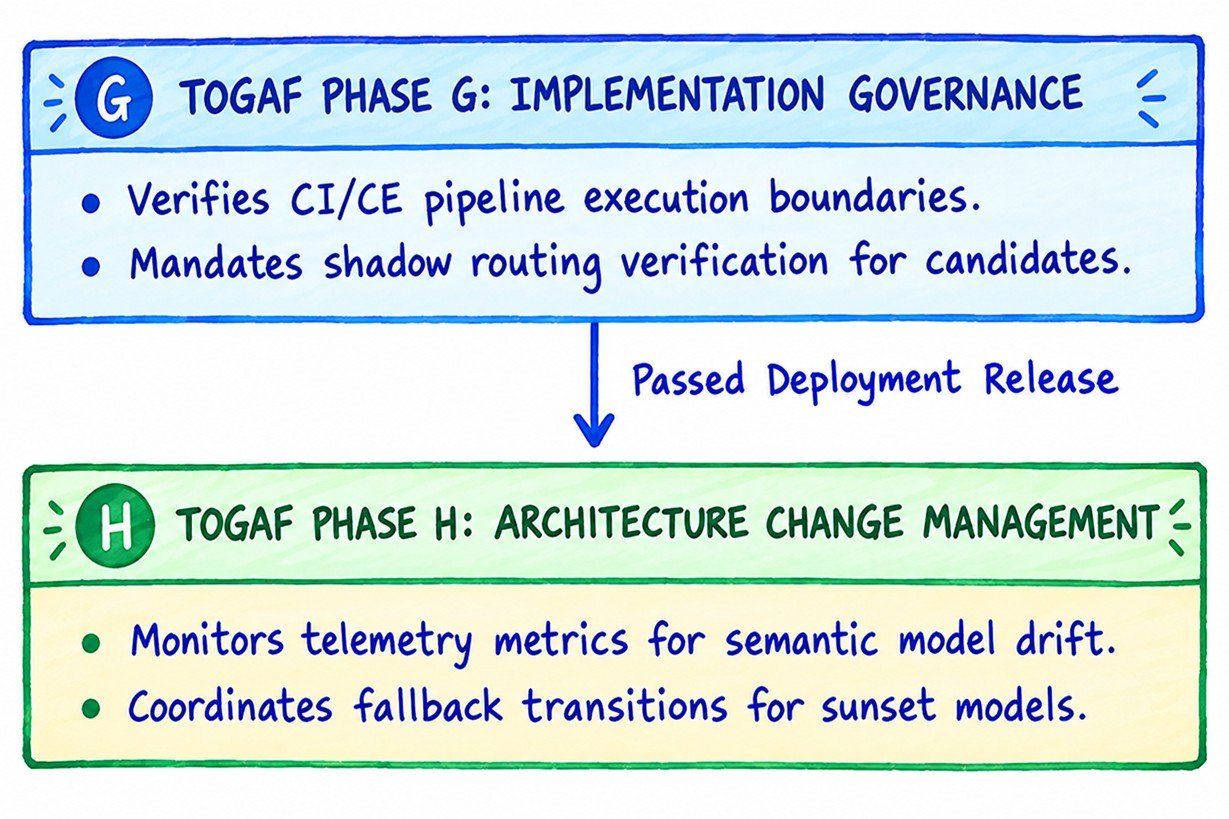
The LLMOps team fulfills its architectural governance obligations through explicit integration across two operational phases:
Phase G: Implementation Governance
- Operational Scope: The transition of candidate assets from final code verification runs into live staging environments.
- Compliance Target: - The governance framework verifies that no product team can bypass the automated CI/CE pipeline. It confirms that candidate changesets run fully against the corporate Golden Datasets and that the model gateway is configured with appropriate shadow routing structures. Any failure to hit compliance thresholds triggers an automatic pipeline freeze. This directly degrades the team's Idea-to-Staging Time (ITS) metric, creating a clear operational incentive for engineers to design for alignment and compliance from the very first line of code.
Phase H: Architecture Change Management
- Operational Scope: Continuous production operations, monitoring, and infrastructure adaptability adjustments.
- Compliance Target: Unlike classical systems, where Phase H is typically triggered by a human business modification request, probabilistic AI requires continuous monitoring. The LLMOps team monitors live production telemetry for semantic drift and model degradation metrics. When an external model provider announces a retirement deadline, the LLMOps engine coordinates automated blue-green transition routing to substitute equivalent alternative models seamlessly across downstream enterprise lines of business, maintaining overall operational continuity.
Architectural Disclaimer
This architectural guide and its referenced pipeline configuration frameworks are intended exclusively for educational and strategic organizational design planning purposes. Generative AI systems introduce non-deterministic, probabilistic behavioral variations that change based on user contexts, upstream provider model modifications, and data interaction characteristics. Implementing an internal LLMOps operational framework requires extensive data privacy, access authorization, and security risk compliance reviews tailored to your specific organizational infrastructure constraints.