The AI Center of Excellence
Introduction
The transition from isolated Generative AI Proofs of Concept (PoCs) to an industrialized, enterprise-scale capability cannot be achieved solely through engineering talent or infrastructure investment. It requires a deliberate, structured organizational construct: The AI Center of Excellence (CoE).
For technology executives, CTOs, VPs of Engineering, and Chief Data Officers, the CoE is the primary vehicle for scaling intelligence across the firm. However, a common failure mode is treating the CoE as either an ivory tower of pure research or a bureaucratic bottleneck that stifles innovation.
To succeed at enterprise scale, the AI CoE must operate with a dual mandate: acting as a high-velocity enabling body while simultaneously enforcing strict governance and architectural guardrails. This section details how to architect, structure, and operate an executive-grade AI CoE, mapped directly to the TOGAF 10 Architecture Development Method (ADM).
1. Structural Topologies for Enterprise Scale
Choosing the correct organizational topology is the first architectural decision when standing up an AI CoE. There is no one-size-fits-all model; the choice depends on your organization's digital maturity, scale, and regulatory environment.
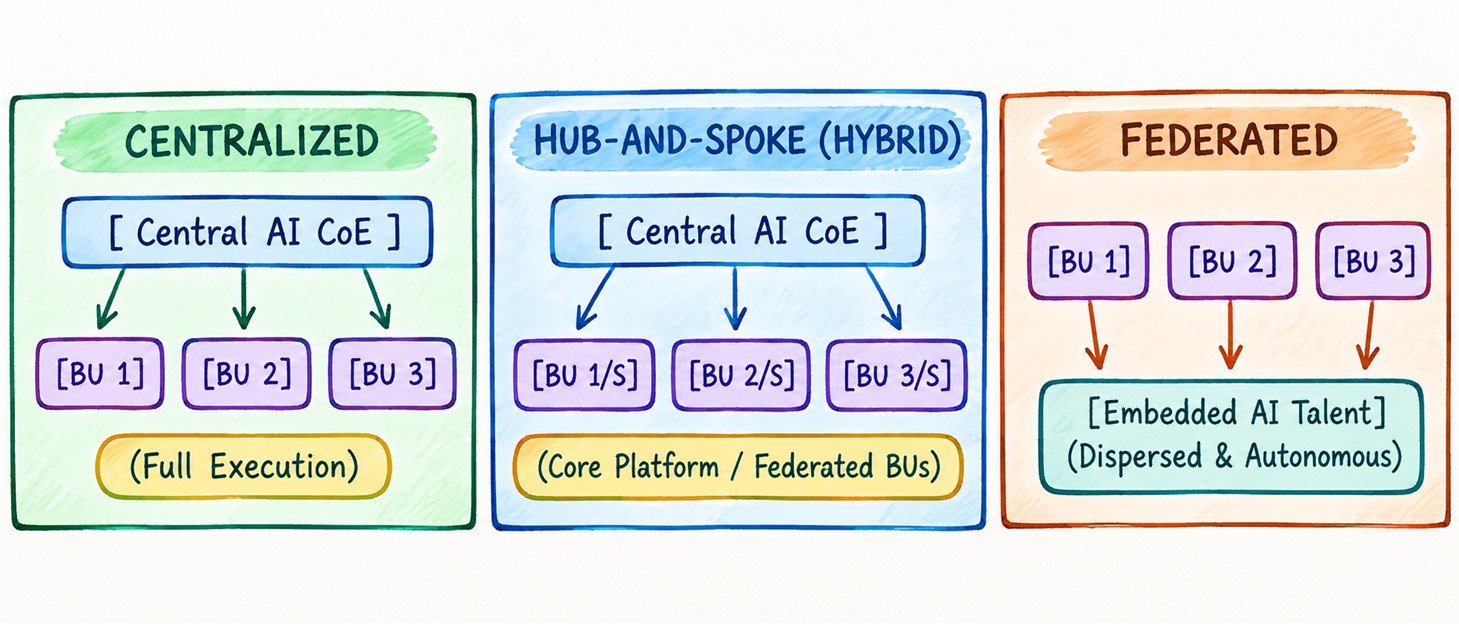
Topology 1: The Centralized Model
In this model, all data scientists, ML engineers, prompt architects, and AI product managers sit within a single, unified business unit.
- Mechanics: Business units (BUs) submit requests to the central CoE. The CoE prioritizes, builds, deploys, and maintains the AI solutions.
- Best Suited For: Early-stage enterprises (scaling from 1 to 5 production use cases) or highly regulated industries where strict, centralized oversight of data exfiltration and model validation is non-negotiable.
Topology 2: The Federated Model
The inverse of centralization, this model decentralizes AI capability completely. Individual business units hire their own AI engineers and data teams to solve specific line-of-business problems.
- Mechanics: BUs operate with absolute autonomy, selecting their own foundation models, vector databases, and orchestration frameworks.
- Best Suited For: Highly decentralized conglomerates or hyper-growth technology companies where speed-to-market outvalues cross-business standardization.
Topology 3: The Hub-and-Spoke (Hybrid) Model
The optimal target state for mid-to-large-scale enterprises. It splits the responsibilities cleanly: a central Hub builds foundational capabilities, while federated Spokes drive business-specific execution.
- Mechanics: The central CoE (Hub) builds the Enterprise AI Platform (gateways, guardrail services, semantic caches). Embedded product teams (Spokes) leverage these shared services to build custom RAG pipelines and multi-agent systems tailored to their customers.
- Best Suited For: Mature enterprises scaling dozens or hundreds of concurrent AI applications across diverse business lines.
Comparative Strategic Blueprint
| Dimensional Metric | Centralized Topology | Federated Topology | Hub-and-Spoke (Hybrid) |
|---|---|---|---|
| Enterprise Scale Fit | Small to Medium (Focused AI footprint) | Large, highly siloed business entities | Large Enterprise (Multi-BU scaling) |
| Speed to Initial PoC | Medium (Constrained by central queue) | Fast (Zero external dependencies) | Fast (Leverages pre-built Hub assets) |
| Time to Production | Fast (Standardized release pipelines) | Slow (Reinventing infrastructure) | Fastest (Shared platform & patterns) |
| Architectural Coherence | Absolute (Single architectural vision) | Poor (Fragmentation and model sprawl) | High (Federated execution with boundaries) |
| Cost Efficiency (FinOps) | High (No duplicate infrastructure) | Extremely Low (Siloed vendor spending) | Maximum (Shared platform economics) |
| Talent Utilization | Optimal (High density of expertise) | Diluted (Engineers isolated in silos) | Balanced (Core platform + domain experts) |
2. The Dual Mandate: Enablement vs. Gatekeeping
An executive-grade AI CoE must maintain an intentional tension between two operating modes: Velocity Injection (Enablement) and Risk Mitigation (Gatekeeping).
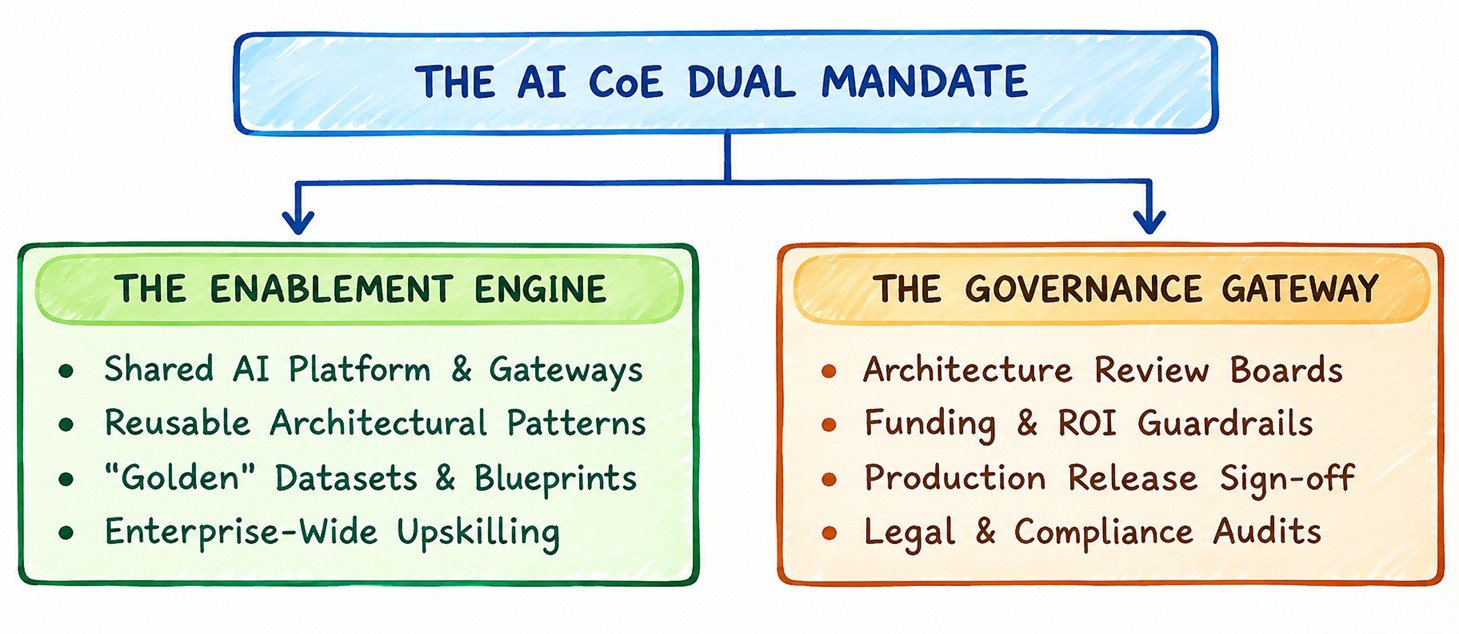
The Enablement Engine (Velocity)
The CoE's primary goal is to lower the activation energy required for a software engineering team to deliver a production-grade AI feature. It achieves this by providing:
- The Enterprise AI Platform: Productizing a unified internal platform that wraps foundation model APIs, abstracts provider failover, optimizes semantic caching, and enforces common data hygiene layers.
- Reusable Architectural Blueprints: Production-ready reference architectures for complex patterns like hybrid retrieval RAG, corrective RAG, or stateful multi-agent orchestrations.
- "Golden" Evaluation Datasets: Curated, production-representative datasets used by product teams to bench-test model drift, hallucinations, and prompt regressions via LLM-as-a-Judge frameworks.
- Upskilling Paths: Turning traditional full-stack and backend engineers into capable AI application engineers who understand context window management, structured outputs, and token-conscious design.
The Governance Gateway (Control)
Conversely, probabilistic systems introduce existential risks to the enterprise, including prompt injections, data poisoning, PII leakage, and runaway token costs. The CoE must act as a strict gatekeeper via:
- Capital Allocation & Funding Gates: Requiring a validated business case before approving model token budgets. The CoE prevents teams from building complex multi-agent frameworks when simple deterministic logic or minor prompt engineering would suffice.
- Architecture Review Boards (ARB): Mandating that any AI-infused application pass an adversarial review before hitting production. This includes auditing agent boundary limits, systemic fallback strategies, and vector access controls.
- Production Release Sign-off: Verifying that the system scores above acceptable thresholds on the enterprise AI PoC-to-Production Readiness Scorecard. No system goes live without automated guardrail integration and explicit legal compliance clearance.
3. Integrating the CoE with the TOGAF 10 ADM
To successfully scale Generative AI, enterprise architects must look beyond standard IT frameworks. Traditional IT environments are built on deterministic systems, code that produces a predictable output for a given input. Generative AI introduces probabilistic behavior, model variability, and contextual dependency.
The AI Center of Excellence (CoE) bridges this gap by adapting the TOGAF 10 Architecture Development Method (ADM) to manage the unique lifecycle of probabilistic systems. The subsections below detail how the CoE operates across key ADM phases to turn fragile demos into resilient, production-ready enterprise capabilities.
1. Preliminary Phase: Framework Initialization and AI Axioms
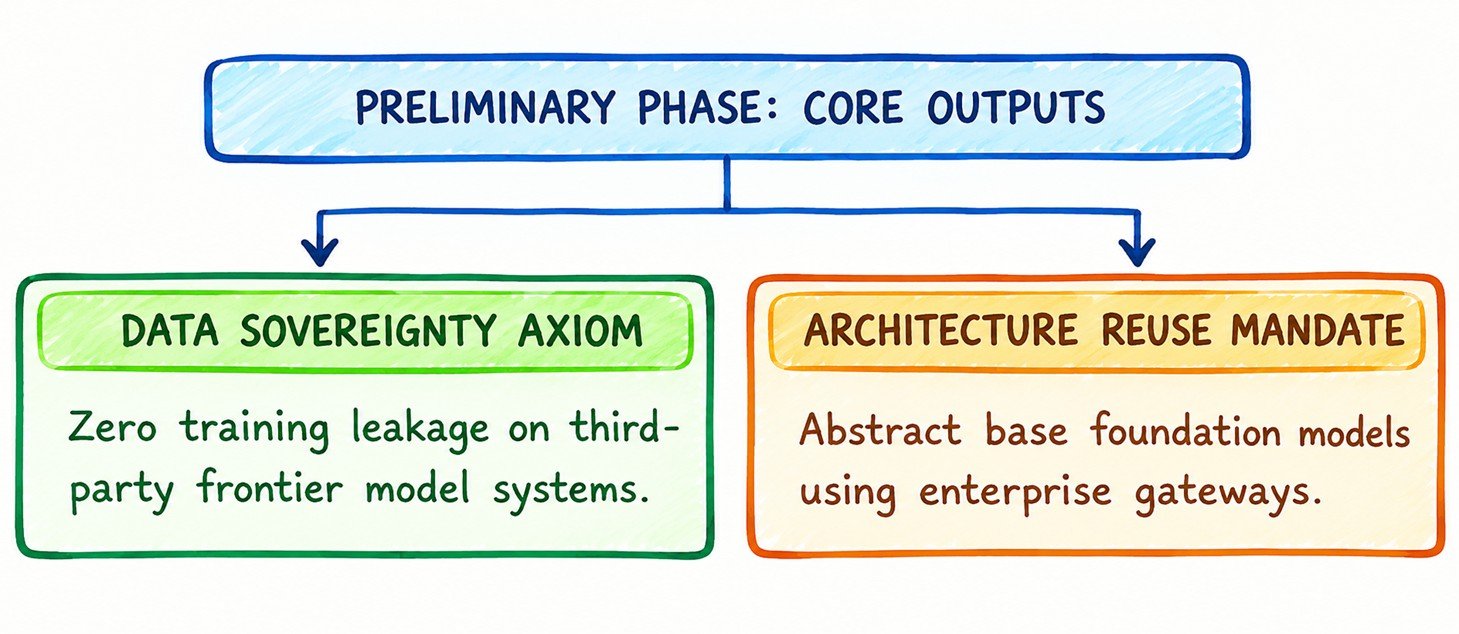
The Preliminary Phase defines how the enterprise will architect AI before a single project starts. The CoE’s goal here is to establish the environmental constraints, toolchains, and immutable architectural axioms that govern all subsequent AI initiatives.
Defining AI Architecture Axioms
The CoE establishes non-negotiable principles that balance velocity with risk management. Two foundational axioms include:
- The Data Sovereignty Axiom: No enterprise data, customer interaction history, or intellectual property may be used to train or fine-tune public, multi-tenant frontier models. This constraint forces downstream architectures to prioritize Retrieval-Augmented Generation (RAG), local open-weights deployments, or contractually protected, isolated model instances.
- The Model Decoupling Axiom: Application logic must never be tightly coupled to a specific foundation model provider's proprietary API. All interactions must go through an enterprise-managed abstraction layer. This ensures the enterprise can swap underlying models as market performance and token economics shift.
Tailoring the Architecture Footprint
During this phase, the CoE updates the organization's existing Architecture Repository to support AI-specific components, including:
- Model Catalogs: Approved foundation models categorized by capability tier (e.g., lightweight routing models vs. reasoning frontier models).
- Vector Infrastructure Registries: Standardized vector databases and embedding models to ensure consistent semantic search indexing across departments.
2. Phase A: Architecture Vision and AI Demarcation
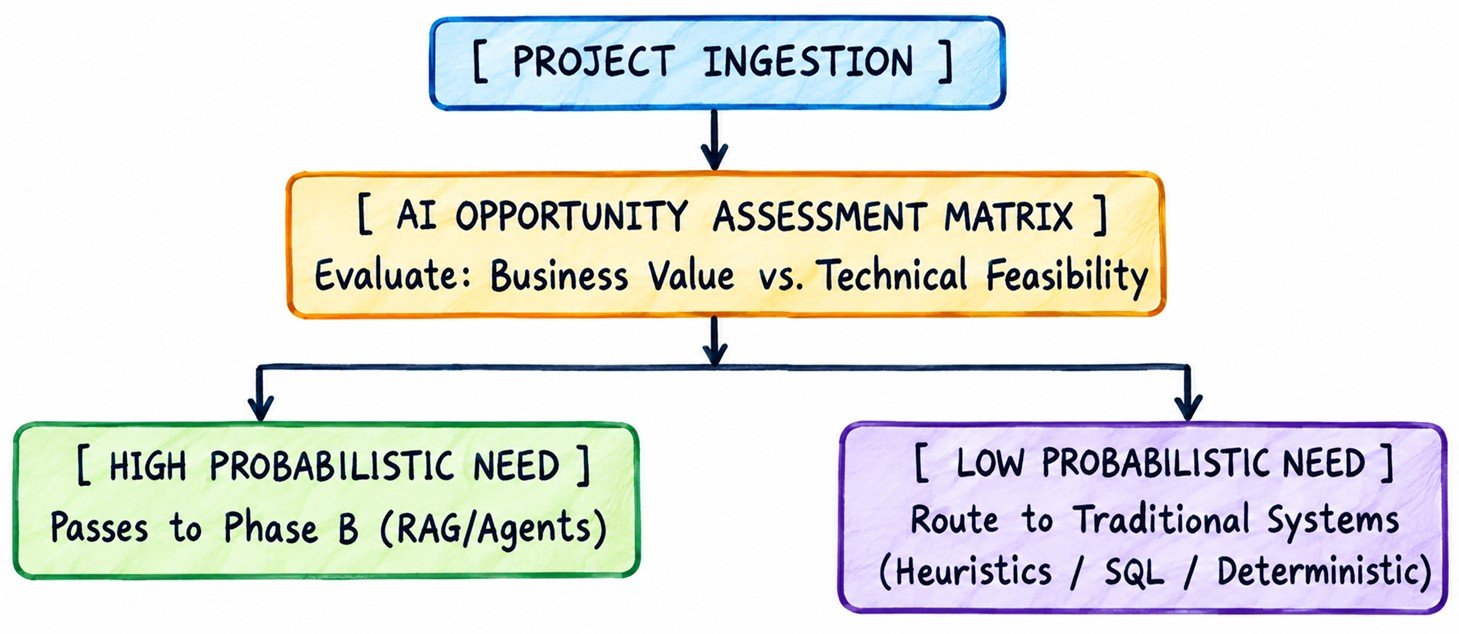
Phase A establishes the scope, constraints, and business value of a specific AI initiative. The CoE acts as a gatekeeper here, using the AI Opportunity Assessment Matrix to separate high-value use cases from projects that are simply "AI-washing".
Demarcation: Probabilistic vs. Deterministic Realities
The CoE evaluates new project proposals against three strict criteria to determine if a probabilistic LLM is truly required:
- Complexity of Input/Output: Does the use case require processing unstructured data (e.g., natural language contracts, audio transcripts) that cannot be parsed by standard regex or relational logic?
- Tolerance for Variance: Can the business process tolerate minor output variations? If a task requires absolute mathematical accuracy (such as calculating core financial ledgers), the CoE routes it to a deterministic application.
- Contextual Dependency: Does the decision-making process change based on subtle, unstructured context, or can it be handled by a defined tree of
if/elsestatements?
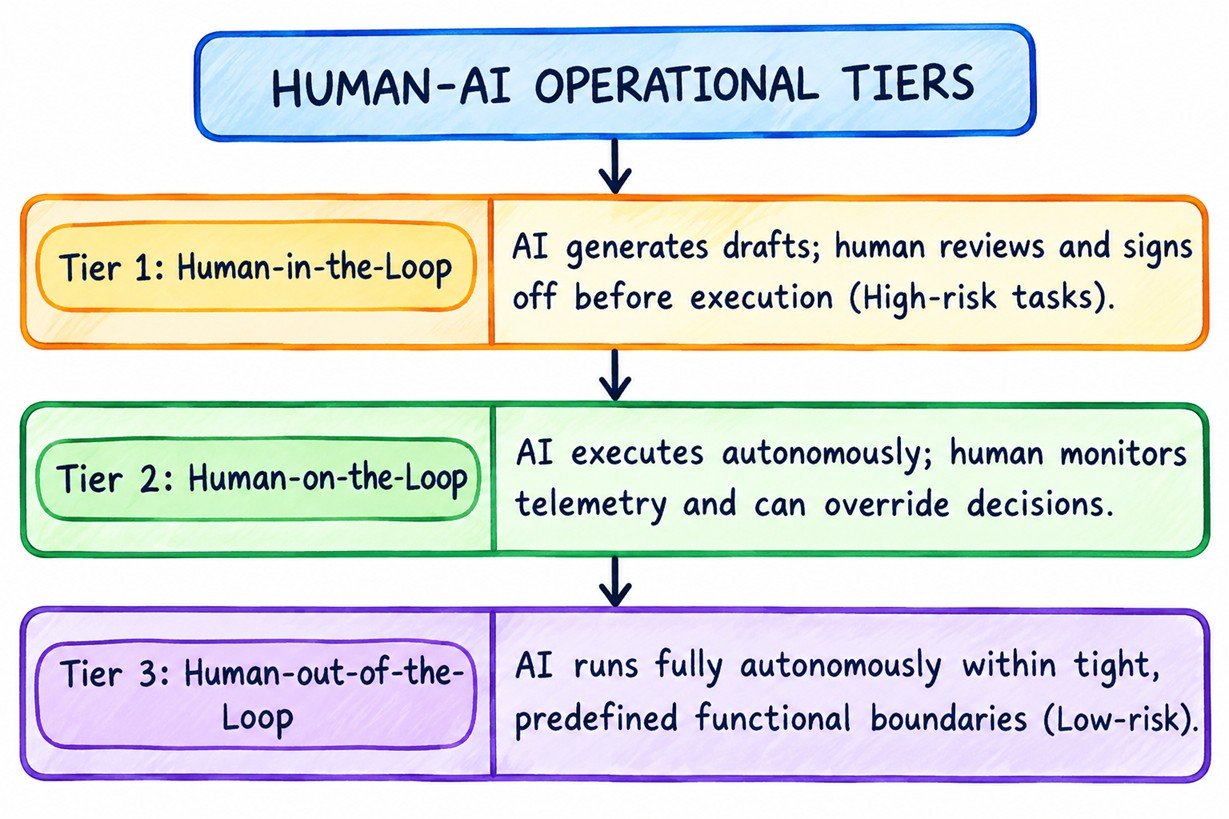
Designing Human-AI Interaction Tiers
When establishing the Architecture Vision, the CoE defines the human-in-the-loop (HITL) pattern based on operational risk:
3. Phase B: Business Architecture and Workflow Decomposition
Phase B maps out how business processes change when probabilistic intelligence is introduced. The CoE ensures teams do not simply place an LLM wrapper over an outdated, inefficient process. Instead, they decompose workflows into modular tasks.
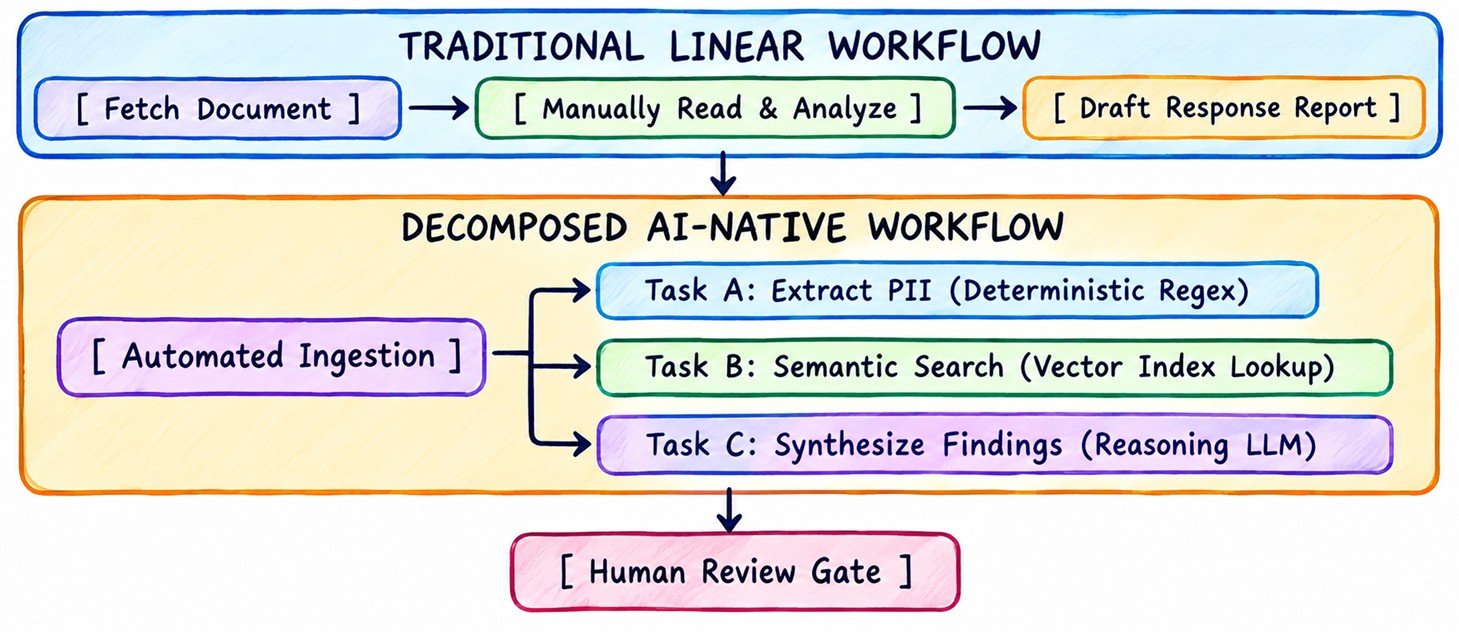
Modular Workflow Decomposition
Consider a complex business process like processing insurance claims. Rather than using a single prompt to evaluate an entire claim file, the CoE guides architects to break the process down into discrete steps:
- Extraction Task: A highly constrained, structured extraction model pulls names, policy numbers, and dates (low token cost).
- Validation Task: A deterministic SQL query verifies those policy numbers against the core database.
- Synthesis Task: A retrieval-augmented model compares the claim details against policy guidelines to generate a summary for an adjuster.
This decomposition keeps token costs under control, lowers the risk of hallucinations, and makes it easier to troubleshoot specific points in the workflow.
4. Phase C: Information Systems Architecture (Data & Application)
Phase C defines the technical systems and data structures required to support the AI capability. For probabilistic systems, this phase is divided into two distinct engineering challenges: Data Architecture and Application Architecture.
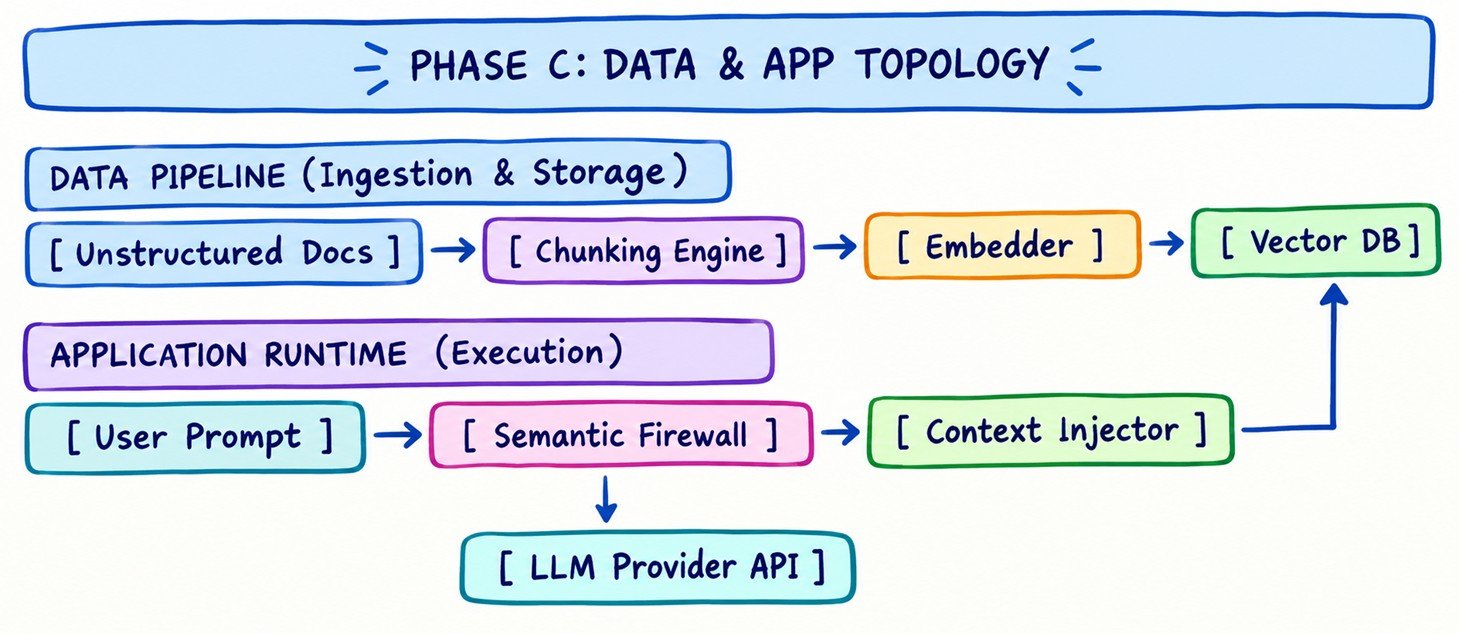
Data Architecture: Structuring Enterprise Knowledge
The CoE provides explicit patterns for data ingestion pipelines destined for vector stores and RAG platforms:
- Deterministic Chunking Strategies: Rather than relying on arbitrary character limits, the CoE mandates semantic-aware chunking (e.g., breaking text by document headers, Markdown sections, or specific logical paragraphs) to preserve context.
- Metadata Enrichment: Every ingested text chunk must be tagged with access control lists (ACLs), creation dates, and source tracking. This ensures the application layer can filter out stale information or restrict unauthorized users from accessing sensitive data during vector queries.
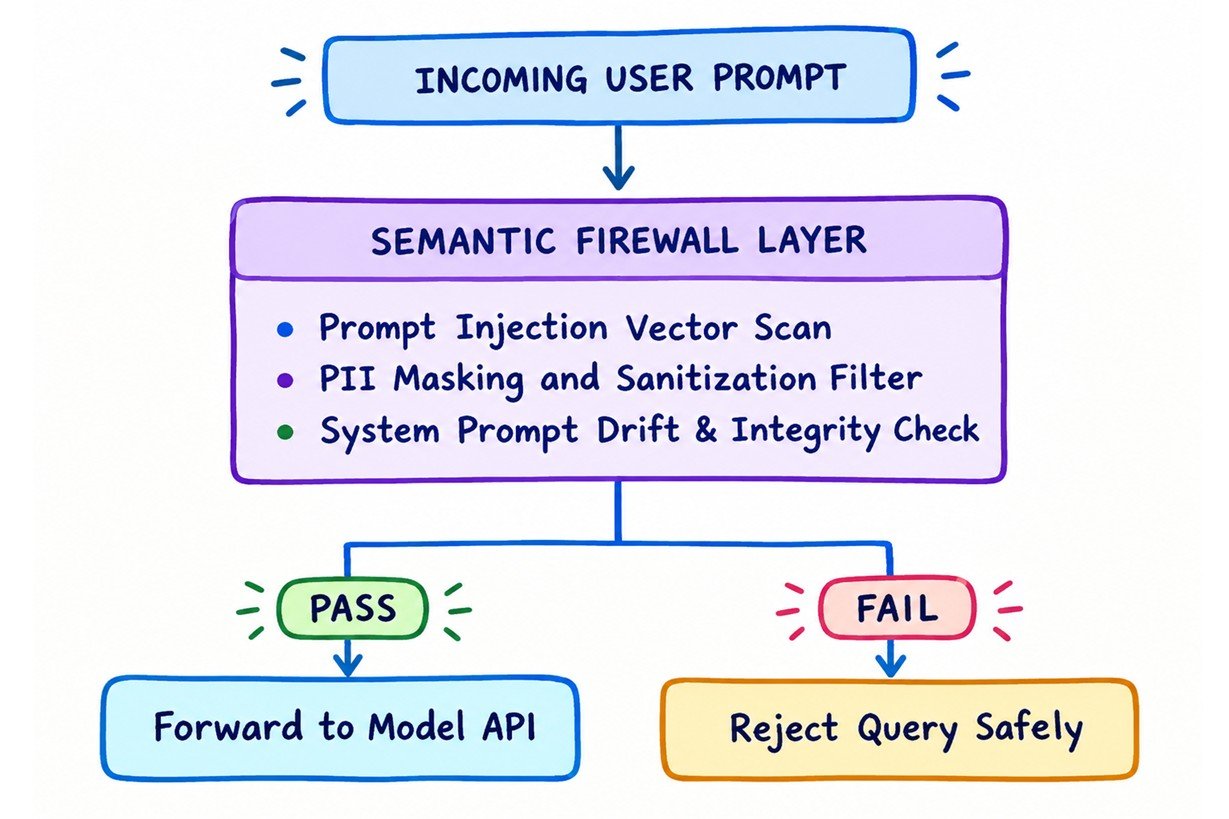
Application Architecture: The Semantic Firewall Pattern
To secure the application runtime, the CoE requires all AI applications to deploy a Semantic Firewall pattern directly before the LLM gateway:
5. Phase D: Technology Architecture and Infrastructure Topology
Phase D defines the hardware and software infrastructure that powers the AI platform. The CoE's core responsibility here is optimizing computing resources and managing the economics of model token consumption.
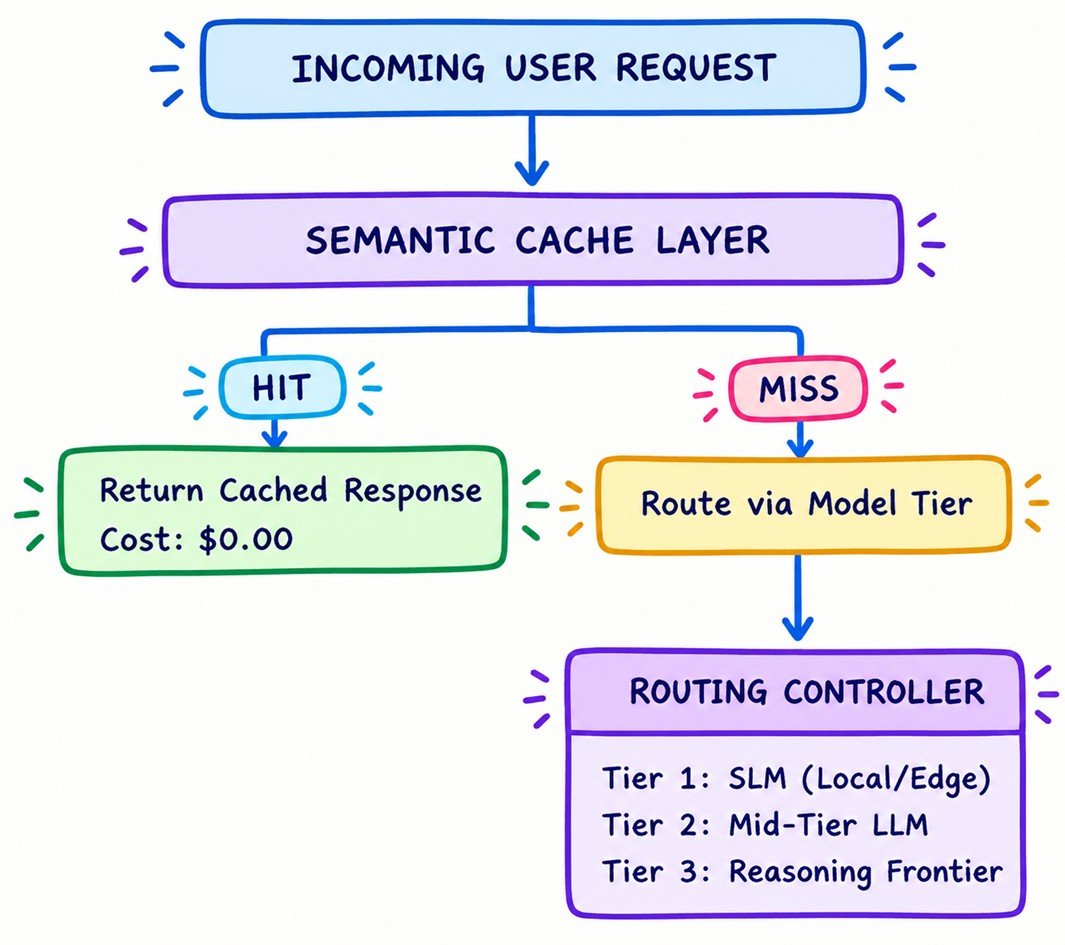
Implementing Semantic Caching
To avoid paying for the same LLM inference repeatedly, the CoE deploys centralized semantic caches. Unlike traditional key-value caches that look for exact string matches, a semantic cache evaluates the vector distance between incoming queries. If an incoming question is semantically close to a previously answered question (e.g., "How do I reset my password?" vs. "Reset my password"), the platform returns the cached response instantly. This reduces model latency and avoids external API costs.
Cost-Optimized Model Routing Infrastructure
The CoE configures the platform gateway to direct requests dynamically based on the required intelligence level:
- Tier 1: Small Language Models (SLMs): Local, open-weights models (e.g., 8B parameters) handle basic filtering, classification, and simple formatting tasks at minimal cost.
- Tier 2: Commercial Mid-Tier Models: General-purpose cloud models handle standard retrieval and summarization tasks.
- Tier 3: Commercial Frontier Models: Premium reasoning models are reserved for complex logic synthesis, multi-step problem solving, or code generation.
6. Phase G: Implementation Governance and Production Readiness
Phase G sets the final quality and security gates before an AI application goes live. The CoE uses automated frameworks to evaluate the system against non-deterministic failure modes.
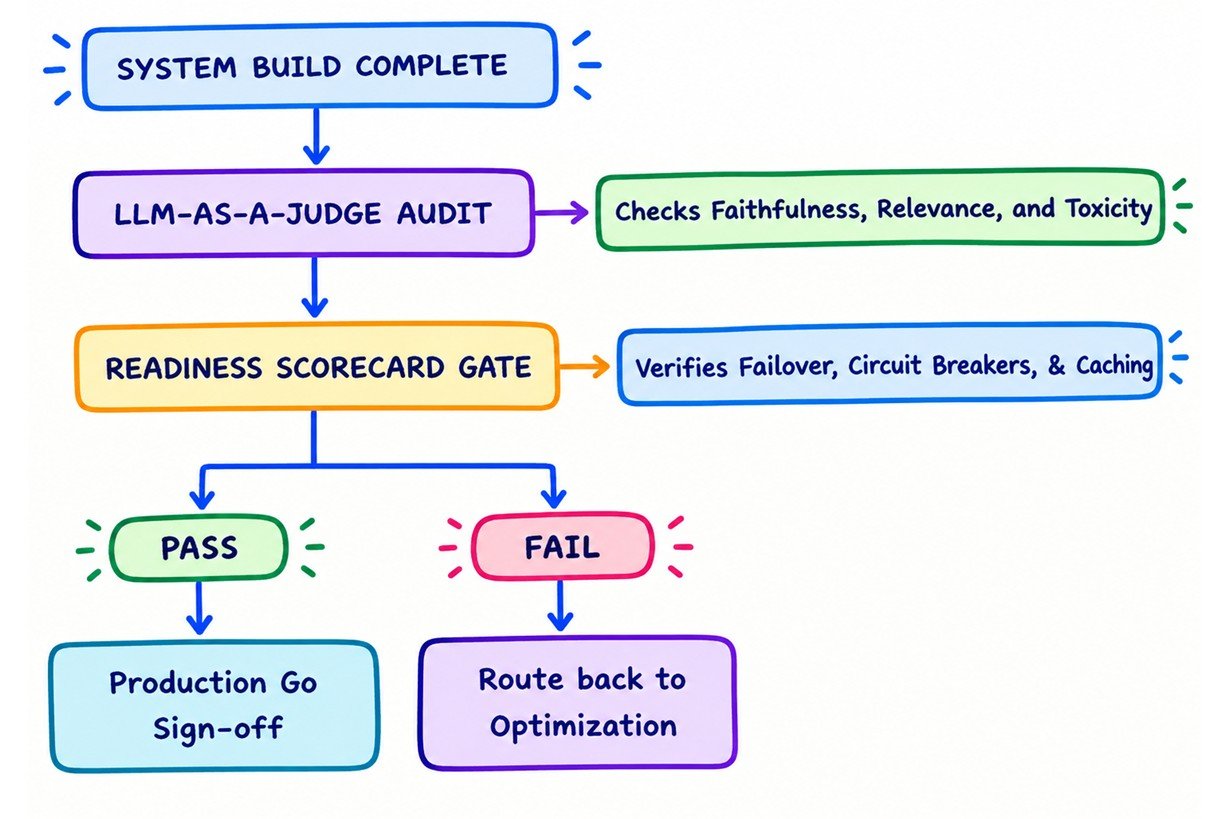
The LLM-as-a-Judge Evaluation Framework
Because system outputs are probabilistic, traditional unit tests cannot determine if a response is correct. The CoE establishes automated pipelines that evaluate outputs using specialized evaluator models running across "golden datasets":
- Faithfulness Scores: The judge model checks the generated response against the retrieved source documents to ensure the system did not invent information (hallucinate).
- Answer Relevance Scores: The judge measures how directly the system response answers the user's original query, helping flag vague or incomplete answers.
- Toxicity and Safety Overlays: Automated test runs attempt to trick the application using adversarial prompt injections to confirm the security layers cannot be bypassed before launch.
Production Readiness Scorecard
Before deployment approval, the application team must verify that their technical design includes essential stability patterns:
- Provider Failovers: The application can automatically switch to an alternative backup model provider if the primary API suffers an outage or severe latency spikes.
- Circuit Breakers: Rate limiters are built into the design to prevent runaway recursive agent loops from consuming the application's entire token budget in minutes.
4. Key Performance Indicators (KPIs) for the CoE Leader
To ensure the AI CoE remains focused on practical business impact rather than vanity metrics, its performance must be measured through quantitative architectural and financial KPIs.
Enablement & Velocity Metrics
-
Idea-to-Staging Time (ITS): The average duration required for a product team to advance a raw AI concept into a functional staging environment using the CoE's core platform tools. Target: Less than 5 business days.
-
Platform Adoption Rate: The percentage of enterprise AI workloads natively deployed on the centralized Enterprise AI Platform versus those built on bespoke, siloed infrastructure. Target: Greater than 85%.
-
Component Reuse Factor: The average frequency with which a shared asset, such as an optimized system prompt, a fine-tuned model, or a custom data-cleansing module, is leveraged across multiple distinct business units.
Governance & Sustainability Metrics
-
Cost per Successful Task (CPST): The definitive FinOps benchmark for Generative AI. It measures the net token and compute spend required to achieve a successful user outcome, explicitly excluding costs from retries, failures, and routing errors. A mature CoE aggressively reduces CPST through semantic caching and dynamic routing.
-
Guardrail Deflection Rate (GDR): The percentage of inbound production queries intercepted and safely resolved by enterprise semantic firewalls before reaching an external foundation model API.
-
Vulnerability Remediation Velocity: The elapsed time required for the CoE to deploy an emergency patch, such as an updated defensive prompt layer, to neutralize a zero-day prompt injection vulnerability across all live enterprise applications simultaneously.
Architectural Disclaimer
This architectural guide is intended exclusively for educational and strategic organizational design purposes. Generative AI systems introduce non-deterministic, probabilistic behaviors that vary based on data context, model selection, and prompt configuration. Implementing an AI Center of Excellence requires rigorous legal, data privacy, security, and financial compliance reviews tailored to an enterprise's specific operational environment and regulatory obligations.