What intelligence does the product actually require?
Enterprise leaders frequently make the mistake of over-engineering their AI solutions. They select the largest available foundation model before defining the specific nature of the problem. This approach leads to inflated compute costs, unacceptable latency, and fragile production environments.
To build a robust, production-ready system, enterprise architects and AI leaders must reverse this pipeline. You must first determine the exact level of cognitive capability your application demands by categorizing business requirements into specific Cognitive Tiers. This alignment protects operational margins, ensures technical viability, and maps technical execution directly to business value.
The Four Tiers of the Cognitive Continuum
[Pattern Recognition] ──> [Information Synthesis] ──> [Complex Reasoning] ──> [Agentic Execution]
1. Pattern Recognition
- Core Capability: Statistical classification, sequence labeling, and deterministic mapping.
- Operational Definition: This tier processes structured or semi-structured inputs to match known distributions. It requires zero generative reasoning, zero creative variance, and minimal contextual windowing.
- Common Workloads:
- High-throughput ticket classification.
- Real-time sentiment scoring for customer telemetry.
- Named Entity Recognition (NER) for compliance screening.
- Architectural Target: Small, fine-tuned Encoder-only models (e.g., BERT-derivatives), highly distilled Open-Source Large Language Models (LLMs), or specialized classical machine learning pipelines.
- Strategic Advantage: Sub-millisecond latency, predictable token costs (often fractional cents per million tokens), and near-zero hallucination risk.
2. Information Synthesis
- Core Capability: Contextual compression, semantic aggregation, and cross-modal translation.
- Operational Definition: This tier ingests high-volume, unstructured text or data and condenses it into highly structured, actionable summaries or structured schemas (JSON/XML) based explicitly on the provided context.
- Common Workloads:
- Multi-document legal contract analysis and delta generation.
- Retrieval-Augmented Generation (RAG) pipelines for internal knowledge bases.
- Automated generation of standardized customer support drafts.
- Architectural Target: Medium-sized Decoder-only models (7B to 70B parameters) optimized for long-context windows, paired with robust vector databases and semantic rerankers.
- Strategic Advantage: High information throughput, moderate cost efficiency, and structured output formatting capable of feeding downstream systems.
3. Complex Reasoning
- Core Capability: Multi-step logic, symbol manipulation, deterministic calculation execution, and conflict resolution.
- Operational Definition: This tier handles tasks where the answer is not explicitly found within a single context block. The system must navigate conflicting data points, execute algorithmic or mathematical constraints, and reason through implicit premises.
- Common Workloads:
- Billing dispute arbitration involving corporate contracts and historical invoice ledgers.
- Automated software code generation, refactoring, and static analysis.
- Supply chain optimization modeling under shifting geopolitical or weather constraints.
- Architectural Target: Frontier-class models or specialized "reasoning tokens" models (e.g., OpenAI o-series, DeepSeek-R1) utilizing Chain-of-Thought (CoT) prompting, external code-interpreter sandboxes, and verification loops.
- Strategic Advantage: Superior cognitive accuracy for edge cases, capability to solve non-linear problems, and self-verifying logic paths.
4. Agentic Execution
- Core Capability: Dynamic planning, environment tool invocation, self-correction, and open-ended goal realization.
- Operational Definition: The highest tier of intelligence. The system is given an objective rather than a sequence of instructions. It evaluates its state, selects appropriate enterprise APIs (tools), inspects the return values, self-corrects upon failure, and iterates until the goal state is achieved.
- Common Workloads:
- Autonomous procurement agents optimizing vendor selection and executing purchases.
- End-to-end automated software engineering agents handling repository-wide issue resolution.
- Hyper-personalized, omni-channel customer lifecycle management.
- Architectural Target: Advanced Agentic Frameworks (e.g., LangGraph, AutoGen) orchestrating mixtures of frontier models, deterministic validation engines, human-in-the-loop (HITL) guardrails, and persistent state management.
- Strategic Advantage: Unprecedented operational leverage, true workflow automation, and the transformation of AI from an assistant into an autonomous digital colleague.
Architectural Matrix for Solution Architects
| Cognitive Tier | Primary Model Class | Target Latency | Unit Cost Profile | Failure Mode | Mitigation Strategy |
|---|---|---|---|---|---|
| Pattern Recognition | Encoder-only / SLMs (< 3B) | < 50ms | Ultra-Low ($0.01/M tokens) | Misclassification | Calibration, threshold gating |
| Information Synthesis | Mid-tier LLMs (7B–70B) | 500ms – 2s | Low-Moderate ($1.00/M tokens) | Hallucination / Omission | Strict RAG guardrails, system prompts |
| Complex Reasoning | Frontier / Reasoning Models | 2s – 15s | High ($15.00/M tokens) | Logical Fallacy / Drift | Chain-of-Thought validation, Unit tests |
| Agentic Execution | Multi-Model Orchestration | Variable (Minutes) | Ultra-High (Per-session cost) | Infinite loops / Rogue actions | Human-in-the-loop, State boundaries |
Case Study: Composite Architecture in Modern Customer Support
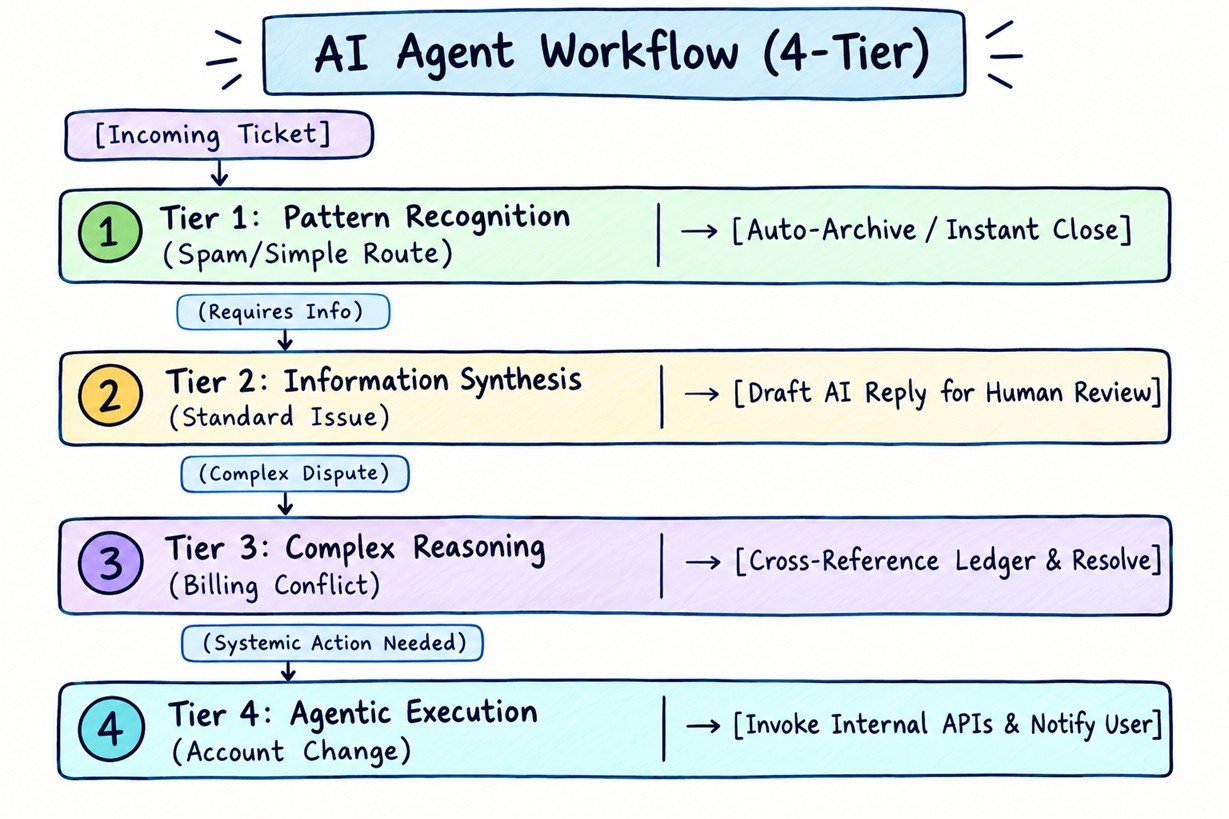
Mapping your product requirements to these tiers prevents the misapplication of technology. A modern, margin-optimized Customer Support System does not pass every incoming query to a frontier reasoning model. Instead, it utilizes a cascaded, tiered approach:
-
Ingress Guardrail (Pattern Recognition): A 1-billion parameter model categorizes incoming tickets. Spam is culled instantly; standard inquiries are tagged. Cost saved: 98% compared to brute-force LLM routing.
-
Context Assembly (Information Synthesis): For standard inquiries (e.g., "Where is my order?"), a mid-tier model reads the CRM data, extracts relevant tracking links, and synthesizes a polite response template.
-
Escalation Logic (Complex Reasoning): If the ticket involves a billing dispute where the user claims a discount code was unapplied over a three-month period, the system escalates to a reasoning model. The model computes the mathematical delta across multiple historic invoices.
-
Action Execution (Agentic Execution): Once the billing error is verified, an autonomous agent is spun up to invoke payment gateway APIs, apply the credit refund, update the internal database record, and draft a final closing confirmation email.
The Engineering Leadership Mandate
Defining these operational boundaries is not just a technical exercise. It is a fiscal imperative that directly protects your operational margin. Over-provisioning intelligence destroys unit economics. Under-provisioning intelligence destroys user trust.
As technology leaders, your goal is to build minimum viable intelligence architectures: solve the business challenge using the lowest cognitive tier possible, escalating to higher tiers only when the complexity of the data structure absolutely demands it.
The Cognitive Efficiency Audit: Technical Checklist for Architects
This checklist is designed for Enterprise and Solution Architects to evaluate existing AI production workloads. Use it to identify over-engineered architectures (intelligence waste causing high cost/latency) and under-engineered systems (insufficient cognitive depth causing fragility or hallucinations).
🏗️ Phase 1: Workload Profiling & Taxonomy Mapping
1. Core Cognitive Classification
Run every distinct component of the AI workload through this decision matrix. A single application may contain multiple sub-workloads.
-
Does the task require generating new natural language or code?
- No (e.g., classification, entity extraction, sentiment, embedding generation) → Target Tier 1: Pattern Recognition
-
Does the task require aggregating, restructuring, or condensing provided data?
- Yes, and all required information is explicitly present in the input context → Target Tier 2: Information Synthesis
-
Does the task require multi-step logic, calculation, or resolving conflicting data?
- Yes, it requires logical deduction or calculation over static information → Target Tier 3: Complex Reasoning
-
Does the task require the system to decide its own next steps, call external APIs, and self-correct?
- Yes, it accepts an open-ended goal and operates autonomously → Target Tier 4: Agentic Execution
🔍 Phase 2: Tier-by-Tier Architectural Verification
Tier 1: Pattern Recognition Audit
Target: Deterministic, Ultra-low latency, Minimum Cost
- Model Scaling: Is a generative LLM (e.g., GPT-4o, Claude 3.5 Sonnet) being used for classification or extraction? If yes, flag for migration to an Encoder-only model (BERT, RoBERTa) or a Small Language Model (SLM < 3B parameters) via fine-tuning.
- Input/Output Determinism: Are outputs validated using strict schemas (e.g., Pydantic, JSON mode)?
- Latency Bounds: Is the P99 latency under 50ms? If not, audit token bloat or model size.
- Cost Efficiency: Is the cost profile below $0.05 per 1,000 requests?
Tier 2: Information Synthesis Audit
Target: High Throughput, Context-Bounded Contextuality
- Context Window Management: Are you stuffing massive raw documents into the context window without preprocessing? (Flag for chunking optimization or semantic reranking).
- Grounding Verification: Is there an explicit evaluation pipeline (like Ragas or TruLens) calculating Faithfulness (hallucination check) and Answer Relevance?
- Prompt Rigour: Does the system prompt explicitly state: "If the answer cannot be found in the provided text, state that you do not know"?
- Model Right-Sizing: Can this workload be run on an open-weight 8B or 70B model (e.g., Llama 3) hosted on internal inference infrastructure rather than a commercial frontier API?
Tier 3: Complex Reasoning Audit
Target: Deep Logic, High Accuracy, Verification
- Reasoning Triggers: Are you paying for expensive "reasoning tokens" (e.g., OpenAI
o1/o3or DeepSeek-R1) for simple text formatting tasks? (Ensure reasoning models are only used when math, code logic, or systemic constraints apply). - Deterministic Offloading: Is the model trying to do mental math or string reversal? If yes, integrate a Code Interpreter sandbox or function-calling tool so the model writes code to compute the answer rather than guessing.
- Chain-of-Thought (CoT) Isolation: Are intermediate reasoning steps hidden from the end-user but captured in logs for debugging and telemetry?
Tier 4: Agentic Execution Audit
Target: High Autonomy, State Management, Strong Guardrails
- State & Memory Management: Is the agent stateful? Does it gracefully handle session dropouts, long-running asynchronous tasks, and token window exhaustion?
- Termination Conditions: Does the agent framework have explicit guardrails against infinite looping (e.g., max loop iteration ceiling set to ≤ 5 or 10)?
- Blast Radius & Security: Are tool invocations executed in isolated, short-lived container environments (sandboxes)? Does the agent possess destructive write access to production databases without human approval?
- Human-in-the-Loop (HITL): Are there explicit breakpoints for high-risk actions (e.g., processing refunds, sending external emails, altering system states) requiring human authorization?
📈 Phase 3: Financial & Operational Telemetry
- Unit Economic Tracking: Do you have distributed tracing (e.g., OpenInference, LangSmith, Phoenix) tracking Cost per User Session and Tokens per Dollar broken down by feature?
- Cache Hit Ratio: Are semantic caching layers (e.g., GPTCache) implemented for repetitive synthesis or pattern queries to bypass the model entirely?
- Time-to-First-Token (TTFT): Is TTFT optimized via streaming for all Tier 2, 3, and 4 workloads to ensure user engagement isn't degraded by high processing times?
📋 Audit Scorecard Summary
📋 Audit Scorecard Summary
| Metric | Current State | Target State | Action Required |
|---|---|---|---|
| Tier Alignment | e.g., Tier 1 task on Tier 3 model | Tier 1 task on Tier 1 model | Migrate ticket classification to fine-tuned Llama-3-8B |
| Avg. Session Cost | |||
| P95 Latency | |||
| Failure Rate |
Framework to Calculate the Return on Investment (ROI) When Optimizing Architectures
We will build a cost-benefit estimation tool formula to calculate the exact ROI of downgrading a specific workload from Tier 3 to Tier 1.
To find the exact economic impact, we isolate Monthly Operational Cost Reductions against your One-Time Engineering Migration Investment.
1. The Core ROI Formula

Where Amortization Period is typically calculated over 12 months for enterprise AI software lifecycles.
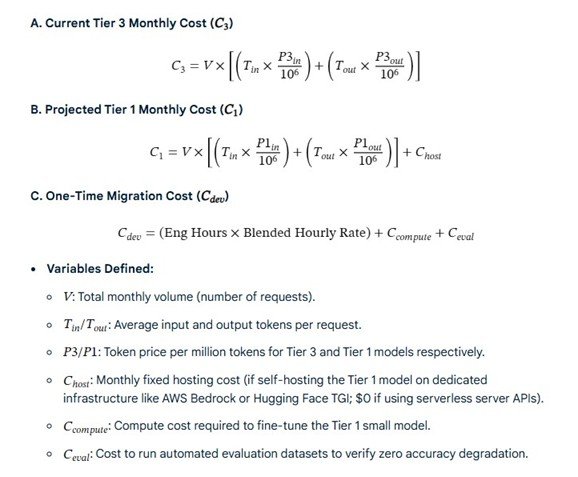
2. Breakdown of Components
3. Financial Thresholds for Tech Leaders
AI Architecture Downgrade ROI Calculator
When migrating your workloads down the cognitive continuum from Tier 3 (Complex Reasoning) to Tier 1 (Pattern Recognition), you can calculate your localized enterprise ROI using the interactive matrix below:
AI Architecture Downgrade ROI Calculator
Workload Dynamics
Blended Token Pricing ($ / 1M tokens)
Implementation Next Steps
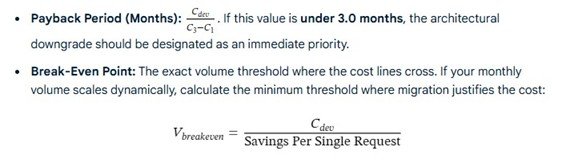
If the calculation widget above renders a payback period under 3.0 months, engineering leaders are advised to immediately schedule a task-migration pilot.