Hosted vs. self-hosted models
Introduction
For technology leaders like CTOs, VPs, and Directors, the choice between consuming AI through hosted third-party APIs and deploying self-hosted open-weight models is a fundamental architectural decision. This choice determines your long-term cost structures, engineering velocity, and corporate risk profile.
While hosted APIs offer unparalleled time-to-market and remove infrastructure burdens, they demand compromises on data sovereignty, predictable operational expenses, and operational control. Conversely, self-hosting provides ultimate control and long-term cost predictability at the expense of upfront engineering capital and operational complexity. This guide provides a comprehensive framework to evaluate, execute, and scale your enterprise AI infrastructure strategy.
Architectural Deep Dive: The Operational Realities
Hosted Third-Party APIs (AI-as-a-Service)
Hosted APIs treat large language models (LLMs) as black-box utilities. Infrastructure management, hardware procurement, model optimization (such as quantization and speculative decoding), and availability SLAs are entirely abstracted away by vendors like OpenAI, Anthropic, or Google.
-
The Advantage: Development teams can build production-ready applications inside a single sprint using standard REST APIs or SDKs.
-
The Technical Debt: You are bound to the provider's runtime environment, default context window management, and proprietary safety guardrails, which can introduce unannounced behavior shifts.
Self-Hosted Open-Weights Models
Self-hosting involves deploying open-source or open-weight models (such as Meta's Llama series, Mistral, or Mixtral) within your own corporate infrastructure. This can be inside a virtual private cloud (VPC) on AWS, GCP, or Azure, or directly on bare-metal on-premise GPU clusters.
-
The Advantage: Complete visibility into the model weights, logits, and activation layers. This enables deep optimization through fine-tuning (LoRA, QLoRA, full parameter tuning), custom inference engines (vLLM, TensorRT-LLM), and tailored system prompts.
-
The Technical Debt: Your engineering organization assumes the burden of infrastructure provisioning, GPU orchestration, auto-scaling under fluctuating traffic, and maintaining low-latency inference pipelines.
Dimension 1: Data Privacy, Sovereignty, and Regulatory Compliance
For enterprises operating in highly regulated verticals like healthcare (HIPAA), banking and finance (SEC, FINRA, GDPR), and defense, data exposure is a binary risk.
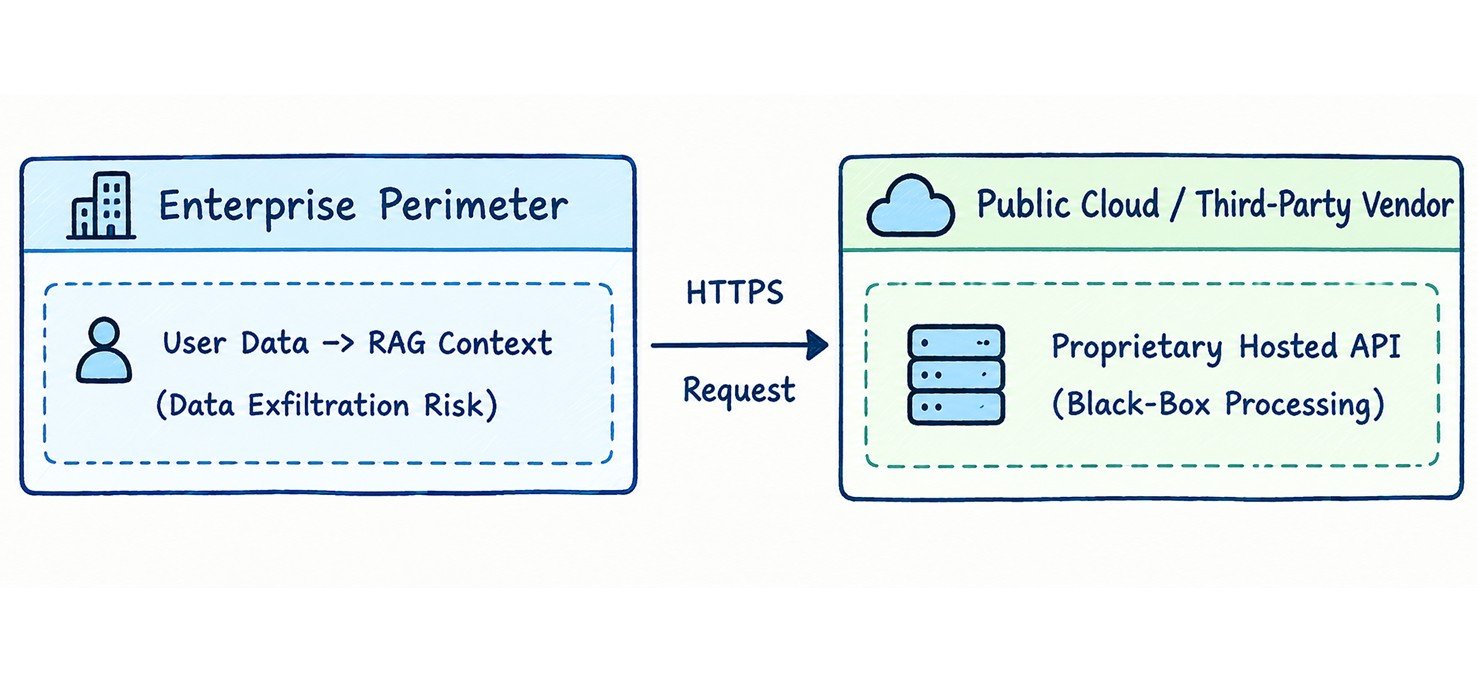
Data Exfiltration and Vendor Trust
When utilizing a hosted API, every prompt, system instruction, and piece of Retrieval-Augmented Generation (RAG) context leaves your secure corporate perimeter. Even when providers contractually agree not to use corporate data for model training, the data still transits through external networks and resides temporarily on third-party logging and auditing servers. This architectural pattern increases your surface area for data breaches, man-in-the-middle attacks, and compliance violations.
Regional Sovereignty and Local Compliance
Global regulations increasingly mandate that citizen data must not cross geopolitical borders. If a hosted API provider processes requests in a data center outside your jurisdiction, you face immediate non-compliance. Self-hosting open-weight models within regionally locked VPCs guarantees that data never leaves its designated geographical boundaries, satisfying strict data residency laws.
Auditability and Forensic Controls
In the event of an anomalous model output or security incident, hosted APIs offer zero visibility into the underlying state transitions. Self-hosting allows your security teams to implement comprehensive logging at the infrastructure, application, and model layer. You can audit every token generation step, examine log probabilities, and ensure that safety filters are executed deterministically within your own firewalls.
Dimension 2: Cost Scale Dynamics and Total Cost of Ownership (TCO)
The financial trajectory of enterprise AI applications changes dramatically as workflows transition from pilot phases to global production scale.
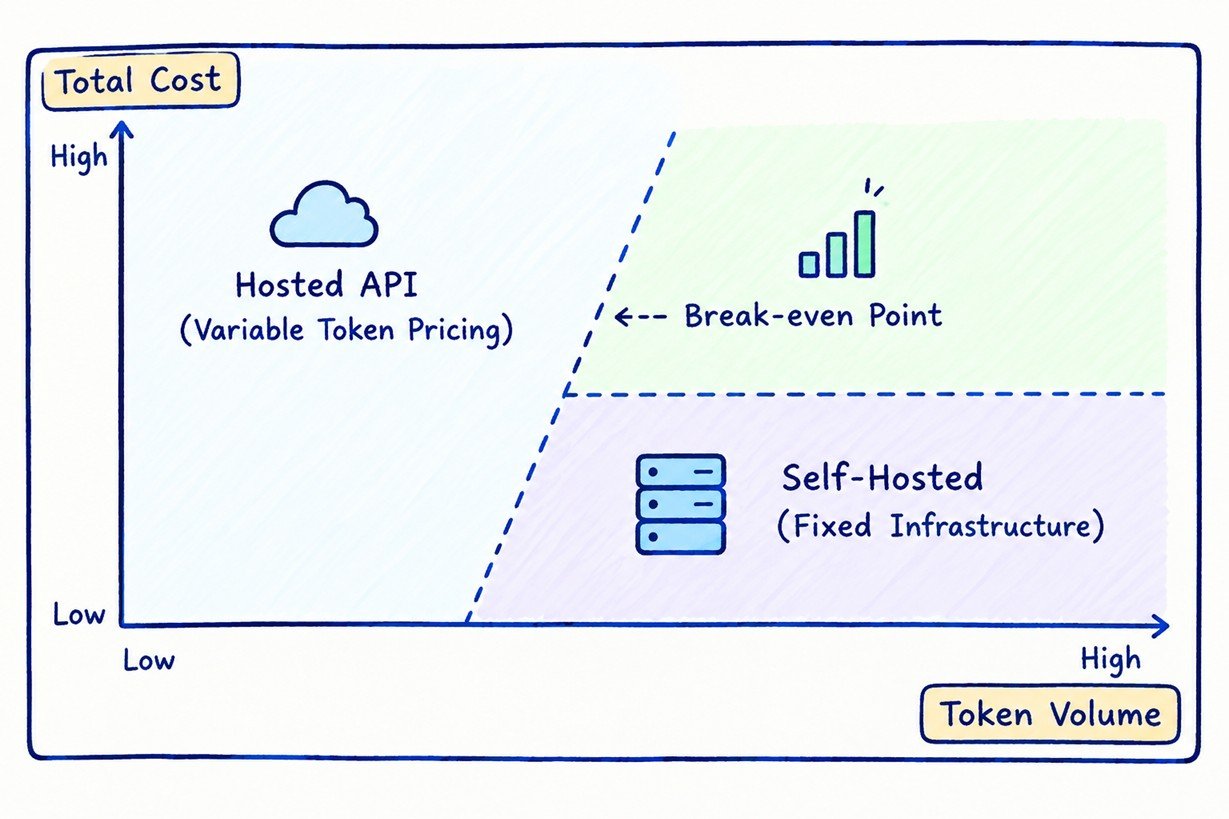
The Inherent Trap of Variable Token Pricing
Hosted APIs operate on a variable utility model, typically charging per million input and output tokens. For rapid prototyping and low-volume applications, this model is highly economical, eliminating any capital expenditure (CapEx).
However, as applications scale to millions of daily active users, or when pipelines ingest massive context windows for RAG and document analysis, token expenses can scale rapidly. The marginal cost of an API call remains largely tied to usage, meaning scale does not automatically yield traditional software cost efficiencies.
Shifting from OpEx to Fixed CapEx/Infrastructure Costs
Self-hosting shifts your financial model from unpredictable operational expenses (OpEx) to predictable infrastructure investments. Whether renting dedicated instances (such as AWS p4/p5 instances or GCP A3 instances) or purchasing physical hardware, your costs are largely bounded by your compute footprint.
Once your baseline token throughput crosses the economic break-even point, self-hosted models can deliver a significantly lower cost per token compared to public APIs.
Hidden Overhead of Self-Hosting
To calculate a true TCO for self-hosting, leaders must account for factors beyond raw compute costs:
-
Engineering Capital: The dedicated hours of DevOps, MLOps, and infrastructure engineers required to configure, monitor, and maintain the inference clusters.
-
Underutilization Costs: Unlike hosted APIs where you pay primarily for active inference, self-hosted GPUs incur costs continuously while provisioned. If your traffic is highly cyclical with deep utilization troughs, unutilized hardware diminishes your cost savings unless dynamic scaling is implemented effectively.
-
Network Ingress/Egress: Moving massive datasets or high-frequency payloads between services across cloud zones can introduce substantial data transfer fees.
Dimension 3: Availability, Control, and Operational Reliability
Production software requires stringent service-level agreements (SLAs), deterministic latencies, and long-term behavioral stability.
| Architectural Dimension | Hosted Third-Party APIs | Self-Hosted Open-Weights Models |
|---|---|---|
| SLA & Reliability | Subject to vendor outages, global capacity constraints, and rate-limiting throttling. | Controlled entirely via internal infrastructure, multi-region redundancy, and dedicated fallbacks. |
| Latency Consistency | Variable. Suffers from noisy-neighbor effects and peak-hour performance degradation. | Highly predictable. Tail latencies (P95/P99) are controlled via dedicated hardware allocation. |
| Model Versioning | Hard deprecation timelines forcing mandatory application rewrites and prompt engineering updates. | Permanent version locking. Models remain unchanged until your team explicitly decides to upgrade. |
| Customization Depth | Limited to high-level prompt engineering, system instructions, and basic fine-tuning APIs. | Unlimited. Direct access to weights for deep quantization, custom fine-tuning, and embedding layer adjustments. |
Mitigating the Risk of System Degradation
Relying on a third-party API introduces structural vulnerabilities to your production stack. If a vendor updates their base model weights, introduces new alignment training, or changes their system prompts, the behavior of your application can shift overnight. Prompts that worked perfectly can break, and structured JSON outputs can become malformed. Self-hosting guarantees absolute behavioral consistency; the model weights are immutable files within your storage buckets.
The Pragmatic Path: Designing a Hybrid Enterprise AI Architecture
Choosing between hosted and self-hosted models is not a binary, winner-take-all decision. The most resilient enterprise architectures utilize a tiered, hybrid approach that matches the workload requirements to the appropriate infrastructure tier.
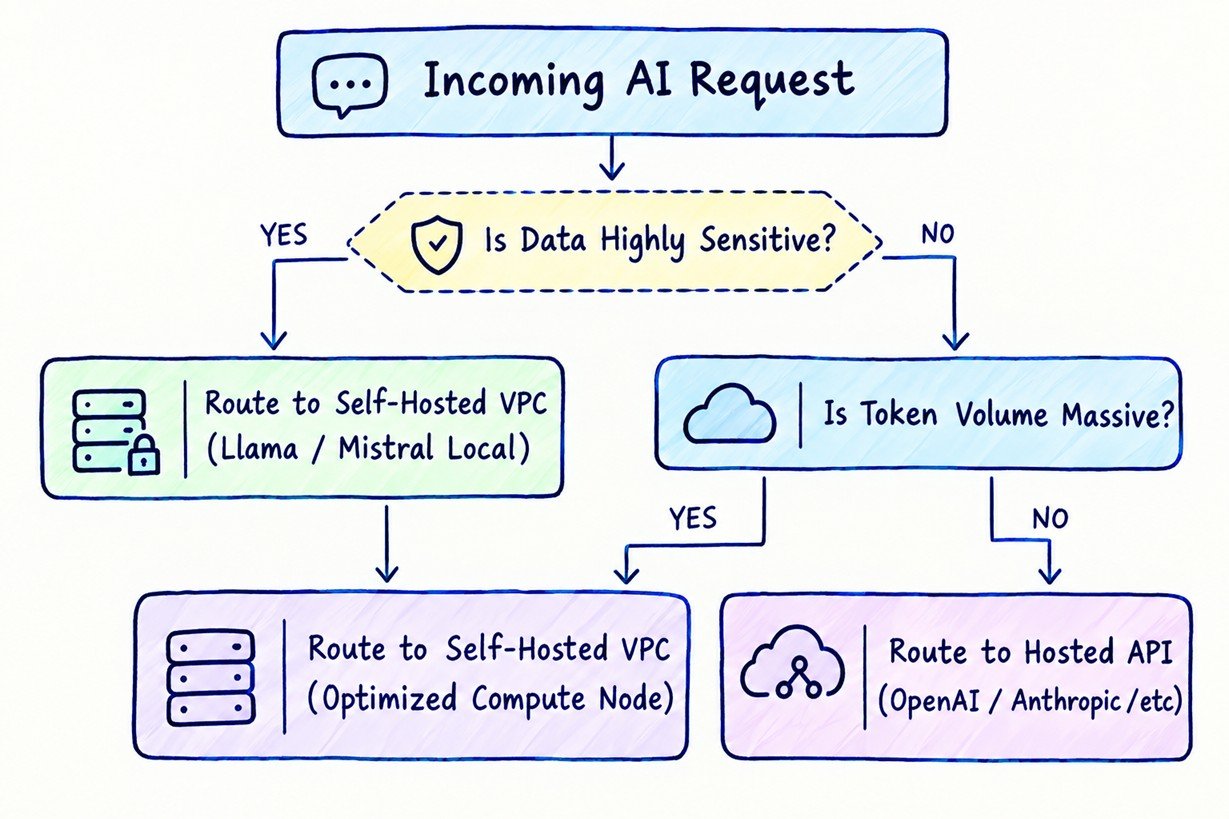
Tier 1: Rapid Prototyping and Exploration (Hosted APIs)
-
Strategy: Utilize premium hosted APIs for greenfield projects, internal hackathons, and alpha features.
-
Justification: Maximizes engineering velocity. Allows your product teams to validate market fit, refine user experiences, and iterate on application logic without waiting for infrastructure provisioning.
Tier 2: Low-Volume, Specialized, or Non-Sensitive Tasks (Hosted APIs)
-
Strategy: Maintain hosted APIs for ancillary workflows, such as offline creative copywriting, generalized content summarization, or complex multimodal reasoning tasks that do not ingest PII or IP.
-
Justification: Avoids dedicating expensive GPU resources to intermittent or low-priority background workloads.
Tier 3: Core, High-Volume Production Workflows (Self-Hosted Open Weights)
-
Strategy: Migrate core enterprise workflows, such as primary customer support bots, automated code synthesis, high-throughput financial document extraction, or internal knowledge-base search, to self-hosted open-weight models.
-
Justification: Protects proprietary enterprise data, reduces exposure to token-based cost scaling, locks in deterministic performance metrics, and protects the business from third-party operational dependency risks.
Implementing the Routing Layer
To operationalize this hybrid model, build or deploy an internal AI Gateway layer. This abstraction layer acts as a proxy between your software applications and the underlying models. It standardizes input/output schemas, handles fallback routing (e.g., falling back to a hosted model if local GPU nodes experience transient failures), enforces rate limits, and dynamically assigns workloads based on data classification and cost-efficiency thresholds.