Small vs. large models
Introduction
For technology executives (CTOs, VPs of Engineering, and Directors of Infrastructure), the monolithic approach to AI deployment is dead. Deploying a massive, hundreds-of-billions-of-parameters frontier model to handle every incoming enterprise request is an operational anti-pattern. It introduces unnecessary latency, inflates token-processing budgets, and introduces critical single-point failure risks.
To build sustainable, production-grade enterprise systems, infrastructure leaders must implement a tiered model strategy. This playbook details the distinct operational profiles of Small and Large Language Models, providing an actionable framework for routing tasks based on the smallest viable architecture.
The Core Trade-off: Diminishing Marginal Returns
When evaluating model architectures, you balance three competing dimensions: model parameter size, operational execution cost, and task accuracy.
As shown in the structural chart above, accuracy does not scale linearly with parameter size across all domains. Instead, it follows a logarithmic curve:
-
The Efficiency Sweet Spot: Small models (< 20B parameters) capture the steep initial slope of the accuracy curve. They deliver maximum utility for deterministic, high-volume tasks at a fraction of the cost.
-
The Zone of Diminishing Returns: Past a certain threshold, expanding parameter size to hundreds of billions drives an exponential spike in infrastructure costs while yielding only marginal, incremental gains in standard task accuracy. Large models should be conserved strictly for edge scenarios that demand their unique cognitive strengths.
Structural Comparison: Small vs. Large Models
Understanding the operational boundaries between these asset classes determines your underlying hardware commitments, orchestration layers, and service-level agreements (SLAs).
| Operational Dimension | Small Models (< 20 Billion Parameters) | Large Models (100+ Billion Parameters) |
|---|---|---|
| Compute & Infrastructure | Commodity enterprise hardware, single-GPU setups, edge devices | Multi-node GPU clusters, specialized interconnects (e.g., InfiniBand) |
| Hosting & Token Cost | Minimal; high density per chip; highly optimized for local inference | Expensive; requires massive memory footprints and specialized cloud tenants |
| Execution Speed & Latency | Low latency; rapid time-to-first-token (TTFT); high throughput | Higher latency; bound by cross-node memory bandwidth limits |
| Core Capabilities | Deterministic, single-step tasks; low-context processing | Advanced reasoning; multi-step planning; abstract text synthesis |
| Adaptability Strategy | Fine-tuning, specialized LoRAs, structured knowledge injection | In-context learning, massive few-shot prompting, agentic tools |
Small Models: High Throughput & Efficiency
Small models are highly focused tactical assets. By restricting parameter bloat, you unlock significant engineering advantages:
-
Edge and Commodity Deployment: These models easily fit into standard enterprise environments without requiring multi-GPU orchestration.
-
Architectural Specialization: While a small base model may lack broad world knowledge, it can be fine-tuned using domain-specific datasets to match or exceed larger models on narrowly defined workflows.
-
Ideal Workflows: High-volume, single-step operations. Examples include text classification, entity extraction (NER), semantic search indexing, and real-time language translation.
Large Models: Cognitive Compute & Abstract Synthesis
Large models represent your system's strategic escalation layer. They should not be treated as everyday data pipelines, but as cognitive engines:
-
Emergent Reasoning: Large parameter counts unlock zero-shot capabilities, deep contextual awareness, and complex logic extraction from chaotic inputs.
-
Handling Ambiguity: They excel when inputs are non-deterministic, unstructured, and require broad cross-disciplinary reasoning to parse safely.
-
Ideal Workflows: Multi-step agentic planning, highly complex financial dispute resolution, legal contract analysis, and multi-variable code generation.
Architectural Execution: Implementing the Routing Layer
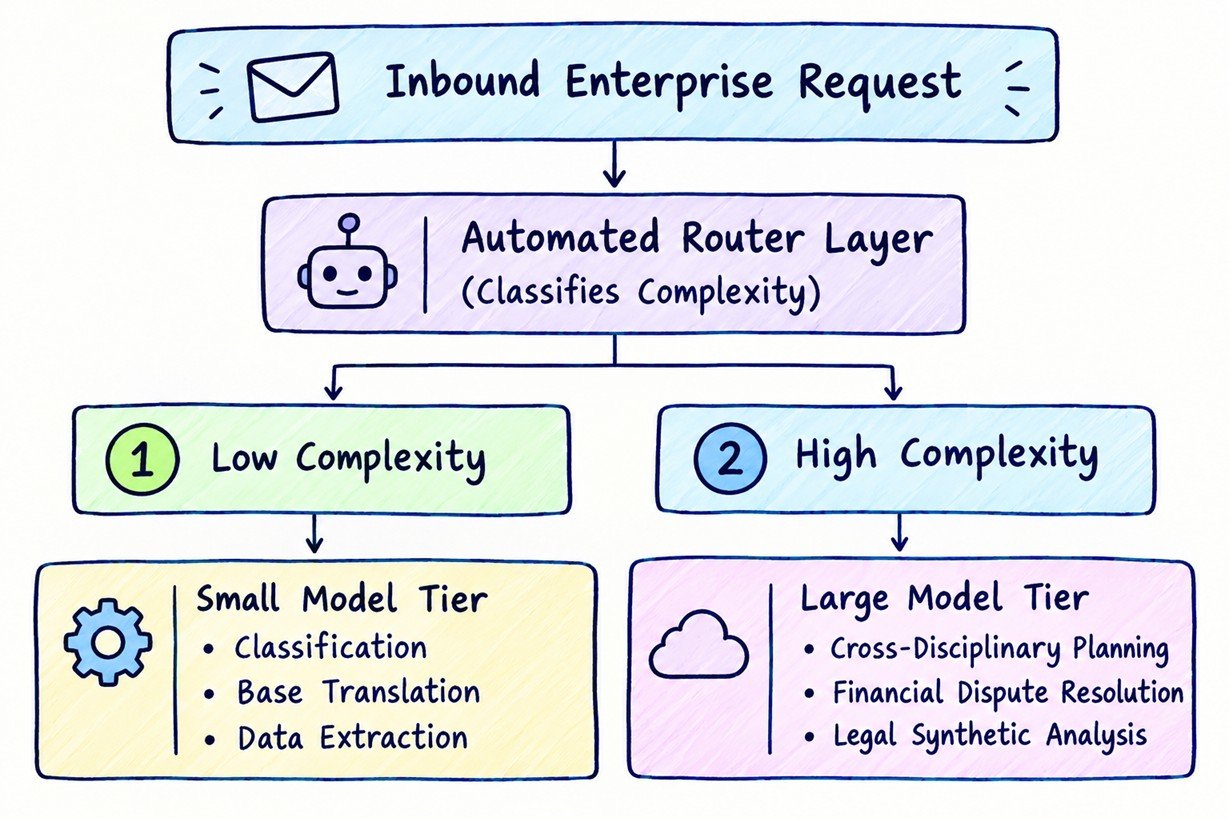
Optimizing your infrastructure requires an automated routing layer that acts as a traffic controller at the API gateway level. The system evaluates the complexity of the inbound prompt before spinning up an inference runner.
Case Study: Enterprise Customer Support Architecture
Consider a modern, high-scale enterprise customer service platform optimizing its routing topology:
-
The Intake Tier: An incoming customer ticket hits the system. A Small Model manages initial categorization, sentiment tracking, and instant language translation. This operation occurs in milliseconds for fractions of a cent.
-
The Escalation Tier: If the query is flagged as a multi-variable financial dispute involving compliance rules, cross-border accounts, and ambiguous user intent, the router elevates the payload.
-
The Elite Tier: The system routes the context-rich ticket to a Large Model. The large model executes the nuanced, multi-step policy evaluation needed to resolve the conflict safely.
By shielding your large models from high-volume, trivial workloads, you keep enterprise infrastructure costs highly sustainable while preserving maximum cognitive power for the moments that truly require it.