Model routing and cascading
Introduction
Running all user queries through a single flagship foundation model is economically unsustainable and introduces severe performance bottlenecks. Simple greetings, common database lookups, and complex analytical tasks require vastly different levels of compute.
To achieve production-grade efficiency, modern enterprise architectures deploy a multi-tiered optimization layer that dynamically matches incoming requests to the lowest-cost, lowest-latency model capable of handling them. Implementing this framework can cut enterprise token expenses by 60% to 80% while maintaining identical quality benchmarks.
The Three-Tiered Routing Strategy
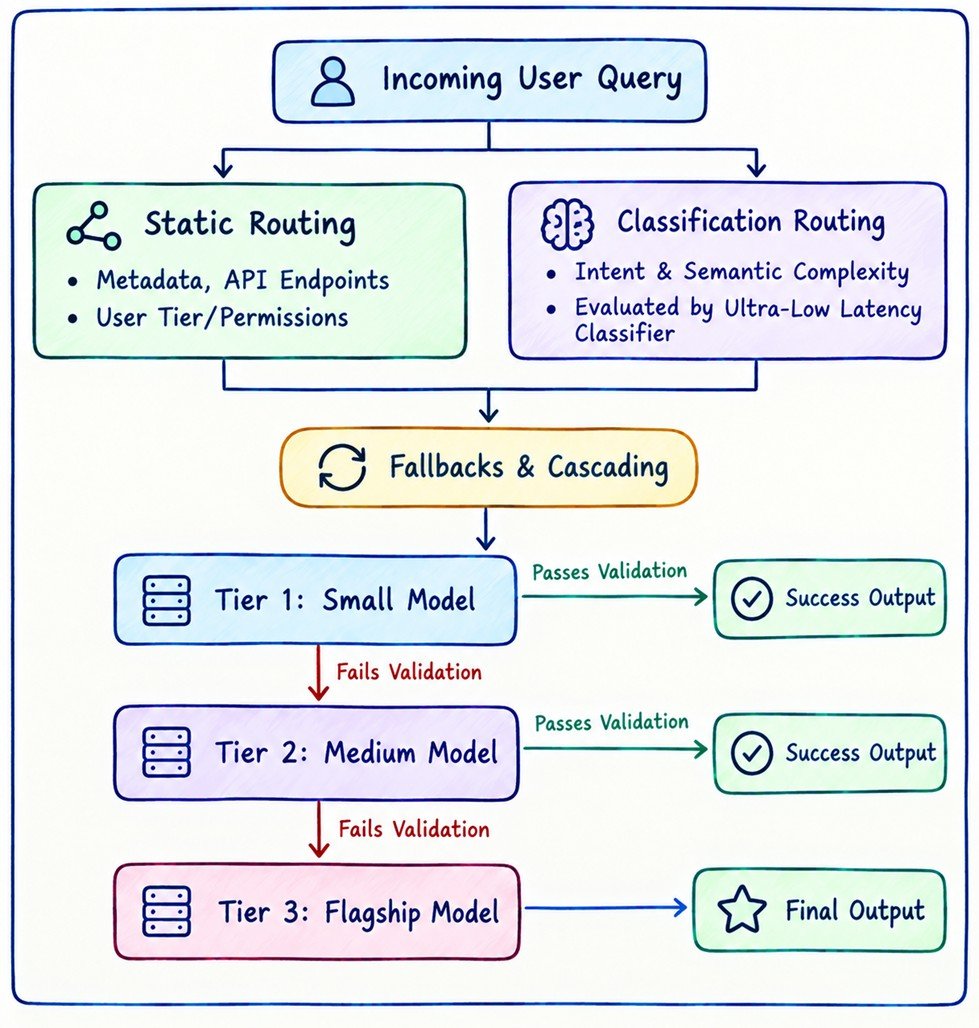
A production-ready AI gateway utilizes three distinct routing patterns to evaluate incoming payloads before executing downstream foundation models.
1. Static Routing (Deterministic Optimization)
Static routing is the first line of defense. It bypasses complex runtime analysis by inspecting the incoming request context, user metadata, or specific application endpoints. Traffic is directed based on predefined, hardcoded infrastructure rules.
-
Mechanisms: Inspection of HTTP headers, API endpoints (
/api/v1/complimentary-chat), user tiers (Free vs. Enterprise Premium), or geographic parameters. -
Production Example: A customer support platform immediately maps basic UI navigation queries or tokenized account status templates directly to an edge-deployed, small-footprint model without consuming upstream routing resources.
2. Classification Routing (Intent-Driven Optimization)
When the intent is ambiguous, the architecture uses a highly optimized, ultra-low-latency classifier model (often a tuned BERT variant, a small LLM, or a semantic vector embedding router) to analyze the query before invoking a foundation model.
-
Mechanisms: The classifier acts as an orchestrator. It evaluates the semantic complexity, safety requirements, and structural needs of the query.
-
Production Example:
- Query: "What is my current account balance?" ( \rightarrow ) Routed to a Fast, Small Model optimized for structured API function calling.
- Query: "Can you analyze my portfolio returns against the S&P 500 for the last decade and draft a tax-mitigation strategy?" ( \rightarrow ) Routed to a Flagship Model capable of long-context reasoning.
3. Fallbacks and Cascading (Quality-Assured Escalation)
This pattern executes tasks sequentially across a strict hierarchy of models, maximizing the utility of cheaper compute while securing a high-quality safety net.
-
Mechanisms: The architecture sends the payload to a Tier 1 (fast, cheap) model. An automated, programmatic evaluation layer evaluates the output against specific guardrails (e.g., confidence scores, JSON schema validation, regex verification, or hallucination detection).
-
The Escalation Trigger: If the Tier 1 model fails the validation check, the system catches the failure gracefully, suppresses the error from the client, and escalates the payload to a Tier 2 or Tier 3 flagship model.
Architectural Deep Dive: Comparison of Routing Tiers
| Strategy | Latency Overhead | Compute Cost | Implementation Complexity | Primary Use Case |
|---|---|---|---|---|
| Static Routing | Sub-millisecond ( < 1ms ) | Near Zero | Very Low | Routing by API endpoint, subscription tier, or user permissions. |
| Classification Routing | 10ms - 50ms | Very Low | Medium | Intent mapping, sentiment triage, and semantic complexity sorting. |
| Fallbacks & Cascading | Variable (Cumulative if fails) | Variable (Optimized for average case) | High | Zero-tolerance structured data outputs, complex logical code generation. |
Enterprise Production Scenario: Financial Services Assistant
Consider an enterprise financial services assistant managing millions of daily queries. The system handles everything from routine tasks to high-stakes compliance reviews.
-
The Incoming Request: A user submits a query.
-
Static Route Strategy: If the user is on a "Free Tier," they are hardcoded to a smaller model cluster unless a premium upsell flow is detected.
-
Classification Route Strategy: A user asks, "What is my balance, and should I move my money into index funds given current inflation?" The intent classifier flags this as a two-part query: a basic database lookup combined with a high-liability investment analysis. It splits the query or routes it directly to a high-reasoning model cluster.
-
Cascading Execution: For standard balance lookups, the system hits a tiny model.
- If the tiny model successfully returns a structured JSON payload like
{"balance": 5000, "status": "success"}, the gateway passes it to the user. - If the tiny model outputs malformed JSON or a low-confidence score, the validation layer catches it within milliseconds and triggers the fallback to a mid-tier reasoning model to regenerate the response flawlessly.
- If the tiny model successfully returns a structured JSON payload like
Key Recommendations for Technology Leaders
-
Implement an AI Gateway Layer: Abstract your routing logic completely away from your application code using API gateways (such as Kong, Envoy, or specialized LLM routers). This ensures you can swap models underneath without changing client-side applications.
-
Define Clear Validation Guardrails: The success of a cascading strategy relies entirely on your validation layer. Invest heavily in deterministic validators (JSON Schema, Pydantic, Guardrails AI) rather than relying on "LLM-as-a-Judge" for low-latency tiers, as LLM judges add significant latency and token costs.
-
Continuous Telemetry & Data Logging: Continuously monitor drift in user intents. A query that requires a flagship model today might be perfectly handled by a fine-tuned, open-weight small model tomorrow. Use production logs to continuously retrain your classification routers.