Foundation-model selection
Introduction
Architects frequently default to selecting Foundation Models (FMs) based entirely on public leaderboard scores. In an enterprise environment, this approach is a systemic failure point. Public benchmarks measure generalized knowledge under sterile conditions. They do not reflect your proprietary data structures, latency budgets, domain-specific edge cases, or regulatory compliance mandates.
To build resilient, production-grade AI systems, engineering leaders must shift from passive model adoption to an active, multidimensional architectural verification framework. This guide establishes the definitive four-pillar framework required to de-risk foundation model selection, avoid vendor lock-in, and build a sustainable, automated evaluation pipeline.
The Four Pillars of Enterprise Model Selection
Evaluating a model requires rigorous verification against four architectural pillars. Failing to validate even one of these pillars introduces severe operational, financial, or legal risk.
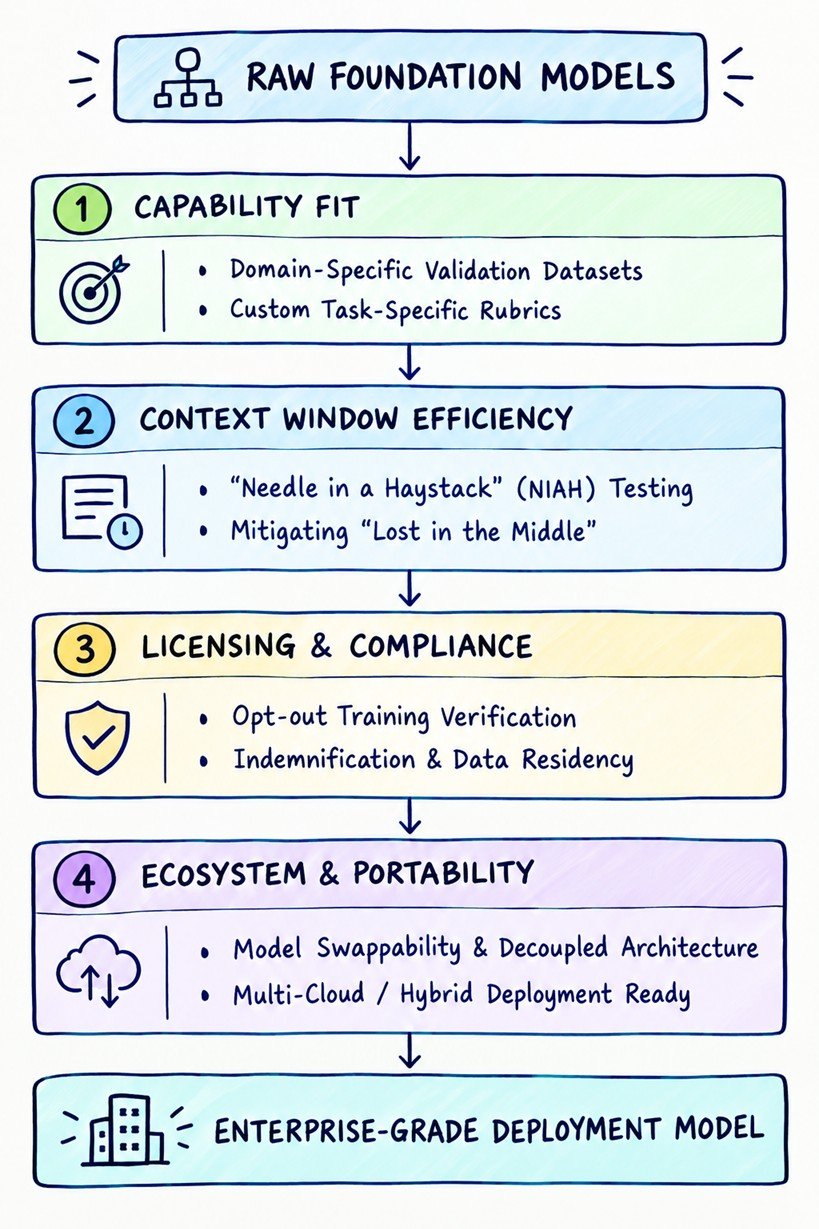
1. Capability Fit
The model must demonstrate absolute proficiency in the specific cognitive tasks your application requires, whether that is structured JSON extraction, multi-step logical reasoning, or domain-specific code generation.
-
Move Beyond Public Benchmarks: Standard benchmarks (e.g., MMLU, GSM8K) are prone to data contamination, where evaluation data accidentally leaks into the model's training set.
-
Establish Internal Golden Datasets: You must curate a proprietary validation dataset (typically 500 to 1,000 high-fidelity, hand-annotated examples) that mirrors real-world production inputs, complete with industry jargon, messy formatting, and expected edge cases.
-
Implement Task-Specific Rubrics: Use programmatic validation (e.g., deterministic assertions for code/JSON syntax) combined with LLM-as-a-Judge architectures to grade model outputs against specialized semantic criteria, rather than relying on blunt statistical metrics like ROUGE or BLEU.
2. Context Window Efficiency
A massive context window is useless if the model suffers from poor retrieval capabilities over long sequences.
-
The "Lost in the Middle" Phenomenon: Many models exhibit a U-shaped accuracy curve. They easily recall information located at the very beginning or the very end of a prompt, but their attention degrades significantly when processing information buried deep within the middle of the context window.
-
Stress-Test via Custom NIAH: Execute comprehensive Needle in a Haystack (NIAH) testing using your enterprise documents. Insert specific, business-critical facts at various depth percentages (e.g., 10%, 50%, 90%) across different token lengths (e.g., 32k, 64k, 128k) to empirically map out where the model's retrieval accuracy degrades.
-
Compute Efficiency vs. Cost: As context consumption scales, token processing costs and Time-to-First-Token (TTFT) latency grow non-linearly. Ensure your architecture evaluates whether a smaller context window paired with a highly optimized Vector Search/RAG pipeline outperforms a brute-force long-context prompt.
3. Licensing and Compliance
Enterprise data governance mandates absolute control over where information flows and how it is processed.
-
Zero-Retention & Training Opt-Outs: Review the provider's data governance policy to guarantee that enterprise prompts, completions, and contextual data are never cached long-term, surfaced to human reviewers, or ingested to train future public iterations of the model.
-
Indemnification Clauses: Ensure commercial contracts include robust intellectual property (IP) copyright indemnification clauses, protecting your enterprise from third-party lawsuits regarding training data provenance.
-
Regulatory & Data Boundaries: Ensure the model deployment conforms to regional compliance standards (e.g., GDPR, HIPAA, EU AI Act). The model provider must guarantee regional data residency, ensuring data never crosses designated geographical boundaries during inference.
4. Ecosystem and Portability
Architecting for vendor agility prevents downstream margin compression and operational vulnerabilities when a provider changes its pricing, deprecates a model version, or suffers a catastrophic outage.
-
Abstract the Inference Layer: Avoid building tightly coupled integrations with vendor-specific SDKs. Standardize your applications around open orchestration layers or unified API gateways. Switching a model should only require modifying an environment variable or configuration file, never rewriting core application logic.
-
Weigh Open vs. Proprietary Trade-offs: Proprietary APIs offer fast time-to-market but risk sudden price hikes, API deprecations, or vendor lock-in. Conversely, open-weight models (e.g., Llama, Mistral) allow you to host infrastructure within your own private cloud or virtual private cloud (VPC), granting total control over security, customization, and hardware optimizations (e.g., vLLM, TensorRT-LLM).
Direct Architectural Comparison
| Architectural Metric | Proprietary Commercial APIs (e.g., OpenAI, Anthropic, Google) | Open-Weights Self-Hosted Models (e.g., Meta Llama, Mistral) |
|---|---|---|
| Time-to-Market | Ultra-Fast: Instant access via managed web APIs. | Moderate: Requires provisioning compute clusters and serving infrastructure. |
| Data Privacy & Governance | Contract-Dependent: Requires enterprise BAAs and strict opt-out agreements. | Absolute: Data never leaves your internal VPC or secure cloud perimeter. |
| Cost Scaling Predictability | Variable: Linear cost growth tied strictly to token consumption volume. | Fixed/Capital: Predictable infrastructure costs based on allocated GPU instances. |
| Customization Depth | Limited: Restricted to surface-level fine-tuning via vendor pipelines. | Deep: Full access to weights for advanced parameter-efficient fine-tuning (PEFT/LoRA) and quantization. |
| Vendor Lock-In Risk | High: Proprietary extensions and custom tooling create platform stickiness. | Zero: Complete portability across cloud providers and on-premise hardware. |
Building a Continuous Evaluation Pipeline
Model selection is not a point-in-time procurement decision. It is a continuous software engineering practice. The rapid lifecycle of foundation models means an industry-leading model today can become economically obsolete within months.
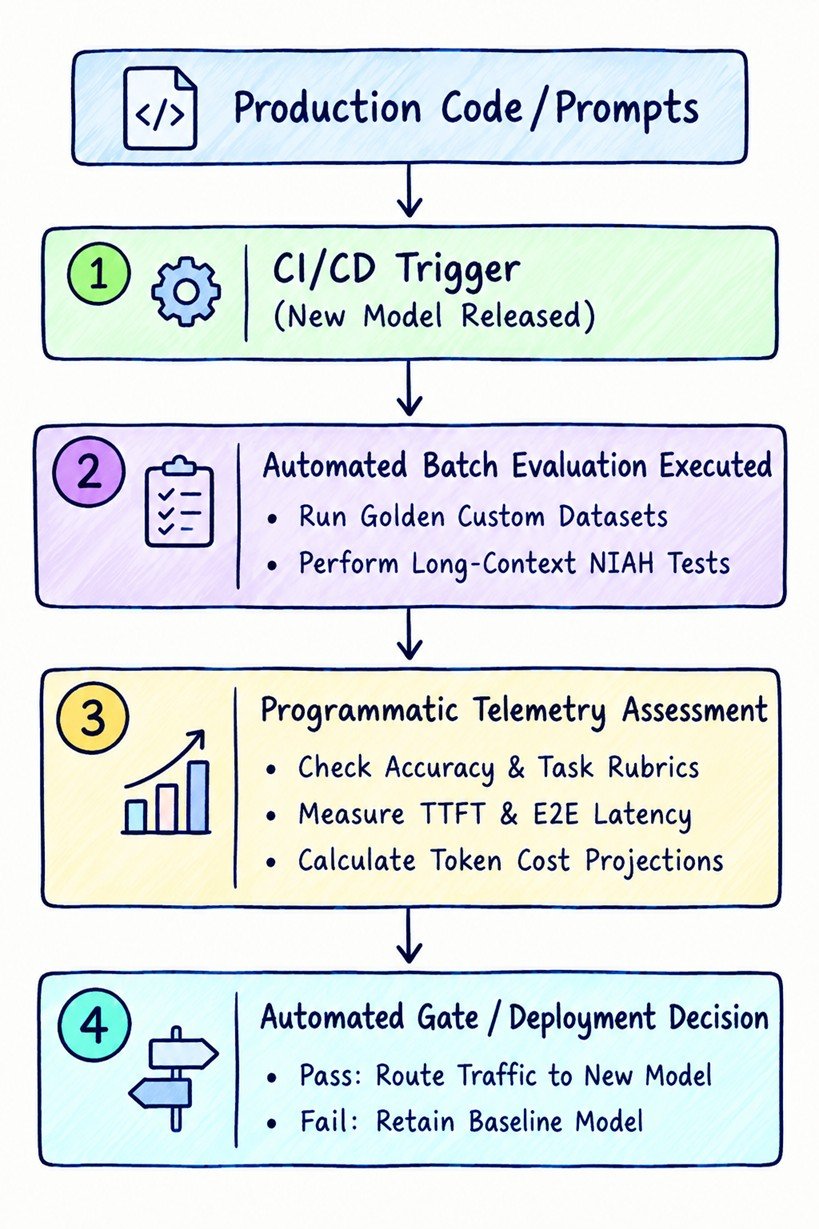
To maintain a competitive edge, organizations must establish an automated evaluation pipeline built directly into their CI/CD workflows:
-
Automated Triggering: Whenever a model provider releases a new model version or a lower-cost alternative becomes available, the CI/CD pipeline triggers an automated evaluation suite.
-
Telemetry-Driven Scorecards: The pipeline routes your enterprise validation datasets through the new model candidate, instantly generating a standardized scorecard measuring task accuracy, semantic validity, TTFT, and total token cost.
-
Shadow Deployments: Before routing production users to a newly selected model, deploy it in a shadow configuration, running parallel to your baseline model, to monitor inference performance, structural integrity, and hardware stability under real production volumes without exposing users to risk.
By decoupling application logic from the underlying model infrastructure and automating your evaluation loop, you transform model selection from a subjective architectural bottleneck into a highly optimized, automated, and agile engine for business innovation.