Human escalation
Introduction
As enterprises shift from pilot programs to production-grade, agentic generative AI systems, managing operational risk changes fundamentally. Probabilistic AI systems will eventually encounter queries they cannot resolve with absolute certainty. In an enterprise environment, a model hallucinating a financial regulation or misinterpreting a legal clause introduces severe operational, financial, and reputational risk.
To mitigate this, technology leaders must transition from a reliance on purely autonomous AI to a deterministic human escalation architecture. This framework acts as a programmatic safety net, gracefully handing off edge cases to human specialists the exact millisecond an AI system crosses its predefined safety, confidence, or policy boundaries.
1. Architectural Foundations: Probabilistic vs. Deterministic Realities
Modern Large Language Models (LLMs) and compound AI systems operate on probabilities, not hard-coded rules. While excellent for processing unstructured data at scale, they lack deterministic guardrails out of the box.
An enterprise-grade human escalation framework enforces a strict decoupling of the Execution Layer (probabilistic) and the Governance Layer (deterministic).
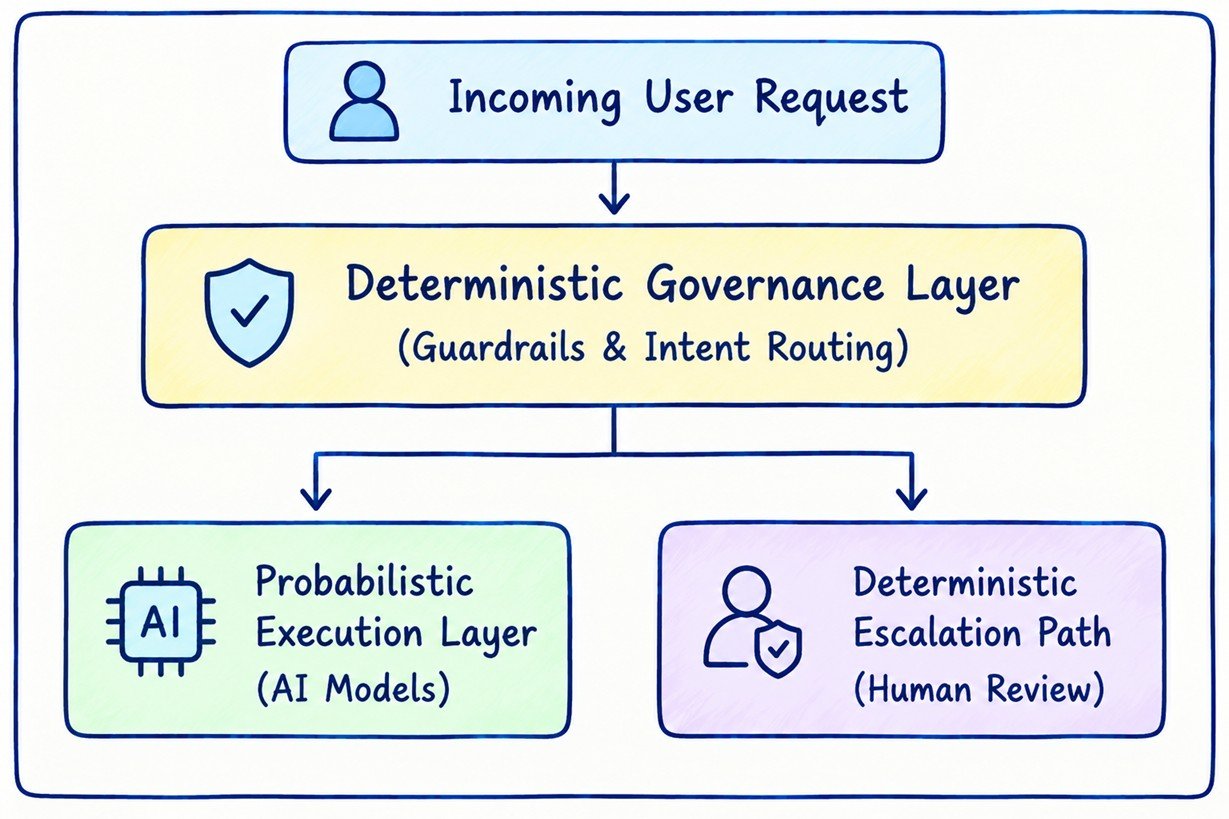
The system ensures that while the AI improvises actions or responses at runtime, the audit trails, boundary enforcements, and routing protocols remain perfectly predictable, auditable, and immutable.
2. The Three Core Escalation Triggers
A robust escalation framework relies on three separate, non-overlapping trigger mechanisms to capture system failures before they impact the end user or internal systems.
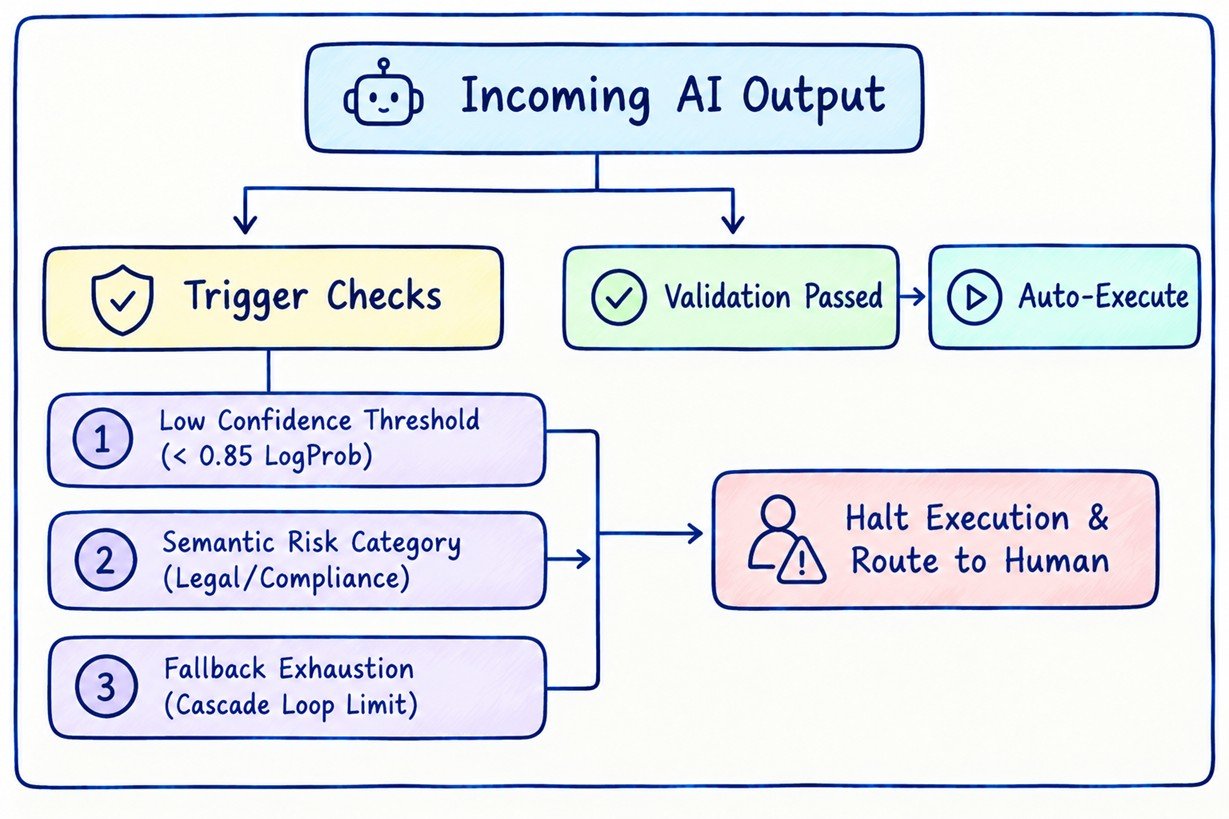
Trigger 1: Low Confidence Thresholds
Your architecture must continuously measure model certainty using log probabilities (token-level generation scores) or dedicated external validation agents.
-
The Mechanism: For every token or structured output generated, the system calculates a composite confidence score (C_x). If (C_x) falls below your defined enterprise threshold (e.g., < 0.85), the system immediately halts automated execution.
-
Enterprise Control: The request is captured, the draft response is frozen, and the entire transaction payload, including the prompt context, model telemetry, and rationale, is injected into a synchronous or asynchronous human review queue.
Trigger 2: Semantic Risk Categorization
Not all low-confidence responses are dangerous, and not all high-confidence responses are safe. Therefore, an independent intent classifier must run in parallel to flag high-risk topics automatically before or during model execution.
-
Standard Path: A customer service assistant handles everyday transactional workflows, such as standard order tracking, independently.
-
Escalation Path: The classifier instantly intercepts and escalates queries containing keywords or semantic vectors related to compliance disputes, explicit legal threats, regulatory breaches, or medical emergencies directly to senior human supervisors. This bypasses automated generation entirely to protect brand equity.
Trigger 3: Fallback Exhaustion
To optimize performance and cost, advanced enterprise architectures utilize an LLM cascade, passing an initial query from a fast, inexpensive small model to a larger, highly capable model if validation checks fail. However, without a circuit breaker, this introduces a vulnerability.
-
The Risk: Runaway compute costs and infinite loops where cascading models continually pass variations of an unresolvable query back and forth.
-
The Solution: The architecture must enforce strict loop counters ((N \le 2)). When a cascading model chain passes a query through its limits and automated validation checks continue to fail, the system forces a hard stop. The transaction is marked for manual intervention, preventing resource draining and maintaining system stability.
3. Designing the Human Workspace and Lifecycle
When an escalation trigger fires, the transition from silicon to human must be seamless. The target architecture requires an optimized human-in-the-loop (HITL) interface built around context preservation.
Payload Context Preservation
Human specialists should never receive an isolated error message. The escalation ticket must dynamically aggregate and display:
-
The Original Prompt & Intent: What the user or system was trying to achieve.
-
The System State Matrix: The specific model data, RAG (Retrieval-Augmented Generation) document snippets retrieved, and prompt templates used.
-
The Failure Diagnostic: Clear highlighting of why it failed (e.g., "Triggered by Semantic Risk Classifier: Legal Threat Detected" or "Confidence Score 0.62 < 0.85").
The Dual Workflows: Review vs. Override
-
Review/Approve Mode: The AI generates a draft answer or structures a financial transaction, but holds it in a pending state. The human specialist reviews, edits if necessary, and clicks "Approve" to resume automated execution.
-
Hard Override Mode: For extreme semantic risk flags, the AI is completely locked out. The human specialist takes total control of the workspace interface, resolving the issue manually from scratch.
4. Operational and Brand Protection Metrics
A human escalation architecture is not just a safety feature; it is an optimization engine for enterprise risk and resource allocation.
| Dimension | Without Escalation Architecture | With Deterministic Escalation Architecture |
|---|---|---|
| Brand Equity Risk | High; unverified hallucinations can reach clients or regulators directly. | Low; risky outputs are caught and corrected inside the perimeter. |
| Compute Cost Control | Uncapped; runaway agentic loops cause unexpected API billing spikes. | Capped; fallback exhaustion circuit breakers stop loops instantly. |
| Compliance & Audit | Poor; impossible to predict or reconstruct probabilistic failures. | Absolute; every human handoff creates an immutable, deterministic audit log. |
| Operational Efficiency | Low; human staff must manually monitor logs or handle retroactive fallout. | High; human intervention is triggered only when predefined safety, confidence, or policy thresholds are breached. |
The 90/10 Paradigm
Consider a mortgage processing system using AI to extract and summarize complex financial documentation. Under normal conditions, the AI successfully processes 90% of standard employment verifications with high confidence and zero human touch.
When the system encounters an unusual, non-standard scenario, such as a self-employed applicant with multiple cross-border corporate entities, the confidence thresholds drop, and fallback exhaustion triggers. By instantly routing the remaining 10% of anomalous edge cases to human underwriters, the enterprise maintains maximum operational velocity without sacrificing its risk profile or compliance posture.