Prompt engineering vs. RAG vs. fine-tuning
Introduction
Architects and technology leaders (CTOs, VPs, Directors) often struggle to choose the right method for bringing enterprise domain knowledge into Large Language Model (LLM) applications. A frequent mistake is defaulting to fine-tuning because it sounds like the most thorough, premium solution. This tactical error results in astronomical compute bills, brittle pipelines, and rapidly outdated models.
To build resilient, cost-effective production AI systems, you must select your optimization strategy based on two primary dimensions: data volatility (how fast your data changes) and the depth of domain specialization (the complexity of reasoning, syntax, and formatting required).
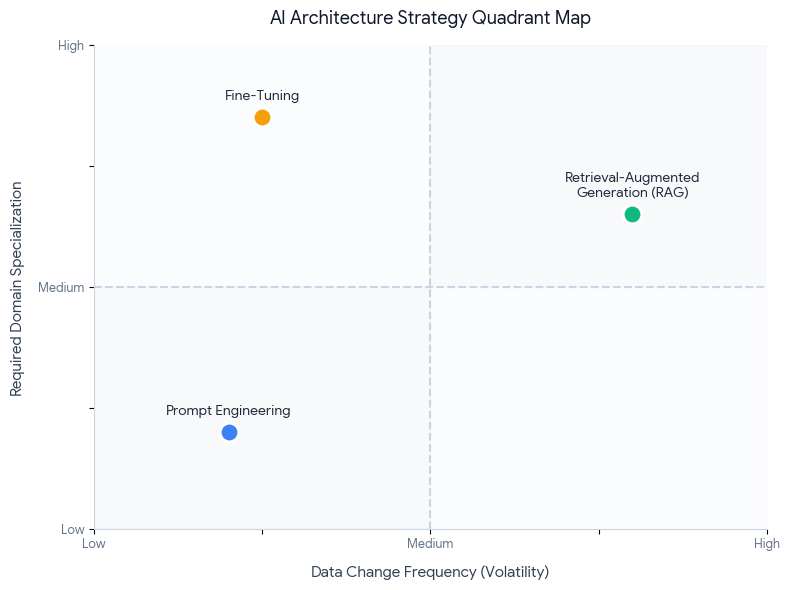
Core Architecture Strategy Deep-Dive
To optimize alignment, enterprise engineering teams must evaluate three distinct levers.
Prompt Engineering
-
Mechanism: Modifies the input context, constraints, and instructions passed to the foundation model without altering its underlying weights or static knowledge base.
-
Feedback Loop: Instantaneous (zero training time). Iterative adjustments happen through prompt design and testing cycles.
-
Best Use Cases:
- Enforcing specific output formatting (JSON structural schemas, Markdown outputs).
- Injecting runtime stylistic constraints (e.g., "Adopt a supportive customer support persona").
- Low-to-medium complexity tasks where the fundamental reasoning capability already exists natively within the frontier model.
Retrieval-Augmented Generation (RAG)
-
Mechanism:
Decouples the model's parametric memory (what it learned during pre-training) from its non-parametric memory (external databases). At runtime, a retrieval mechanism queries vector stores, knowledge graphs, or databases based on the user's input, extracts relevant contextual chunks, and embeds them directly into the context window.
-
Feedback Loop: Near real-time. System updates happen as fast as your ETL pipelines can re-index updated documents into your database.
-
Best Use Cases:
- Highly dynamic corporate environments where data changes constantly (e.g., live warehouse inventory, stock prices, customer account history, and daily compliance updates).
- Massive enterprise corpora where it is cost-prohibitive or impossible to fit all documents inside a single context window natively.
Fine-Tuning
-
Mechanism: Updates the core weight parameters of the model using supervised fine-tuning (SFT) or preference optimization (RLHF/DPO) on a highly curated, premium domain dataset. This structurally adapts the model's internal behaviors and neural pathways.
-
Feedback Loop: Slow and expensive (hours to weeks of training runs, data collection, and evaluations).
-
Best Use Cases:
- Teaching the model complex, highly specialized industry syntaxes (e.g., proprietary codebases, specialized medical nomenclatures).
- Hardcoding a strict, unyielding tone or structural format that prompt engineering fails to maintain at scale.
- Reducing latency and token costs by embedding long, repetitive operational instructions directly into the model's weights rather than passing them in the prompt every time.
Direct Strategic Comparison
| Evaluation Metric | Prompt Engineering | Retrieval-Augmented Generation (RAG) | Fine-Tuning |
|---|---|---|---|
| Primary Goal | Directing attention & immediate style | Providing dynamic, grounding context | Changing structural behavior & domain vocabulary |
| Data Volatility Tolerance | Low (bounded by prompt size) | Extremely High (real-time updates) | Low (requires a full retraining loop to update facts) |
| Specialization Depth | Surface-level guidance | Access to deep data, shallow structural shifts | Deep structural adaptation & domain immersion |
| Time to Value | Minutes | Days to Weeks | Weeks to Months |
| Token Cost Impact | Increases input cost per request | Significantly increases input token cost | Minimizes prompt token overhead |
| Risk of Hallucination | Moderate | Lowest (fully auditable source citations) | High (can confidently hallucinate outdated facts) |
Production Architectures: The Power of Composition
Enterprise architectures should rarely treat these methods as mutually exclusive options. Elite engineering teams combine them to create comprehensive, multi-layered solutions.
For instance, consider an enterprise legal assistant:
-
The Foundation Layer (Fine-Tuning): The system utilizes a model fine-tuned on specialized legal corpora to master the distinct vocabulary, archaic syntax, and structural formatting of formal contract drafting.
-
The Knowledge Layer (RAG): The architecture connects this model to a RAG pipeline tied to live, updated court dockets, evolving statutory laws, and the firm's historical case database. This ensures the assistant works with real-time legal precedents and avoids citing overturned laws.
-
The Execution Layer (Prompt Engineering): Finally, prompt engineering is applied at the user interface level to inject immediate context, such as specifying whether the final output should be formatted as a brief, a memo, or an NDA, along with client-specific constraints.