LLMs vs. traditional ML vs. deterministic logic
Introduction
Modern enterprise systems suffer from an acute engineering anti-pattern: The Golden Hammer Syndrome. Enthralled by emergent capabilities, technology leaders are treating Large Language Models (LLMs) as a universal computing engine. This design flaw replaces highly reliable, sub-millisecond, cost-effective infrastructure with non-deterministic, high-latency, and financially volatile neural network inferences.
To build resilient, highly scalable, and compliance-ready platforms, CTOs, VPs, and Enterprise Architects must enforce a rigorous hybrid approach. Production enterprise systems require an intentional partitioning of logic across three core paradigms based strictly on data structure, predictability requirements, latency tolerances, and unit economics.
Deep-Dive Comparison Matrix
| Architectural Vector | Deterministic Logic | Traditional Machine Learning | Large Language Models (LLMs) |
|---|---|---|---|
| Primary Data Types | Structured Tables, Enums, Primitives, JSON | Tabular Data, Matrix Arrays, Dense Vectors | Unstructured Text, Code, Images, Audio, Video |
| Predictability | 100% Mathematical Certainty (Zero variance) | Statistical Reliability (Bounded confidence intervals) | Probabilistic/Stochastic (Generative variance, non-zero error rate) |
| Latency Profile | Sub-millisecond ( < 1ms ) | Low-latency ( 5ms - 50ms ) | High-latency ( 200ms - 5000ms+)per token/request) |
| Compute & Cost | O(1) to O(N), Negligible CPU/Memory cost | Low-to-medium CPU/GPU training, ultra-low inference footprint | Massive GPU cluster requirement, volatile token-based pricing |
| Failure Modes | Hard exceptions, logic bugs, unhandled edge cases | Concept drift, data bias, overfitting, feature degradation | Hallucinations, prompt injection, alignment drift, context loss |
| Primary Mechanism | State Machines, If/Else, Rete Algorithm engines | Tree ensembles (XGBoost), Regressions, SVMs, KNN | Transformers, Attention Mechanisms, Deep Autoregressive Networks |
Deconstructing the Three Computational Paradigms
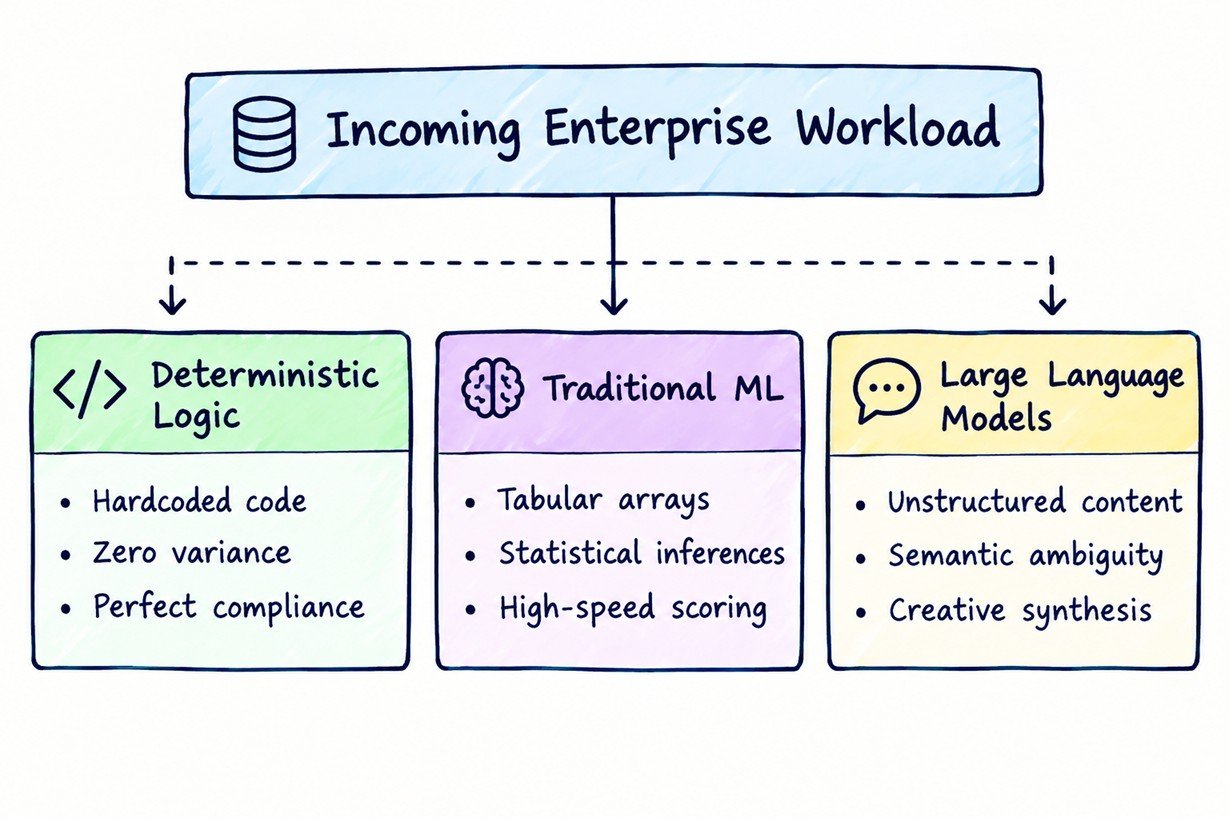
A. Deterministic Logic: The Immutable Backbone
Deterministic computing relies on explicit instruction sets. There is no training phase, no statistical weight, and no probabilistic deviation. If input (X) is fed into system (F), it will yield output (Y) identically across an infinite timeline.
-
Core Architectural Mechanics: Abstract Syntax Trees (ASTs), hardcoded application code (Java, Go, Rust), declarative rule engines (Drools), and strict schema validators.
-
When to Enforce:
- Financial Ledgers & Tax Calculators: Double-entry bookkeeping cannot tolerate a plus/minus 0.01% margin of error.
- Regulatory & Compliance Rules: Checking if an applicant resides in a blacklisted jurisdiction must be absolute.
- State Machine Transitions: Managing the strict linear lifecycle of an order (e.g.,
PENDING→PAID→SHIPPED).
-
Strategic Pitfall: Attempting to hardcode rules for ambiguous fields (like conversational natural language) leads to an unmaintainable "spaghetti code" nightmare that breaks under new edge cases.
B. Traditional Machine Learning: The Statistical Workhorse
Traditional ML extracts patterns from structured data tables by optimizing static mathematical formulas. It converts historical datasets into low-latency predictive scoring functions.
-
Core Architectural Mechanics:
- Gradient Boosted Decision Trees (GBDTs like XGBoost, LightGBM)
- Random Forests
- Linear/Logistic Regressions
- K-Means Clustering
-
When to Enforce:
- High-Frequency Fraud Scoring: Evaluating credit card transaction risks within a 15ms API response window.
- Predictive Churn & Customer Lifetime Value (LTV): Analyzing transactional rows to pinpoint retention risks.
- Recommendation Systems: Real-time collaborative filtering for e-commerce checkouts.
-
Strategic Pitfall: Traditional ML is completely blind to semantic context. Feeding unstructured customer feedback paragraphs into a tabular regression model without deep feature engineering yields poor, brittle results.
C. Large Language Models: The Semantic Synthesizer
LLMs map linguistic tokens into highly dimensional vector spaces, capturing complex semantic context, nuance, tone, and unstructured relationships.
-
Core Architectural Mechanics:
- Transformer blocks
- Multi-head self-attention layers
- Multi-modal neural network weights
-
When to Enforce:
- Unstructured Data Synthesis: Extracting key clinical values from messy, multi-page, handwritten physician notes.
- Semantic Search & RAG: Surfacing deep conceptual policies from thousands of complex corporate PDFs.
- Human Conversational Interfaces: Translating a chaotic user request into a clean, intent-parsed command.
-
Strategic Pitfall: Using an LLM as a calculator, a database storer, or a strict validator. Forcing a stochastic model to enforce exact rule compliance introduces catastrophic unreliability and massive GPU waste.
Enterprise Case Study: Multi-Paradigm Insurance Underwriting Architecture
To maximize throughput and maintain regulatory compliance, an enterprise platform must orchestrate these paradigms together. Consider a high-throughput automated insurance underwriting system processing a new policy application:
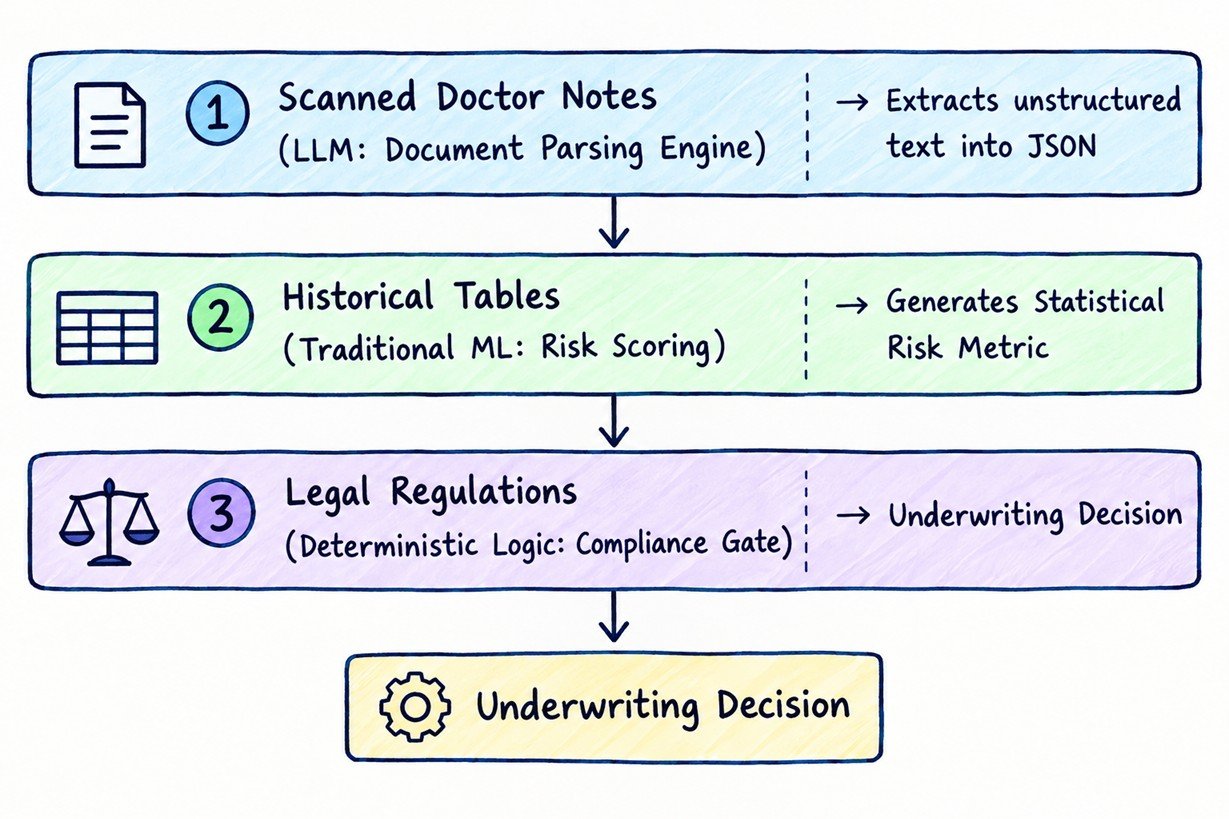
Phase 1: Large Language Model (The Ingestion Gateway)
- Input: Scanned, unstructured, handwritten notes from a physician's check-up.
- Execution: An LLM extracts unstructured text, parses semantic anomalies, standardizes diagnostic vocabulary, and outputs a highly clean, structured schema object containing the patient's verified medical history.
Phase 2: Traditional Machine Learning (The Analytics Engine)
- Input: The structured schema object generated in Phase 1, joined with historical tabular policyholder data.
- Execution: An XGBoost classification model evaluates thousands of historical risk parameters to output a continuous actuarial risk score and fraud probability metric within milliseconds.
Phase 3: Deterministic Logic (The Compliance Guardrail)
- Input: The risk score from Phase 2, paired with statutory regulatory criteria.
- Execution: A hardcoded rule engine validates explicit legal requirements: Is the applicant over the age threshold for this jurisdiction? Is the risk score within the mandatory legally authorized limit? If all boolean statements evaluate to true, the system writes the final transaction to the system of record.
Architectural Decision Framework for Leadership
To protect your systems from architectural fragility and uncontrolled cloud spend, establish this definitive matrix as a mandatory gate inside your Architecture Review Board (ARB):
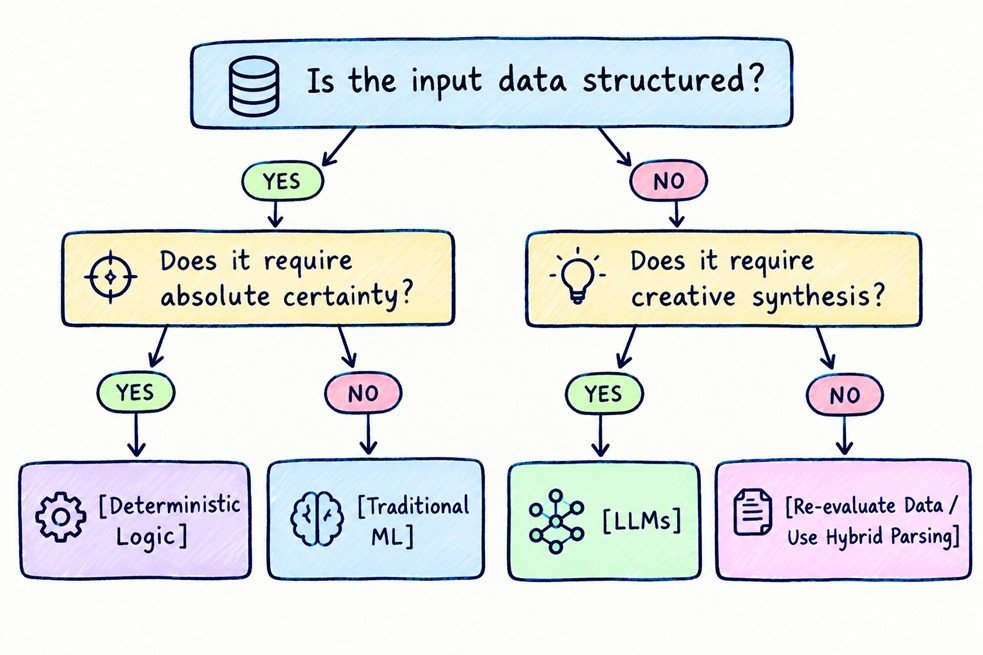
By enforcing this multi-paradigm approach, engineering organizations avoid over-engineering simple problems with expensive models, while unlocking the true, transformative potential of generative AI exactly where it yields the highest business value.