Tool calling
Introduction
Foundation models, by their native design, are isolated inside their training data. They cannot check current inventory levels, calculate complex interest rates, or update database records independently. To solve this limitation, enterprise architectures must implement tool calling. This capability transforms an isolated text predictor into an operational system that interacts with your existing software ecosystem.
For technology executives like CTOs, VPs, and Directors, tool calling represents the critical bridge between passive generative AI and active enterprise automation. It shifts the paradigm from "chatbots that answer questions" to "agentic workflows that execute corporate strategy."
The Core Value Proposition: From Text Predictor to Operational Engine
Standard Large Language Models (LLMs) operate on static weights frozen at the time of training. In an enterprise environment, this creates severe operational gaps:
-
The Currency Gap: Inability to access real-time transactional, market, or customer data.
-
The Logic Gap: Prone to hallucinating mathematical computations or complex logical evaluations.
-
The Action Gap: Complete isolation from triggering state changes in internal systems (CRMs, ERPs, databases).
Tool calling solves these gaps by positioning the LLM not as the executor of tasks, but as the reasoning engine and router. The model evaluates intent, extracts structured parameters, and designates the appropriate software service to execute the action.
The Secure, Three-Step Execution Loop Architecture
To scale tool calling across an enterprise safely, you must implement a strict, decoupled, three-step execution loop. This architecture ensures the foundation model remains an advisory layer, while your orchestration layer retains operational control.
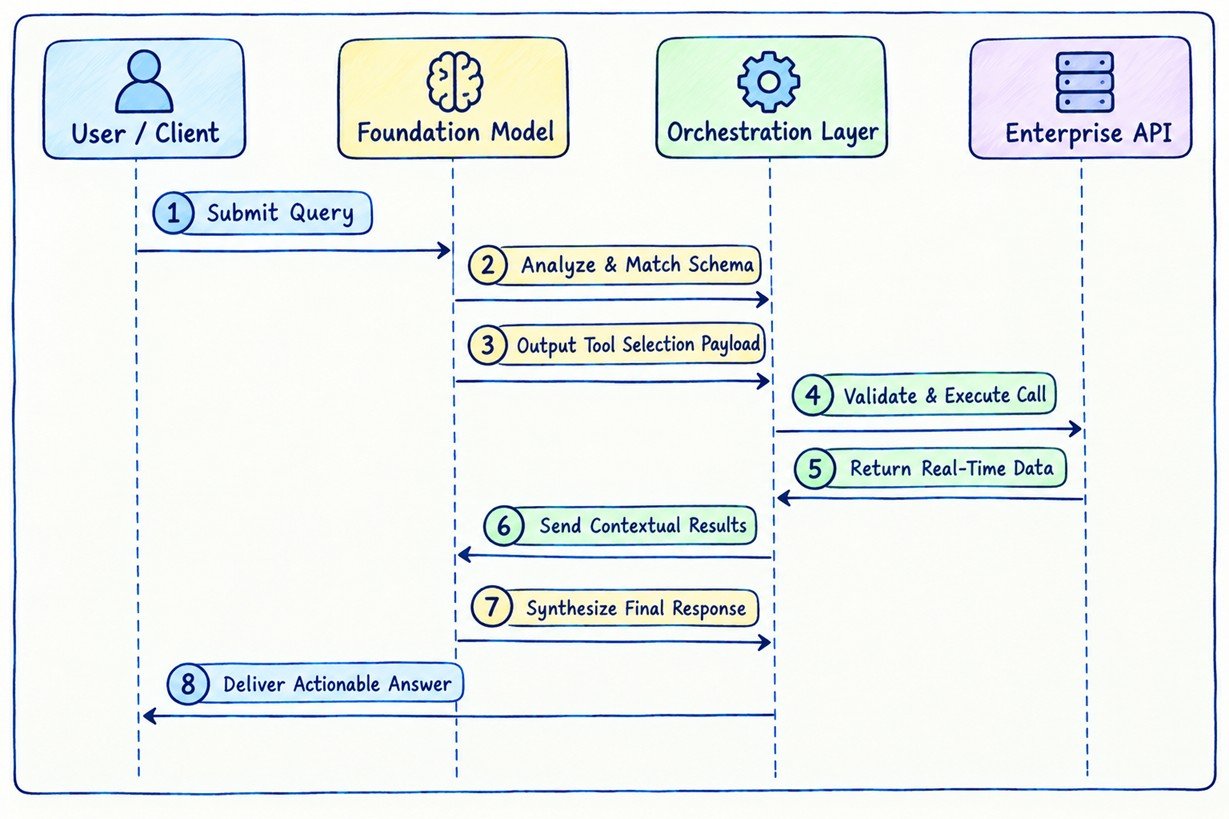
1. Tool Definition and Registration
You define your enterprise APIs, databases, and microservices using descriptive metadata schemas. The foundation model reads these schemas to understand what tools exist, what parameters they require, and when to use them.
-
Semantic Schema Design: Tools are typically registered using JSON Schema formats. The most critical component of the schema is the
descriptionfield. Because models use semantic matching, your tool and parameter descriptions must be highly precise, defining exact boundaries and units (e.g., specifying whether a currency parameter requires USD or cents). -
Registry Management: Maintain a centralized tool registry (e.g., via an API Gateway or Service Mesh). Do not expose your entire IT catalog to the model at once. Instead, dynamically inject only the relevant schemas based on the user's operational context, role, and current application state to optimize context window usage and reduce model confusion.
2. Intent Identification
The model analyzes the user query and outputs a tool selection intent rather than a conversational response. The model packages this intent as a structured payload containing the exact function name and extracted arguments.
-
Deterministic Structuring: The model stops standard text generation when it detects that a tool is needed. It outputs valid JSON matching the registered schema. For example, if a user asks to "check delivery status for order 98765," the model extracts
order_id: "98765"and selects theget_shipping_statusfunction. -
Zero-Shot Routing: Advanced foundation models can perform multi-tool routing, identifying when a complex query requires parallel tool execution (e.g., checking both inventory levels and shipping rates simultaneously) or sequential dependencies (using the output of Tool A as the input for Tool B).
3. Application Execution
Your enterprise orchestration layer intercepts the model payload, executes the actual API or database call within your secure environment, and returns the real-time result to the model for final synthesis.
-
The Orchestration Buffer: The model never calls the end system directly. It simply generates the request to call it. The enterprise orchestration layer (built using frameworks like LangChain, Semantic Kernel, or custom enterprise middleware) reads the JSON payload, instantiates the connection, and safely handles network communication.
-
Feedback Synthesis: Once the corporate API returns the raw data (e.g., a JSON response from an ERP system), the orchestration layer feeds this back to the foundation model as a structural message. The model reads this new data, verifies that the user's intent is met, and generates a natural language response or moves to the next logical step in the workflow.
Strategic Governance: Strict Security Boundaries
Exposing enterprise infrastructure to LLMs introduces net-new attack vectors. Your architecture must enforce the following security pillars:
Air-Gapped Execution
Never allow the foundation model to execute code or API calls directly. The LLM operates strictly in an untrusted sandbox environment. The model suggests actions; the orchestration layer enforces them. The foundation model should have no direct network access to your internal databases, core VPCs, or downstream applications.
Zero-Trust Validation and Input Sanitization
Treat all arguments generated by the model as untrusted user inputs. Foundation models are highly susceptible to Prompt Injection Attacks, where a malicious user overrides system prompts via the chat interface to force the model into generating unauthorized tool arguments (e.g., injecting SQL commands into a text parameter).
- Implement strict data validation schemas at the orchestration layer before execution.
- Use strict type-checking, regex filtering, and bound constraints on all arguments.
- Sanitize inputs to prevent SQL injection, Remote Code Execution (RCE), and cross-site scripting (XSS) at the API gateway level.
Identity Propagation and Entitlement Mapping
An LLM cannot override your corporate access management matrix. Tool calling must adhere to the principle of least privilege:
-
User-Context Passing: The orchestration layer must execute the API call using the specific end-user's authentication token (OAuth2, JWT) or explicit IAM role, not a generic "AI System Admin" service account.
-
Entitlement Verification: If a user does not have permission to view payroll data through standard applications, the orchestration layer must block a model-generated payload attempting to call
fetch_payroll_data, returning an access-denied error back to the model.
Executive Checklists: Engineering Milestones for Leadership
| Phase / Strategic Objective | Key Deliverable | Leadership Action |
|---|---|---|
| Architectural Design | Establish decoupling boundaries. | Formalize the orchestration layer specifications and block direct LLM-to-API network routes. |
| Data Governance | Standardize corporate schemas. | Implement a centralized repository for JSON schemas with semantic description guidelines. |
| Security & Compliance | Enforce Zero-Trust protocols. | Build validation pipelines for parameter sanitization and implement user-identity propagation on all tools. |
| Observability | Trace agentic lifecycles. | Deploy distributed tracing (e.g., OpenTelemetry) to log user inputs, model choices, tool execution times, and payload data. |